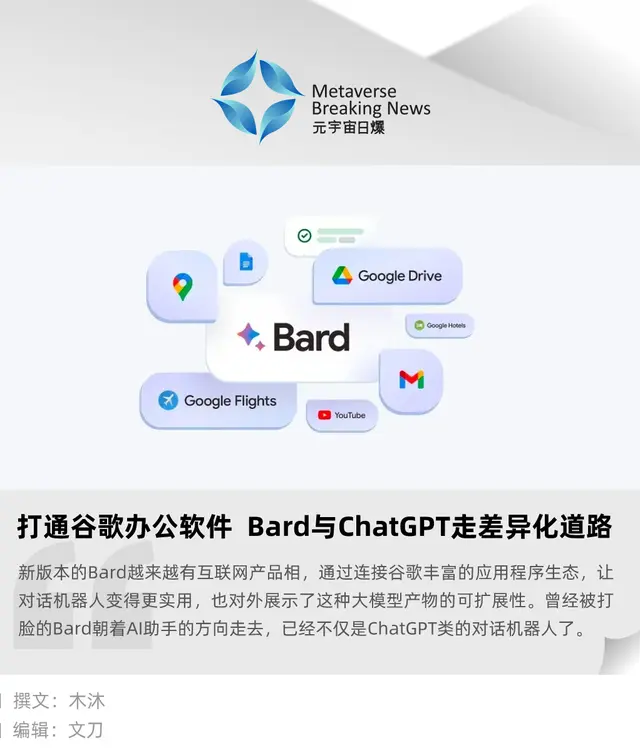
 After half a year, Bard, which was once beaten by ChatGPT, released a major update, opening up the data of Gmail, Docs and other Google office applications, and supporting one-click transfer of AIGC content to Google-based mailboxes, documents, forms and other applications. , and also added the “Google it” self-verification function to the conversation page to avoid the hallucination bug of the conversation robot.
In fact, Bard has been iterating since it went online, with new versions released almost every month, constantly adding functions, such as voice input, and directly giving pictures that could only be found by search engines in the past according to user text instructions.
After personal testing, the new version of Bard is more and more like an Internet product. By connecting to Google’s rich application ecosystem, the conversational robot becomes more practical, and it also demonstrates the scalability of this large-model product.
Bard, who was once slapped in the face, is moving in the direction of an AI assistant. He is no longer just a ChatGPT-type conversational robot.
Bard updates deep-binding Google apps
Do you still remember the conversational robot Bard that overturned at Google’s press conference in February this year? At that time, it placed the astronomical telescope that “taken the first picture of an extrasolar planet” on the head of the James Webb Space Telescope. After being pointed out that the error was wrong (the correct answer was “The Very Large Telescope”), it was ridiculed by the crowd. It was evaluated by the technology circle as “hastily acted” and “exposed its shortcomings” in the AI arms race with Microsoft.
Now that half a year has passed, the popularity of the AIGC topic has declined, but Bard still released its major update “Extension Plug-in” in September, which integrates Gmail, Google Docs, Youtube, Google Drive, Google Maps, Google Flights and other applications and data .
Needless to say, you can also see that this update of Bard is deeply bound to Google’s data and application market. Through this plug-in, Bard can directly access Google’s emails, documents, videos, cloud storage, maps, flights, etc. application data and then generate content based on user needs.
What kind of experience upgrade can conversation robots directly adjust application data bring to users? We use cases to answer your questions.
For example, when you want to make a travel strategy, Bard can read relevant itinerary information from your Gmail mailbox and find out the most suitable departure date. It can also use Google flight and hotel information resources to provide you with Real-time, practical flight and hotel selections. Bard also emphasized that the conversational robot will not invade your personal privacy, let alone use your data for training.
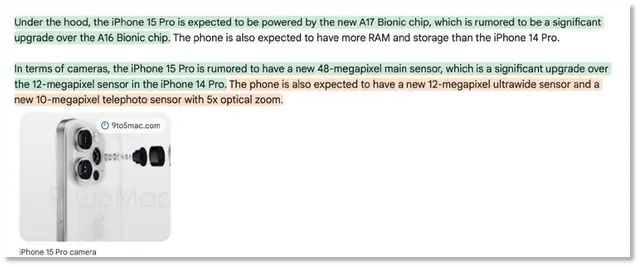 Green content is more credible than yellow content
The most criticized thing about conversational robots is that they talk nonsense. Now, Bard is trying to fix this loophole. After integrating with search engines, it has launched a verification function. Clicking “G” allows Bard to self-check whether it has made any mistakes, so that the conversational robot can be “knowledgeable”. If you make a mistake, correct it." What’s more advanced is that Bard will automatically mark which content is highly credible and which content is contrary to the searched content, and attach a link to the source.
On the road to mainstream upgrading of conversational robots into creative assistants, Bard is also strengthening its integration with Google’s existing products.
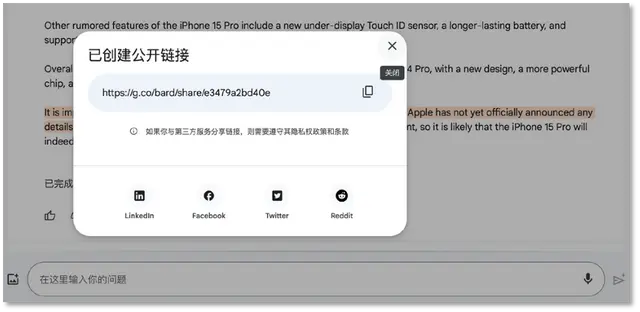 Share a conversation link to invite others to join the discussion
If you are a writer in the technology circle, you can ask Bard to write an iPhone 15 review. Now, it can save it to Google Docs with one click for you to polish and modify. If you feel that the content is too subjective, you can also share the current conversation link to the four social platforms of Linkedin, Facebook, Twitter, and Reddit to invite others to participate in the conversation. After the conversation stops for a period of time, the discussion can still continue with the previous article.
You can also ask Bard to generate a data table of a listed company’s financial report and get data analysis from the robot, such as the source of the company’s revenue growth. Of course, you can also ask Bard to make the analysis more “professional,” “short,” “detailed,” “relaxed,” or “simple.” This is already the basic behavior of Internet-connected conversational robots on the market. The extended function of Bard is that it can be exported to a table with one click for users to edit charts on office software.
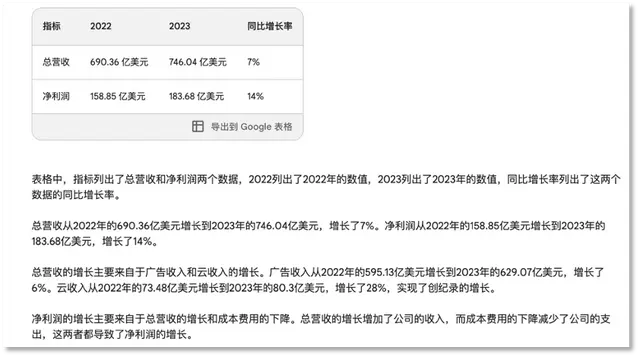 Bard directly generates tables and analysis in one step
After the September update, Bard is getting closer and closer to a powerful AIGC product, no longer just a question answering machine. In fact, the current performance of Bard is the result of its continuous updates since April this year. The updates are almost every month, focusing on an “additional function”.
For example, on May 10, Bard added a one-click option to export generated content directly to Google Docs and Gmail. You can ask Bard to generate a cover letter and save it to the Gmail draft box with one click through Bard. After a few adjustments, it can be sent directly to the HR mailbox, saying goodbye to trivial details of “copy and paste”.
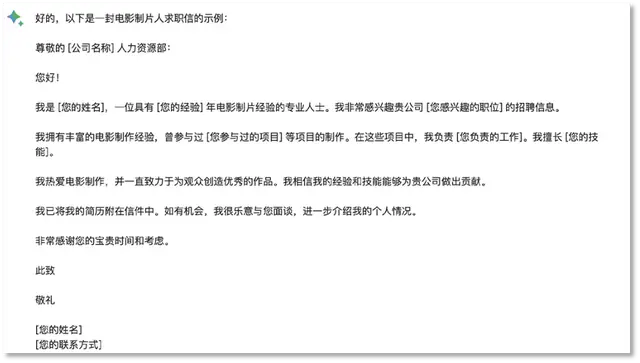 Bard can be used as an efficient work assistant
On June 7, the charts generated by Bard can be exported to Google Sheets; on July 13, Bard lifted the “English only” fence for using the updated function, adding more than 40 new languages for the new function, including Arabic, Chinese (Simplified/Traditional), German, Hindi, Spanish, etc.
When Bard is opened again in August, it can read pictures. Using Google Smart Lens, users can upload pictures. This conversational robot can also read Internet memes. At the end of the analysis, it even showed correct views.
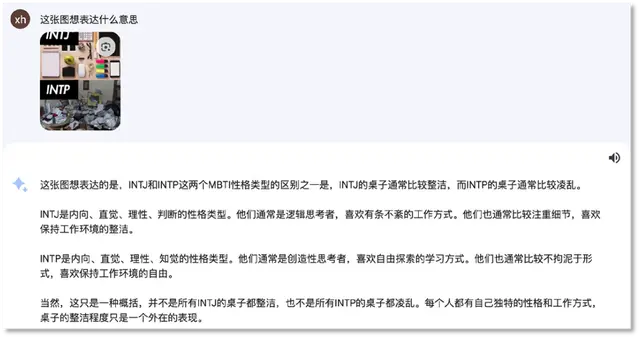 Bard can also read memes
It can be seen that the deep binding with Google products has brought Bard closer and closer to qualified Internet products, that is, focusing on practicality, being close to user scenarios, and focusing on user experience. The AIGC field has finally shifted from the large-model arms race to products more conducive to mass users.
Giants from large model volumes to AIGC products
Having an Internet company that understands products as the “mother company” is Bard’s biggest advantage compared to ChatGPT. It allows large-model products such as conversational robots to be directly integrated with its own G series products to complete the advancement. Not only can it become an independent product with powerful functions and sustainable upgrades, but it can also enable Google’s inherent products to achieve AI upgrades.
In contrast, OpenAI’s GPT can tend to fully demonstrate its capabilities to shareholder Microsoft, allowing Microsoft’s applications to quickly add AI. However, the upgrade of ChatGPT as an independent product depends entirely on OpenAI, a team that focuses on large models.
Currently, in order to implement the search function in ChatGPT, it needs to be upgraded to the Plus version and implemented with the help of a browsing plug-in. BingChat, with the support of GPT, gives the Bing browser a conversational robot function. Today, the upgraded Bard shows the potential of an independent product. Its performance is more like a combination of ChatGPT Plus + Bing + BingChat, and its combat effectiveness is directly doubled.
From the perspective of development trends, after experiencing the surge in models and computing power in the first half of 2023, people have gradually calmed down from the AI technology craze and turned to the application innovation and ecological development of generative A.
The actions of large companies are confirming this trend. Not only foreign countries, but also domestic 360 Intelligence and Tongyi Qianwen have recently chosen to open to the public in the form of application + ecology.
On September 21, 360 Intelligent Brain’s “Family Bucket” was officially opened to the public. Currently, 360 Intelligent Brain is connected to all 360 products. In the future, it will gradually open up intelligent creation, intelligent office, intelligent social networking, intelligent management, intelligent marketing and other life and work scenarios.
Alibaba’s Tongyi Qianwen is also following a similar route. The first business to be connected to Tongyi Qianwen is DingTalk and Tmall Genie, targeting the two major traffic portals of collaborative office and smart home. After DingTalk is connected to Tongyi Qianwen, it can automatically generate work plans, and can also automatically generate summaries and to-do items after meeting minutes. Tmall Genie focuses on solving problems in life scenarios.
Internet technology giants around the world have begun to roll out applications, and each company has come up with its own special skills to test scenarios, which is a trend that cannot be stopped. Some gaps in opportunities are emerging, and ChatGPT’s first-mover advantage is no longer obvious. According to Reuters data, the average time spent by each visitor on ChatGPT has decreased from 8.7 minutes in March to 7 minutes in August.
The endless emergence of competing products is undoubtedly one of the reasons why users stay on ChatGPT for a shorter time. Now, Bard has given users a new choice, and the obvious advantage of its deep binding with Google applications is that Google software has accumulated With a large number of users, this is much more convenient than digging traffic for new products on their own.
“Roll it up” is probably what all users who are getting used to using AIGC tools are most looking forward to, because only competition can make products more functional and cheaper to use. It is recommended that large and small manufacturers engaged in AIGC in China quickly align themselves with Google, get involved with Microsoft, compete for new heights, and reach new levels.


