Source: NFT GO
Summary
- Although still in its infancy, the NFT options market has grown significantly, with peak trading volumes closely correlated with floor price fluctuations for some NFT series.
- Wrapped Cryptopunks, Bored Ape Yacht Club, and Pudgy Penguins are the three NFT series with a large proportion of options trading, accounting for a combined 55.68% of the total market share.
- There are an average of more than 20 NFT options trades per week, but only about 6 NFT options are exercised.
- The NFT option protocol provides lower-cost exposure for high-value NFTs, allowing traders to better grasp price movements.
- NFT options are able to bet on price fluctuations for a fraction of the actual cost of the NFT (as low as 0.01 ETH).
- NFT options trading is subject to market volatility, which is subject to floor price data, trading volume, liquidity, NFT market capitalization, blue chip NFTs, and market sentiment.
- The reduction in trading volume exposes the market to potential manipulation risks. Traditional pricing models such as the Black-Scholes Model may not be suitable for the distribution of returns unique to the NFT market.
Chapter 1: Introduction
2021 marked an explosion of NFTs, with more than 1 million ETH traded as the project proliferated. Non-fungible tokens (NFTs) take center stage in the blockchain trading space. As NFTs evolve from community-based avatars and keys to speculative assets that are heavily traded and hyped, their tools and means have become more sophisticated. As the industry matures, we slowly transition from speculative bubbles to sustainable expansion. This process is accelerated by the increased diversity and use cases of NFTFi.
Derivatives is one such tool that has quickly become popular in the NFT trading space. In this report, we will dive into the current state of NFT options, explore their mechanisms, provide data insights, and explore the potential benefits for traders and NFT creators.
Bear market Currently, NFT options offer users new opportunities to participate and gain liquidity. For newbies, it is a convenient gateway into the NFT ecosystem.
To understand this emerging market, NFTGo has partnered with Wasabi, Hook, and Global Coin Research to release the first comprehensive NFT Options Report. This report covers everything from market overview to outlook, options mechanisms to industry insights.
Chapter 2: Overview of NFT Options
Options are a financial derivative that has been the backbone of the traditional financial industry for decades. These advanced financial instruments give holders the right, but not the obligation, to buy (call) or sell (put) the underlying asset at a predetermined price within a specified period of time, enabling traders to profit from potential price movements without fully owning the asset. In exchange, the option buyer pays the option premium to the seller. Depending on market conditions, holders can choose to exercise or expire the option at any time, making options an extremely versatile tool in hedging, speculation, and risk management strategies.
Why buy NFT options instead of the NFT itself?
For a variety of reasons, people may prefer to buy NFT options over the NFTs themselves. First, options allow investors to participate in the opportunity for potential price appreciation of NFTs without having to own them heavily. Second, options provide a degree of downside protection, after all, the maximum loss is limited to the premium paid. Third, options provide greater flexibility, allowing holders to freely decide whether to exercise or allow the option to expire based on prevailing market conditions. In addition, options allow investors to hedge against falling prices and provide a way for speculators to profit from falling prices. Finally, traders do not need to hold NFTs for a long time and can profit from short-term price fluctuations through options. Therefore, NFT options are particularly attractive to investors with speculative purposes and risk management strategies.
Explanation of terms
- Exercise Price: A pre-agreed price at which the NFT can be bought or sold.
- Expiry Date: The last day on which option contract holders can exercise their right to buy or sell NFTs at the strike price. If no action is taken, then the contract will be worthless when it expires.
- Premium: The price at which the investor buys the option contract from the issuer. The pricing of premium is affected by various factors.
- American Options: American options can be exercised at any time prior to the expiration date.
- European Options: European options can only be exercised on the expiration date.
Mechanism
Call option
A call option speculates that the price of the NFT underlying will appreciate within a specified time frame and allows the buyer to purchase the underlying at the specified price and date.
Example
Let’s say the current floor price of Azuki NFT is 5ETH. If you are bullish on Azuki’s price and want to take advantage of potential price increases without buying the NFT outright, you can choose to buy a call option. In this case, your option is exercised at 5.5ETH, the expiry date is two months from today, and the premium is 0.2ETH.
In order to get an option, you need to pay an option premium of 0.2ETH to the option seller, thereby gaining exclusive rights to purchase Azuki NFTs within the next two months (American options) or expiration date (European options), regardless of the floor price at that time. This way, you can profit from the potential increase in the price without owning the NFT directly.
Scenario 1: Floor prices climb
Six weeks later, the floor price of Azuki has soared to 6.5ETH, and the value of your options increases accordingly. At this point, you have three options:
You can choose to exercise the option and pay 5.5ETH to get Azuki NFTs. Once you own the NFT, you can sell it at the current floor price of 6.5ETH, making a profit of 0.8 ETH (earning 1 ETH - investing 0.2 ETH). The return is up to 400% compared to the initial investment. Some platforms offer arbitrage tools and, with the help of flash loans, enable users to perform this procedure without upfront capital.
Alternatively, you can decide to sell the option with a new premium of 0.7ETH. This way you will get a profit of 0.5ETH, and the ROI is still as high as 250%. The advantage of this method is that you don’t need to have 5.5ETH ready at all times to buy an NFT, but you can still benefit from its price appreciation.
Alternatively, you can choose to continue holding the call option, expecting the floor price to continue to rise further for the remaining two weeks. At this point, you are taking a balanced risk, because if the price of the NFT continues to soar, it has the potential to bring higher profits.
Scenario 2: The floor price is lower than the exercise price
Two months later, Azuki’s floor price failed to reach 5.5 ETH. In this case, you are not obliged to buy the NFT at 5.5ETH, but you will lose all the premium. Therefore, the maximum loss will be 0.2ETH.
Put option
Put options speculate that the price of the NFT underlying will depreciate within a specified time frame and allow the buyer to sell the underlying at a specified price and date.
Example
Assuming that the current floor price of Azuki NFT is 5ETH, let’s explore a scenario: you are bearish on Azuki and want to profit from the drop in floor prices. In order to execute this strategy, you need to buy a put option with an exercise price of 4.6ETH with an expiry date of the next two months. The cost (premium) of buying the put option is 0.2ETH.
Scenario 1: Floor prices fall below 4.6ETH
Six weeks later, the floor price of the Azuki NFT dropped to 4ETH, causing your put value to increase to 0.45ETH. Now, you have three options:
You can choose to buy the Azuki NFT at the current floor price of 4ETH and then exercise the put option to sell the NFT back to the issuer at 4.6ETH. This will result in a profit of 0.4ETH – spread of 0.6ETH minus option purchase price of 0.2ETH.
Alternatively, you can decide to sell the option at 0.45ETH for a net profit of 0.25ETH.
The third option is to continue to hold the put option and wait for the floor price to fall further, so as to obtain a greater potential gain.
Scenario 2: Floor price remains above 4.6ETH
Two months later, the option expires and the floor price is still above 4.6ETH. The good news is that you are not obligated to sell Azuki NFTs, so the spread will not cause you a loss. However, there is also a problem - you will lose the entire premium spent on the option, which amounts to 0.2ETH.
Existing platform
The NFTFi space is still in its early stages, and as such, there are only a handful of well-featured platforms that offer NFT options trading. For those keen to explore NFT options trading, there is still some room for choice. Each platform has slightly different features and functions, and users can choose the most suitable one according to their needs and preferences.
| | Nifty Options | Wasabi | Hook | Cally |
| Blockchain | Ethereum | Ethereum | Ethereum | Ethereum and Optimism |
| Call Options | None | Yes | Yes | Yes |
| How call options work | | Issuers deposit NFTs into escrow contracts and determine volatility surfaces based on their risk appetite. They also create a virtual order book with different strike prices and expiry dates accordingly. | The issuer deposits the NFT into an escrow contract and sets the expiration date, premium, and exercise price. At expiry, the NFT is auctioned, the issuer receives the strike price, and the option holder receives the difference between the ask price and the strike price. | The option issuer deposits the NFT and determines the expiration date and premium. Next, the Dutch auction begins and the strike price decreases. If the option is not exercised before the expiry date, a new Dutch auction begins
| Put option | Yes | Yes | None | None |
| How put options work | The issuer deposits the NFT into an escrow contract that determines the premium, exercise price, and expiration date. The issuer pays the premium to the buyer, who deposits the exercise price into the escrow contract and collects the premium. When the issuer exercises the option, the NFT will be sold to the option buyer at the strike price. | The issuer deposits ETH into an escrow contract agreeing to purchase the NFT at a specified price. Option buyers are not required to deposit an NFT initially, but to exercise an option, they must first acquire an NFT during the exercise process. Wasabi offers the means to achieve this with flash loans in a single transaction, without the need for additional upfront capital for traders None | None |
| Sale and Exercise | Options cannot be sold, only exercised | Users can sell and exercise options at any time Options can be sold at any time. When the option expires, it will be automatically exercised through an auction. | Options cannot be traded. Option buyers can exercise options at any time
Chapter 3: Key Data Analysis of NFT Options
The NFT options market, while young, has witnessed significant growth and resilience. Some platforms have entered this space, and the market development remains largely optimistic.
Trends and patterns in NFT options trading

There are an average of more than 20 NFT options trades per week, but only about 6 NFT options are exercised, with a sharp spike in the week of July 2, with the number of options issued by Wasabi soaring to 55.
A closer look at NFT option spikes traded and exercised reveals that these spikes appear to correlate closely with floor price fluctuations in some of the top NFT collections.
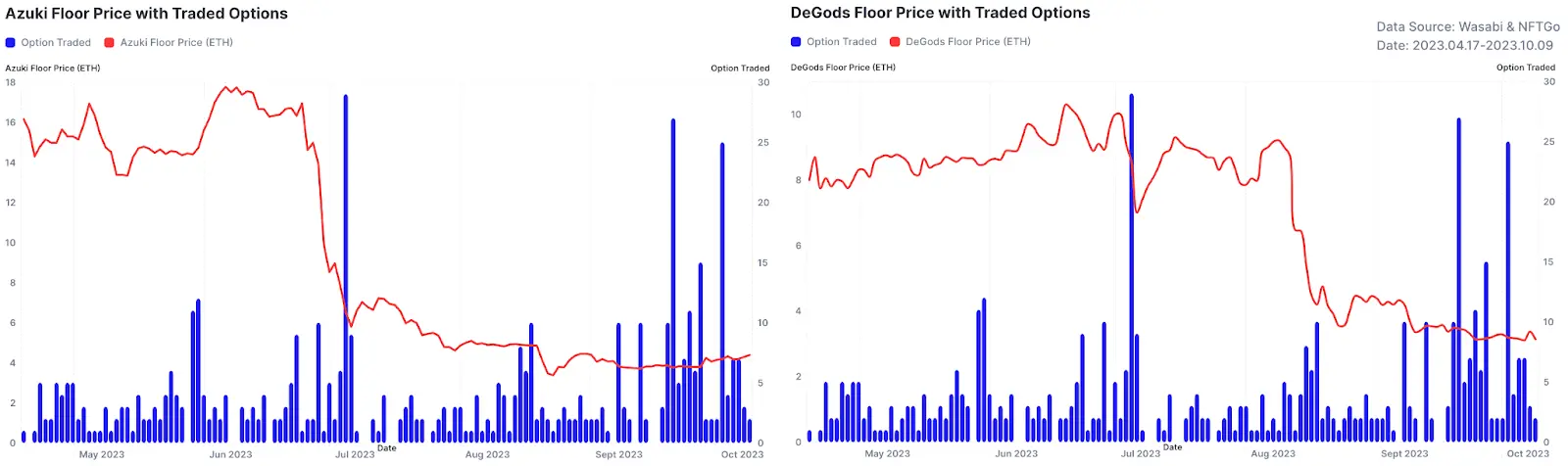
For example, the surge in July 2 date rights trading coincided with a drop in the price of floor prices for collectibles such as Azuki and DeGods. Azuki floor prices began to fall at the end of June, followed by DeGods in early July, and investors appeared to be using options as a strategy to reduce potential risk. The rise in options trading from mid-August to early September also followed this pattern. Therefore, using options to hedge the unpredictability of NFT prices is an investment strategy.
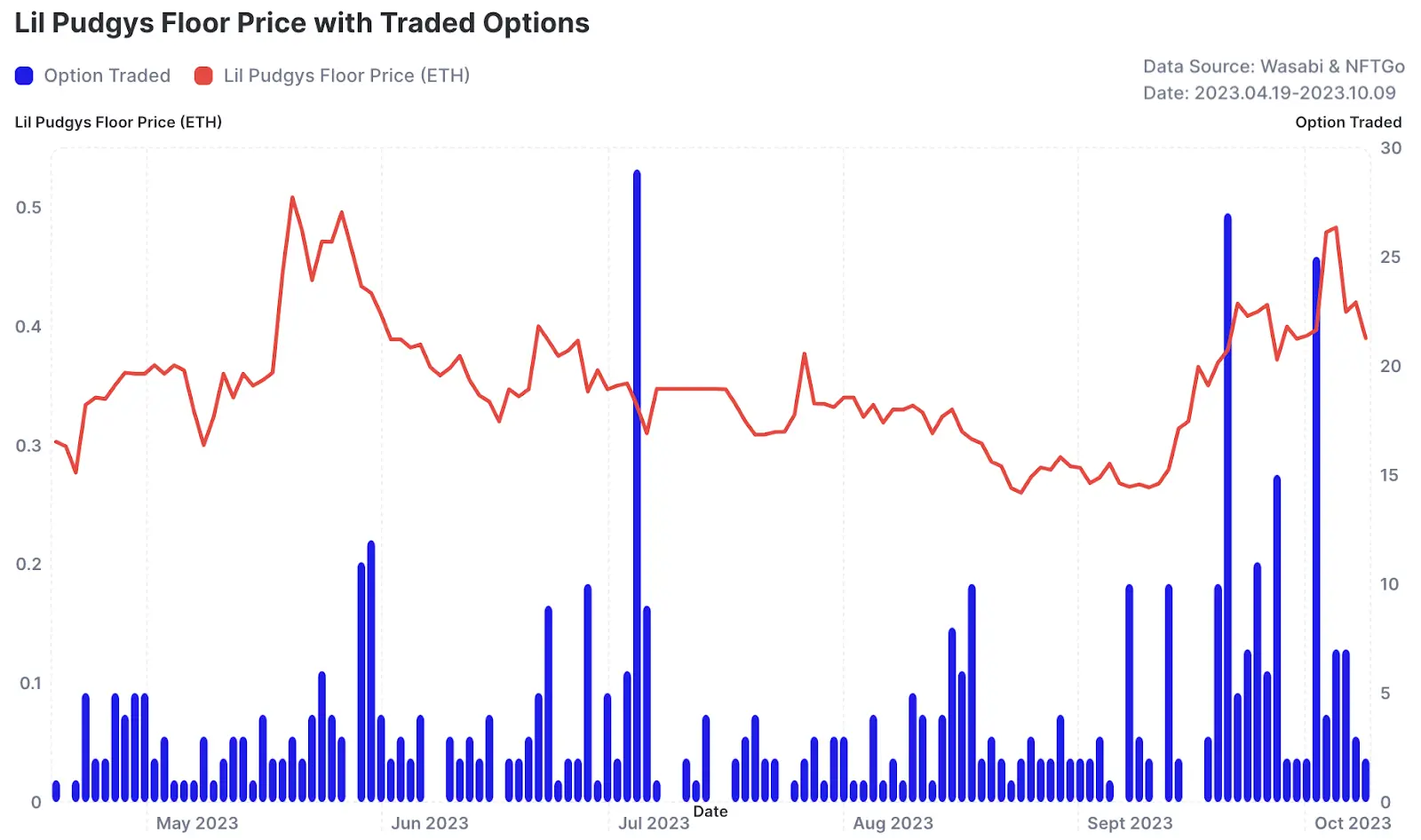
Lil Pudgys is another NFT collection that has a significant impact on options trading volume. When Lil Pudgy’s floor price began to rise in September, options trading volumes spiked accordingly, and a clear correlation emerged between the two. Specifically, on September 24 and October 4, floor prices in Lil Pudgys increased by 10% and 20%, respectively. At the same time as the price jump, options trading volumes also peaked, at 27 and 25 times, respectively. This shows that options are not just a hedging mechanism that investors seek in a market downturn. Conversely, options are also an attractive investment channel during the bullish phase of the market.
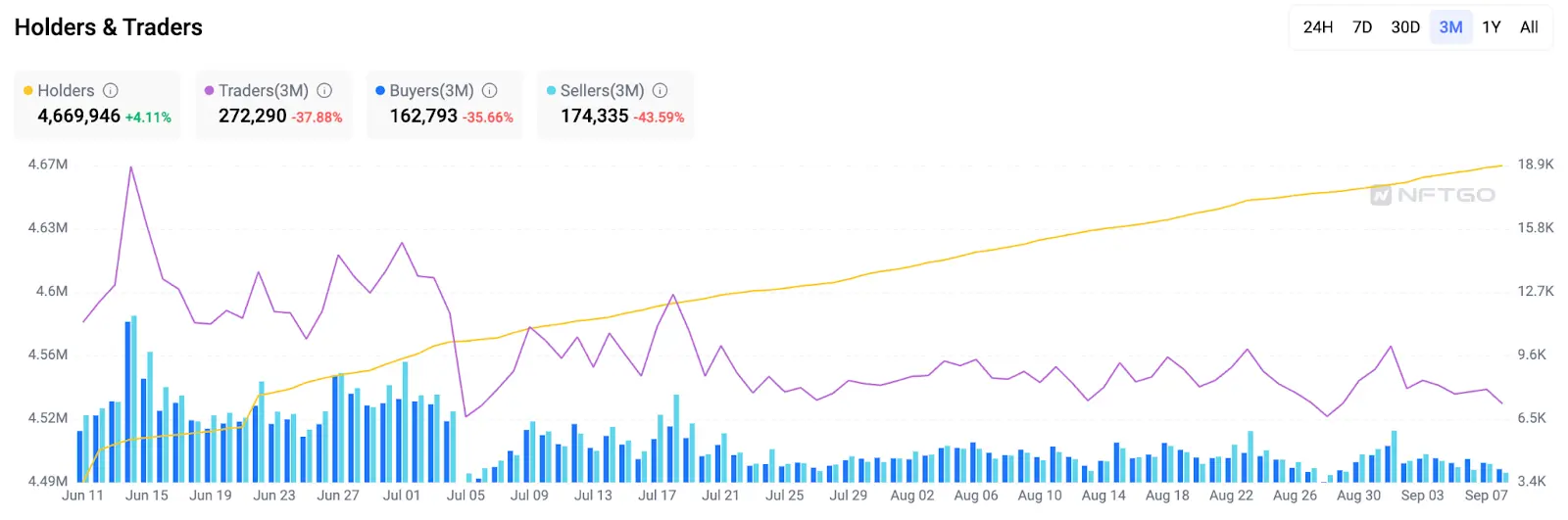
By extension, there is a clear correlation between options trading activity and spot trading when comparing options trading volume and general market trends. In layman’s terms, when there is volatility in the regular NFT market, the options market will also fluctuate. This correlation is not uncommon. In traditional finance, options tend to be a barometer of relevant market sentiment, reflecting broader trends and traders’ outlooks.
In conclusion, while the options market is actively issued, fewer options are still converted into exercise. This gap proves that traders are hedging bets or speculating on future price movements rather than taking advantage of options immediately.
Market share dynamics
When digging into the NFT options market, it is undeniable that certain series are leading the way in terms of total available liquidity (TAL). Among them, “Wrapped Cryptopunks”, “Bored Ape Yacht Club” and “Pudgy Penguins” are the leading three NFT series, accounting for a combined 55.68% market share. This dominance highlights the reach and popularity of these collections in NFT options.
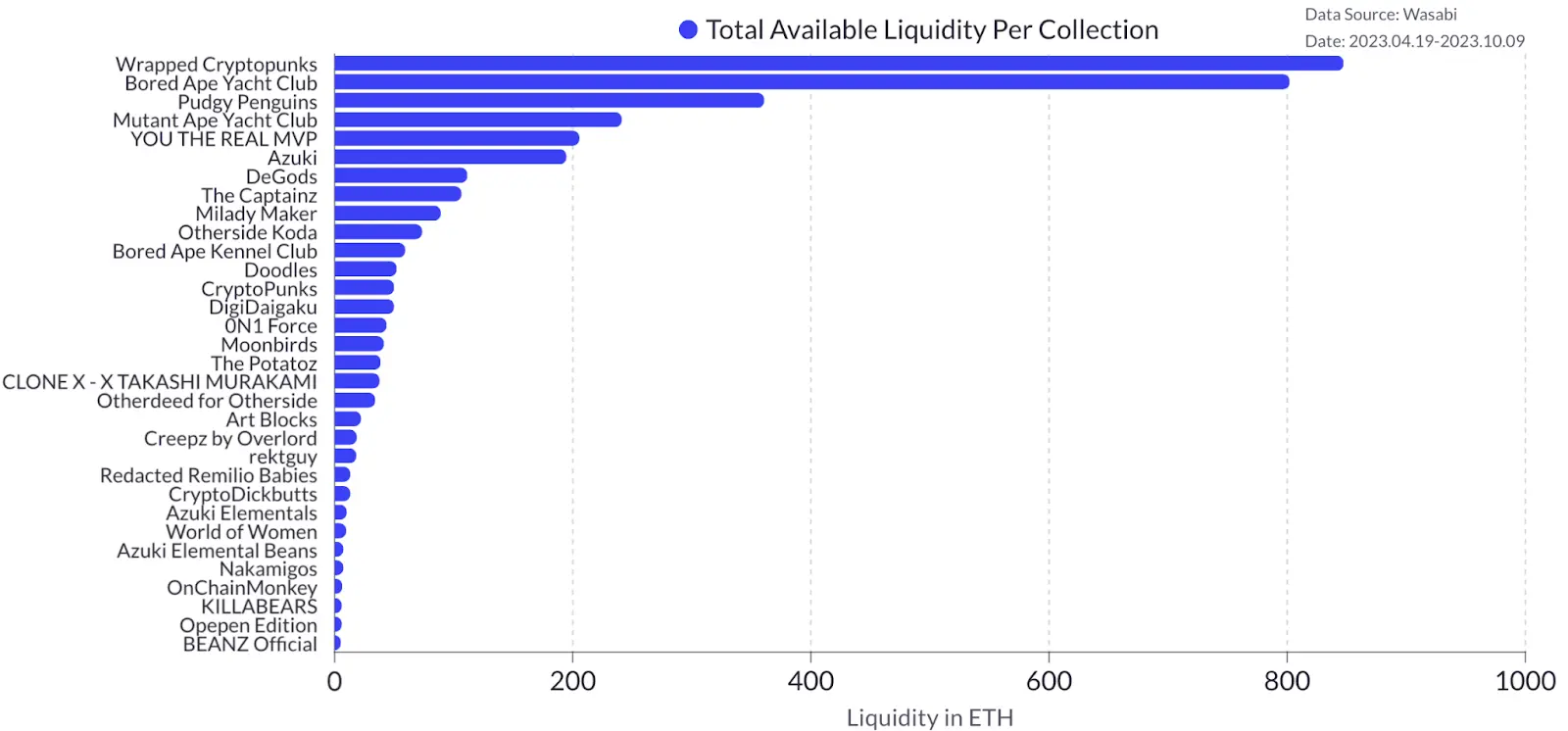
With a TAL value of 847.32 ETH, “Wrapped Cryptopunks” appears to be the market leader. It was followed by “Bored Ape Yacht Club” and “Pudgy Penguins” with TAL of 802.05 ETH and 360.76 ETH respectively. The large market share occupied by these three series indicates their pivotal role in the options market and perhaps their broader appeal in the NFT space.
While these collections dominate, it’s worth noting that the rest of the NFT collections collectively account for around 44% of the market. This distribution suggests that while top collections play an important role, there is plenty of room and potential for other collections to grow. Therefore, despite the influence of major players, the NFT options market remains a dynamic market, with both established collectibles and emerging contenders.
In mature financial markets, derivatives trading volume is more than 30 times higher than stock market trading volume. Derivatives, especially options, will continue this growth trajectory.

The number of active options users has grown steadily, with the NFT options market increasing from zero to over 140 active users, with a total available liquidity of over 3,000 ETH. Notably, the number of users at Wasabi skyrocketed 150% per month from June to July.
Chapter 4: How to Trade and Use Options Strategically**
Protect holders from severe price fluctuations
Buy NFTs on a low budget
Reaching high-value NFTs at a low price is one of the biggest breakthroughs in NFT option protocols. Traders can touch the price movements of the most popular collections at very little cost.
June 2023 was a critical and turbulent month for the 0N1 Force series. Traders do not need to pre-collateralize to take advantage of these huge price fluctuations.
Here’s a real-life example of making money with options:
! [fsp8i47Ngthlsa2Wj0ACj2jlFjSDNezeONpJLPpI.jpeg] (https://img-cdn.gateio.im/webp-social/moments-40baef27dd-8ecebd18f1-dd1a6f-69ad2a.webp “7121809”)
On June 5, 2023, 0N1 Force traded at a floor price of 1.3ETH following some key announcements. A smart trader expects that the price will continue to rise, so he buys options at a price that is only a small part of the entire NFT. He bought a call option with a premium of 0.047ETH at an exercise price of 1.3ETH.
In just a few hours, the floor price of 0N1 Force rose to 1.54ETH, at which point the bold trader decided to exercise the option at this price.
Finally, the trader pays 0.047 ETH, hitches a ride on the upward trend of the 0N1 Force series price during periods of volatility and makes a profit of 0.193 ETH in just a few hours, i.e. a 410% return in less than a day.
Without options contracts, this upside risk would not have been possible at such a low cost. This case also demonstrates the great potential of such an agreement.
Hedging when the price falls
Hedging is a key concept in all market risk management, and options provide an excellent way to hedge. Broadly speaking, this risk management tool does not exist in the cryptocurrency market, which is why put options are a breakthrough innovation.
Let’s look at an example of this: Trader 2 sells Nakamigo at 0.4ETH when the floor price drops to 0.279ETH.
! [2pHsHxz6XVxH9TiEfstm1xUStD3fgw7Xqy6MDFSz.jpeg] (https://img-cdn.gateio.im/webp-social/moments-40baef27dd-12af5bbb48-dd1a6f-69ad2a.webp “7121810”)
In the days following the launch of the Nakamigos collection in May 2023, there was a surprising increase in floor prices for the original free casting collection. Traders looking to hold Nakamigos can use put options to hedge new gains without having to liquidate their original NFTs.
On May 27, the floor price of Nakamigos rose to 0.44ETH, and smart traders took advantage of this opportunity to hedge their positions. They bought Wasabi’s put option at an exercise price of 0.4ETH, with an upfront premium of only 0.0325ETH.
Over the next 15 days, the price of Nakamigos continued to fall, reaching a low of 0.279ETH on June 10. However, since traders have the ability to hedge their positions on Wasabi, their put option gives them the right to sell one Nakamigo at 0.4ETH.
Traders can use Arbitrage Flow, an internal tool, to buy NFTs on the open market at a lower price with flash loans, then exercise the option to sell it back to the pool and profit from it.
In this case, traders took advantage of this approach and made a profit of 0.089ETH even though their initial investment was only 0.0325ETH, i.e. a 296% return in just two weeks without having to sell their NFTs.
This case study shows that put options can successfully hedge against market declines without having to sell NFTs.
Hedge newly issued NFTs
! [GPyrUfoEIJY2oHZF0PT8EESPLHAG9xZHyWJi5fBm.jpeg] (https://img-cdn.gateio.im/webp-social/moments-40baef27dd-721574ba0f-dd1a6f-69ad2a.webp “7121811”)
From past experience, NFT artworks will cause large fluctuations in stages, often downward fluctuations.
Azuki launched Elementals during one of the most volatile periods in NFT history. The project was hyped, but holders simply could not hedge against the risk of falling prices of the original collectibles without a put option. Fortunately, some market participants have succeeded in doing this using our protocol.
On June 24, 3 days before the Elementals reveals was revealed, a trader bought a 1-week put option with a premium of 3.93ETH at an exercise price of 17ETH and reserved the right to sell an Azuki at that price. After Elementals was officially released, Azuki’s floor price fell all the way down to 9ETH.
On June 30, the trader exercised the option, locking in a profit of 4.07 ETH, gaining 103% in just 6 days. He successfully used put options to hedge against the downside of floor prices, which was not possible before.
There is no need to buy NFTs to generate profits for traders
Bet on the market with small payouts
! [hX3NTqVMZGKd8wV9VBTUx1SCOxksj2LPOnqSgbD5.jpeg] (https://img-cdn.gateio.im/webp-social/moments-40baef27dd-e4cdfb1197-dd1a6f-69ad2a.webp “7121812”)
The magic of NFT options is that for a fraction of the actual cost of an NFT (as low as 0.01ETH), you can gain huge exposure and bet on price fluctuations. There are many such examples, as follows:
On May 12, 2023, a trader took advantage of the ability to bet on large price fluctuations to buy a 1-week call option on 0N1 Force with a premium of only 0.02ETH upfront. At the time of purchase, the floor price of the series hovered below 0.6ETH, and the trader bought a call option with an exercise price of 0.6ETH.
In less than a day, the floor price of 0N1 Force rose to 0.85ETH, at which point the trader decided to exercise the option to make a profit. By using Wasabi, this trader made a profit of 0.23ETH with an initial investment of 0.02ETH, creating a staggering 1150% return in a matter of hours.
Options are particularly suitable for NFT scenarios as they are useful for both long-term holders and active traders.
! [Hmd0GYizS2sxayjFfypDtpzXeBCxoH6C1MmxTf2T.jpeg] (https://img-cdn.gateio.im/webp-social/moments-40baef27dd-c00ef48758-dd1a6f-69ad2a.webp “7121813”)
An NFT trader recently purchased the Pudgy Penguins option on Hook for 0.0864ETH (about $160). A month later, the trader sold the option for 0.4ETH (about $750), earning a return of 0.3136ETH (363%).
Traders bought the option when the Pudgy Penguins floor price was around 3.4ETH, and the following month, the Pudgy Penguins floor price rose to 4.3ETH, causing the option to be in the red.
If a trader buys a Pudgy Penguins at the same time at floor price and then sells it, they will earn 0.9ETH (26.5%). While the ETH amount will be higher, on a percentage basis, they will gain much less.
Earn upfront premiums
NFT holders earn income by creating and selling call options. If NFT holders believe that the value of the NFT will increase, but not exceed a certain amount, they can sell the call option, earn a premium, and they can keep the premium regardless of how the price changes.
For long-term holding NFTs, selling call options is a great way to boost returns.
On July 15, a Milady holder minted and sold an option for 0.149939ETH. The option has an exercise price of 2.8ETH and expires on August 11, 2023.
Assuming the option expires without making money, the Milady holder can replicate this strategy over and over again and earn a lot of ETH over a period of a year.
Chapter 5: How to spot opportunities from volatility
In the NFT market, volatility is often seen as a challenge, but it also presents unique opportunities. NFT options provide a way to navigate volatility, enabling market participants to speculate on future price movements or hedge their investments, much like options in traditional financial markets. The innovative application of options in the NFT space highlights their importance as a strategic tool that minimizes risk and increases potential profits.
To understand NFT options and utilize them effectively, it is essential to have the ability to sense key market signals and make predictions based on data. This requires analyzing large amounts of market data such as price data, volume, liquidity, market sentiment, market capitalization, as well as advanced indicators such as the Relative Strength Index (RSI), Natural Logarithmic Rate of Return (LnR), Hypothetical Volatility Index, and Sharpe Ratio. Through this lens, we delve into the volatility of the NFT market and explore how data-driven decision-making can empower NFT options traders.
Detect market fluctuations
To identify the potential volatility of the NFT market, several metrics need to be measured:
- Price Data: Large price fluctuations may indicate market volatility. For example, if the price of an NFT fluctuates significantly over the course of a day or week, it may indicate that the market is volatile. Traders can take advantage of NFT options to profit from them.
- Volume: A sudden increase or decrease in trading volume may signal impending volatility. High trading volume usually means greater price volatility. For example, if there is a sudden increase in the trading volume of an NFT, this could be a precursor to large price swings. Options traders can use this information to buy options in anticipation of price fluctuations.
- Liquidity: Lower liquidity leads to greater volatility because smaller trades have a greater impact on prices. This provides options traders with the opportunity to take advantage of potential price differences. For example, if an NFT is less liquid, buying in small amounts may significantly increase its price. A trader may anticipate this and buy a call option in hopes of profiting from the price increase.
- Market Cap: NFTs with smaller market capitalizations may exhibit higher volatility, providing options traders with the opportunity to benefit from these price fluctuations. For example, a trader might find an NFT with a relatively small market cap but strong fundamentals. By purchasing options, they can profit from potential price fluctuations without having to invest a lot of money in the NFT itself.
- Blue Chip NFTs: Blue chip NFTs refer to NFTs that have built a reputation for quality, reliability, and the ability to make a profit in good times and bad. They tend to be less volatile due to stability. Therefore, the overall trend of change in the market can often be seen in the volatility of blue-chip NFTs. When blue-chip NFTs fluctuate, people can predict the direction of fluctuations in their collections.
- Market Sentiment: Market sentiment refers to an investor’s overall attitude towards a particular market or asset. Market sentiment is often driven by news events, product launches, or other events that affect the market. For example, if there is good news about a particular NFT or its issuer, it will drive bullish sentiment, potentially raising the price of the NFT. Options traders can take advantage of this and buy call options that are expected to rise in price.
Understanding and accurately interpreting the signals of the NFT market is an essential first step towards efficient options trading, requiring careful analysis of various indicators such as price data, trading volume, liquidity, and market capitalization. In addition to these quantitative indicators, focusing on qualitative factors such as market sentiment and the reputation of blue-chip NFTs can also provide valuable analysis of potential market volatility. By effectively detecting these market signals, whether speculating on future price movements or hedging against potential losses, traders can take advantage of market volatility to their advantage and adopt strategies accordingly.
Make data-driven predictions
In order to effectively navigate and profit from the NFT market, traders need to predict market trends and make decisions, which requires comprehensive analysis of various market data and indicators in the process.
- Relative Strength Index (RSI): The RSI is a momentum indicator used in technical analysis to measure the speed and change of price movements, where “RS” is the average gain in the rising session divided by the average decline in the falling period in a certain time frame. An RSI above 70 usually indicates that the NFT is overbought, indicating that its value may be overvalued and the price may experience a pullback. Conversely, an RSI below 30 usually indicates that the NFT is oversold, indicating that its value may be undervalued and the price may rise. As a result, options traders can speculate on these potential price corrections by buying put options when the RSI is high and calls when the RSI is low.
- Natural Logarithmic Rate of Return (LnR): The natural logarithmic rate of return allows traders to simulate price changes over time, with larger yields indicating higher volatility. For example, if a trader observes an upward trend in the natural logarithmic yield of an NFT price, they may predict a period of high volatility in the future and can buy options to profit from the predicted price fluctuations.
- Volatility Index: A hypothetical volatility index, similar to the VIX index in traditional markets, that measures expected volatility in the future. Higher volatility drives up the premium of the option, creating opportunities for the option seller. For example, if the index shows high future volatility, a trader may create options to charge a higher premium, especially if they believe that the actual future volatility will be lower than the volatility shown by the index.
- Sharpe Ratio: Sharpe Ratio = (Expected Return on Investment - Risk-Free Rate) / Standard deviation of investment income. The Sharpe ratio is used to understand how an investment returns compare to its risk. A higher Sharpe ratio indicates better risk-adjusted returns. For example, if a trader compares two NFTs and one of them has a higher Sharpe ratio, they may choose to buy an option on that NFT as it indicates better risk/reward coordination.
As an integral part of risk management, NFT options protect traders from falling prices (via put options) and potential price increases (via call options) when selling NFTs.
In conclusion, despite the challenges posed by the volatility of the NFT market, it also presents a special opportunity for strategic profitability. By thoroughly understanding market signals and making data-driven predictions, traders can effectively leverage NFT options to reduce risk and potentially maximize gains in this booming, dynamic market.
Chapter 6: Current Challenges and Risks
NFT options are undoubtedly an interesting innovation, but there are still some issues to consider during widespread adoption. One is liquidity, and the NFT market is quite fragmented, as most collections only have 10,000 pieces. Outside of the most popular collections, it is difficult to create enough liquidity for NFT projects.
Another consideration surrounding NFT options has to do with the depth of the relevant NFT trading volume. This has the potential to trigger manipulation (or what some call a highly profitable trading strategy). A trader can own an NFT, buy a downside put option on the item, and then list the NFT below the floor price. And vice versa – if the floor price is low, traders can buy a call option and then buy that NFT. It is important to monitor open interest relative to floor thickness, liquidity, and collectible volume.
In addition, pricing accuracy is a key element and another important factor. Options have historically been priced using the Black-Scholes Model. However, this model assumes that the returns of the underlying assets are normally distributed.
According to NFTGo’s data, we can see the distribution of daily floor price changes for two popular NFT collections, CryptoPunks and Bored Ape Yacht Club.


As you can see, the ETH-denominated daily returns of CryptoPunks and BAYC are not normally distributed, but have varying degrees of skewness and kurtosis. The absence of a normal distribution affects the Black-Scholes Model’s ability to price options contracts correctly.
Chapter 7: The Future of NFT Options
Derivatives are an extremely important innovation in the operation of capital markets. They are a way for traders to speculate, hedge and manage risk across asset classes.
The cryptocurrency market, while still in its infancy, is growing rapidly. At Wasabi, we believe that as the industry continues to move forward, non-fungible tokens will become a potential flashpoint for cryptocurrencies and Web 3, mapping the nature of real-world assets and collectibles themselves. In order for non-fungible digital assets to grow further as an industry, infrastructure is necessary. It can promote the steady development of the market, introduce suitable liquidity, and make the overall benefit increasing. That’s why we established the Wasabi protocol.
We are already familiar with the fact that NFTs are inherently illiquid, vary in appreciation, and are not suitable for splitting. For now, options are still the best way to increase liquidity and build a solid market structure to bring in large players. Wwasabi’s options are physically settled, do not involve any synthetic instruments that can be manipulated, and do not result in cascading liquidation like other models for similar purposes.
As the non-fungible asset market continues to grow, the derivatives market will continue to grow, eventually surpassing the spot market in terms of trading volume, just like traditional markets. The role of options in this is crucial, and this was already evident within a few months of the launch of the Wasabi Protocol.
As we expand into new markets such as games, real-world assets, and the entire non-fungible commodity space, we look forward to seeing how market participants can leverage this novel financial instrument to create new scenarios.
Options today promote capital efficiency for holders, but are inefficient for creators. Option holders use the natural leverage of options to gain higher exposure relative to the amount of money they invest, completely independent of Oracle and without the need for liquidation. In today’s market, the NFT underlying must be deposited before an option can be created, thus significantly driving up the option price. The main reason is that the asset is locked up until expiration, making it more difficult to create options.
The next generation of NFT option protocols will not face this problem. The options market suggests that we still have many options available: Panoptic is creating options based on existing AMM LP positions, Aevo is building synthetic options, and Aori is implementing a full collateral margin system to address this.
Once a solution is found, the liquidity of the options market will no longer be limited to tokens in circulation. Options will drive the growth of the entire derivatives market and even become the anchor of stabilizing the collectible market, as active traders will be able to gain more effective exposure through the derivatives market without the need for constant spot trading.
Finally, options will be combined with other NFT financial instruments to form complex positions. Lenders can hedge with options to further compress the annual interest rate of the loan. When people borrow money, they also buy options and use the option proceeds to pay interest expenses.


