ETF approval is the biggest catalyst for the crypto market right now, with huge upside potential but limited downside.
Written by: Dessislava Aubert, Clara Medalie
Compiled by: Web3CN
We have been keeping a close eye on crypto liquidity since the FTX crash, which saw an across-the-board decline in trading volume and order depth across all assets across all exchanges, with even the most recent market rally failing to bring depth or volume back to The level FTX was at before it crashed. **
However, with spot ETFs likely to be approved as early as January, liquidity is expected to see a real recovery soon (albeit with some downsides). There are two ways this might happen:
- Liquidity is transferred through transactions;
- Liquidity is transferred through market makers (MM);
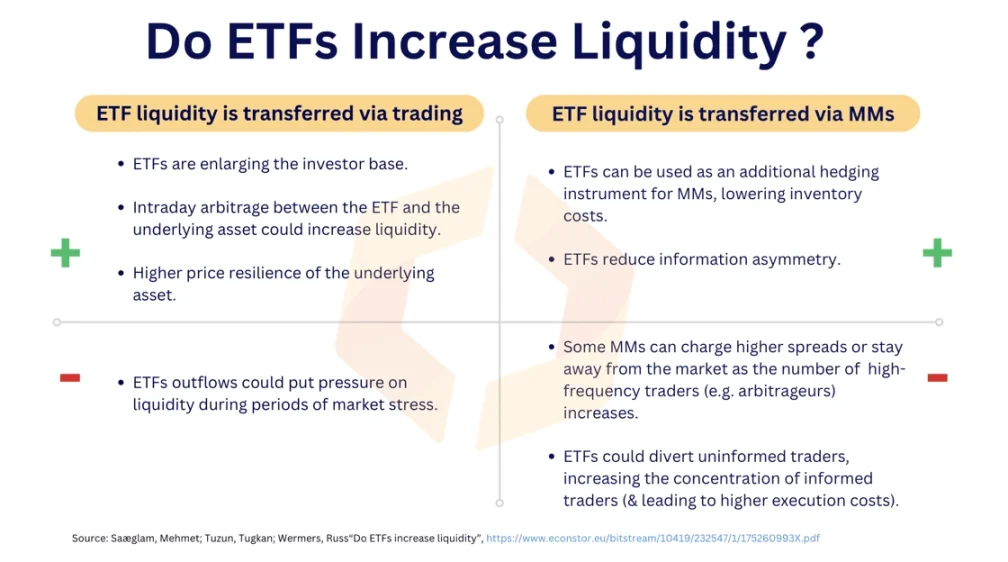
In terms of “ETFs will increase liquidity,” there are compelling arguments that ETFs will expand the number of cryptocurrency traders, resulting in greater trading volumes and more efficient markets. Market makers will also benefit from the properties of ETFs as hedging instruments and may expand their activities.
In terms of “ETFs will harm liquidity,” there are real concerns that large outflows from ETFs could put selling pressure on the underlying market. On the market maker side, they may charge higher spreads due to the greater number of well-informed traders.
Let’s take a look at the state of Bitcoin liquidity to understand the impact.
Bitcoin Market Depth
The FTX crash resulted in a significant drop in Bitcoin market depth. Not only did FTX’s sudden disappearance reduce liquidity, but market makers also liquidated positions on many exchanges amid heavy losses and difficult market conditions.
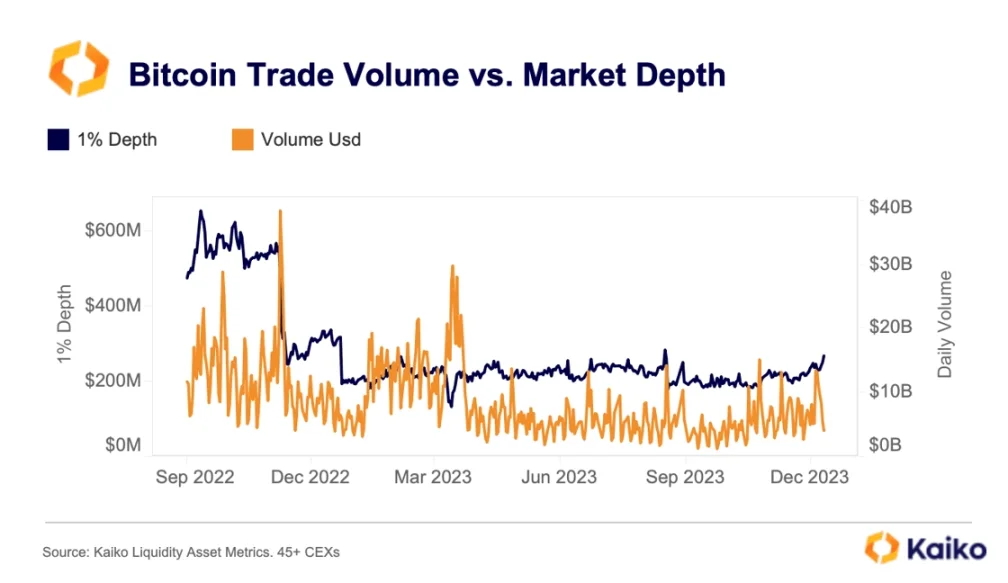
1% market depth, which measures the number of bids and offers within 1% of the price on the order book, has fallen from about $580 million to about $230 million across all exchanges and trading pairs.
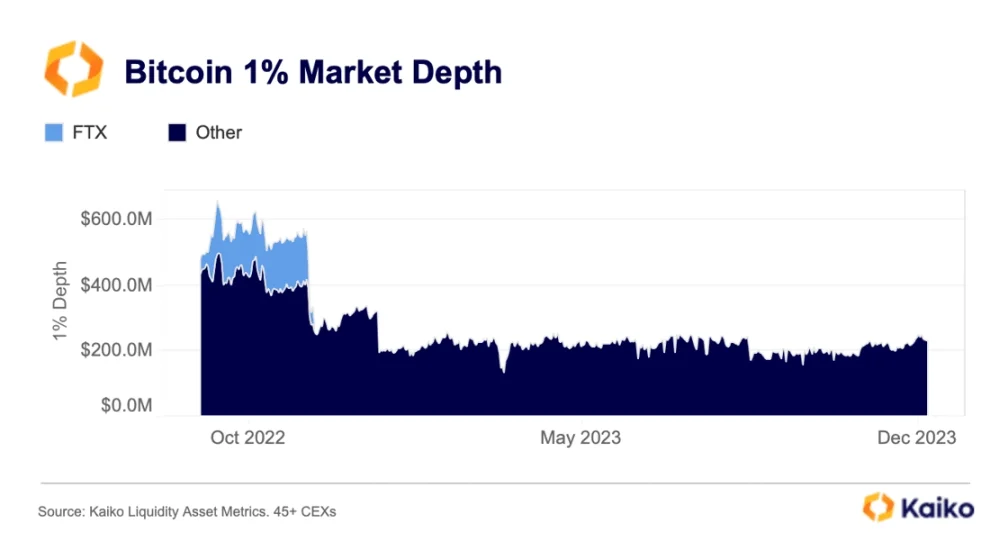
The recent market rally has had a negligible impact on liquidity, and the small increase observed is primarily due to price effects.
Why is market depth important for ETFs? ETF issuers are required to buy and sell the underlying assets. While it’s unclear exactly where they will do this (spot exchanges, OTC, or miners), it’s likely that at some point centralized spot exchanges will see an increase in traffic, especially since there are So many ETFs will be approved immediately.
Liquidity is also important from an arbitrageur’s perspective. The price of an ETF needs to track the underlying asset, which can be accomplished by buying and selling whenever a premium or discount occurs. Illiquid markets create more frequent price dislocations that complicate the job of arbitrageurs, so liquidity is important for market efficiency.
U.S. cryptocurrency exchanges in particular can play an important role in spot ETFs - they currently account for approximately 45% of global BTC market depth.
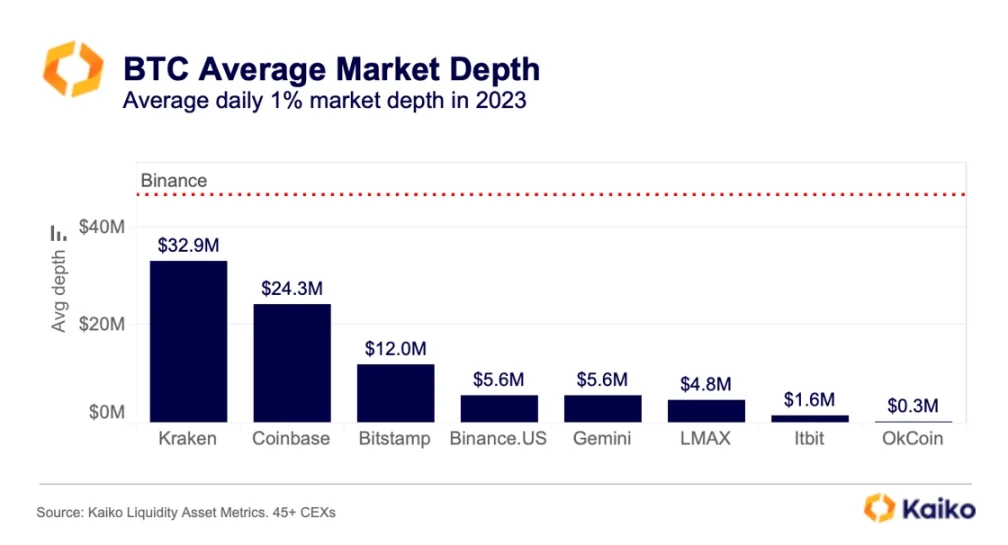
Throughout 2023, Kraken had the best BTC trading depth on average, with a depth of $32.9 million in the 1% price range, with Coinbase in second place at $24.3 million. Binance’s daily average market depth is shown in red for reference.
If more informed investors enter the Bitcoin market, ETF approval could also impact transaction costs. Over the past year, the costs incurred by traders in the form of spreads have mostly improved since last year, likely due to lower price volatility.
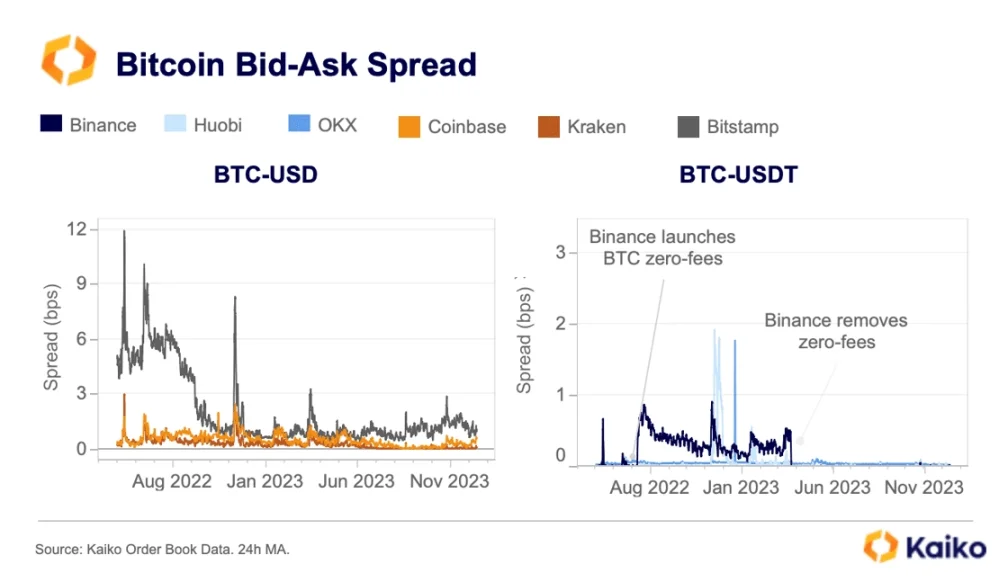
All in all, Bitcoin market depth has remained flat for much of the year (no change in liquidity), while spreads have mostly narrowed (lower costs for traders), but ETF approval could change that.
Bitcoin transaction volume
FTX’s impact on trading volume is much smaller than market depth, accounting for less than 7% of global trading volume. Since November last year, trading volume has fluctuated significantly. Volumes had remained elevated during the first three months of 2023, but plummeted following the banking crisis in March and hit multi-year lows in the summer.
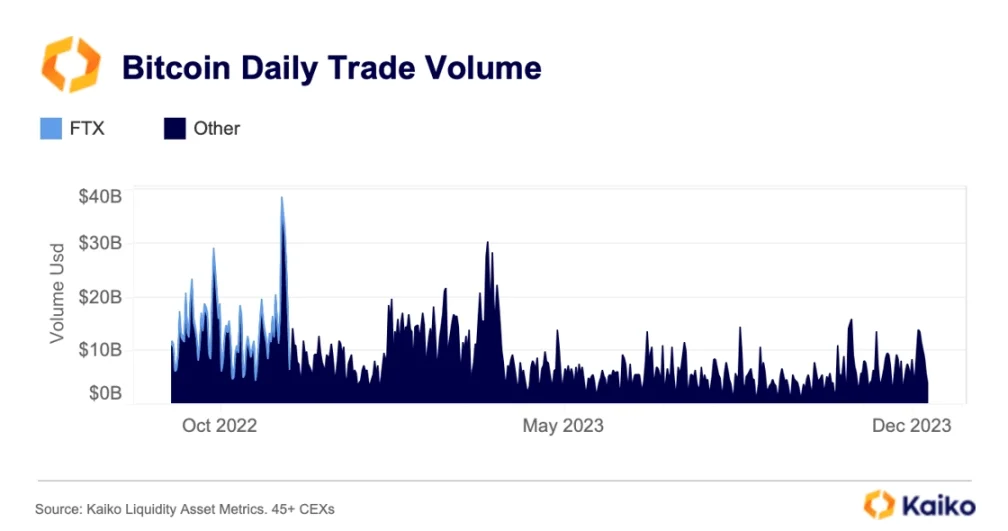
With the recent rally, we have seen a slight recovery over the past few months, but overall, trading volumes are still well below FTX’s previous levels.
Therefore, when comparing trading volume to market depth, we can observe that the decline in depth since November 2022 has been much larger, but the volatility throughout the year has been much smaller than trading volume. This indicates that the level of market making activity remains unchanged without any new entrants (or exits).
Bitcoin Dominance
Bitcoin remains by far the most liquid crypto asset and has proven to be the most resilient during tough market conditions. ETFs may further cement their dominance.
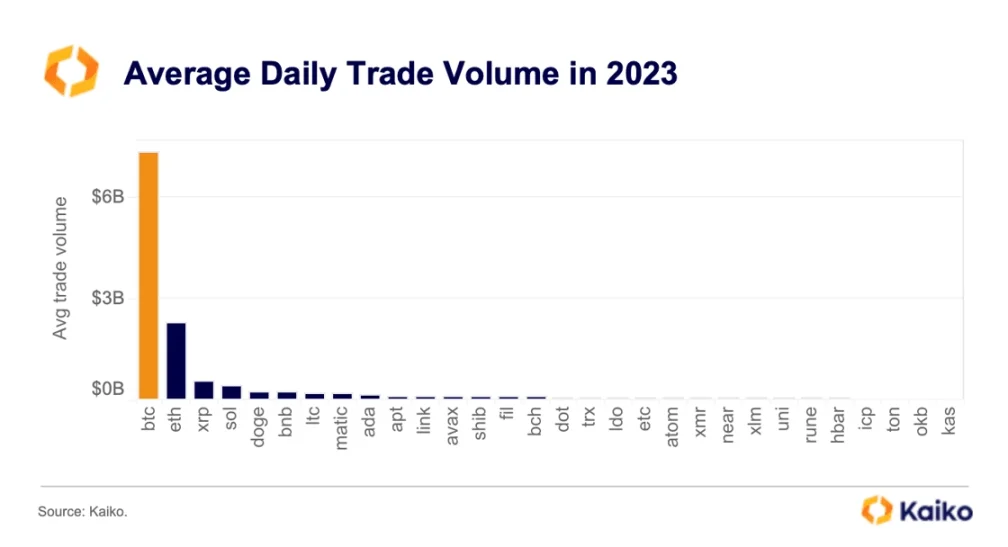
From the distribution of trading volume over the past year, we can see that the trading volume of BTC is on average 3 times that of ETH and more than 10 times that of the top 10 altcoins. Notably, Binance’s zero-fee Bitcoin trading promotion that ended in the spring exacerbated this trend.
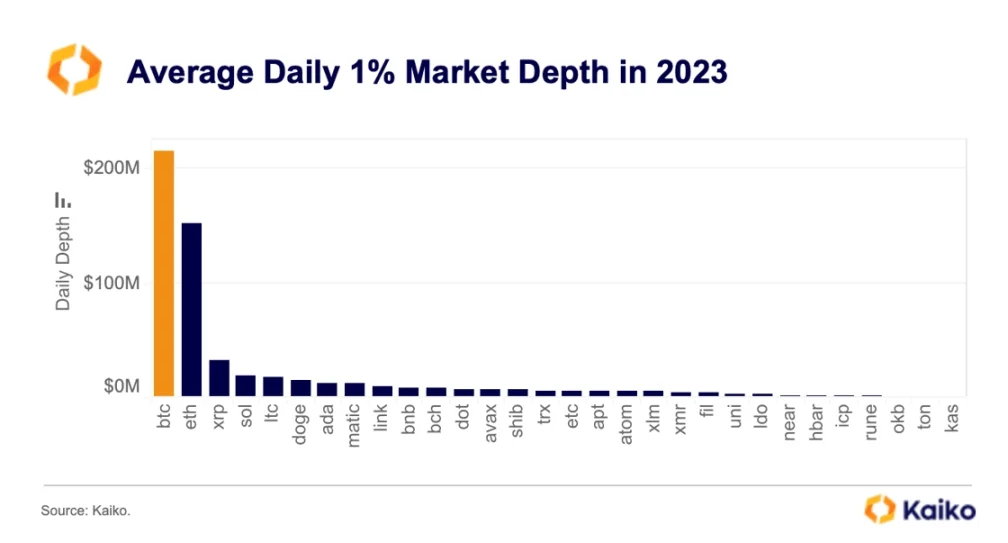
Bitcoin’s average daily market depth is very similar to ETH, although it is still much larger than most altcoins.
in conclusion
Bitcoin is by far the most liquid crypto asset. However, both liquidity measures have fallen significantly since the FTX collapse, with only a slight recovery over the past few months. Therefore, **ETF approval is the biggest catalyst for the cryptocurrency market right now, promising huge upside potential and limited downside. **Although there is some liquidity risk, ETFs could improve market conditions across the board if investor appetite increases significantly.
Disclaimer: The information on this page may come from third parties and does not represent the views or opinions of Gate. The content displayed on this page is for reference only and does not constitute any financial, investment, or legal advice. Gate does not guarantee the accuracy or completeness of the information and shall not be liable for any losses arising from the use of this information. Virtual asset investments carry high risks and are subject to significant price volatility. You may lose all of your invested principal. Please fully understand the relevant risks and make prudent decisions based on your own financial situation and risk tolerance. For details, please refer to
Disclaimer.


