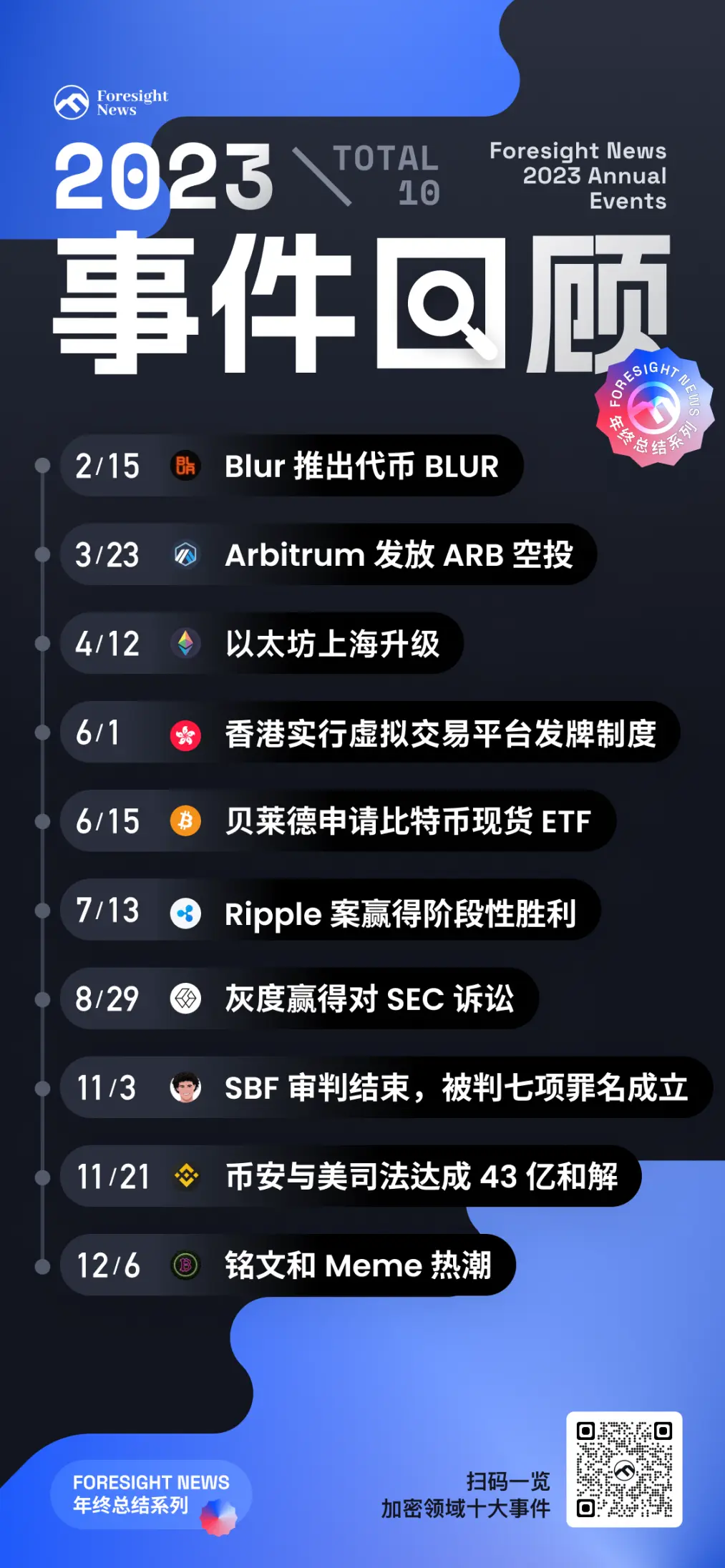
The top ten events in the Web3 industry in 2023 focus on token airdrops, regulation and new technologies.
Written by angelilu, Foresight News
2023 is coming to an end. While the Web3 industry has inherited the impact of many thunderstorms in 2022, it still shows tenacious vitality, with many innovations and crazes emerging.
“Learning from history”, looking back at the major events that occurred in the Web3 industry in 2023 will not only define the development trajectory of the past year, but also indicate the possible future development direction. 2023 first ushered in the airdrops of BLUR and ARB in the “mundane”; in April, Ethereum successfully upgraded in Shanghai; good news continued in the middle of the year, Hong Kong officially implemented encryption-friendly policies, and financial giants successively applied for Bitcoin spot ETF, Ripple and Grayscale twice defeated the US Securities and Exchange Commission in lawsuits; in October and November, the FTX case trial and Binance’s huge fine put crypto exchanges in the spotlight, while the year-end focus turned to Inscription and Meme.
The following is a full review of the top ten events in 2023:
1. BLUR sets off the first airdrop wave in 2023
The first major event in the cryptocurrency field in 2023 occurred on February 15. On this day, the Blur platform distributed the first batch of airdrops to its community members, totaling 360 million Blur tokens. Due to the large number of participating users, Blur’s official website was once paralyzed due to excessive traffic on the airdrop collection page, resulting in users being unable to access and receive airdrops normally. It took more than half an hour after going online for the problem to be resolved. At the same time, the Gas fee of the Ethereum network has also surged, reaching approximately 1000Gwei. According to data from the ultrasound.money website at the time, the contract operation to receive the Blur airdrop resulted in the destruction of more than 980 ETH, which ranked first in the entire network. However, 10 months after it was launched, the performance of the token BLUR was not as expected. The price when it was launched in February was US$0.65, and as of the publication of the article, the price of BLUR was US$0.51.
The Blur platform has emerged from the NFT craze in mid-2022 and has quickly stood out from many NFT markets, even surpassing OpenSea, which has long held the market leadership. Therefore, people are full of expectations about whether a new NFT market leader will emerge in 2024. For example, due to the recent inscription craze, the transaction volume of OKX NFT Marketplace once exceeded OpenSea and Blur.
2. ARB airdrop is online
Arbitrum issued a token airdrop on March 23, which was one of the most high-profile events in the crypto industry in March. However, only one-third of the airdrop ratio makes ARB airdrop one of the “most volume airdrops”. Arbitrum is one of the most important Layer 2 of Ethereum. Many users compare ARB with OP. The price of ARB online is 1.35 USD, which is similar to the USD 1.4 when OP was launched last year, but as of this writing, OP’s price is USD 3.52, and the token price has performed better than ARB’s USD 1.38.
3. Ethereum Shanghai upgrade
The Ethereum Shanghai upgrade on April 12 marks another milestone since the Ethereum merger in September 2022. The Ethereum merger is a key step in the network’s transition to the Proof of Stake (PoS) consensus mechanism. One of the focuses of the Shanghai upgrade is to allow the ETH pledged in the Ethereum Beacon Chain smart contract to be open for withdrawal, and the distance is in the Beacon Chain. It has been two years since the staking was launched.
Before the Shanghai upgrade, the market was generally worried about the possible ETH sell-off after staking was opened. In fact, the first day after the upgrade was the highest single-day outflow of ETH pledges, with a total of 14,249 validators withdrawing. One month after the upgrade, a total of 48,341 validators withdrew, and the withdrawal amount was 1.55 million ETH (the value at the time $2.93 billion), but has not had a significant impact on the market price, and net inflows into the staking pool have remained positive to date due to the high demand for Ethereum staking.
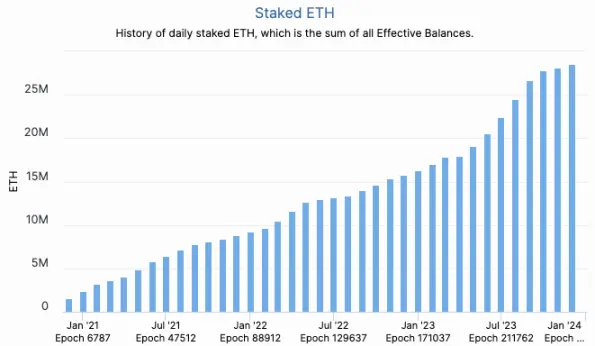
Next, Ethereum’s most talked about technological advancement will be sharding.
4. Hong Kong implements virtual trading platform licensing system
Since the Hong Kong SAR government issued the Virtual Assets Policy Declaration on October 31 last year, it has been vigorously developing Web3.0 and passed the “Anti-Money Laundering and Counter-Terrorist Financing (Amendment) Bill 2022” in December last year. The licensing system for virtual asset service providers will officially take effect on June 1 this year. This move means that Hong Kong has officially brought virtual asset trading platforms into the scope of supervision, and platforms that want to provide this service in Hong Kong must apply for relevant licenses.
So far, 13 virtual asset trading platforms have submitted applications to the Hong Kong Securities and Futures Commission. Two trading platforms, HashKey Exchange and OSL Exchange, have obtained licenses. In addition, one has been rejected and 10 are still applying. Although there was a fraud scandal involving the unlicensed exchange JPEX, involving more than HK$1 billion.
In addition, Hong Kong also launched the first Asian virtual currency futures ETF this year and is exploring the “digital Hong Kong dollar”. Tokenized assets are also a potential development direction for Hong Kong. After the Hong Kong Fintech Week ended in November, Hong Kong Web 3.0 The three key directions are retail investors, digital Hong Kong dollar and digital renminbi, and stable coins.
5. BlackRock applies for Bitcoin spot ETF
U.S. financial giants have been wrangling with regulators over the application for Bitcoin spot ETFs for several years. However, Blackrock, the world’s largest asset management company with approximately $9 trillion in assets under management, announced in June The Bitcoin spot ETF application submitted on the 15th was considered proof that “institutions have once again entered the encryption market”, pushing the price of Bitcoin from US$25,000 to US$30,000.
After BlackRock, asset management companies such as WisdomTree, Invesco, and Fidelity have once again submitted applications for Bitcoin spot ETFs. The U.S. Securities and Exchange Commission (SEC) has repeatedly postponed resolutions as before, but with the SEC and Grayscale litigation Due to the loss of the lawsuit and the loosening of its own attitude, the 13 applicant institutions currently applying have held 24 meetings with the SEC to discuss the details of the ETF. January 5 to 10 next year is the deadline for the SEC to approve or disapprove. Wall Street insiders predict that in order to maintain market fairness, it is very likely that multiple ETFs will be approved at the same time.
6. Ripple wins initial victory in SEC lawsuit
Ripple achieved a preliminary victory in the lawsuit with the U.S. Securities and Exchange Commission (SEC) on July 13 this year. The lawsuit started in December 2020. The key to the lawsuit is to determine whether the $1.3 billion XRP sold by Ripple is a security. , so the lawsuit was of epoch-making significance for the encryption industry. After three years of fierce fighting, it was not until July 13 this year that a U.S. federal judge ruled that Ripple’s sale of XRP tokens did not violate federal securities laws, believing that XRP is in many Failure to meet securities standards. This is the first time a U.S. judge has ruled in favor of Ripple and could set a precedent for future token classification cases, sending the crypto community into a frenzy.
XRP price also rose from $0.47 to $0.82, hitting a new high since January 2018. Affected by this judgment, several tokens that were previously recognized as securities by the SEC in the SEC v. Coinbase case all experienced increases in this incident, such as SOL, MATIC, ADA, and XLM, all of which saw double-digit increases.
However, this judgment can only be regarded as a staged victory for Ripple. The US SEC has appealed. Although its appeal was rejected, the SEC may still try to appeal the entire case.
7. Grayscale wins lawsuit against SEC
More than a month after losing to Ripple, the US SEC suffered another defeat in its lawsuit against Grayscale. Grayscale’s Bitcoin Trust Fund GBTC has become the world’s largest Bitcoin investment trust fund, with more than 408,500 Bitcoins, accounting for nearly 2% of the total number of Bitcoins. Grayscale’s victory is therefore significant for the crypto industry.
On August 29, a U.S. federal court ruled that Grayscale Investments LLC won a lawsuit against the U.S. Securities and Exchange Commission (SEC) for refusing to apply for a Bitcoin spot ETF. The case originated in October 2021, when Grayscale first applied to convert its closed-end Bitcoin trust fund GBTC into a Bitcoin spot ETF, but was rejected by the SEC.
The judge ruled that the SEC’s initial rejection of Grayscale’s ETF application was “arbitrary and capricious.” Administrative agencies must treat administrative actions equally. The logic of Bitcoin futures ETF approval should be equal to the logic of Bitcoin spot ETF approval. Otherwise, all Bitcoin All applications for currency futures ETFs should be revoked. The SEC allowed the trading of Bitcoin futures ETFs for the first time in 2021 and stated that futures products are more difficult to manipulate, but the Bitcoin spot ETF has never been approved. Because Bitcoin is the only crypto asset that has been explicitly recognized as a non-security by the SEC, and ETFs are regulatory and compliant financial products, there should be no obstacles to applying for a Bitcoin ETF.
If BlackRock’s Bitcoin spot ETF application is a good start for the application, then Grayscale’s victory can be considered as accelerating the SEC’s approval rush. Bitcoin also rose in response, breaking through the $27,000 and $28,000 levels. Prior to this, Bitcoin fell below the US$26,000 mark many times, and the market value of Bitcoin fell below US$500 billion. But the market did not last long, as the SEC delayed the approval of several Bitcoin spot ETFs within 48 hours of the ruling.
8. FTX Bankruptcy Case: SBF was convicted on seven counts
At the end of 2022, the cryptocurrency exchange FTX announced that it had filed for bankruptcy, causing shocks in the crypto market. Many encryption companies such as BlockFi and Genesis went bankrupt one after another, and the overall market value of the encryption market fell sharply. As the case proceeds, more details from within FTX are coming to light. Ahead of the SBF trial, other FTX executives pleaded guilty and agreed to cooperate with prosecutors.
In this shocking trial, the testimony of SBF’s ex-girlfriend was full of revelations: she said she was ordered by SBF to commit crimes and misappropriated approximately US$14 billion in FTX customer funds; Alameda had bribed Chinese officials to unlock accounts; and under the instructions of SBF, Alameda repeatedly forged On the balance sheet, FTX co-founder Gary Wang said Alameda owes FTX at least US$8 billion in debt, and most of Alameda’s investments are paid for by FTX user funds. SBF also said that he was aware of Alameda’s dangerous situation and that he had tried to shut down Alameda two months before the FTX thunderstorm.
A trial that alerted the entire crypto world ended with SBF being convicted on seven counts and facing up to 115 years in prison. Of course, the trial was not the final result. SBF’s second trial is currently scheduled for March 11 next year. The sentencing Scheduled for March 28, 2024.
9. Binance turmoil: regulatory hammer falls, industry reshuffle accelerates
In June this year, the U.S. Securities and Exchange Commission swung its iron fist at Binance and its founder Changpeng Zhao, and filed 13 charges, putting Binance at the center of a whirlpool of public opinion. However, data shows that the balance of Binance’s Bitcoin wallet has remained unchanged for 7 days. No huge changes.
On November 22, the criminal investigation of Binance by the U.S. Department of Justice finally settled, and Binance will pay a fine of up to $4.3 billion to the U.S. Treasury Department, setting a record for the highest settlement amount in history. At the same time, Changpeng Zhao stepped down as CEO of Binance. The crypto market fell upon hearing the news, with Bitcoin once falling below $36,000. However, in this incident, Binance’s capital outflow was lower than expected. New CEO Richard Teng also stated that Binance will embark on a path of stability, growth, and compliance from now on.
After FTX collapsed and Binance faced turmoil, the cryptocurrency industry will face new challenges and opportunities. Increased regulatory pressure will force cryptocurrency industry participants to strengthen compliance awareness and self-construction. At the same time, the reshuffle of the cryptocurrency industry will also accelerate industry concentration and bring new growth opportunities to leading companies. Coinbase, perhaps the crypto exchange that will benefit the most, has become the custodian of the BlackRock crypto ETF, which will bring many benefits to it if the Bitcoin spot ETF is approved next year.
10. The inscription and Meme craze begins
In late 2023, the inscription and meme craze swept the entire cryptocurrency market.
Inions is a technology for burning arbitrary content onto Bitcoin (BTC). It first appeared in March 2023, when developers imitated ERC20 and created BRC20 on its basis, bringing issuance synchronization to Ordinals. The ability to capitalize on assets. Inscriptions were tepid at the beginning because there were still some minting thresholds for Bitcoin inscriptions at that time. However, as platforms such as Unisat launched proxy printing tools, the minting thresholds were lowered and more users entered the market. Until November this year, the price of ORDI The rise was astonishing, ushering in the so-called “Summer of Inscriptions.”
The turning point occurred on December 6 this year. Bitcoin Core developer Luke Dashjr stated that Inions was exploiting a vulnerability in the Bitcoin Core client to send spam information to the blockchain, and said that it would be fixed in the new version. loopholes. This move means that inscriptions such as ORDI may be repaired and no longer exist in the new version. The community is divided into two opposing parties: those who support and those who oppose inscriptions. However, it does bring a new wave of popularity to ORDI, and the price of ORDI once exceeded 68 New highs for the dollar. In late December, the Bitcoin network’s single-day transaction fees even exceeded those of Ethereum due to the large number of Ordinals transactions.
And with the popularity of Bitcoin inscriptions, a wave of inscriptions has gradually set off on various public chains, driving the tokens of each public chain to rise. Among them, SOL led the way, breaking through $110, with a 30-day increase of nearly 100%. In addition, with the spread of low Gas events and active communities, the Meme craze of the Solana ecosystem has begun. Meme is one of the indispensable sectors that promotes the market rise at the end of this year. Various animal coins are emerging in an endless stream. The market values of WIF, LEIA, SILLY, etc. are all rising in the short term. Increased nearly ten times.
end
2023 is a year of recovery for Web3, with progress in supervision, technology, applications and other aspects. At the end of the year, the prices of mainstream cryptocurrencies such as Bitcoin and Ethereum rose sharply, which gave Web3er a satisfactory answer and laid the foundation for further development in 2024.
As Bill Gates’ annual outlook puts it, “The road ahead will reach a turning point in 2024.”


