


2023 Annual Report Selections: The Rise and Competition of DEX
Uniswap is gradually transitioning from a “one dominant player” to a structure of “one super, many strong”.
Written by: xiaoyu, DODO Research
The footsteps of spring always step on the muddy path, and 2023 is a year where challenges and opportunities coexist. We have witnessed the release of Uniswap V4 and UniswapX, the underlying code of Curve has been attacked, and the emergence of DEX newcomers such as Maverick.
In this volatile market environment, DEXs not only experience technical challenges, but also face growing competitive pressure. Despite this, many DEXs continue to make breakthroughs in innovation, launching safer and more efficient trading mechanisms, attracting a large number of new users.
Over the past year, the DEX Weekly Brief column has closely monitored and reported the latest trends and key data in the decentralized exchange (DEX) market. **The DEX annual report condenses the DODO Research team’s detailed observation and analysis of the market throughout the year, and provides an in-depth discussion of the significant trends and important findings in the DEX field in 2023 for reference. **
I. Transaction Volume & Market Share
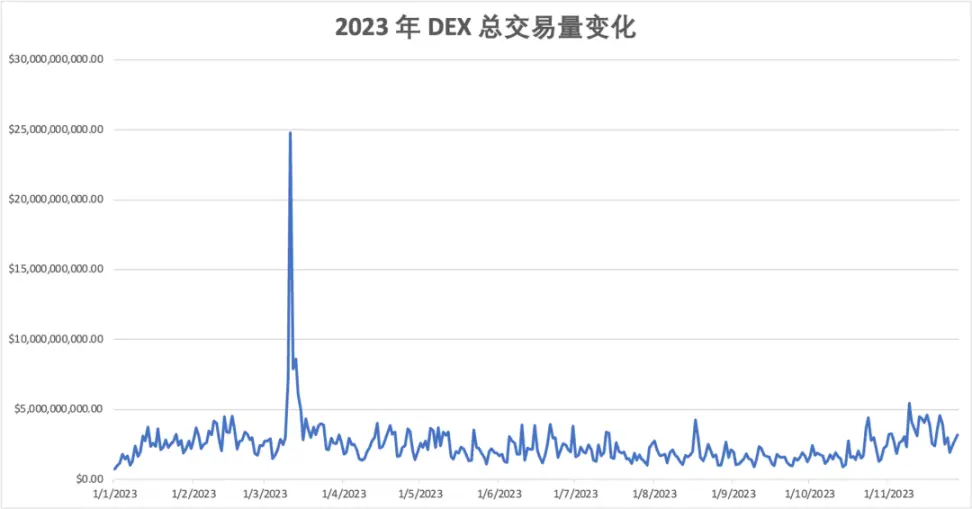
“The total DEX trading volume in 2023 will be at a high level at the beginning and end of the year, and will fluctuate at a low level during the rest of the time, showing a certain positive correlation with the market trend.”
Since October, due to the expected impact of ETF adoption, the total DEX trading volume has shown a relatively obvious rise and growth. Market volume is showing clear signs of recovery and is expected to maintain growth in 2024.
Judging from individual trends, Uniswap performed stably throughout the year and occupied a major share of the market. Other DEXs have performed well in event-driven events. For example, Pancakeswap launched V3 on the BNB chain and Ethereum chain in April, which improved fund utilization and reconstructed the fee results, resulting in significant short-term growth in the platform’s monthly trading volume and market share. .
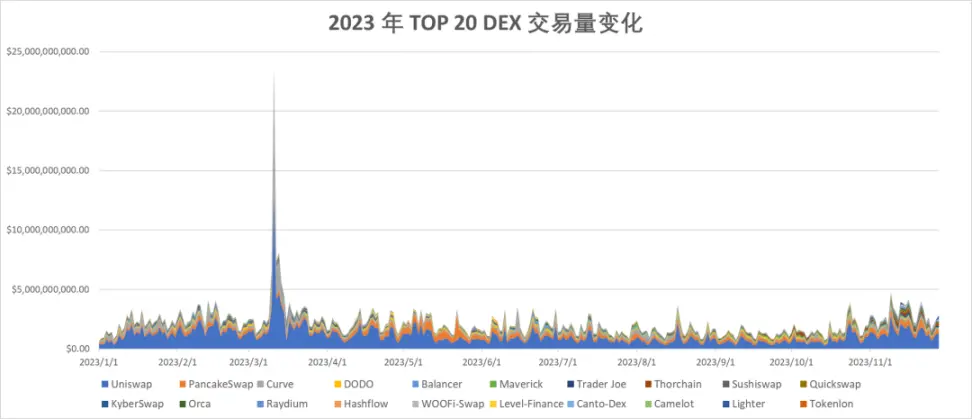
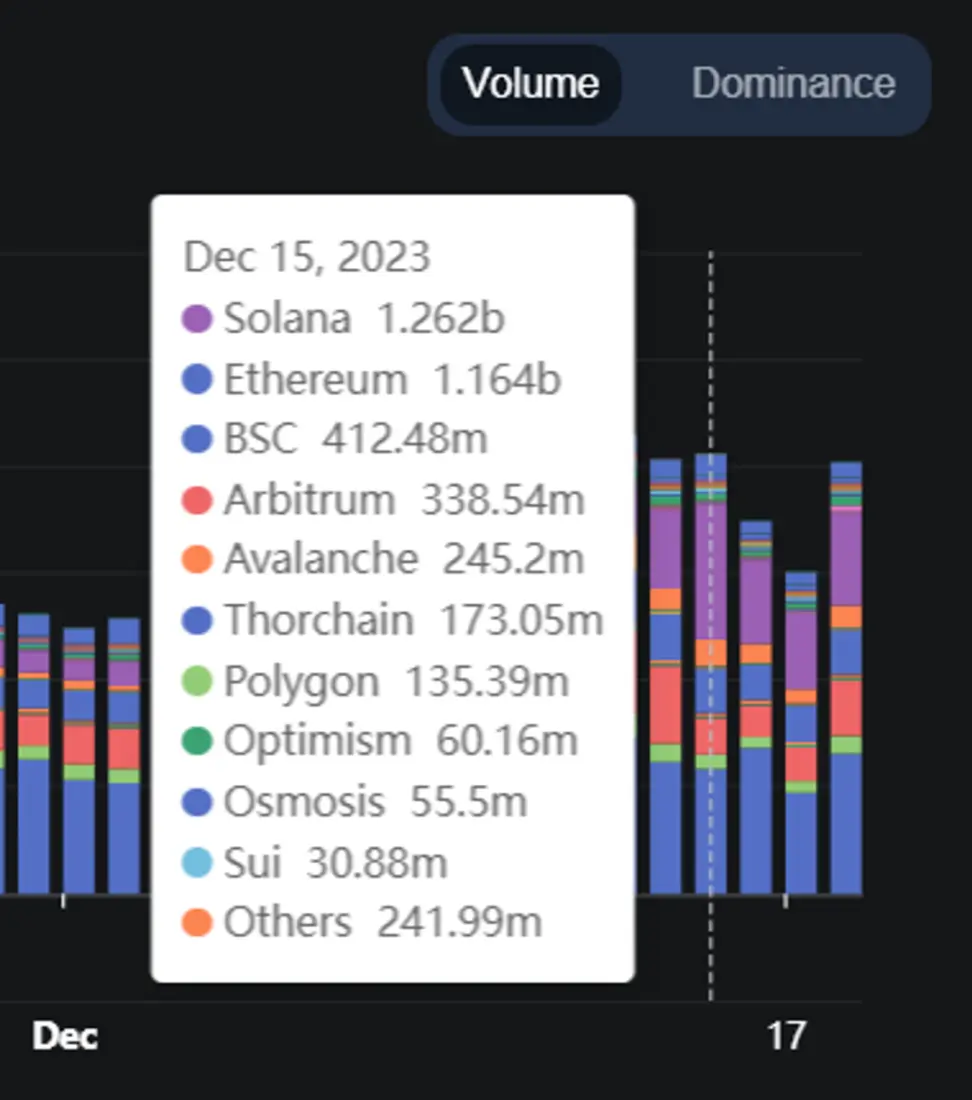
**Since the end of October, the market style has gradually changed: from Uniswap’s “one dominant player” to the structure of “one super, many strong”. **Affected by the active ecology of major public chains such as SOL and AVAX, the DEXs at the head of these chains have contributed a lot of transaction volume, even surpassing the traditional mainstream DEXs on the Ethereum chain (see Weekly Brief for details). According to data from Defillama, on December 15, the DEX trading volume on the Solana chain exceeded US$1.2 billion, surpassing the Ethereum chain that dominated the list for the first time.
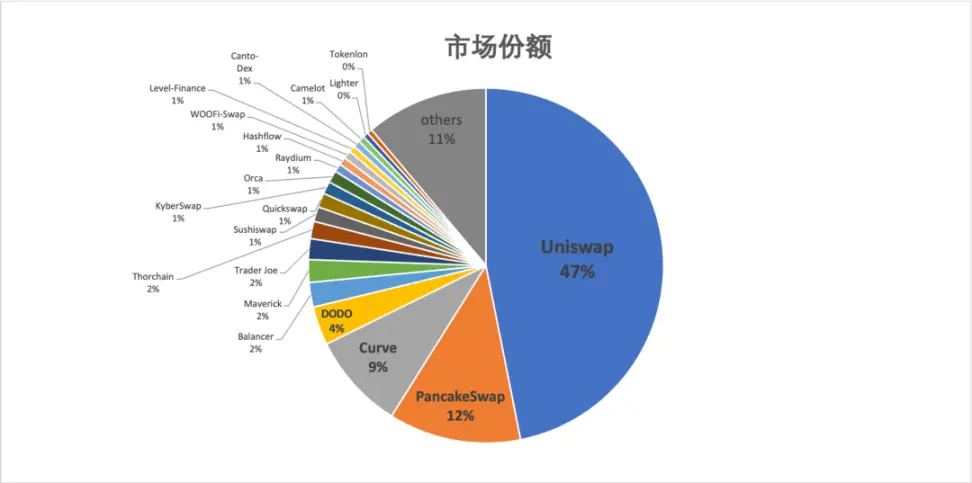
The ranking of the top 20 DEX market shares is shown in the pie chart. These DEXs account for approximately 89% of the total DEX market share. **Uniswap has maintained its dominant position as the top player this year with 47%, and the overall DEX maintains an “echelon stratification” pattern. **
Uniswap is in the first echelon, with rich products, wide reputation, and half of the market share. The second tier is Pancake, Curve, and DODO. These three DEXs account for 25% of the market share. The third tier includes Balancer, Maverick, TraderJoe, Thorchain, etc., and the remaining DEXs are divided into the fourth tier.
The second tier are all established exchanges with long operation times and mature and stable products. There is no shortage of newcomers in the third tier. Maverick has frequently reached the TOP5 in market share since its launch at the beginning of the year with its automatic balancing liquidity mechanism; Thorchain’s unique casting mechanism has also been rejuvenated with the support of the market recovery.
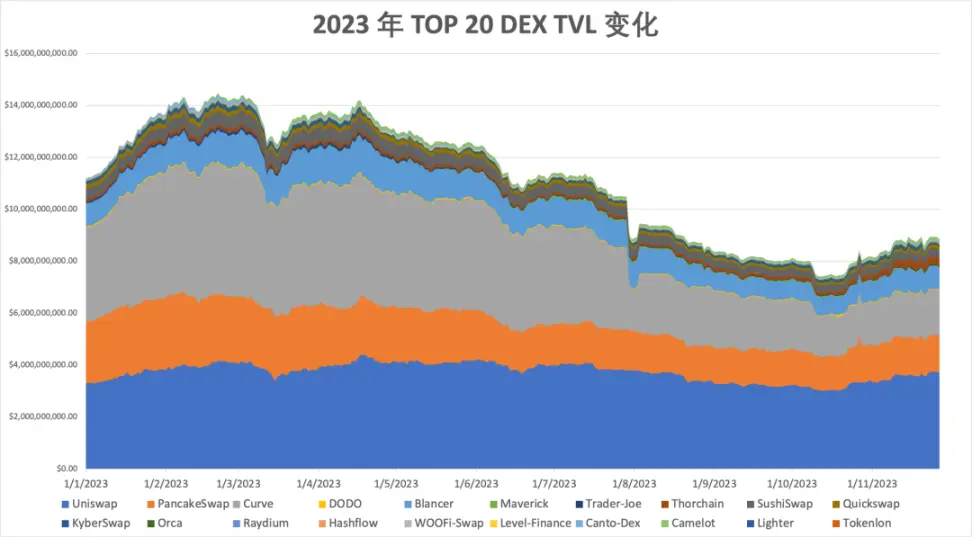
Represented by the TVL of the TOP 20, the TVL of the overall DEX has not fallen off a cliff similar to that in 2022. After showing a certain recovery at the beginning of the year, the decline of TVL has gradually slowed down, with an inflection point in October, and there is a possibility of reversal. The overall TVL scale is around $9B.
The vast majority of TVL is locked in the leading exchanges: Curve, Pancaksswap and Uniswap. Uniswap’s TVL performance is stable, while Curve’s TVL has shrunk significantly after the hacking incident, and is not much different from Pancakeswap’s TVL. Thorchain’s TVL performance is better.
II. DEX Capital Efficiency
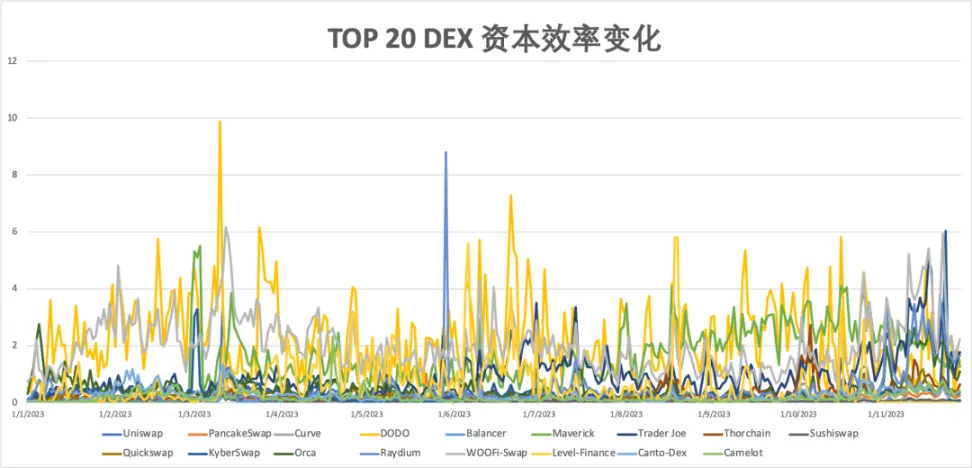
“Looking at DEX capital efficiency as a whole, the overall capital efficiency performance of the DEX track has recovered. Capital efficiency has gradually transitioned from local activity to global activity. Capital efficiency has improved, and the market has tended to pick up.”
From the perspective of capital efficiency of a single DEX, the yellow line DODO led the market throughout the year, and only the gray line Curve remained active at the beginning of the year. In the second half of the year, starting from August, the green line Maverick suddenly emerged and performed well during the market shock.
III. Multi-chain deployment of DEX
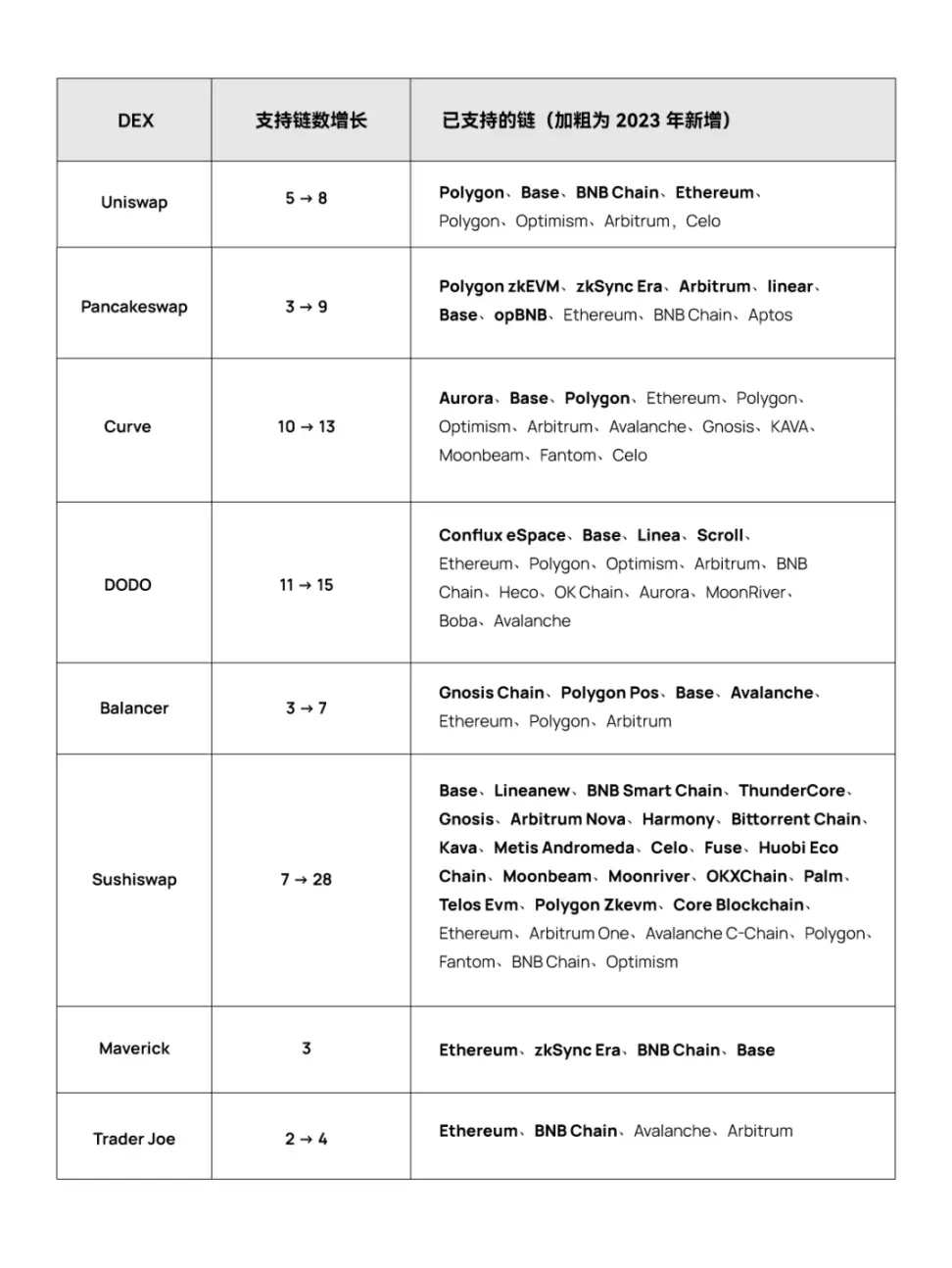
“Overall, major DEXs are actively expanding into EVM-compatible public chains and L2.”
Not only does this help diversify the product’s user base, it also reflects that DEXs are leveraging L2’s solutions to reduce fees and congestion associated with the Ethereum chain (4.5x transactions per second, 10x savings). Due to the different underlying architecture, the Solana chain has relatively high deployment costs and currently has less DEX support. Raydium and Orca are the main DEX platforms that undertake exchanges on the SOL chain.
However, the Solana chain has high throughput and low transaction costs, so we are seeing more cross-chain solutions emerging, allowing assets to be transferred more seamlessly between different blockchains. The cross-chain platform ThorChain provides the exchange of native assets and performed well in Q4. Cosmos’ IBC architecture enables interoperability between different blockchains and is also a potential solution for DEX multi-chain deployment.
We listed the multi-chain development of common exchanges on Ethereum among the top 20 market shares:
IV. DEX and CEX market share comparison
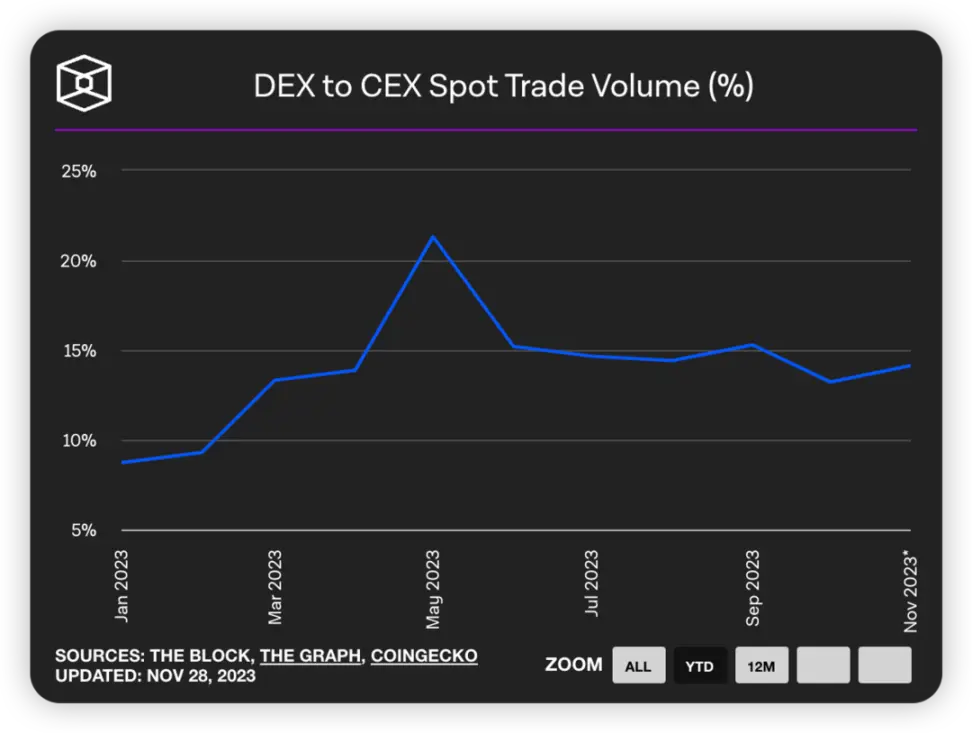
“The market share of DEX spot trading increased in the first two quarters, reaching a maximum of 21.31%, a record high.”
It then fell back and stabilized around 15%. This continues the trend of the previous year. The trust crisis caused by the FTX thunderstorm forced users to transfer their assets to DEX. At the same time, the user experience of DEX is also further optimized, such as Uniswap, Paraswap, etc., have successively launched their own wallet apps.
Most importantly, DEX (especially AMM) allows users to add liquidity to long-tail tokens (such as meme tokens, etc.) without permission, which bypasses regulatory issues or other factors and breaks away from the problems of listing on centralized exchanges. shackles. Through DEX, projects can channel liquidity immediately, allowing for greater market participation. According to data from CoinGecko, Uniswap has almost 20 times more coins listed than Coinbase and 3.4 times more coins than Binance.
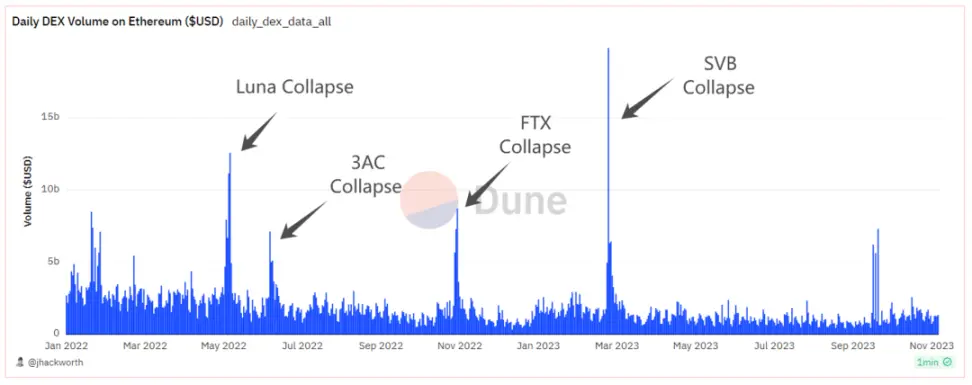
The most essential difference from CEX is that DEX repeats what it is programmed to do: provide permissionless transactions. During the days when centralized entities such as FTX, BlockFi, Celsius, and Voyager collapsed, DEX trading volumes surged, recording huge single-day trading volumes. The collapse of SVB (decoupling from USDC) resulted in the largest single-day trading volume on DEX being ~$19.7B.
V. DEX’s Mechanism Innovation
“MEV and large-scale adoption are still difficult problems facing DEX, and DEX has also launched many mechanism innovations this year.”
Representative ones include Uniswap Provide professional market makers with proactive market making to increase profits.
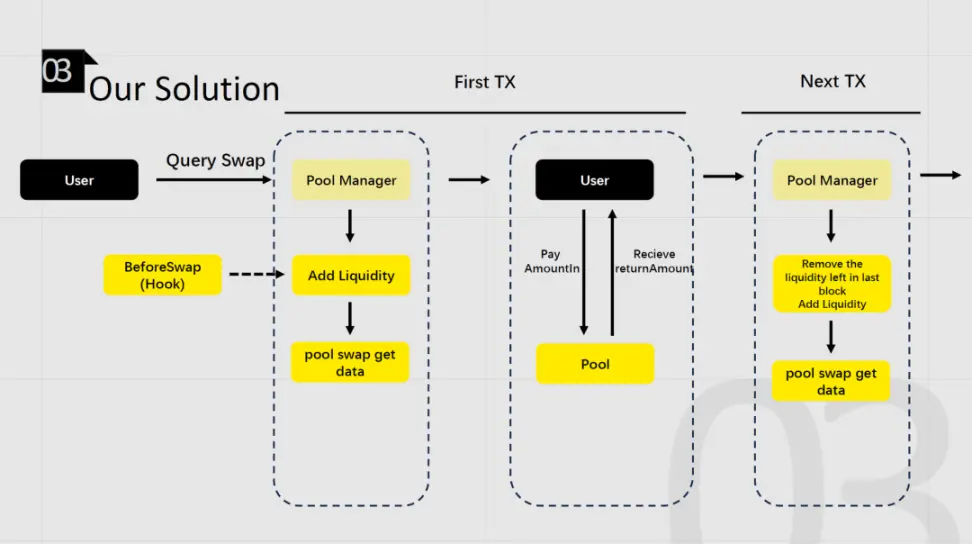
Hooks in Uniswap V4 allow customizing the functions of the pool, providing an innovative platform with more possibilities for DEX. Based on this, the Aggregator_Hook developed by the DODO team created a system that can accurately map the liquidity positions on each DEX platform to Uniswap V4 quotes, simplifying LP operations and enhancing user experience and market liquidity.
VI. DEX Big Event
product update
- Uniswap launches V4 and Uniswap X; Trader Joe launches AutoPool; Balancer is about to launch V3, etc.
- Uniswap front-end charges, charging 0.15% for transactions of certain tokens from October 17, causing huge controversy in the community
- Curve issued crvUSD stable currency, with a total amount of ~$150M
- Uniswap and Paraswap launch wallet apps
- DODO’s Hook aggregator Aggregator_Hook won the Best Hook Use Award at the Istanbul Hackathon
Governance Token
- DODO suspends DODO emissions in the vDODO pledge pool and reduces the vDODO exit fee to 0%.
- Pancakeswap launches veCake’s token governance model, enhancing $CAKE’s governance rights
- Sushiswap proposes a new SUSHI economic model for transaction fees, routing fees, staking fees, and partnerships
user experience
- DODO will launch intelligent slippage prediction function
- Matcha launches query history function
- Sushiswap automatically detects “tax tokens”
- Trader Joe’s Quick-Picks intelligently recommend popular coins
- Pancakeswap’s Dumb mode allows automatic closing of positions after expiration
hacker attack
- On July 30, Curve was attacked by hackers. Due to vulnerabilities in the underlying code version, TVL fell by a minimum of 51%, resulting in a loss of US$62 million. Currently, about 79% of the funds have been successfully recovered.
- On September 20th and November 18th, the front-ends of Balancer and Trader Joe were attacked successively, resulting in losses of ~$238K and ~$87k respectively.
- On November 23, KyberSwap suffered a hacker attack and lost approximately $4.8M worth of crypto assets.
Summary and Outlook
DEX is the core infrastructure in DeFi and a bridge for circulation between different tokens. LP assets are also the mainstay of the underlying assets in many Defi protocols. TVL and trading volume can reflect market activity, and capital efficiency reflects the response of different DEX mechanisms to capital utilization. This year may be an inflection point for the market.
DEX has withstood the test of the market by operating without permission and supervision. In response to the crisis and market pain points, each DEX has made colorful and unremitting efforts, innovating along the way. Despite this, DEX still faces challenges in its development, such as hacker attacks, MEV, large-scale applications… But there is always a lack of newcomers in the market, which makes people shine.
DEX is always developing and has never stopped. It is bound to achieve a decentralized experience of market making without trust and threshold.
**Why should your next exchange be CEX? **
References
\\*\\