


10,000 words to assess Bitcoin health: not perfect, but good enough
Original author: Lyn Alden
Original compilation: Luffy, Foresight News
When investing in Bitcoin as an asset, or investing in companies built on the Bitcoin network, we need metrics to assess the progress of investment themes and, in turn, the health of the Bitcoin network.
Bitcoin isn’t just a price on a chart, it’s an Open Source network with millions of users, thousands of developers, hundreds of companies, and multiple ecosystems built on top of it. Most Wall Street analysts and retail investors don’t actually use BitcoinWallet, don’t self-custody the asset, don’t send it to others or use it in various ecosystems, but doing so is very helpful for fundamental research.
Bitcoin means different things to different people. It enables portable savings, censorship-resistant global payments, and immutable data storage. If you’re an investor in high-quality stocks and bonds in the U.S. or Europe and haven’t considered the Bitcoin network from the perspective of middle-class savers in Nigeria, Vietnam, Argentina, Lebanon, Russia, or Turkey, you haven’t fundamentally analyzed the use cases for this asset.
On top of that, people assess the health of the network in a number of different ways. If Bitcoin doesn’t meet the results they want, they may conclude that Bitcoin is not performing well. On the other hand, if Bitcoin is exactly what they want, then they may think that Bitcoin is still doing well even though there are still a lot of frictions that need to be resolved.
I’ve spent a lot of time studying currency history in recent years and spent a lot of time in the startup/venture capital space around Bitcoin, working on the technical details of this protocol, so I consider some unique key metrics when assessing the health of the Bitcoin network. This article will go through them one by one and see how the Bitcoin network performs on each.
- Market Cap and Liquidity
- Convertibility
- Technical Security and Decentralization
- User experience
- Legal Acceptance and Worldwide Recognition
Market Cap and Liquidity
Some people say that the price doesn’t matter. They often say, “1 BTC = 1 BTC.” It’s not Bitcoin that Fluctuation, it’s the world that revolves around BitcoinFluctuation.
There is some truth to this. Bitcoin has a Maximum Supply of 21 million, created and distributed in a pre-programmed decreasing pattern. The Bitcoin network produces an average of one block every ten minutes according to an automatic difficulty retargeting mechanism, and it has been operating with significant consistency since its inception, with higher uptime than Fedwire. I don’t know what the supply of dollars will be next year, but I do know what the supply of Bitcoin will be and can directly audit its exact supply at any time.
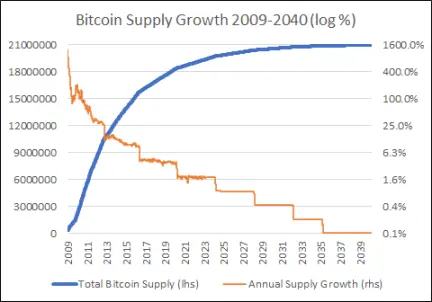
But the price is an important signal. It doesn’t mean much for a day, a week, or even a year, but it does for a time span of years. The Bitcoin network itself may be the heartbeat of clockwork order in a chaotic world, but price is still the measure by which it is adopted. Bitcoin is now competing with more than 160 different fiat currencies, gold, silver, and various other Crypto Assets in the global currency market. As a store of value, it also competes with non-monetary assets such as stocks and real estate or other things that we can have with limited resources.
It is not, as some proponents claim, that the price of the dollar revolves around BitcoinFluctuation. Bitcoin is a younger, more volatile, less liquidity, and smaller network than the US dollar, which is more Fluctuation than the US dollar. In some years, Bitcoin holders can buy more property, food, gold, copper, oil, S&P 500 stock, dollars, rupees, or anything else than the previous year. But in other years, they have much less to buy. The price of Bitcoin mainly Fluctuation on any given medium-term basis, and its Fluctuation affects the purchasing power of holders. Currently, the price of Bitcoin has risen dramatically, which means that Bitcoin holders can buy more than they did just a few years ago.
If the price of Bitcoin stagnates for a long time, we may need to think about why Bitcoin does not attract people. Doesn’t that provide a solution to their problem, and if it doesn’t, why?
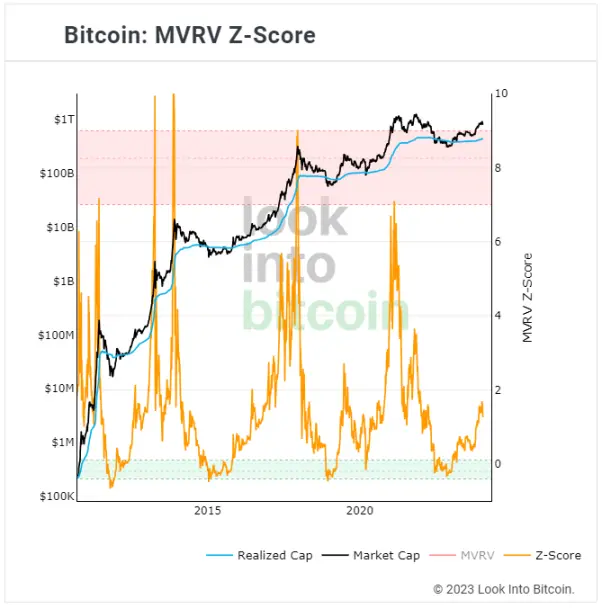
Fortunately, as you can see in the chart above, this is not the case. The price of Bitcoin continues to make history cycle after cycle. It is one of the best-performing assets in history. I would say that this trend has held up quite well, given the sharp tightening of central bank balance sheets and the sharp rise in real positive Intrerest rates over the past few years. Judging by on-chain metrics, historical correlation with the global Broad Money supply, and other factors, Bitcoin will continue its long-term path of adoption and growth.
Then there’s liquidity. What is the daily trading volume of the exchange?How much transaction value is sent on-chain?Money is the best-selling commodity, Liquidity is very important.
Bitcoin also ranks very well on this indicator, with billions or tens of billions of dollars in daily transactions against other currencies and assets, and it is on par with Apple (AAPL) stock in terms of daily trading liquidity. Unlike Apple, where the vast majority of trading volume is on the NASDAQ exchange, Bitcoin is traded on many exchanges around the world, including some peer-to-peer markets. The Bitcoin network also generates billions of dollars in daily on-chain transfers.
One way to think about liquidity is that liquidity creates more liquidity. For money, this is an important part of network effects.
When Bitcoin is traded in the thousands of dollars per day, a person cannot invest a million dollars without large price fluctuations, and he even has to spread the transactions over a period of several weeks. For them, this is not yet a market with enough liquidity.
When Bitcoin is traded in the millions of dollars per day, one cannot invest a billion dollars or even spread the transactions over several weeks.
Bitcoin now has billions of dollars in daily trading volume, and trillions of dollars of capital pools still can’t put a meaningful part of it, and liquidity is still not enough for them. If they start putting in a few hundred million dollars or billions of dollars a day, it’s enough to tilt supply and demand in the direction of buyers and push prices up significantly. Since its inception, the Bitcoin ecosystem has had to reach a certain level of liquidity to gain the attention of a larger pool of capital. It’s like upgrading.
So, when the price of Bitcoin exceeds $100,000, $200,000, who will buy it? Who is the entity that won’t buy Bitcoin before it’s so powerful? At $100,000 per Bitcoin, each sat is worth 0.1 cents.
Just as the price of 400 ounces of gold (Delivery Standard Gold Bar) is not important to most people, the price of each full Bitcoin is not important. What matters is overall network size, liquidity, and functionality. What matters is whether their share of the network is able to maintain or enhance their purchasing power in the long run.
Like any asset, the Bitcoin price is a function of supply and demand.
The supply is fixed, but at any given time, a portion of it may be in the hands of a weak hand, or it may be in the hands of a strong hand. During the Bull Market, many new investors bought excitedly, and some long-term holders cut their Holdings and sold to these new buyers. During Bear Market, many recent buyers sell at a loss, while the more determined ones rarely sell. Supply has shifted from a weak hand that wants to make a quick buck to a strong hand that won’t give up easily. The chart below shows the percentage of Bitcoin that hasn’t been transferred on-chain for more than a year, as well as the price of Bitcoin:
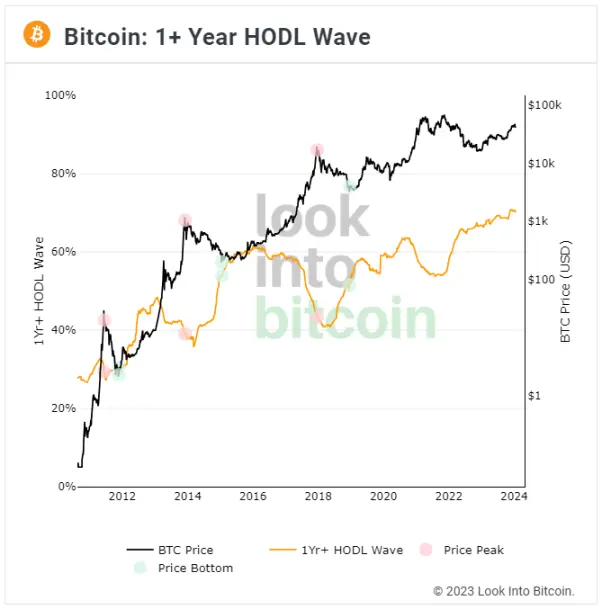
When Bitcoin’s supply is tight, it only takes a little new demand and new capital inflows to raise the price dramatically, because existing holders don’t create a huge supply-response function. In other words, even if the price rises sharply, it will not encourage a massive sell-off of more than 70% of Tokens that have been held for more than a year. But where does this demand come from?
In general, what I find to be most relevant to Bitcoin demand is the global Broad Money supply denominated in US dollars. The first part is the global money supply, which is a measure of global credit growth and central bank money printing. Second, the U.S. dollar denomination is important because the U.S. dollar is the global reserve currency and is therefore the primary unit of account for global trade, global contracts, and global debt. When the dollar strengthens, countries’ debt becomes stronger. When the dollar weakens, it softens countries’ debt. The dollar-denominated global Broad Money is like an important indicator of liquidity in the world. How quickly are fiat currency units created, and how strong is the US dollar relative to other currencies in the global currency market?
Look Into Bitcoin has a macro data suite, and as part of that, they show the Bitcoin price in relation to the global Broad Money rate of change, and I made a chart with it:
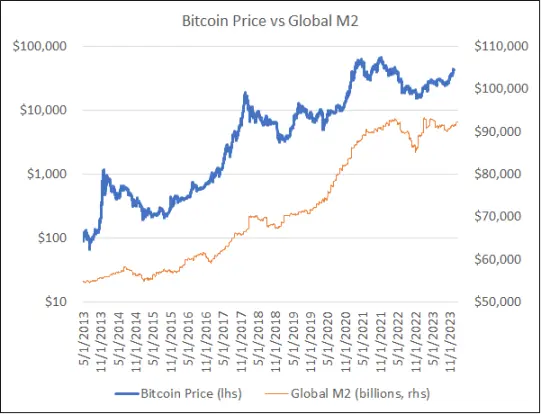
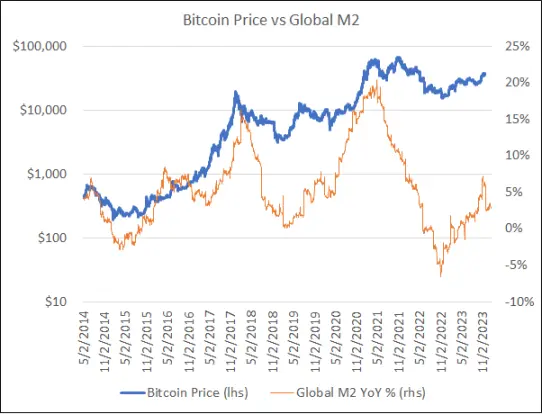
We compare Exchange Rates between two different currencies here. Bitcoin is smaller, but Bitcoin has grown stronger over time due to its continued supply rate Halving and the 21 million supply cap. The value of the US dollar is much larger and will go through periods of weakness and firmness, but most of the time, it is in periods of weakness and increasing supply, with periods of cyclical firmness being shorter. Both the fundamentals of Bitcoin and the fundamentals of the US dollar (global liquidity) affect the Exchange Rate between the two over time.
Therefore, when I evaluate the Market Cap and Liquidity of the Bitcoin network, I do so in terms of global Broad Money and other major assets over time. It doesn’t matter if it has big ups and downs, after all, it is from zero to an unknown future, and it comes with Fluctuation. Rising prices attract leverage, which eventually leads to a crash. If Bitcoin is to be widely adopted, it must constantly go through cycles and get rid of leverage and revolving collateral.
Bitcoin’s notoriously volatile Fluctuation is unlikely to diminish significantly unless it is more liquidity and wider holdings than it is now. There is no other way to address Bitcoin’s Fluctuation than more time, more adoption, more liquidity, more understanding, and a better user experience for wallets, exchanges, and other applications. The asset itself is only slowly changing, and the world’s perception of it, the process of increasing and removing leverage on top of it, goes through a cycle of mania and depression.
What would I be worried about? If global liquidity rises for a long time, but Bitcoin prices remain stagnant, or if global liquidity does, but Bitcoin fails to consistently make new highs over a multi-year time frame. Then, we will have to ask some tough questions about why the Bitcoin network has not been able to capture market share for a long time. But so far, by this indicator, it is quite healthy.
Convertibility
Bitcoin has undergone multiple narrative shifts over its 15-year lifespan, and interestingly, almost all of these shifts were discussed by Satoshi Nakamoto, Halfini and many others back in the Bitcoin Talk forum back in 2009 and 2010. Since then, the Bitcoin market has risen strongly around different use cases for the network.
It’s like the parable of the blind man touching the elephant. Three blind men are touching an elephant, one touching the tail, one touching the side, one touching the tusks. They are all arguing about what they touch, when in reality they are all touching different parts of the same object.
An important topic that recurs in the Bitcoin ecosystem is whether it is a payment method or a way to save. The answer, of course, is both, but sometimes the emphasis changes. Satoshi Nakamoto’s original white paper was about peer-to-peer electronic cash, although in his earlier posts he also talked about Central Bank currency depreciation and how Bitcoin resists this depreciation due to its fixed supply (i.e., as a means of saving). After all, money does serve multiple purposes.
Am I contradicting myself? Okay, then I’m contradicting myself, I’m big-hearted and all-encompassing.
– Walt Whitman
Paying and saving are both important, and the two go hand in hand. Since Bitcoin is primarily designed as a low-throughput network (maximizing decentralization), it primarily acts as a settlement network. Actual day-to-day consumption-shaped transactions need to be done at higher levels of the network, such as Layer 2.
- The ability of Bitcoin to be sent from any internet user to any other internet user in the world is an important part of making it work. It provides holders with the ability to make permissionless, censorship-resistant payments. In fact, its first use case was more than a decade ago, when WikiLeaks was unsupported by major payment platforms. WikiLeaks then turned to Bitcoin to continue receiving donations. It has been exploited by democracy advocates and human rights advocates of dictatorships, bypassing bank freezes, among other things. People use it to evade unjust capital controls that seek to permanently lock them in the rapidly depreciating currencies of developing countries.
- Similarly, Bitcoin’s 21 million supply cap and immutability make its ruleset credible (including the supply cap), which is why Bitcoin is attractive. The supply of most currencies increases indefinitely over time, and even the supply of gold increases by an average of about 1.5% per year, but Bitcoin does not. If people don’t want to hold it, but just convert back and forth from fiat to Bitcoin for a short settlement/payment, then this will add all sorts of friction, costs, and external scrutiny to the network. When you do want to hold Bitcoin for a long time, paying with Bitcoin or receiving Bitcoin payments is the best way to go.
Therefore, it is the combination of payment and saving that is important. The key to thinking about this is optionality. If you hold Bitcoin for the long term, you can choose to take this wealth anywhere in the world, or make permissionless, censorship-resistant payments to anyone in the world connected to the internet if you want or need to. Your money will not be unilaterally frozen or devalued by any bank or government with a single stroke of the pen. It’s not limited to a narrow jurisdiction, it’s global. These features may not be important to many Americans, but they mean a lot to many people around the world.
Many countries impose Capital Gains Tax on Bitcoin (and most other assets), which means that if people sell or spend it, they must be taxed on its cost basis, and their accounting treatment must be tracked. This is an important part of the maintenance of monetary monopolies by countries. With the widespread adoption of Bitcoin and the fact that some countries have made it legal tender, this may disappear. But this taxation is now a reality in most places, which makes the use of Bitcoin consumption drop attractive compared to fiat currencies in many cases. It doesn’t make me want to spend too much money yet. But then again, it’s rare for my jurisdiction to have payment friction with the fiat currency system.
Gresham’s Law states that in the case of a fixed Exchange Rate (or, I think, some other frictions, such as Capital Gains Tax), people will spend weaker currencies first and hoard stronger currencies. For example, in Egypt, if someone has dollars and Egyptian pounds, they spend Egyptian pounds and keep them as savings. Or, if I have taxes on every Bitcoin transaction and my USD transactions don’t, I usually spend the dollars and keep my Bitcoin. Egyptians can spend dollars, and I can spend Bitcoin in many places, but we all choose not to.
Thiers’ Law states that when a currency becomes extremely weak beyond a certain tipping point, merchants will no longer accept it and will instead demand payment in a stronger currency. At that point, Gresham’s law will be overturned, and people will have to spend more money. When a currency completely collapses, those who have been saving in dollars in these countries tend to start spending dollars, which even replace weaker currencies in the medium of exchange.
In most economic environments, it’s not just merchants who sell goods and services that matter, money brokers are also important. In Egypt or many developing countries, businesses like restaurants may not accept US dollars, even though they are a precious item that can appreciate in value in the country. Sometimes you’ll need to convert to your local currency before you can spend at official merchants, and less formal merchants are often more likely to accept premium currency payments.
Let’s say I bring a stack of physical dollars, a few South African Kruger coins, or some Bitcoin to a certain country, but I don’t bring a Visa card. How can I get local goods and services? I can find a merchant who accepts these currencies directly, or I can find a broker who can exchange this strong money for local currency at a fair local price. For the latter method, like I’m entering a playground or a casino, I may need to convert the real global currency to the monopoly currency of the place, and then back to the real global currency when I leave. It sounds ironic, but it’s just the way it is.
In other words, what we need to know is the saleability or convertibility of a certain currency, not just how many merchants directly accept it or how many merchant transactions a certain currency completes. To give a clear example, the number of people paying directly in gold around the world is extremely low, but the liquidity and convertibility of gold is high. You can easily find buyers to buy recognizable gold coins almost anywhere at a fair market price. As a result, gold provides holders with quite a bit of options. Bitcoin is similar in this regard, but more portable on a global scale.
Most fiat currencies have extremely high liquidity and marketability in the country, and are accepted by almost all merchants. However, with the exception of a few fiat currencies, all fiat currencies are not marketable and convertible abroad. In this sense, they are like arcade game Tokens or casino chips. For example, my Egyptian pound and Norwegian krone are almost useless in New Jersey, even if you find a place where you can easily exchange them:
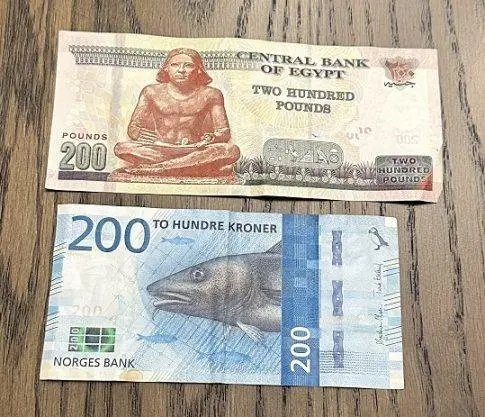
Egyptian and Norwegian banknotes
To roughly quantify:
- Physical U.S. dollars have 10/10 convertibility in the United States, 7/10 convertibility in some countries, and 5/10 convertibility in others. There is a range, but in general, it is usually the best-selling currency in the world at the moment. Sometimes you can spend it outright, sometimes you have to redeem it first, but there tends to be plenty of liquidity either way.
- Most physical currencies also have 10/10 convertibility in their home country, but only 1/10 or 2/10 in other places. When they are outside of their jurisdiction, it takes quite a while and may require a high discount rate to find someone willing to exchange with. It’s like arcade game Token.
- Gold has 6/10 convertibility almost everywhere, which makes it one of the bearer assets as convertible as the U.S. dollar. You can’t use it as easily as a country’s local fiat currency, and overall it has a small amount of spending, but in almost any country, you can easily exchange it for liquid value. Gold is a globally recognized form of liquidity and fungible value.
- Bitcoin has a convertibility of about 6/10 in many urban centers around the world, in the sense that it resembles gold, but in many rural areas its convertibility drops to around 2/10, similar to fiat currencies outside the boundaries of monopolies. But it’s on a strong rise and has made so much progress from nothing in just 15 years. In addition, in most countries, it can also be converted online into mobile top-ups, digital gift cards that can be spent locally, and other forms of value, so the total number of offline and online conversion methods is significant for those who carry Bitcoin.
In my opinion, the correct question is “If I carry Bitcoin with me, can I easily spend or cash out its value?” In urban centers in many countries, such as developing countries like South Africa, Costa Rica, Argentina or Nigeria, or basically any developed country, the answer is a fairly resounding “yes”. In other countries, such as Egypt, this has not really materialized.
By now, Bitcoin will certainly become more convertible in any given period of years.
The rise of Bitcoin hubs
In my opinion, the most promising trend is the growth of many small Bitcoin communities around the world. El Zonte in El Salvador is one of them, which has caught the attention of the country’s president. But there are also other community booms, such as Bitcoin Jungle in Costa Rica, Bitcoin Lake in Guatemala, Bitcoin Ekasi in South Africa, Lugano in Switzerland, F.R.E.E. in Madeira, and many others that have become dense areas for Bitcoin use and acceptance. Bitcoin marketability and convertibility are quite high in these places. Bitcoin hubs are popping up.
In addition, Ghana hosted the African Bitcoin Conference hosted by a woman named Farida Nabourema for the second year in a row. She is an advocate for democracy in exile from Togo, well aware that financial repression is a tool of authoritarianism, and a critic of France’s current neocolonial currency in a dozen African countries. In addition, Indonesia now hosts regular Bitcoin conferences, moderated by a woman named Dea Rezkitha. There are Bitcoin conferences all over the world.
There are also smaller organizations, such as Bitcoin Commons in Austin, Texas, Bitcoin Park in Nashville, Pubkey in New York, and Real Bedford in the United Kingdom, which are all local Bitcoin hubs. In a particular city, it has become increasingly common to have a dedicated Bitcoin community or regular gatherings. BitcoinerEvents.com and other websites can help you find them, and they can also be used as channels to redeem Bitcoin.
There are also apps that allow you to find Bitcoin merchants in your area. For example, BTCMap.org lets you find businesses around the world that accept Bitcoin. Both the BTC Prague 2023 conference and the Africa Bitcoin Conference 2023 are present in the Fedi event app. In addition to acting as a BitcoinWallet, the app provides a timeline of all the major events at the conference, including an interactive map showing the locations of merchants in the area that accept Bitcoin payments, such as an AI assistant that uses BitcoinLighting Network micropayments. (Disclosure, I’m an investor in Fedi and invested through Ego Death Capital.) )
Technical Security and Decentralization
My friend and colleague Jeff Booth often uses the phrase “as long as Bitcoin remains secure and Decentralization” before describing his outlook for the future of Bitcoin and its macroeconomic implications. In other words, it’s an if/else view based on the idea that the network continues to operate the way it has been for the past 15 years and that the features that make the Bitcoin network valuable will continue to exist in the future.
Bitcoin isn’t magical. It is a distributed network protocol. To continue to play its value, it must function through opposition and attack, and it must be the best and most liquidity way. The concept of Bitcoin is not enough to make a real impact on anything; what matters is the reality of Bitcoin. If Bitcoin suffers a catastrophic Hacker attack or becomes centralized (permissioned/censored required), then it will lose its current use case and its value will partially or completely disappear.
In addition to network effects and associated liquidity, the focus on security and Decentralization is largely what sets Bitcoin apart from other Crypto Assets networks. It sacrifices almost every other category of performance: speed, throughput, and Programmability in order to be as simple, streamlined, secure, robust, and Decentralization as possible. It is designed to maximize these features. All the additional complexity must be built on the network layer on top of Bitcoin, not embedded in the base layer, because embedding these features into the base layer sacrifices the performance of key attributes such as security and decentralization.
Therefore, it is important to monitor Bitcoin’s security and level of decentralization when building and maintaining long-term themes about the value and utility of the network.
Security Analytics
Bitcoin has a very strong security record as an emerging Open Source technology, but it is not flawless. As I wrote in Broken Money, here is a list of some of the more notable technical issues it has faced so far:
In 2010, when Bitcoin was still brand new and had almost no market price, the Node client had an Inflation error, which Satoshi Nakamoto fixed with a soft fork.
In 2013, due to an inadvertent BitcoinNode client update, the previous (and widely used) Node client was unexpectedly incompatible, resulting in an unexpected chain split. Within a few hours, the developer analyzed the problem and told the Node Operator to return to the previous Node client, resolving the chain split issue. For more than a decade since then, the Bitcoin network has maintained perfect 100% uptime. During this time, even Fedwire experienced outages that failed to achieve 100% uptime.
In 2018, another Inflation vulnerability was accidentally added to the BitcoinNode client. However, this issue was identified and carefully fixed by the developers before it was exploited, so it did not cause problems in practice.
In 2023, people are starting to use SegWit and Taproot Soft Fork upgrades in ways developers didn’t expect, including inserting images into the signature section of the BitcoinBlockchain. While this is not a bug in itself, it shows the risk that some aspects of the code may be used in unexpected ways, which means that you need to be conservative on an ongoing basis when performing upgrades in the future.
Bitcoin faces the “2038 problem” that many computer systems have. By 2038, for many computer systems, 32-bit integers for Unix Timestamps will run out of seconds, resulting in errors. However, because Bitcoin uses unsigned integers, it won’t run out until 2106. You can work around this by updating the time to a 64-bit integer or by putting the block height into a 32-bit integer. But as I understand it, this may require a Hard Fork, which means backwards incompatible upgrades. This shouldn’t be difficult in practice, as it’s obviously necessary and can be done before the problem arises (or even years or decades), but it can open a window of vulnerability. One possible approach is to release a backwards-compatible update first, but activate when the integer runs out, thus resolving the issue.
–Broken Money, Chapter 26
Bitcoin can indeed recover from technical issues. The basic solution is for the Node Operator on the Decentralization Network to Rollback to an update before the error existed and reject the new update that caused the problem. However, we have to imagine the worst-case scenario. If a technical issue goes unnoticed for years and becomes part of a broad network of Nodes, and is then discovered and exploited, then this is a much more serious problem, a catastrophic one. It’s not impossible to recover yet, but it’s going to be a serious blow.
Since Bitcoin’s code stock lasts for years or even decades, it becomes stronger and benefits from the Lindy effect.

Overall, the incidence of major errors has decreased over time, and the fact that the network has maintained 100% uptime since 2013 is remarkable.
Decentralization Analytics
We can use Node Distribution and Mining Distribution as key variables to measure Decentralization. A widely distributed network of Nodes makes it very difficult to change network rules because each Node enforces rules for its users. Similarly, the widespread distribution of mining networks makes transaction review more difficult to achieve.
Bitnodes identifies more than 16, 000 accessible BitcoinNode. Bitcoin core developer Luke Dashjr estimates that the total number of final Nodes will exceed 60, 000 considering privately running nodes.
In comparison, Ethernodes identifies about 6, 000 EthereumNode, about half of which are hosted by cloud operators rather than running on-premises. And since EthereumNode uses too much bandwidth for private runs, this may be close to the actual number.
Therefore, Bitcoin is quite powerful in terms of node distribution.
BitcoinMiner can’t change the core rules of the protocol, but they can decide which transactions go into the network or don’t. Therefore, Miner centralization increases the likelihood of transaction censorship.
The largest publicly traded miner, Marathon Digital Holdings (MARA), has less than 5% of its network Computing Power. There are several other private Miners who are about the same size. There are also various public and private miners with 1-2%, as well as many miners with less computing power. In other words, Mining is indeed quite Decentralization; even the largest participants can only allocate very few network resources.
The U.S. has been the largest Mining jurisdiction since China banned BitcoinMining in 2021, but its MiningComputing Power is estimated to be less than half of the total Computing Power. Ironically, China remains the second-largest mining jurisdiction because even with their high levels of authoritarianism, the mining industry is difficult to eliminate. Other energy-rich countries, such as Canada and Russia, have large mining infrastructures, and dozens of countries also have small-scale mining operations.
Mining companies typically allocate their computing power to mining pools. Mining pools are currently quite centralized, with the two mining pools collectively controlling about half of the transaction processing, while the top ten mining pools control almost all the transaction processing. I think here’s something that needs to be improved:
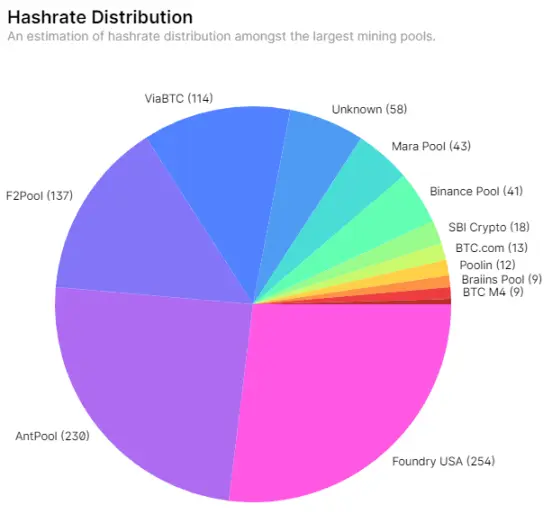
Source: Blockchain.com
However, there are some important caveats. First, mining pools don’t host mining rigs, which is a key difference. If there is a problem with one mining pool, miners can easily switch to another mining pool. So, while several mining pools can collectively carry out a short-lived 51% attack on the network, their ability to sustain such attacks can be very weak. Second, Stratum V2 has recently launched, which gives miners more control over the block building process than just letting the mining pool do all the work.
The physical MiningSupply Chain is also quite concentrated. TSMC and a number of other foundries around the world are key bottlenecks in the production of most types of chips, including the specialized chips used in BitcoinMiner. In fact, I would even go so far as to say that mining pool centralization is an overestimated risk, while semiconductor foundry centralization is an underestimated risk.
Overall, the ownership of active Mining Rig is very fragmented, but the fact that some countries have a lot of Miner, some Mining Pool have a lot of Mining power against them, and MiningSupply Chain have some centralized aspects, these factors weaken the Decentralization of the Mining industry. I think Mining is an area that could benefit from more development and attention, and luckily the most important variables (ownership and physical distribution of mining rigs) are very Decentralization.
User experience
If Bitcoin is technically difficult to use, then it is limited to programmers, engineers, theorists, and advanced users who are willing to take the time to learn. On the other hand, if it is almost effortless to use, it can be more easily disseminated to the average person.
When I look back at Crypto Assets exchanges from 2013-2015, they look very sketchy. Nowadays, buying Bitcoin at reputable exchanges and brokers is usually easier and has a simple interface. In the early days, there were no dedicated Bitcoin hardware wallets; people often had to figure out how to manage secret keys on their own computers. Most of the “lost Bitcoins” you hear in the media are from early days, when Bitcoin wasn’t worth enough to keep an eye on and secret keys were harder to manage.
Over the past decade, hardware Wallets have become more common and easier to use. The software Wallet and interface have also been greatly improved.
One of my favorite combinations lately is Nunchuk+Tapsigner, which works well for small amounts of Bitcoin. Tapsigner is a $30 NFC Wallet that keeps Private Keys offline for a low price, while Nunchuk is a mobile and desktop Wallet that works with a variety of hardware Wallet types, including Tapsigner for medium amounts of Bitcoin or a full-featured hardware Wallet for larger amounts of Bitcoin.
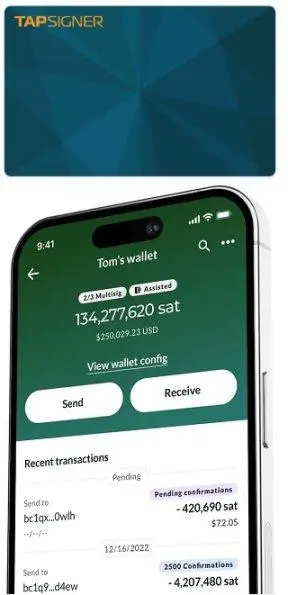
A few decades ago, learning to use a checkbook was an important skill. Nowadays, many people get Bitcoin / crypto Wallet before getting a bank account. Managing Public Key/Private Key pairs may become a more routine part of life, both for managing funds and for signing to distinguish real social content from fake content. It’s easy to learn, and a lot of people will grow with the technology around them.
According to Statista, the number of Bitcoin ATM worldwide also increased by more than 100 times from 2015 to 2022:
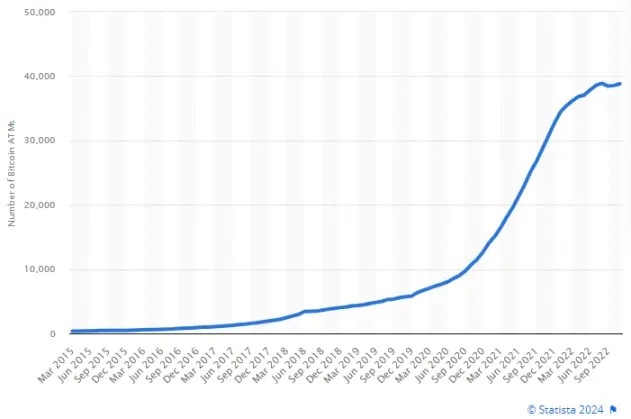
In addition to ATMs, there has also been an increase in coupon purchase methods, which I think is one of the reasons why the number of ATMs has started to flatten recently. Azteco was founded in 2019 and raised $6 million in seed capital in 2023 in a funding round led by Jack Dorsey. Azteco vouchers can be purchased for cash on hundreds of thousands of retail and online platforms, especially in developing countries, and then exchanged for Bitcoin.
The Lighting Network has evolved over the past six years, reaching a very respectable level of liquidity by the end of 2020.
Websites such as Stacker News and communication protocols such as Nostr also integrate the Lighting Network, ultimately merging value delivery with information delivery. Novel browser add-ons like Alby make it easy to use the Lighting Network on multiple websites with a single wallet and can replace usernames/passwords as a signature method for many scenarios.
Overall, the use of the Bitcoin network has become easier and more intuitive over time, and from what I’ve seen as a venture capitalist in the space, this will continue to be the case for years to come.
Legal Acceptance and Global Recognition
“But what if the government bans it?” Since the birth of Bitcoin, it has been something that people have generally opposed. After all, the government does have the power to monopolize state-issued currency and control capital.
However, in answering this question, we need to ask, “Which governments?” There are about 200 of them. Game theory is such that if one country bans it, another country can get new business by inviting people to build together. El Salvador now even recognizes Bitcoin as legal tender, and a number of other countries are using funds from their sovereign wealth funds to BitcoinMining.
And, there are some things that are really hard to stop. Back in the early 90s of the 20th century, Phil Zimmerman created Pretty Good Privacy (PGP), an open source encryption program. It allows people to send private messages to each other over the internet, which most governments don’t like. After his Open Source code flowed outside the United States, the U.S. federal government opened a criminal investigation into Zimmerman for “unauthorized arms exports.”
In response, Zimmerman released his full Open Source code in a book, protected by the First Amendment. After all, it’s just a collection of words and numbers that he chooses to express to others. Some, including Adam Back (creator of Hashcash, which eventually used as a PoW-proof-of-work mechanism in Bitcoin) have even started printing various cryptographic codes on T-shirts with warnings that “the shirt is classified as an arms and therefore illegal to export or display to foreigners.” 」
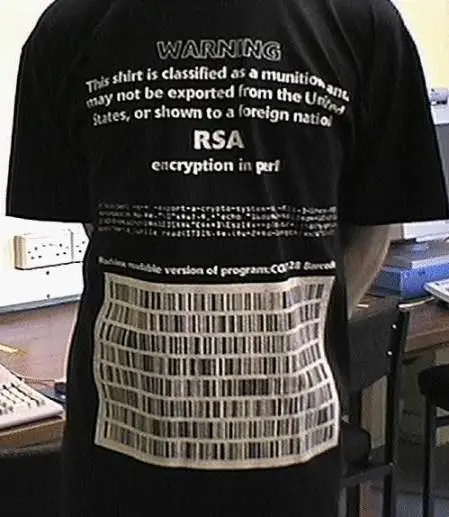
The U.S. federal government did drop the criminal investigation into Zimmerman and made changes to crypto regulations. Crypto becomes a key part of e-commerce because online payments require secure encryption, so much of the economic value could be delayed or shifted to other countries if the U.S. federal government tries to overstep its authority.
In other words, these types of protests have been successful and have used the rule of law to oppose the government’s ultra vires, also pointing out that it is absurd and infeasible to try to limit this concise and easy-to-spread message. Open source code is just information, and information is hard to suppress.
Similarly, Bitcoin is free and open source code, which makes it very difficult to eliminate. Even restricting the hardware aspect is difficult, China banned BitcoinMining in 2021, but China is still the second largest Mining jurisdiction, and it is obviously not easy to ban it. The software side is more sticky than that.
Many countries have been capricious in banning Bitcoin or have fallen into their own rule of law and division of power. In relatively free countries, government is not monolithic. Some government officials or representatives prefer Bitcoin, while others don’t.
In 2018, the Central Bank of India banned banks from participating in Crypto Assets related businesses and lobbied the government to ban the use of Crypto Assets altogether. But in 2020, India’s Supreme Court ruled against the case, restoring the private sector’s right to use the technology for innovation.
At the beginning of 2021, amid a decade-long double-digit inflation in the national currency, the Central Bank of Nigeria banned banks from interacting with Crypto Assets, although they did not try to make it illegal among the public because it was really difficult to implement. Instead, they launched the eNaira central bank Digital Money and restricted physical cash with stricter withdrawal limits in an attempt to bring people into their centralized digital payment system. During the ban, Chainaanalysis assessed that Nigeria had the second-highest Crypto Assets adoption rate in the world (mainly Stable Coins and Bitcoin), and in particular had the highest peer-to-peer trading volume in the world, which is how they bypassed the banking blockade. At the end of 2023, after imposing a ban that had been ineffective for nearly three years, the Central Bank of Nigeria reversed its decision and allowed banks to interact with Crypto Assets in compliance with compliance.
In 2022, in order to combat triple-digit inflation, the Argentine public demand for Crypto Assets is strong, and some major banks are stepping up their efforts to offer Crypto Assets to customers, but the Argentine government prohibits banks from providing such services to customers. They cite typical causes of Fluctuation, cybersecurity, and Money Laundering, but are actually aimed at slowing the exodus of national currencies. Then in 2023, they went a step further and also banned fintech payment apps from offering digital assets to their customers. But this began to reverse after the election of Javier Milei, who supported Bitcoin and supported the market in deciding what it wanted to use as a currency. During Milei’s campaign, economist Diani Mondino (now Argentina’s foreign minister) wrote that "Argentina will soon become a Bitcoin paradise. 」
U.S. SEC have been cracking down on BitcoinSpot ETFs for years. There is nothing wrong with SpotBitcoin ETFs in other countries, the Commodity Futures Trading Commission allows Bitcoin futures trading, and the United States SEC allows futures-based ETFs. The SEC even allows the launch of leveraged futures Bitcoin ETFs. But they have repeatedly blocked all spot ETFs, which is the simplest type and what the market wants. In 2023, the Court of Appeals for the Washington, D.C. Circuit found that the SEC’s practice of allowing Bitcoin futures ETFs over spot ETFs was “arbitrary and capricious” rather than based on sound and coherent arguments. By early 2024, multiple SpotBitcoin ETFs will begin trading.
There are about 160 currencies in the world, and there is a kind of “financial brainstorm” around them. They can control how much physical currency, such as cash and gold, passes through the port of entry and is severely restricted, they can control which currencies banks use to operate, which domestic and foreign bank wire transfers can be made, and what monetary accounts can be made to customers.
Even if developing market jurisdictions do allow access to USD accounts, they can be dangerous for holders. They are partial reserves and are not FDIC insured by the U.S. government and the U.S. central bank. In other words, the dollar deposits of foreign banks in developing countries are essentially junk-grade and uninsured leveraged bond funds. In times of currency shortage, U.S. dollar accounts can be forcibly converted to local currency at a fake Exchange Rate or blocked from withdrawing. If someone holds U.S. dollars in a domestic bank account in a country where malign Inflation occurred, they are unlikely to get back most or any of the U.S. dollars.
These 160 different fiat currencies can be a real problem for a lot of people. There are more than 30 currencies in Latin America and more than 40 in Africa. There are trade frictions at all these financial borders, and all these financial boundaries keep people partially locked in a rapidly depreciating monetary unit.
In other words, if I want to pay a graphic designer from a developing country using a variety of traditional payment methods, and they want to receive dollars instead of a local currency that is rapidly depreciating, their government and banking systems can block the transfer and have them receive the local currency represented in multiple ways. They can also set an artificial Exchange Rate. Finance is tightly controlled:
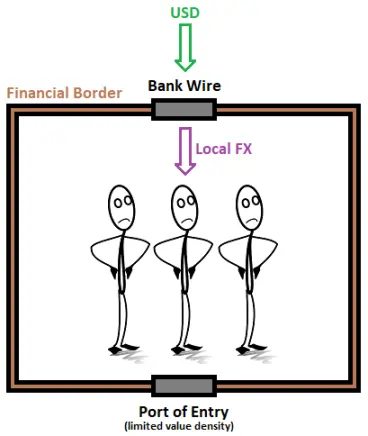
But if the designer chooses to pay in Bitcoin or USD Stable Coin, I can send them the QR code via video call, or via direct message or email, and it will spread through their banking system. For legal reasons, I wouldn’t send it to a sanctioned country (which is too risky for me), but if they’re in a country that legally allows Americans to send money, I’d be happy to do so, the main friction is on their side, and they represent the vast majority of countries.
In addition, as long as they have a private key, someone can carry an unlimited amount of Bitcoin and Stable Coin around the world. They can write it in their luggage, store it on their device, remember the twelve words that represent the secret key, or temporarily paste it in a password-protected encrypted cloud file, bringing infinite density of value through any entrance.
I saw a sign at the airport that said “No cash over $10, 000” and I snickered because they had no way of knowing who in line had $10 million or any other value in Bitcoin or Stable Coin.
With this technology, the 160 financial boundaries between us are becoming more and more loose. Trying to wipe out Bitcoin or Stable Coin or something like that is like trying to build a wall of sand to stop the tide. The ability to transfer money between banks, between any internet-connected parties, opens up a global competition between currencies.
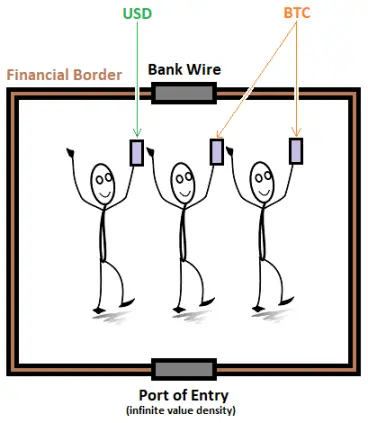
That’s a good thing for most people. This is bad for those who seek rents from the top down, constantly dilute people’s savings and wages, funnel those values to themselves and their cronies, and finance themselves by relying on confusion rather than transparency. Capital naturally flows where there are good legal protections and the rule of law, and technology has made this process faster and smoother, and has made it accessible to the working and middle classes, not just the rich.
If governments try to ban Bitcoin, holding and using Bitcoin puts them in an awkward position, especially those that ostensibly rule the law. They had to argue that it was a bad thing to have a currency that could not be devalued, that people could hold for themselves and send to others. In other words, they must prove that decentralization spreadsheets pose a threat to national security, and such dangerous things must be banned under the threat of incarceration.
Conversely, the biggest legal challenges facing the Bitcoin network in the future are likely to come from the privacy space and from major governments such as the United States. The government really doesn’t want people to have any form of financial privacy, especially on a large scale. For most of history, financial privacy has been the default, but in recent decades, things have become increasingly different.
Their reasoning is that in order to prevent the 1% of bad people from doing terrorist financing or human trafficking or other bad things, 100% must give up their right to financial privacy and let the government monitor transactions between all parties. In addition, the government has derived most of its revenue from income tax, whose enforcement relies on ubiquitous monitoring of all payment flows. But of course, such a thing could lead to large-scale ultra vires with serious consequences.
In addition, we live in an era of surveillance capitalism. If we give up our digital soul, which is all our data, then companies will offer us a myriad of free services. What we see and consume is very valuable business information. The government reinforces this and helps make it the norm because they also meddle in the backend and collect this data. Sometimes it may be for national security reasons, and sometimes it may be an attempt to control the entire population.
However, the ability for people to take care of their own money and remit it to others in a way that corporations can’t monitor, governments can’t monitor, or devalue is an important check and balance on power. There are many reasons for businesses not to want them to spy on us, especially since they are often hacked and data leaked onto the Deep Web. For governments, this type of technology does not comprehensively monitor and freeze funds without a reasonable justification in a way that benefits them, but rather forces them to have a reasonable justification before using targeted enforcement, which entails costs and legal process.
In the 19th century and before, financial privacy was the norm because most transactions were made through physical cash and there wasn’t any significant technology to monitor this. The idea of monitoring everyone’s transactions is a kind of science fiction. Beginning in the late 19th century, and especially throughout the 20th century, people increasingly used banks for savings and payments, and these banks became increasingly centralized and monitored by the government. The age of telecommunications, and the modern banking era it enabled, made ubiquitous financial surveillance the norm. Governments mostly don’t have to impose privacy controls on individuals, they mostly only need to enforce them against banks, which is easy and happens behind the scenes. The rise of factories and corporations made people leave their farms and go to the cities, earn salaries in bank accounts, taxes were automatically withdrawn, and all their financial activities were easily monitored.
However, with the continuous improvement of computer processing, encryption, and telecommunications technology, eventually Bitcoin was created and allowed peer-to-peer anonymous value transfer. The more widespread Bitcoin and related technologies become, especially the layers of privacy and methods on top of them, the less tenable it becomes for governments to maintain existing centralized surveillance. People can start opting out, but the government won’t give up easily. They are now trying to impose bank-style surveillance and reporting requirements on individuals, which are orders of magnitude more difficult to enforce than for institutions.
I suspect there will be more Zimmerman-like conflicts in the coming years, but this time for financial privacy. Governments will increasingly engage in friction to use a variety of privacy-preserving methods, even including attempts to criminalize them, and the justification for this privacy is that many of these methods are open source, they are just information. In order to limit the creation and use of those who have not committed crimes, the use of words and numbers needs to be criminalized in a certain order. It is difficult to legally justify it in free speech jurisdictions, and because Open Source code spreads easily, it is also difficult to enforce in practice. In the United States and certain other jurisdictions, well-funded lawsuits can overturn these laws on the grounds of unconstitutionality. So, I expect that time to be chaotic.
Final Grade: A-
Scoring the Bitcoin network is a bit of a joke because it’s not really quantifiable, but basically most aspects of the network either get better or stay roughly the same.
The areas where we can subtract the score and thus bring it down to A- rather than A or A+ are that MinerDecentralization could be better (especially in terms of Mining Pool and ASIC production), and that the overall user experience and Layer 2 app/ecosystem could evolve further than it is now. For the second item, I’d like to see more and better Wallets, more seamless use of higher-tier networks, more adoption of built-in privacy features, and so on.
If Bitcoin enters a period of sustained high fees, as it has done recently, then I think the growth of Layer 2 will accelerate. When expenses are lower, people are more likely to use the base tier and there is no reason to use a higher-tier solution. When fees are high, a variety of existing use cases are stress-tested, and users and capital gravitate toward content that works or is in demand.
In addition, governments are often forced to accept it to some degree, sometimes voluntarily and sometimes passively. However, the battle of the future may revolve around privacy, and in my opinion, this battle is far from over.
Overall, I still think the Bitcoin network has high investment value, both as Bitcoin directly as an asset and equity in companies built on top of the network.
Risks remain, but they represent areas of potential improvement and contribution. Part of what makes the Bitcoin network powerful is that its open source allows anyone to review code and suggest improvements, anyone can build additional layers on top of it, and anyone can build interactive applications and continuously improve it.