Original author: Malanii Oleh
Original translation: Vernacular Blockchain
Bitcoin has recently hit a new all-time high of $73,000 and is about to be halved, which has once again attracted public attention. This hardware-intensive proof-of-work architecture is secure but not scalable. The network can only process a small number of transactions per second, so it is not efficient for daily peer-to-peer transactions. However, things are changing, and we are not talking about a new token, but a whole new dimension - Bitcoin’s second layer (L2).
L2 is a network that overlays the main chain and can process a batch of transactions, moving the most important tasks of the main chain out, thereby increasing overall throughput.
1. Why Bitcoin needs L2
According to the scalability trilemma, no network can be secure, decentralized, and fast at the same time. Energy-intensive PoW Bitcoin is undoubtedly the most secure of all blockchains. More than 75,000 core nodes make it extremely decentralized. Is this a trade-off? It cannot handle more than 3-4 transactions per second.
Bitcoin was designed this way, and when it was created 15 years ago, these numbers seemed adequate. Satoshi Nakamoto recommended generating a block every 10 minutes as an example of balancing network latency, propagation time, and computational efficiency. While the SegWit upgrade did expand the block size, it was still not enough. For example, Ethereum’s block creation time is approximately 20 seconds.
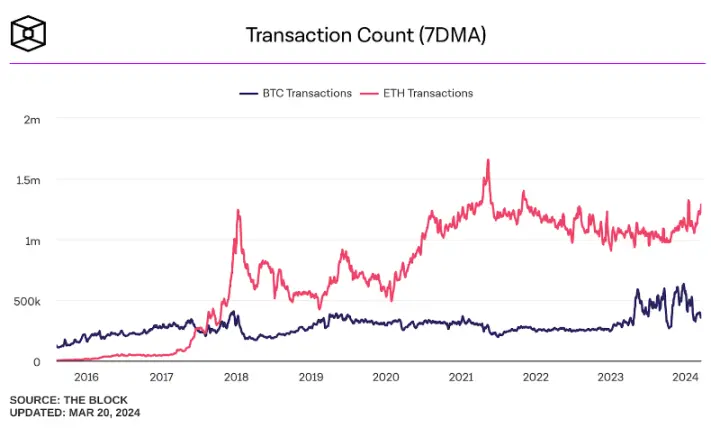
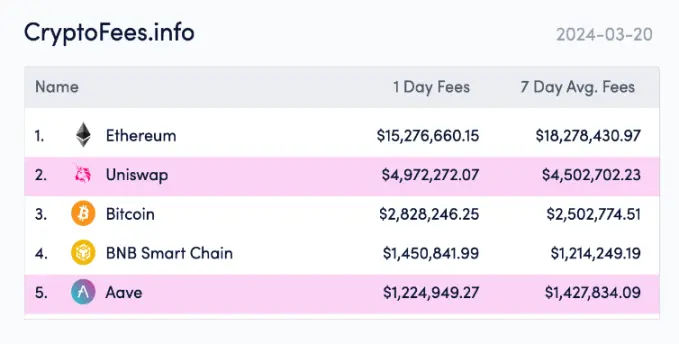
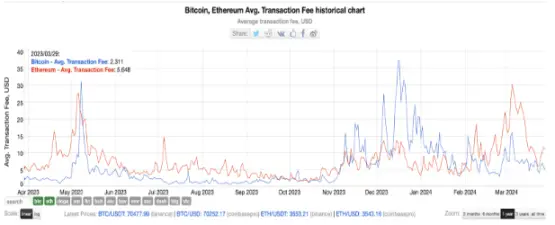
Despite Bitcoin’s lead, people aren’t actually using Bitcoin as much as Ethereum or Uniswap for daily transfers, even though the average transaction fee on the Bitcoin network is $4.96, now two times lower than Ethereum’s $10.51 times. As a result, much of the vast sum of money in Bitcoin remains untapped and dormant. Additionally, the rise of NFTs like Ordinals and BRC-20 on Bitcoin has only exacerbated the pressure on the first-layer network, leading to more congestion and increased fees.
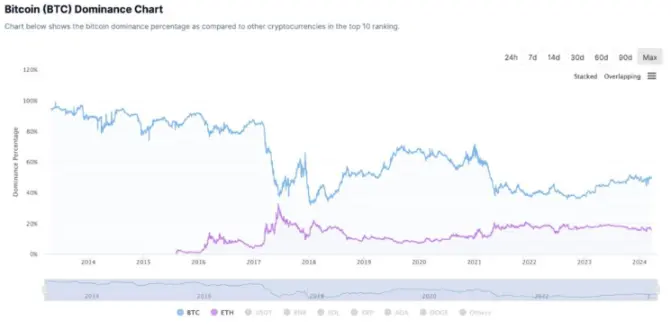
Although Bitcoin’s current market share is around 50%, this number has steadily declined over the long term. And the gap is likely to get wider. Ethereum is rapidly moving towards full data sharding (which, as we explain in this article, could be a real game-changer), and Bitcoin cannot afford to be left behind. External competition is increasing, demanding better scalability solutions.
2. Understand L2 solutions
L2 solutions are technologies built on top of or alongside the underlying network that facilitate transactions outside of the main chain. The two most popular methods for implementing L2 are state channels and sidechains; others include merged-mining chains and proof-of-stake chains.
Status channel
State channels are protocols managed by smart contracts that create payment channels that combine on-chain settlement and off-chain processes.
Side chain
Sidechains are alternative blockchains in which users typically send pre-existing Bitcoin (as a wrapper coin) to participate. In sidechains, users can conduct transactions as they wish. Transfers from the side chain back to the main chain are performed through “guess and refute” (that is, transactions are asserted and gradually confirmed over time), ensuring a 1:1 ratio between the side chain and the Bitcoin market price.
3. Take stock of the top Bitcoin L2 solutions
1) Lightning Network (LN for short)
The Lightning Network (LN) enables fast Bitcoin transfers with virtually zero fees. It works by establishing a payment channel between sender and receiver, using multi-signature transactions and time locks. Payment channels are basically deposit boxes where funds are held for off-chain transactions between a specific group of individuals.
Transactions on LN “jump” through channels between nodes to reach their destination. To achieve this, it uses onion routing similar to Tor relays. Therefore, LN provides a high degree of anonymity.
History background
An important point is that LN has long been supported in the Bitcoin community. Satoshi Nakamoto conveyed the idea of using channels for high-frequency trading; later, Mike Hearn further developed the idea. In 2016, the white paper was published, and dozens of developers reached a consensus on the direction of LN at the Scaling Bitcoin Milan conference. In 2017, Segregated Witness was implemented as the final milestone before the launch of LN.
Lightning Network Limitations
In theory, LN can handle millions of transactions per second, but adoption of LN has not yet reached this level. The total locked value of LN is as follows:

Since there are almost zero fees on LN, nodes don’t have much incentive to keep running. Nodes may go offline, channels can be closed unilaterally, there are security risks, and large transactions are not practical. Additionally, Bitcoin price volatility means that most people don’t hold their BTC in LN channels for too long, but instead move them back and forth (the creation of each channel requires a separate on-chain transaction).
Overall, the Lightning Network has not emerged as the ultimate solution for Bitcoin scalability, primarily due to design and operational challenges. Many even consider it an outdated solution. It has no smart contracts by default (the RGB project is committed to introducing smart contracts on Bitcoin through LN). However, it is arguably the best Bitcoin second layer solution currently available, or at least the most widely used.
2)Liquid Network
Liquid Network is the largest L2 Bitcoin sidechain with a TVL of $260 million. It was launched by Blockstream in 2018. Block creation takes 1-2 minutes; speed comes at the cost of high centralization. In practice, the sidechain provides a Bitcoin settlement mechanism for various trusted parties (mainly businesses such as trading platforms and market makers). It uses a Bitcoin wrapper called L-BTC as currency and runs as a private chain. At its core, the Liquid Network is like a bridge, with one L-BTC for every Bitcoin.
Limitations of Liquid Network
Liquid Network doesn’t actually solve the scalability trilemma because it’s not decentralized enough. Of the 3,836 Bitcoins in TVL, 99.5% or 3,817 Bitcoins are stored in one address, bc 1 …ff 4 aj 4 . This level of centralization is due to its design as a federation. An honest criticism of Liquid is that it somewhat defeats the purpose of cryptocurrencies since it only has about 60 members.
Overall, the Liquid network is not well suited to retail investors and requires high levels of trust from counterparties. Nonetheless, Liquid hopes to attract everyday users by allowing exchange (i.e. via the AQUA wallet) or tokenization of various assets within its chain at any time.
3)Rootstock(RSK)
Rootstock is another Bitcoin sidechain with 2,721 Bitcoins in TVL. For every Bitcoin sent to RSK, it issues a Token called RBTC, maintaining a 1:1 peg. The main difference with Liquid is that RSK focuses on smart contracts. The fact that the blockchain is EVM compatible means it can host common DeFi applications (e.g. borrowing, staking). According to its updated white paper, new blocks can be generated in 30 seconds. Rootstock has adopted a comprehensive approach that focuses on users, developers, and miners to grow its ecosystem. One of its strengths is the user-friendly design, as well as support for dozens of wallets/dApps, making RBTC-BTC swaps easy. For developers, it provides $2.5 million in grants. RSK positions itself as the low-hanging fruit for existing Bitcoin miners. In particular, miners can leverage the same infrastructure to earn high rewards in a process called merged mining. In 2023, Uniswap expanded to RSK.
Limitations of Rootstock
Since its launch nearly a decade ago, the Root Network has yet to conquer the masses (despite being one of the most popular second-layer solutions). Public acceptance aside, it can be said that introducing Ethereum smart contracts into the mix makes RBTC owners more vulnerable to hacks than just holding BTC. Projects deploying to the Root Network must ensure that their smart contracts do not contain any vulnerabilities for third-party audits. Beyond that, the state of the network’s decentralization remains unknown, as data is not easily accessible. Let’s not forget that the Root Network was set up as a federation. As such, it relies on central custodians to ensure security.
4)Stacks Network(STX)
Stacks is a second-layer Bitcoin sidechain with a TVL of $155 million. It adopts the Proof of Transfer (PoX) consensus mechanism and uses the native STXToken as currency. Staking is essential to activate the PoX mechanism. STX holders stake their tokens and receive returns in BTC as rewards. Similar to RSK, Stacks provides smart contract support; but it uses Clarity as the programming language. One of its advantages is that it has a fairly complete ecosystem, including dozens of applications and tools and an active developer community. In addition, STX ranks among the top 25 most valuable cryptocurrencies in the world.
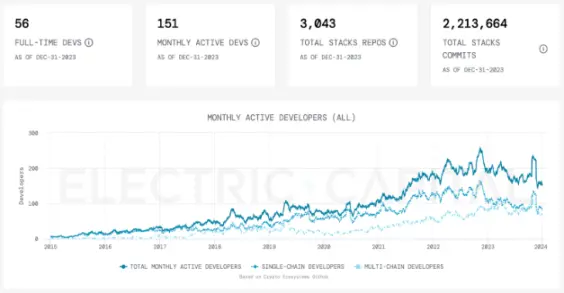
How does staking support PoX?
The Proof of Transfer (PoX) mechanism relies on network stability to activate. Miners confirm PoX anchor blocks during the “preparation phase” to start the reward cycle. The choice of the anchor block determines the PoX reward set, but miners need to have it in their chain state in order to mine blocks descending from it. If the PoX anchor block is lost, the recovery procedures outlined in SIP-007 involve miners mining a chain through PoB (Proof of Burn) to “bypass” it. The system design solves this problem by encouraging staking, thereby helping miners determine whether a missing block is truly unavailable, or simply not propagated to them.
Limitations of Stacks
Miners compete to append blocks via cryptographic ordering using weighted cryptographic selections. Ranking is a decentralized method that uses cryptography to select participants, which is crucial for consensus.
In the current model, since the block generation rate is tied to Bitcoin’s rate, slow Bitcoin blocks and Stacks forks can disrupt on-chain applications, causing transaction confirmation delays of up to 10-30 minutes. Microblocks cannot speed up transaction times because there is uncertainty in confirmations until the next ordering, resulting in orphaned transactions. Additionally, the Stacks fork has nothing to do with the Bitcoin fork, allowing for cheap reorganization, plus poorly connected miners manipulating the sorting results by excluding others’ block submissions. Fortunately, Stacks is well aware of these issues and is addressing them in the Nakamoto upgrade and related SIP.
What does Nakamoto offer?
The major change proposed by Nakamoto is to decouple block generation from cryptographic ordering, which reduces transaction confirmation time to seconds. Stacks will no longer fork independently after a transaction is confirmed, ensuring that transaction reversal is as challenging as reversing a Bitcoin transaction. In addition, changes to the ordering algorithm prevent Bitcoin miners from gaining an advantage as Stacks miners. These changes include decoupling Stacks term changes from Bitcoin block arrival, requiring individual stakers to cooperate in verifying and signing each Nakamoto Stacks block, and adopting the Bitcoin MEV solution to punish block submission censorship.
Overall, with the Nakamoto upgrade, Stacks L2 hopes to achieve an increase in transaction throughput and 100% transaction finality. This is a promising development that could elevate Stacks to the most sophisticated L2 solution possible.
4. Comparison of Bitcoin L2 Solutions
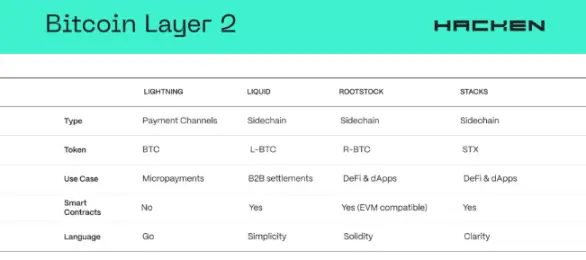
Stacks, Lightning Network, Liquid and RSK are collectively referred to as the “Big Four” in L2. They have been in the game the longest and therefore have the widest adoption. More novel L2s include Babylon, MintLayer, Ark, Botanix and RGB. In particular, RGB is working on enabling the Lightning Network to support smart contracts.
5. Limitations of Bitcoin L2
Most Bitcoin layer 2 solutions are still in the early stages of development, especially compared to other L2 solutions such as Polygon, ZKSync, etc. Many side channels are not decentralized enough, but are jointly developed and rely on a central escrow.
No current Bitcoin L2 solution actually solves a similar trilemma. There’s always a trade-off.
The Lightning Network is open and does not introduce new Tokens, but it lacks a global virtual machine. Liquid does not introduce new tokens and has a global virtual machine, but is a federated organization. Stacks is both open and supports global virtual machines, but introduces new Tokens.
In the complex landscape of Bitcoin L2 development, rigorous testing and thorough code review are crucial. You get industry-leading expertise through Hacken’s L1/L2 audit team, which reviews distributed ledger rules, conducts in-depth research on vulnerabilities, and analyzes architecture and known threats. Protect your Bitcoin layer 2 solution with Hacken’s blockchain protocol audit.
Additionally, there is a lack of adoption of current technology. Bitcoin L2 solutions process only a small portion of Bitcoin transactions, but analysts believe this share could increase to 25% in the future.
6 Conclusion
All in all, Bitcoin L2 solutions are critical to unlocking the potential of the Bitcoin network. A large amount of money in Bitcoin is used inefficiently and mainly as a store of value. To become the trustless financial system it is destined to be, it must leverage technology built on top of or alongside mainnet.
In this way, the first layer can maintain its extremely high security and decentralization, while the Bitcoin L2 solution can provide fast and scalable Bitcoin transactions and smart contracts for a wider range of Bitcoin native transactions and Web3 applications.
Currently, the off-chain Lightning Network is the most popular and decentralized L2 solution – fast and cheap, but limited to simple transactions. Sidechain solutions offer more functionality in terms of smart contract support but are less decentralized. In particular, Stacks (STX) has the potential to become the ultimate Bitcoin L2 solution.


