


A quick look at the Solana DEX competitive landscape: Raydium, Jupiter, Orca, and Meteora, who has more potential?
The DEX landscape of Solana is shifting towards higher efficiency and more concentrated Liquidity.
Author: vik0nchain, Researcher at Cyber Capital
Compiled by: Luffy, Foresight News
Between Q4 2024 and early 2025, Solana’s DeFi ecosystem is emerging with the rise of aggregators, user experience (UX) abstractions, significant integrations, and evolving tokenomics standards. While these changes may not have been obvious at first, the recent data has clearly shown their impact, highlighted by the reallocation of liquidity, fee generation, and changes in market share.
This analysis provides an in-depth look at the liquidity positioning of Solana’s major decentralized exchanges (DEXs) – Raydium, Jupiter, Orca, and Meteora, highlighting their strengths, weaknesses, and potential investment implications over existing and emerging competitors.
Investment Analysis Framework
Raydium (RAY) prospects are optimistic: deep Liquidity and repurchase advantages
- Liquidity and Volume Dominance: Raydium remains the strongest and most frequently used decentralized exchange for Liquidity in the Solana ecosystem. More than 55% of transactions routed through Jupiter are settled on Raydium. In addition, Raydium holds the market leader among decentralized exchanges on all blockchains, along with long-time leader Uniswap, and sometimes even surpasses Uniswap, while its fully diluted valuation (FDV) and market cap are only about one-third of Uniswap’s.
- Raydium/Uniswap Fully Diluted Valuation Ratio: 28.72828346 billion US dollars / 91.02379018 billion US dollars = 31.5%
- Raydium/Uniswap market value ratio: 15.05604427 billion US dollars / 54.65824531 billion US dollars = 27.5%
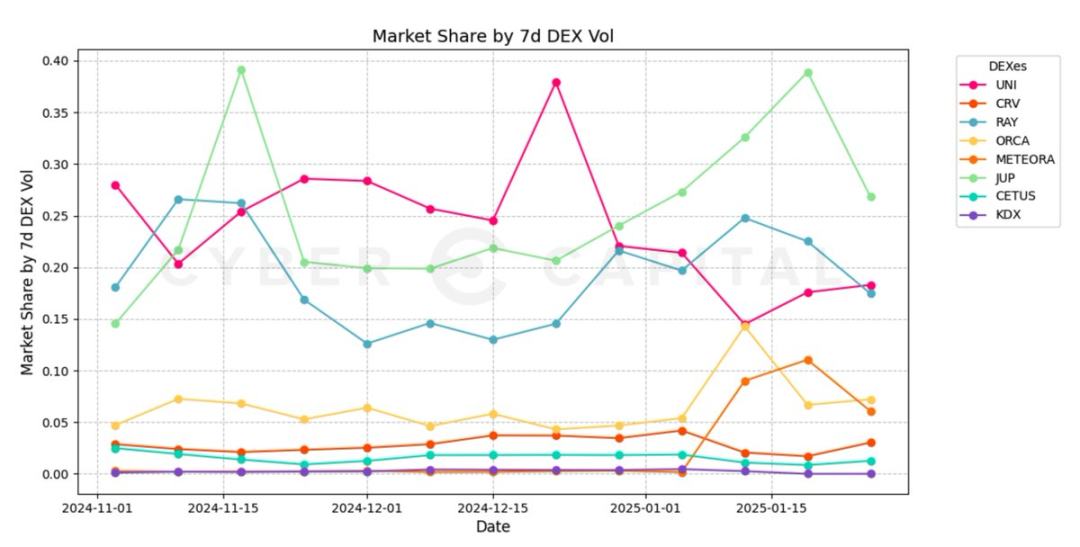
- Pump.fun Integration: Key partnerships, including integration with Pump.fun, increased transaction volume and protocol stickiness due to the migration of all new meme pools to Raydium.
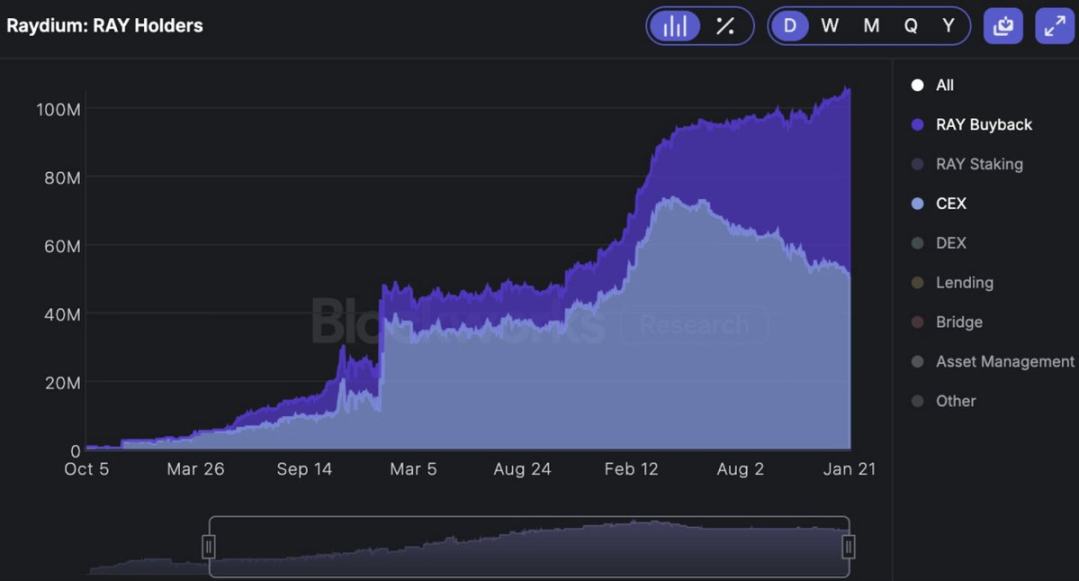
- Token Buyback: Raydium’s 12% fee buyback program has repurchased more than 10% of the total supply of tokens, significantly alleviating selling pressure. It is worth noting that the amount repurchased by Raydium far exceeds that held by centralized exchanges.
Jupiter (JUP) has a positive outlook: a market-leading aggregator
- Liquidity Aggregation Advantage: Jupiter plays a key role as Solana’s dominant aggregator.
- Acquisition of Moonshot: The acquisition of Moonshot enables Jupiter to integrate deposit/withdrawal lanes within its decentralized exchange, increasing competitiveness by simplifying the user experience.
- Unlock Pressure: Jupiter is facing a 127% supply increase due to token unlocking, which poses a medium-term inflation risk. Despite the recent announcement of a buyback mechanism, an internal estimate of an annual buyback rate of 2.4% provides some support for the token economy but is of limited use in competition with Raydium.
- Business model: Since the aggregator fee is charged on top of the underlying protocol fee, the aggregator model faces a dilemma in the low-fee dimension.
- Lack of competitors: As the first aggregator on Solana, Jupiter lacks strong competitors.
Meteora has a positive outlook: the rising Liquidity aggregator
- Aggregated Liquidity Efficiency: Unlike independent decentralized exchanges, aggregators like Meteora essentially have lower downside risk and more stable capital efficiency.
- Token issuance catalyst: The successful issuance of the Meteora token may change the Liquidity preference and provide long-term support for its market positioning. Unlike industry LP leader Kamino, MET points are not publicly displayed on the user interface. In addition, there has been no official statement about airdrops since the MET points system was first announced over a year ago. Although liquidity providers can earn higher returns elsewhere in the ecosystem (such as lulo.fi), market positioning and airdrop expectations may be the main drivers for Liquidity providers.
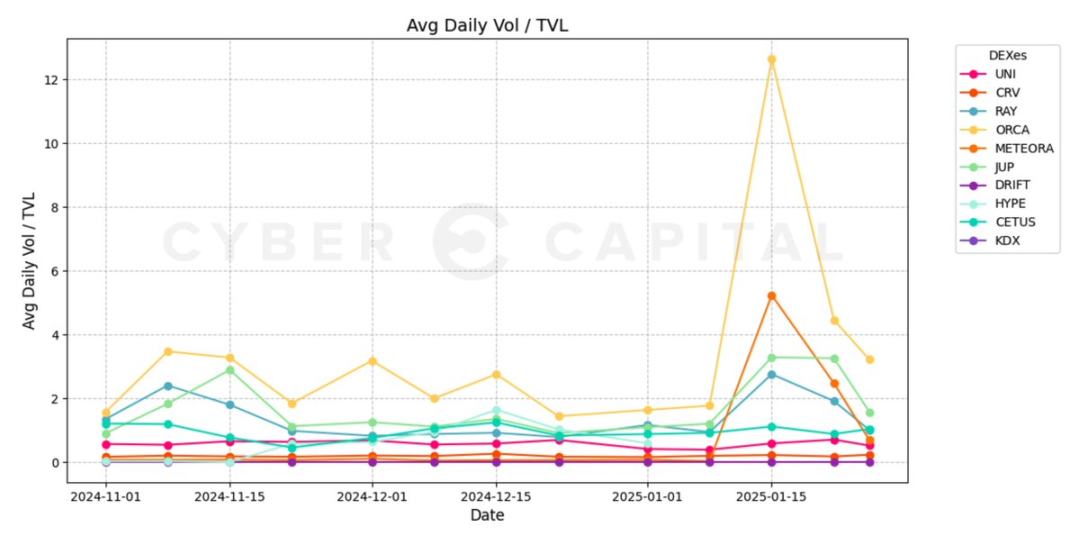
- Total Locked Value (TVL) retention: Meteora has seen development through Pengu airdrops, as well as the launch of Memecoins related to Trump and Melania and other significant events. Although the trading volume/Total Locked Value (Vol/TVL) ratio of many trading pairs temporarily increased during the Memecoin launch period due to temporary demand, the total locked value of Meteora continued to rise after the event, demonstrating good retention.
- Integrated Development: Virtuals migrates to Solana in the first quarter of 2024 and announces integration with the Meteora Liquidity pool.
Orca’s gloomy outlook: Liquidity is under-retained
- Insufficient Liquidity: Although Orca has very high efficiency, its pool size is significantly smaller than Raydium, resulting in higher slippage for large trades.
- Market positioning issues: Jupiter’s routing mechanism prioritizes deeper liquidity exchanges, making emerging low-liquidity decentralized exchanges and liquidity pools unattractive.
- The emergence of Meteora as a Liquidity aggregator further limits the competitive survival ability of non-dominant decentralized exchanges in the routing framework, because routing only occurs when the slippage cost is lower than the fee premium of Meteora, which is extremely rare outside of market demand spikes.
- Limited Liquidity provider incentives: Orca lacks strong Liquidity mining strategies, leading to a low long-term Liquidity provider retention rate.
- Inefficient capital allocation: Unlike Meteora, Orca has not implemented automated yield optimization and requires manual management of LP, resulting in a more cumbersome user experience.
- Downbeat Liquidity Trend: The upcoming launch of the Meteora token could completely lure Liquidity providers away from Orca, making it even more difficult.
- Insufficient integration: In early 2024, it failed to cooperate with Pump.fun, and recently missed the opportunity to cooperate with Virtuals, highlighting its competitive disadvantage in acquiring orders for emerging retail-driven applications. If there are no upcoming catalysts to reverse this trend, Liquidity migration may continue.
- As a result of these factors, Orca was unable to retain the additional subscribers it acquired during periods of peak network demand.
Key Catalysts & Risks
Catalysts to watch
- RAY repurchase vs. centralized exchange holdings: RAY’s repurchase speed now exceeds the total amount of RAY held by centralized exchanges, reinforcing the scarcity of the token.
- The trend of total locked value growth: The continued dominance of Raydium, Jupiter, and Meteora indicates the long-term sustainability of Liquidity. In high-pressure market conditions, the stickiness performance of emerging protocols is worth noting and cannot be ignored.
- Partnership: Just as Pumpfun’s integration brings significant Liquidity to Raydium, the integration of Meteora and Virtuals may also have a similar effect. Given the impact of such collaborations on Liquidity and the total locked value, partnerships with less well-known participants are highly anticipated.
- Meteora’s Token Offering: This event could mark a turning point in Solana’s decentralized exchange Liquidity allocation.
- Fee-to-market value ratio: Orca demonstrated extreme efficiency during the months of high demand, but its lack of liquidity retention hindered long-term competitiveness. JUP, on the other hand, faces the opposite, constrained by its business model. Compared to the latest “hot item”, Hyperliquid, Raydium incurs tenfold fees at a fully diluted valuation of one-eighth.
Risk
- Inflationary pressures on JUP: Despite Jupiter’s solid aggregator position, its large token supply could create short-term price pressures.
- Decline in Orca market share: If the trend of Liquidity provider migration continues, Orca may face sustained Liquidity loss.
- Meteora Airdrop and Token Economy Execution Risk: Despite strong growth in total locked value in the early days, its token economy and incentive structure remain untested.
Conclusion and Investment Outlook
The landscape of Solana’s decentralized exchange is shifting towards greater efficiency and more concentrated Liquidity. Raydium’s excellent Liquidity positioning, active buyback mechanism, and market leadership make it a decentralized exchange with high investment confidence. Jupiter’s aggregator role remains crucial, providing a competitive barrier, but token supply dilution poses a short-term resistance. Orca used to be a competitive participant, but faces severe challenges in retaining Liquidity and capital efficiency, becoming an increasingly fragile asset, indicating the dilemma of missing key integrations and struggling to compete head-on with mature participants. Meteora is poised to rise after successfully launching the upcoming token. Based on our current theory, investment positions in decentralized exchanges should be concentrated in leading decentralized exchanges, decentralized exchange aggregators, and Liquidity aggregators within a given ecosystem, with emerging participants that meet catalyst criteria also holding a small position.