Editor’s note: The author reviews the U.S.-led global economy from the outbreak of World War II in 1939 to Trump’s re-election in 2024. During this period, the U.S.-led global economy experienced a super bull market driven by one-off events such as becoming a superpower after World War II, the entry of women and minorities into the labor market, and the victory of the Cold War. However, the author believes that this feast has ended due to trends towards deglobalization, unsustainable labor force expansion, and the difficulty of further interest rate cuts. In the future, there will be financial asset liquidation, capital controls, and fiscal repression. Traditional markets will struggle to regain their former glory, while gold and Bitcoin, as non-traditional assets that are difficult for governments to control, will become safe havens. In particular, Bitcoin may rise in small and medium-sized countries due to its digital advantages, potentially reaching a market capitalization of one million dollars, but it will first have to withstand the test of a bear market.
The following is the original content (for ease of reading comprehension, the original content has been slightly edited):
TL;DR
Globalization has ended, and your financial assets have been liquidated.
Non-traditional assets are your redemption.
- BTC may reach one million US dollars.
From the outbreak of World War II (1939) to Trump’s second election victory (2024), we have experienced an unprecedented super bull market. This sustained rise has shaped generations of passive investors who habitually believe that the “market will never have a problem” and that the “market will only rise.” However, I believe this feast has come to an end, and many people are about to face liquidation.
How did we get here?
The super bull market from 1939 to 2024 is not accidental, but is due to a series of structural changes that have completely reshaped the global economy, with the United States always at the center.
Rise to Superpower After World War II
The Second World War catapulted the United States from a middling power to the undisputed leader of the ‘free world’. By 1945, the U.S. produced over half of the world’s industrial output, controlled a third of global exports, and held about two-thirds of the world’s gold reserves. This economic dominance laid the foundation for growth in the following decades.
Unlike the isolationism of the United States after World War I, the United States actively embraced the role of global leader after World War II, promoted the establishment of the United Nations, and implemented the “Marshall Plan,” injecting more than $13 billion into Western Europe. This was not just simple assistance—by investing in the reconstruction of post-war countries, the United States created new markets for its own products, while establishing its dominant position in culture and economy.
Labor Force Expansion: Inclusion of Women and Minorities
During World War II, about 6.7 million women entered the labor market, increasing the female labor force participation rate by nearly 50% in just a few years. Although many women left their jobs after the war, this large-scale mobilization permanently changed society’s views on women’s employment.
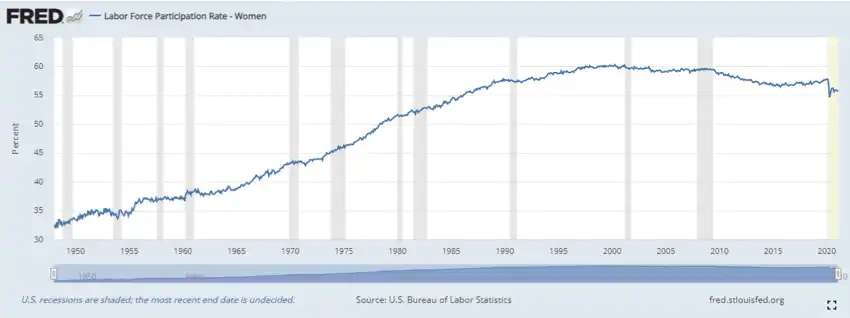
By 1950, the massive trend of married women entering the workforce became increasingly apparent, with labor force participation rates for women in most age groups rising by an unprecedented 10 percentage points. This was not just a wartime exception, but the starting point of a fundamental shift in the American economic model. The ‘marriage bar’ (policies prohibiting married women from working) was abolished, part-time work increased, technological innovations in household labor, and higher levels of education all contributed to women transitioning from temporary workers to long-term participants in the economic system.
A similar trend is also happening among minority ethnic groups, who are gradually gaining more economic opportunities. This expansion of the workforce has effectively boosted America’s production capacity, supporting decades of economic growth.
The Victory of the Cold War and the Wave of Globalization
The Cold War shaped the political and economic role of the United States after World War II. By 1989, the United States had formed military alliances with 50 countries and stationed 1.5 million troops in 117 countries worldwide. This was not only for military security but also to establish American economic influence globally.
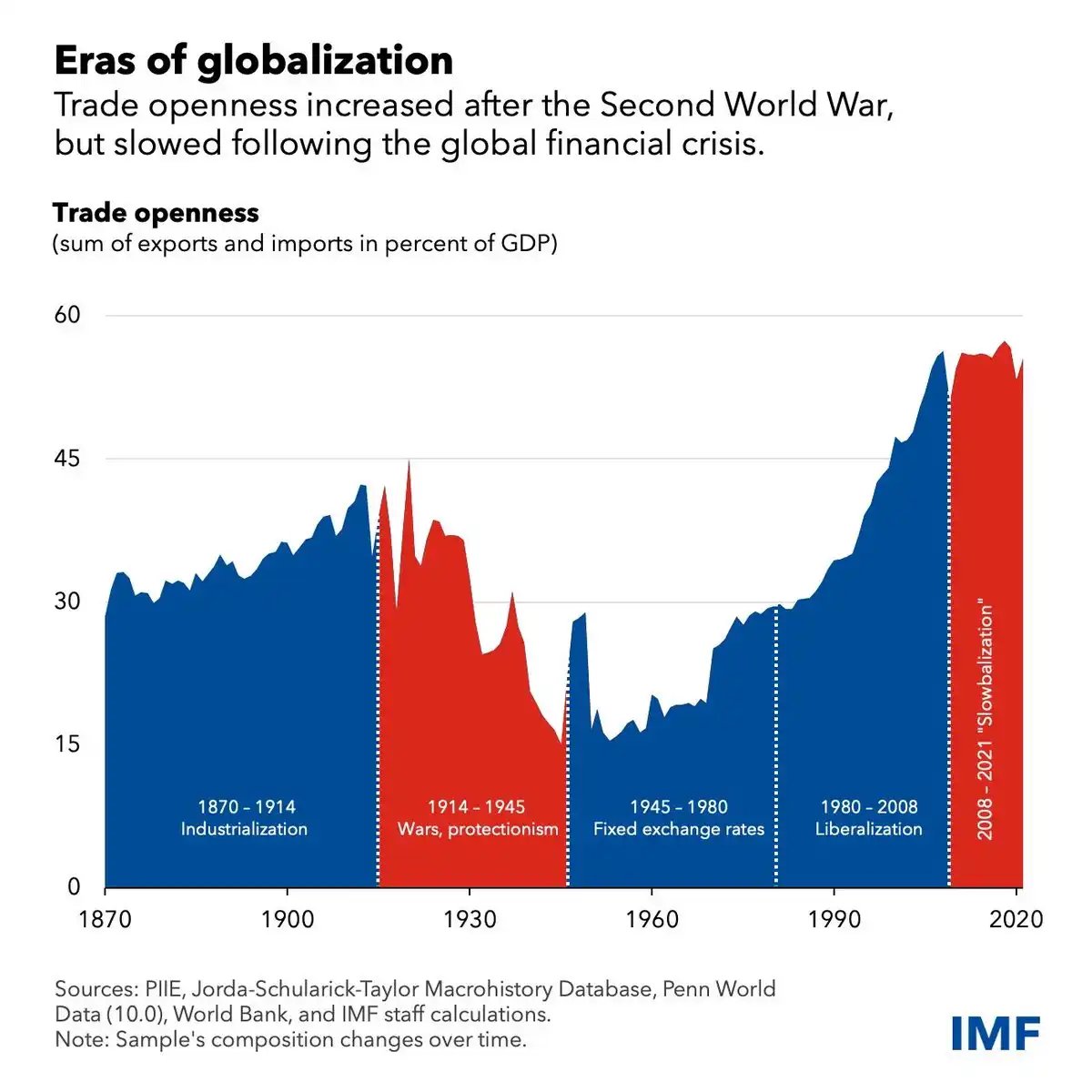
After the dissolution of the Soviet Union in 1991, the United States became the world’s only superpower, entering an era that many saw as a unipolar world. This was not only a victory of ideology, but also the opening of the global market, allowing the United States to dominate the global trade landscape.
In the 1990s to the early 21st century, American companies expanded massively into emerging markets. This was not a natural evolution, but rather the result of long-term policy choices. For example, in countries where the CIA intervened during the Cold War, the volume of imports to the United States increased significantly, especially in industries where the United States did not have a clear competitive advantage.
Western capitalism defeated Eastern communism not only through military or ideological superiority. The Western liberal democratic system is more adaptive and was able to effectively adjust its economic structure even after the 1973 oil crisis. The ‘Volcker Shock’ in 1979 reshaped America’s global financial hegemony, making the global capital market the new engine of growth for the United States in the post-industrial era.
These structural shifts - the rise of superpowers after World War II, the entry of women and minorities into the labor market, and the victory in the Cold War - have collectively driven this unprecedented bull market in financial assets. However, the core issue is that these shifts were all one-time events and cannot be repeated. You cannot bring women back into the labor market, and you cannot defeat the Soviet Union again. Now, both parties are promoting deglobalization, and we are witnessing the last support of this super-long cycle of growth being withdrawn.
What Will Happen Next?
I like Tom, he is my TradFi sentiment indicator in the Crypto circle.
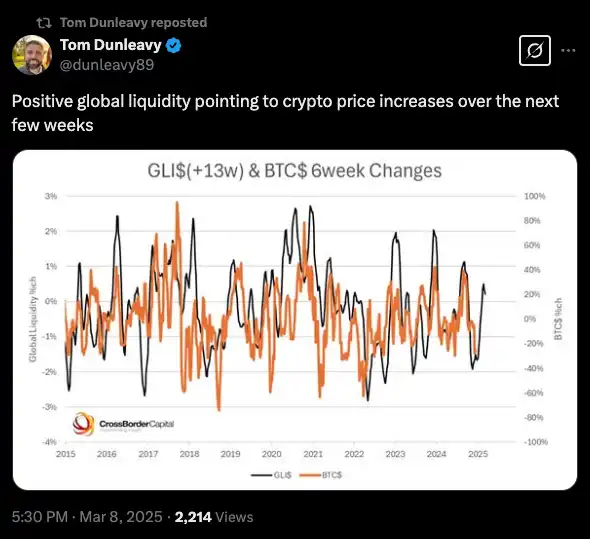
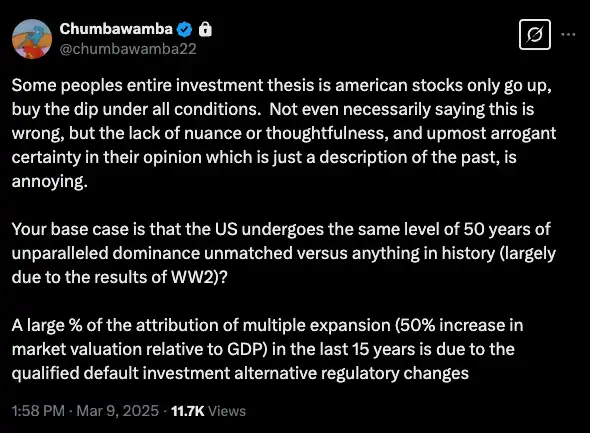
However, unfortunately, everyone is praying for the market to return to historical norms. The market consensus is: things will get worse, then the central bank will start to loosen again, and then we can continue to make money… But the reality is: these people are heading for the slaughterhouse.
The bull market of the past century was built on a series of events that cannot be repeated (cannot continue the bull market), and some of these factors are even reversing.
-
Women will not re-enter the labor market on a large scale: in fact, with Musk and the pro-natalist elite advocating for higher birth rates, the female labor participation rate may decline.
-
Ethnic minorities will not be absorbed into the labor market in large numbers again: In fact, the Democratic Party’s position on immigration policy is almost as tough as the Republican Party’s, which has become a bipartisan consensus.
· The Intrerest Rate will not decrease again: In fact, every elected leader knows very well that inflation is the biggest threat to their re-election. Therefore, governments around the world will do everything possible to avoid cutting interest rates and reigniting inflation.
· We will not further globalize: in fact, Trump is moving in the completely opposite direction. And, I expect the Democratic Party to replicate this policy in the next election (don’t forget, most of Biden’s policies are directly copied from Trump’s first term policies).
· We will not win another World War: in fact, it seems we may even lose the next war. Anyway, I don’t want to validate this guess.
My point of view is very simple: all the global macro trends that have driven the stock market up in the past century are now reversing. How do you think the market will go?
Goblin Town
When an empire is in decline, life can be really tough - just ask Japan. If you bought at the historic high of the Nikkei 225 index in 1989 and held it until now, 36 years later, your return is approximately -5%. This is a typical ‘buy and hold, endless pain’. I think we are walking the same path.
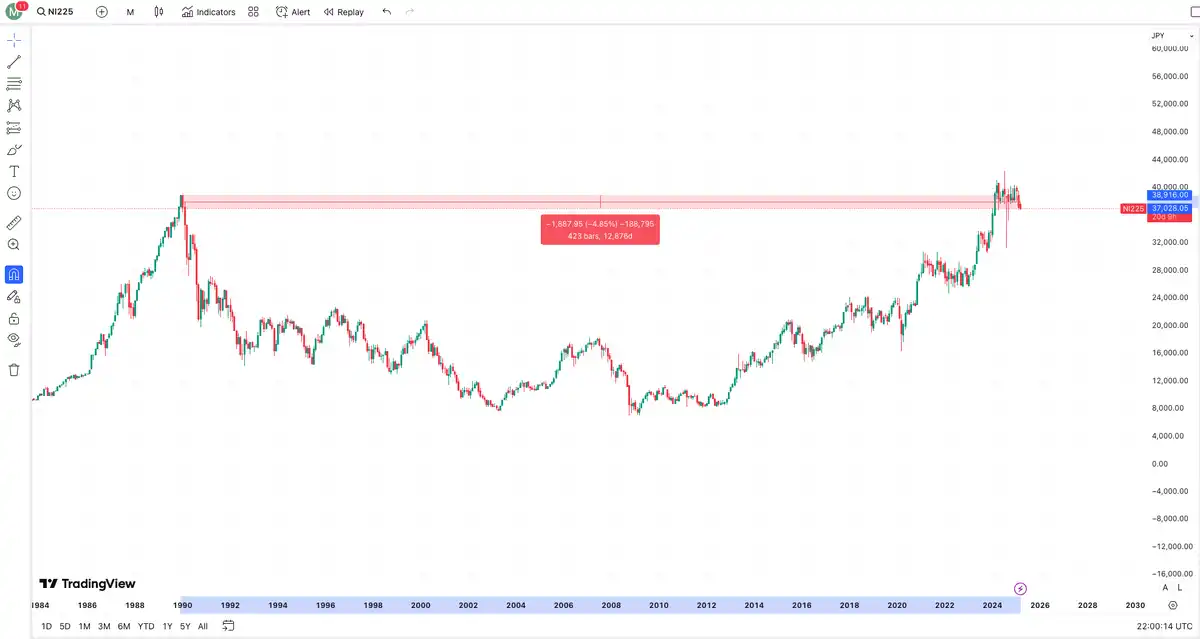
Even worse, you should be prepared for capital controls and fiscal repression policies. A market that does not rise does not mean that the government will accept reality. When traditional monetary policies fail, the government will turn to more direct financial control measures.
The upcoming capital control
Financial Repression refers to the practice of providing savers with returns below the inflation rate, so that banks can offer cheap loans to businesses and governments, and reduce the pressure of debt repayment. This strategy is particularly effective in government liquidating domestic currency debt. In 1973, economists at Stanford University first used this term to criticize the policies that suppress economic growth in emerging market countries, but now these strategies are increasingly appearing in developed economies, such as the United States.
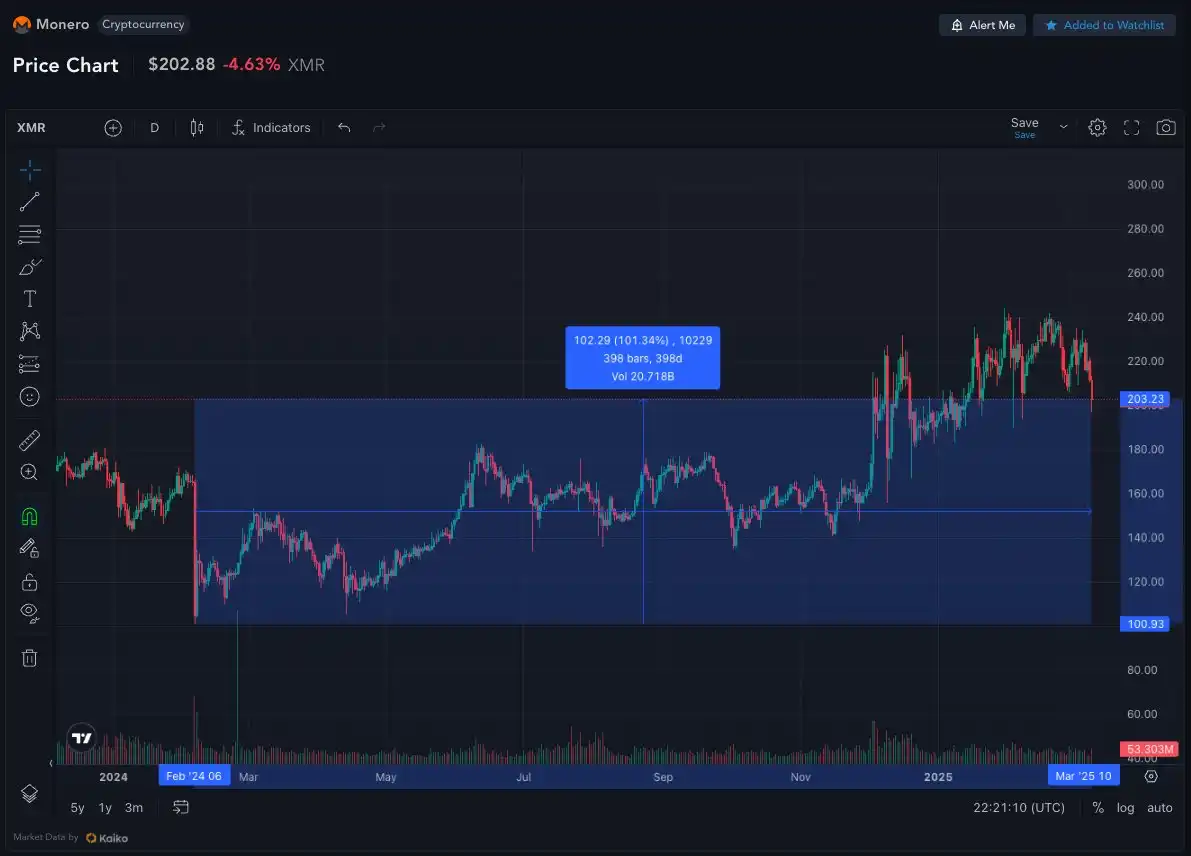
It may sound like a joke, but you should seriously consider why the K-line chart of Monero looks so perfect now.
With the U.S. debt burden surpassing 120% of GDP, the possibility of repaying debt through traditional means is decreasing. The ‘playbook’ of financial repression has begun to be implemented or tested, including:
· Direct or indirect restrictions on government debt and deposits Intrerest Rate
· Government controls financial institutions and sets up barriers to competition
· High reserve requirements
· Create a closed domestic debt market, forcing institutions to purchase government bonds
Capital controls, restricting the cross-border flow of assets
This is not a theoretical hypothesis, but a real case. Since 2010, the US Federal Funds Intrerest Rate has been below the inflation rate for more than 80% of the time, effectively forcibly transferring the wealth of savers to borrowers (including the government).
Your Retirement Account: The Next Target of the Government
If the government cannot rely on printing money to buy bonds, lower Intrerest Rate to avoid a debt crisis, they will target your retirement account. I can totally imagine a future where 401(k) and other tax-advantaged accounts will be required to allocate more and more “safe and reliable” government bonds. The government no longer needs to print money, just directly misappropriate existing funds in the system.
This is the script we have seen in the past few years:
· Frozen assets: In April 2024, Biden signed a law authorizing the government to seize Russia’s reserve assets in the United States, setting a precedent for the government to freeze foreign exchange reserves at any time. In the future, this practice may not only target geopolitical adversaries.
· Canadian Freedom Convoy protest incident: The government froze around 280 bank accounts without court approval. Finance officials admitted that this was not only to cut off the flow of funds but also to “deter” demonstrators and ensure they make “the decision to leave.” When asked how freezing accounts would affect innocent families, the government’s response was: “They just need to leave.”
Confiscation and Monitoring of Gold
This is not surprising, the history of the United States is filled with similar actions:
In 1933, Roosevelt (FDR) issued Executive Order 6102, which required citizens to surrender gold or face imprisonment. Although enforcement was limited, the Supreme Court supported the government’s power to confiscate gold. This was not a “voluntary purchase program”, but a “forced wealth confiscation” disguised as “fair market price” transactions.
Government surveillance capabilities expanded rapidly after the 911 incident. The FISA Amendments Act gives the NSA almost unlimited power to monitor the international communications of American citizens. The Patriot Act allows the government to collect the phone records of all Americans every day. Section 215 even allows the government to collect your reading records, study materials, purchase history, medical records, and personal financial information without any reasonable suspicion.
The issue is not whether ‘financial repression will come,’ but ‘how serious it will be.’ As the economic pressure of deglobalization intensifies, government control over capital will only become more direct and severe.
Gold & BTC
The gold monthly chart since 1970 is currently the strongest K-line chart in the world.
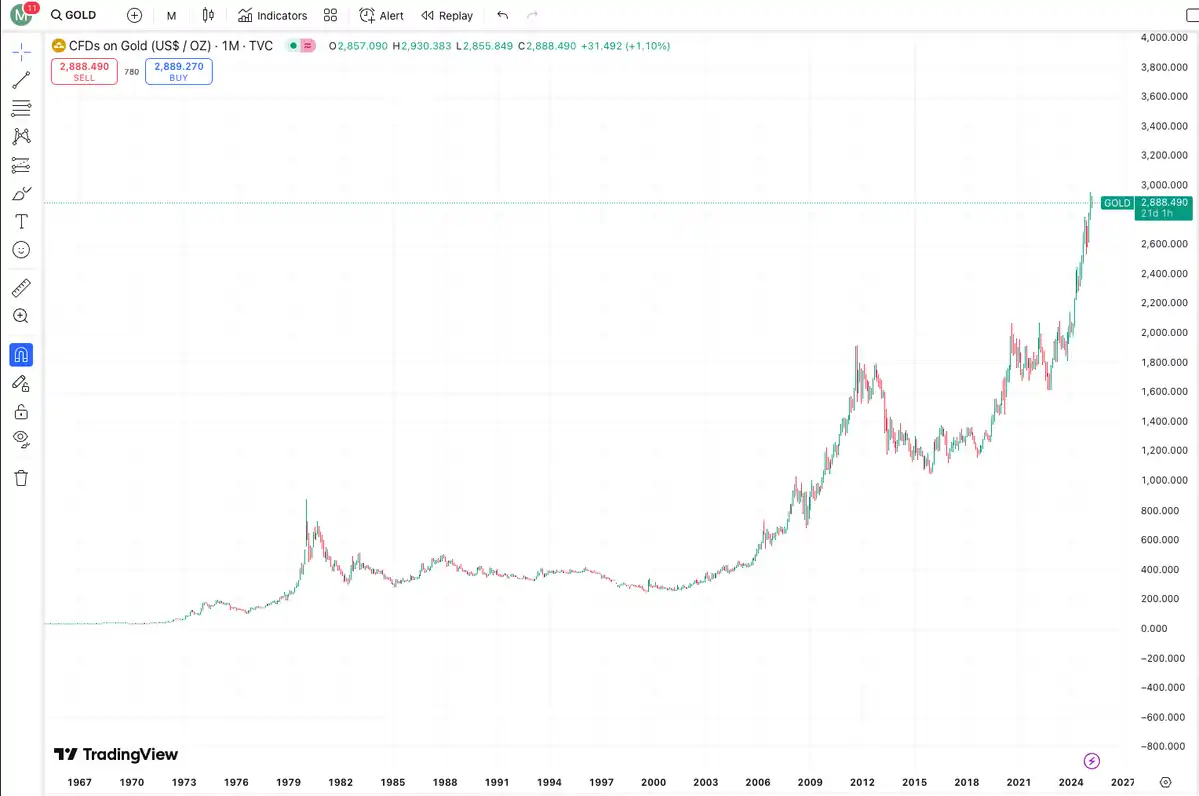
Based on the process of elimination, the most suitable financial asset to buy has become apparent - you need an asset with no historical correlation to the market, difficult to be confiscated by the government, and not controlled by Western governments. I can think of two, one of which has increased its market capitalization by $60 trillion in the past 12 months. This is the most obvious bull market signal.
Global Gold Reserve Competition
Countries such as China, Russia, and India are rapidly increasing their gold reserves to cope with changes in the global economic landscape:
· China: 5 tons of gold were added in January 2025, with net purchases for three consecutive months, totaling 2,285 tons held.
· Russia: Controls 2,335.85 tons of gold, becoming the fifth largest gold reserve country in the world.
· India: ranked eighth globally, holding 853.63 tons, and continue to increase holdings.
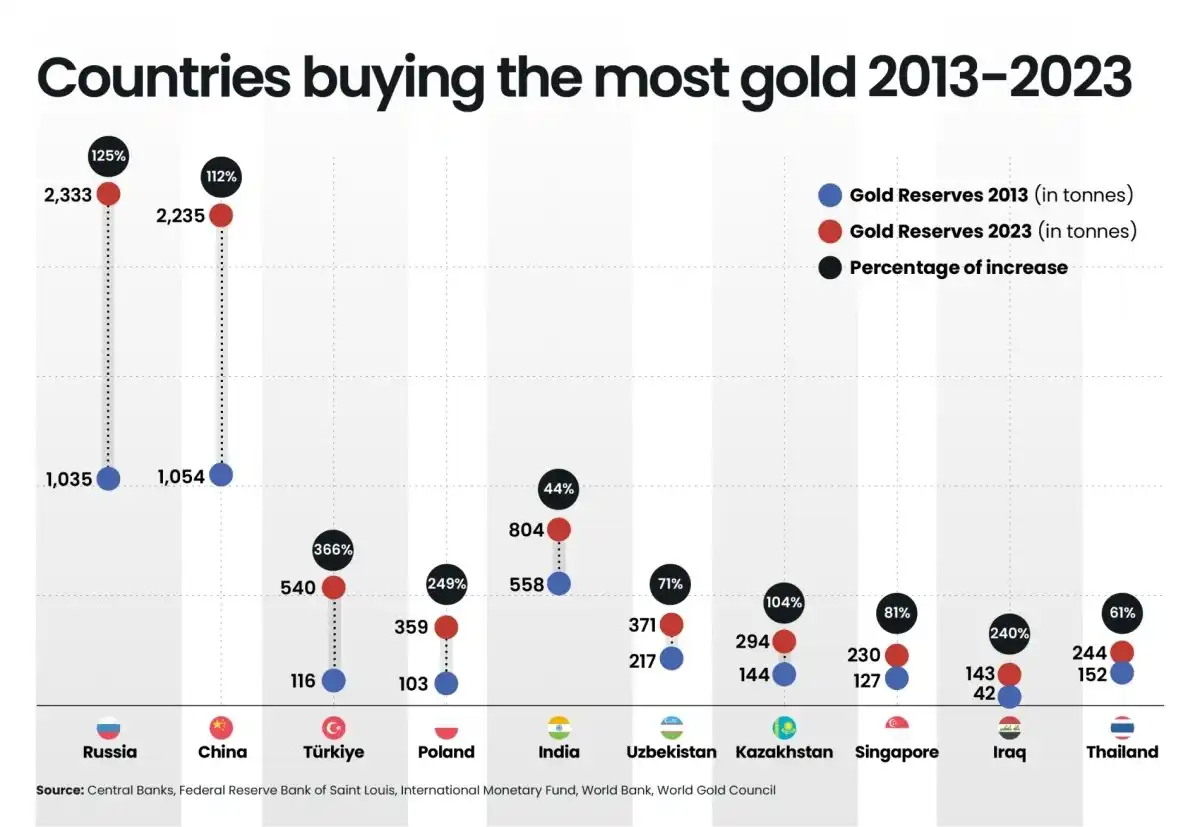
This is not a random act, but a strategic layout. After the G7 froze Russia’s foreign exchange reserves, central banks around the world took notice. A survey of 57 central banks showed that 96% of respondents viewed the reputation of gold as a safe-haven asset as a motivation for continued investment. When assets denominated in dollars can be offset by freezing, physical gold stored domestically becomes very attractive.
In just 2024, Turkey increased its gold reserves by 74.79 tons, a growth rate of 13.85%. Poland’s gold reserves increased by 89.54 tons, nearly 25%. Even small countries like Uzbekistan increased their gold by 8 tons in January 2025, bringing their gold holdings to 391 tons, accounting for 82% of their foreign exchange reserves. This is not a coincidence but a coordinated effort to break free from potentially weaponized financial systems.
Governments around the world are most confident in gold because they have established a system for using gold for reserves and trade settlement. The total gold holdings of the central banks of BRICS countries account for more than 20% of the global central bank gold holdings. As the Governor of the Central Bank of Kazakhstan mentioned in January 2025, they are transitioning to a “currency-neutral in gold purchases” to increase international reserves and “protect the economy from external shocks”.
BTC
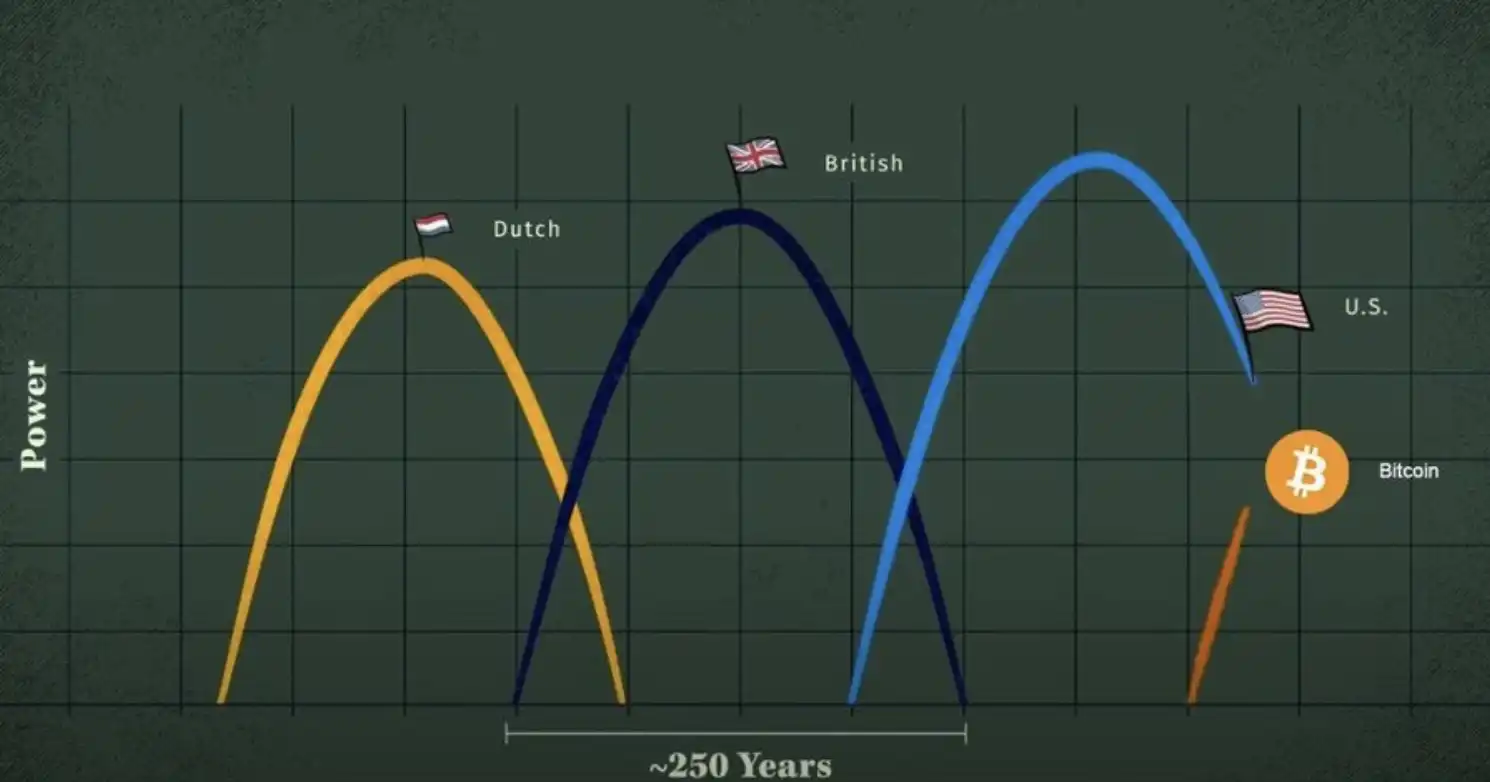
This gold-dominated era may last for several months or even years, but eventually, its limitations will become apparent. Many small and medium-sized countries do not have enough banking systems and navies to manage the global logistics of gold, and these countries may become the earliest adopters of BTC to replace gold.
El Salvador: In 2021, it became the first country to adopt Bitcoin as legal tender. By 2025, its BTC reserves have grown to over 550 million dollars.
· Bhutan: Mining using hydroelectric power, BTC reserves have exceeded $1 billion, accounting for one-third of the country’s GDP.
As the world becomes more chaotic, it is unlikely that countries will entrust gold to their allies. The risk of confiscation is too great, as evidenced by Venezuela’s failed attempt to retrieve gold from the Bank of England. For smaller countries, BTC offers a compelling alternative—it can be stored without a physical vault, transferred without ships, and protected without an army.
This transitional period will propel us into the next phase of Bitcoin adoption, but you must remain patient. The world will not change overnight, and neither will the monetary system. By 2025, we have already seen the beginning of this shift, with increasing adoption rates of BTC in countries like Argentina, Nigeria, and Vietnam as people seek protection against inflation and financial instability.
The path forward is clear: first gold, then Bitcoin. As more and more countries realize the limitations of physical gold in an increasingly digital and fragmented world, the proposal of BTC as digital gold becomes more prominent. The question is not whether this shift will happen, but when—and which countries will lead the way.
$1 million worth of Bitcoin is on the way, but you must be patient. Get ready to face a severe Bear Market first.
“Original Text Link”


