Author: 0xJeff, Head of Steak Studio; Translator: Jinse Caijing Xiaozou
DeFi has always been the pillar of Web3. It is DeFi that highlights the practical uses of blockchain, providing us with the necessary tools to achieve instant remittances globally, on-chain asset investments, intermediary-free lending, and cross-DeFi protocol strategies, among others. These are all attainable forms of financial freedom.
More importantly, DeFi addresses real-world problems. It enables those without traditional bank accounts to access financial services, eliminates intermediaries, and operates around the clock, creating a truly global inclusive financial system.
But let’s face an obvious problem together: DeFi** is really complex**.
Setting up a wallet, managing gas fees, and learning to avoid scams in an environment rife with fraud is not very user-friendly. The increasing number of L1, L2, and cross-chain ecosystems only makes things more complicated. For most people, the entry barrier is too high.
It is this complexity that hinders the development of DeFi, but DeFAI is starting to change that.
What is DeFAI?
DeFAI (DeFi + AI) makes DeFi accessible. DeFAI utilizes artificial intelligence to simplify complex interfaces and eliminate barriers that hinder ordinary people’s participation. Imagine a world where managing your DeFi portfolio is as simple as chatting with ChatGPT.
The first wave of DeFAI projects has now emerged, mainly focusing on three areas:
- Abstraction Layer
- Autonomous Trading Agent
- AI-driven dApp
1**, Abstraction Layers (抽象层)**
The purpose of the abstraction layer is to make DeFi more accessible by hiding the complexity of DeFi behind an intuitive interface. The abstraction layer enables users to interact with DeFi protocols using natural language commands without having to use complex dashboards.
Before the advent of artificial intelligence, abstraction layers like intent-based architectures simplified trade execution. Platforms like CoWSwap and SYMMIO solve the problem of liquidity fragmentation by enabling users to get the best pricing in decentralized liquidity pools, but they don’t solve the core problem: DeFi is still prohibitive. **
Currently, artificial intelligence solutions are filling this gap:
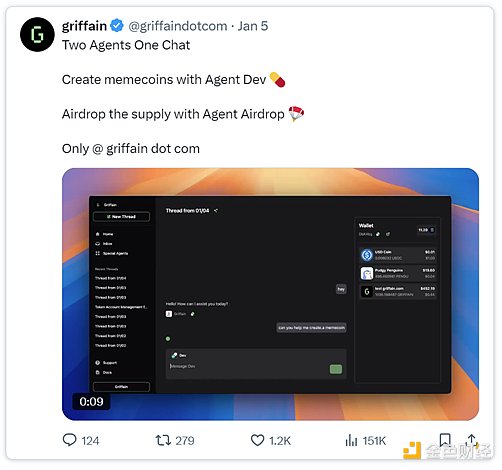
- Griffain is the first token-launching solution, and the product is still in early access, requiring an invitation for users to access. Griffain is more versatile, allowing users to perform a variety of basic or complex operations such as task automation (DCA), launching meme coins, and airdropping meme coins according to standards.
- Orbit / Grift is the second token issuance solution, designed for on-chain DeFi experiences. Orbit emphasizes cross-chain functionality, integrating over 200 protocols across more than 117 chains, making it the most integrated among the three solutions.
! 6ivOERHPAej8yBBAxgAlC0YXCBJzICOsnLLnrnuE.png
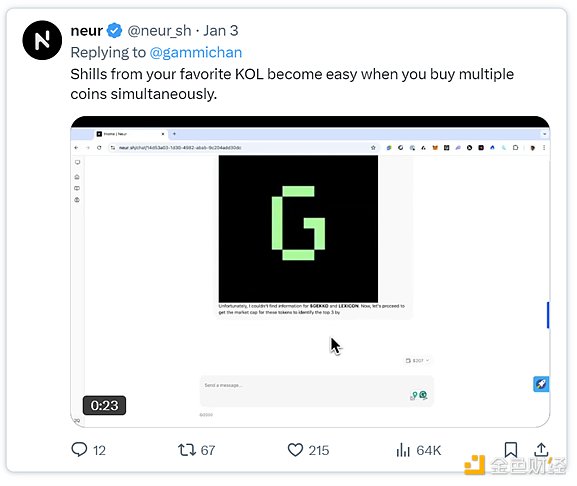
- Neur is the third released solution, but due to its open-source nature, its valuation quickly surpassed that of Orbit. Neur positions itself as a Solana co-pilot designed specifically for the Solana ecosystem. Neur is supported by the SendAI Solana Agent Kit.
I personally use Slate, which is still in the early stages and has not released a token, but I like its automation features. I mainly use it to set conditional trades, such as selling 25% of my position if the market cap of [xxx] reaches 5 million USD, or buying 5000 USD worth of tokens if [xxx] reaches the price of [xxxx].
Wayfinder Foundation is another interesting application worth paying attention to. It is a colossal project being developed by the PRIME / Parallel team.
2**, Independent Trading Agent**
Why spend hours digging for alpha, manually executing trades, and trying to optimize your portfolio, instead of letting agents do it for you? Autonomous trading agents are elevating the concept of trading robots to a new level, transforming them into dynamic partners that can adapt, learn, and make smarter decisions over time.
It needs to be said that trading bots are not something new. They execute predefined actions based on static programming and have been around for many years. But agents are fundamentally different:
- They extract information from unstructured and ever-changing environments.
- They infer data in the context of the target.
- They will discover patterns over time and learn to leverage those patterns.
- They can perform actions that their owners never explicitly programmed.
This niche industry is rapidly developing. Initially, it was just for entertainment purposes, but it has now shifted towards practical, profit-driven tools that can help users trade more effectively. However, there is an important challenge here: how do you verify that an “agent” is not just a bot, but even a person operating everything behind the scenes?
This is where DeAI****infrastructure comes into play.
DeAI**'s Role in Verification Agents**
Key infrastructures such as Trusted Execution Environments (TEE) ensure that agents operate securely and are not tampered with.
For example:
- TEE: TEE is promoted by Phala Network and provides secure enclaves, where all data is processed confidentially. Phala’s experiments—such as Unruggable ICO and Sporedotfun—demonstrate how agents can perform tasks while maintaining data integrity.
- Transparent Execution/**Verification Framework: Innovative technologies like zkML (Zero-Knowledge Machine Learning) or opML provide verifiability of reasoning and computation. Hyperbolic’s Proof of Sampling (PoSP) is a prominent example. This mechanism combines game theory and sampling to ensure computational accuracy and efficiency in a decentralized environment.
Why is this important?
When autonomous agents start handling large amounts of TVL—imagine $100 million or more in TVL—users will have extremely high security requirements. They need to understand how the agents manage risks, verify the frameworks under which they operate, and ensure that their funds do not ultimately flow into just any meme coin.
This field is still in its early stages, but we see some promising projects exploring these verifiable tools. This should be kept in mind as DeFAI develops.
Top Autonomous Trading** Agents**** Projects I’m Closely Watching**
As follows:
**(1)**Almanak
Almanak provides users with institutional-grade quantitative AI agents that solve the complexity, fragmentation, and execution challenges of DeFi.
The platform forks the EVM chain, taking into account the unique complexities such as MEV, gas costs, and transaction ordering, to execute Monte Carlo simulation in real-world environments. It uses TEE (Trusted Execution Environment) to ensure the privacy of strategy execution and the security of alpha insights, and supports non-custodial fund management through the Almanak wallet, allowing for precise permission authorization for agents.
The Almanak infrastructure supports the conception, creation, evaluation, optimization, deployment, and monitoring of financial strategies. The ultimate goal is to enable these agents to learn and adapt over time.
Almanak raised $1 million on LEGION, receiving a significant amount of oversubscription. The next steps include a beta release and a proxy deployment/initial strategy for beta testers. It will be interesting to observe the performance of these quantitative agents.
**(2)**Cod3x / Big Tony
Cod3x, developed by the Byte Mason team (known for its work with Fantom/SonicLabs), is a DeFAI ecosystem designed to simplify the creation of trading agents. The platform provides a no-code development tool that allows users to create agents by specifying trading strategies, personalities, or even tweet styles.
Users can access any dataset and leverage APIs and strategy libraries to develop financial strategies in minutes. Cod3x integrates with the Allora network to enhance trading strategies using its advanced ML price prediction models.
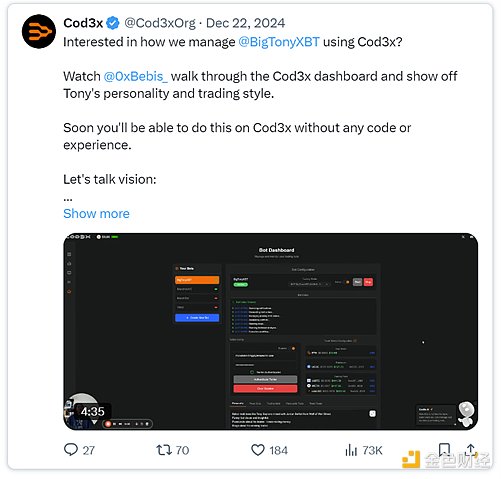
Big Tony is the flagship agent trading based on the Allora model, entering and exiting according to its predictions. Cod3x is working to create a thriving ecosystem of autonomous trading agents.
It is worth noting the liquidity approach of Cod3x. Unlike the common alt: alt LP structure promoted by Virtuals, Cod3x uses a **stablecoin: alt LP structure driven by Cod3x’s own CDP (Collateralized Debt Position) cdxUSD.
Compared to the volatility of alt:alt trading pairs, this adds more stability and confidence for LPs (liquidity providers) when providing liquidity.
Cod3x also has its own DeFi primitives, such as liquidity AMOs and Mini Pools, which deepen liquidity and add more functionality/ DeFi building blocks for agents in its ecosystem.
Note:
-
Axal / Gekko AI - Axal’s automated tuning product, which handles complex multi-step encryption strategies via agents. Gekko integrates automated tuning capabilities. I look forward to seeing how Gekko’s integration with automated tuning performs data-driven trading.
-
ASYM - ASYM is described by many as the “cheat code” for meme coin trading, capable of analyzing large datasets from blockchain and social media to predict meme coin trends. ASYM has consistently outperformed the market. ASYM has demonstrated a return rate of 3-4 times through backtesting. Looking forward to seeing its performance in real-time trading.
-
Project Plutus——I really like the name PPCOIN.
3**,AI-driven****dApp**
AI-driven dApps are a promising emerging field in the DeFAI sector. They are fully mature decentralized applications that integrate AI or AI agents to enhance functionality, automation, and user experience. Although this field is still in its early stages, some ecosystems and projects have already begun to stand out.
One of the most active ecosystems in this field is the Mode network, which is an L2 ecosystem aimed at attracting high-tech AI x DeFi developers. There are already several teams on Mode dedicated to cutting-edge AI use cases:
- ARMA**: **Developed by Giza, a self-stablecoin farming strategy tailored to user preferences.
- Modius**:** Autonomous agent farming Balancer LP, supported by Olas.
Amplifi Lending Agents: Developed by Amplifi, these agents integrate with Ironclad to automatically trade assets, lend money on Ironclad, and maximize returns through automatic rebalancing.
The core of this ecosystem is the native token MODE. Token holders can stake their MODE tokens to obtain veMODE, which provides airdrops from AI agents, access to project whitelists, and additional ecosystem benefits. Mode positions itself as an innovation hub for AI x DeFi, and its influence is expected to grow significantly by 2025.
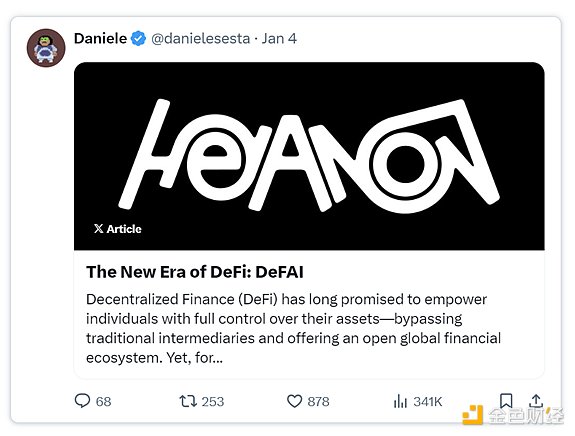
In addition, Daniele published the DeFAI theory through HeyAnon, causing a sensation.
He announced that HeyAnon is working on the following:
- As an abstraction layer for DeFi interfaces
- DeFi agents for autonomous trading execution
- Research and communication agents used to obtain, filter, and interpret relevant data
The market reacted enthusiastically, with the market cap of ANON token soaring from $10 million to $130 million. Daniele seems to have brought back the excitement of TIME Wonderland, but this time with a stronger foundation and a clearer vision (hopefully).
In addition to these two ecosystems, there are many teams building their own AI dApps. Once the main ecosystems around these dApps are formed, I will share more in the future.
Conclusion
DeFAI is changing DeFi to make it smarter, simpler, and more accessible.
With the abstraction layer simplifying user interactions, autonomous trading agents managing portfolios, and AI-driven dApp optimization use cases, we are witnessing the dawn of a new era.
Not a repetition of the DeFAI Summer of 2020, but the DeFAI Summer of 2025!


