






🚨 #BitcoinMiningIndustryUpdates — The shift in power that defines the future of blockchain infrastructure
The Bitcoin mining industry in 2026 is no longer just about hash rate—it has evolved into a high-stakes global competition driven by energy economics, institutional capital, regulatory pressure, and technological efficiency. What was once a fragmented ecosystem of independent miners is now rapidly consolidating into an industrial-scale sector dominated by publicly traded companies, sovereign-backed operations, and vertically integrated hybrid models between energy and mining. This transformation is reshaping not only Bitcoin’s security model but also its long-term valuation narrative.
📊 Industry overview and professional statistics:
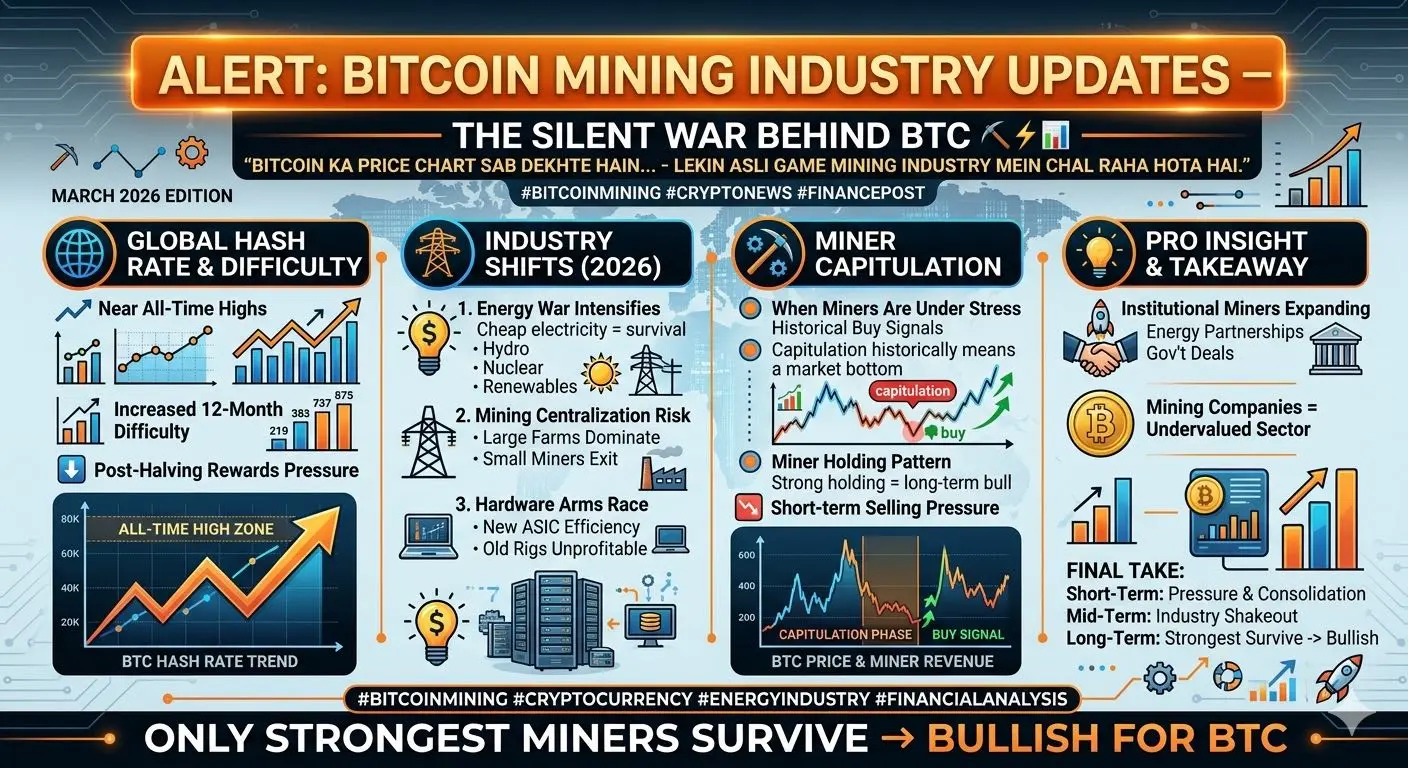
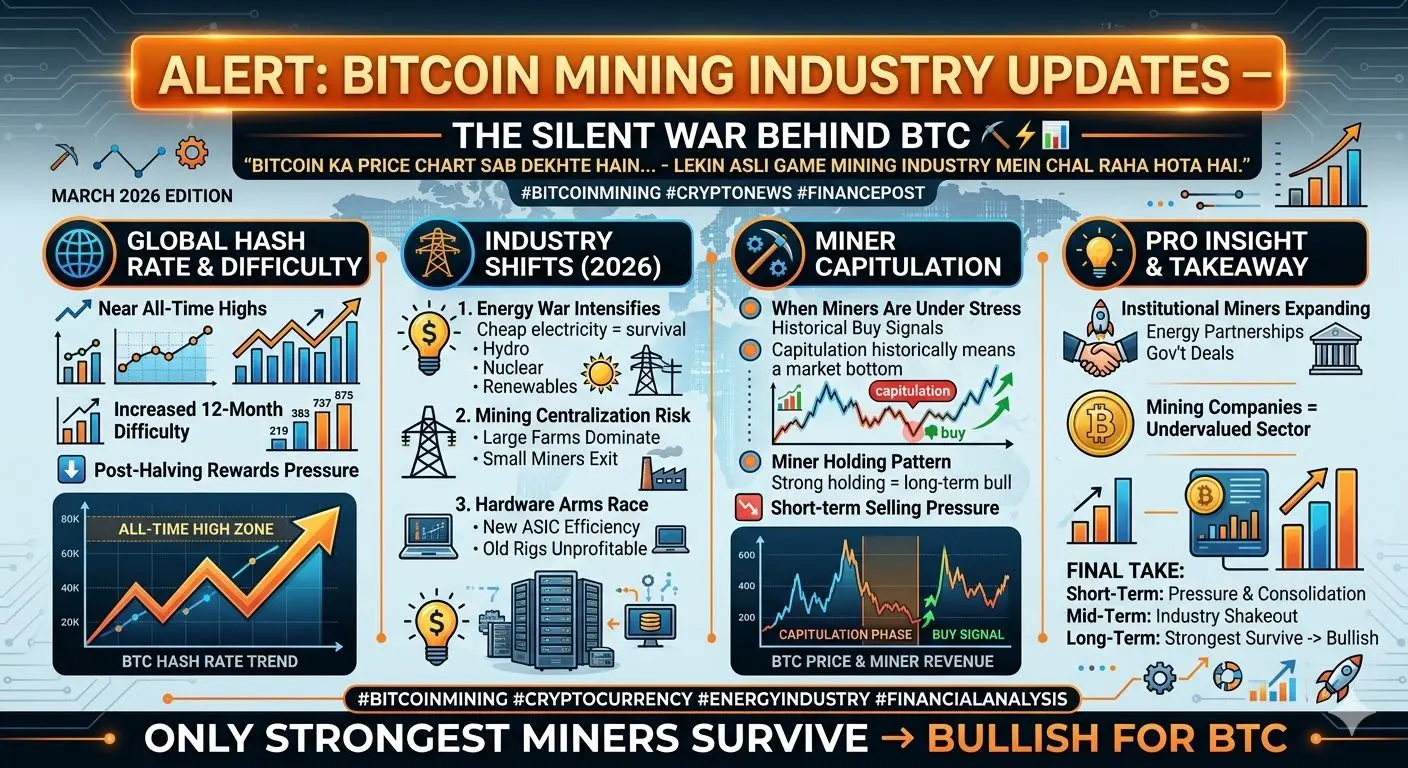
The global Bitcoin hash rate continues its aggressive expansion, reaching all-time highs despite market volatility. Network difficulty has steadily increased, reflecting intense competition and hardware deployment improvements. Meanwhile, average mining costs have risen significantly, with estimates ranging from $35,000 to $55,000 per Bitcoin depending on energy efficiency and location. Public mining companies now account for an increasing share of total hash rate, with some estimates indicating institutional players control 25-35%+ of the network, signaling a clear move toward professionalism. Additionally, post-halving dynamics have reduced block rewards, forcing miners to rely more on transaction fees and operational efficiency.
⚡ Energy wars and geopolitical shifts:
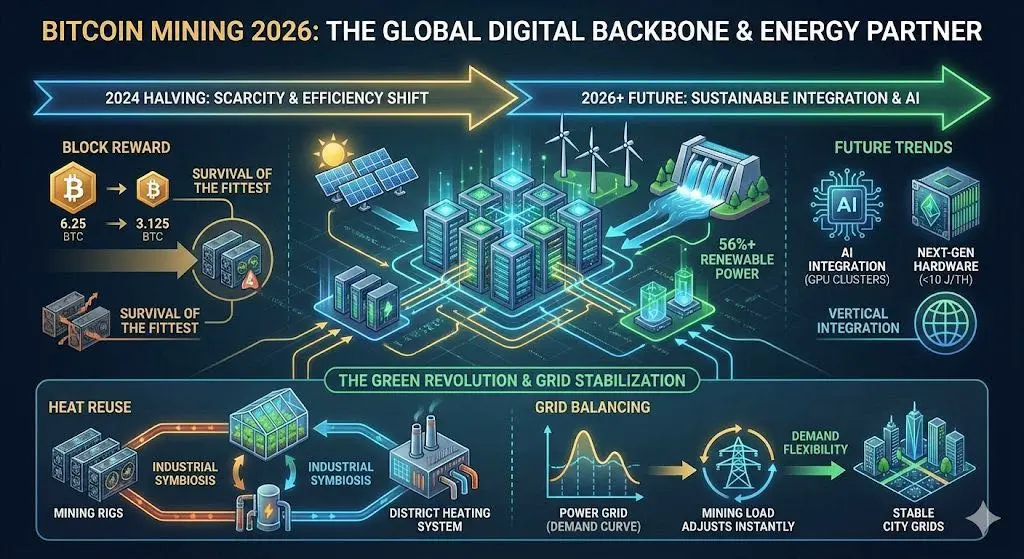
Energy has become the ultimate battleground. Mining operations are moving toward regions offering cheap, stable, and renewable power, including water-rich areas, flare gas utilization sites, and emerging nuclear grids. Countries competing for mining dominance are offering incentives, tax breaks, and regulatory clarity to attract capital. At the same time, stricter regulations in some regions are prompting miners to relocate, creating a dynamic redistribution of hash rate worldwide. This has led to a more geographically decentralized spread—but paradoxically, a more centralized ownership structure.
🏛️ Institutional impact and market dynamics:
Institutional capital is now deeply embedded in mining. Public companies leverage stock markets, debt financing, and strategic partnerships to expand their operations. This adds a new layer of market interconnectedness—where mining stocks increasingly correlate with Bitcoin price movements and traditional equity market conditions. Furthermore, miners are no longer just sellers of Bitcoin; many adopt treasury strategies, holding BTC on their balance sheets and using it as collateral. This reduces immediate selling pressure but increases systemic risks during downturns.
🔥 Tech race — efficiency or exit:
The next generation of ASIC devices is driving a massive efficiency race. Companies deploying advanced chips with significantly improved hash rates per watt gain a crucial advantage. Outdated, inefficient machines quickly become obsolete, forcing smaller operators out of the market. This has created a survival-of-the-fittest environment where only those with access to capital, cheap energy, and cutting-edge hardware can compete. Cooling technologies, including immersion cooling, are also becoming mainstream, enabling higher performance and longer device lifespan.
📉 Challenges and risk factors:
Despite growth, the industry faces serious headwinds. Rising energy costs, regulatory scrutiny, environmental concerns, and declining block rewards are squeezing margins. The “miner capitulation” cycle remains a real threat—especially if Bitcoin’s price falls below the average production cost. Additionally, increasing hash rate without proportional price growth can put further pressure on profitability. There’s also the risk of over-leveraged mining companies facing liquidity crises during bear markets.
📈 Strategic outlook — what smart money is watching:
Professional investors closely monitor miner behavior as a leading market indicator. Metrics like hash rate growth, miner reserves, and sell pressure provide insights into market cycles. Continued increases in hash rate alongside stable prices indicate strong network confidence, while aggressive miner selling often precedes volatility. The coming phase is expected to be shaped by AI-driven efficiency improvements, smarter network participation, and energy arbitrage strategies.
💡 Professional perspective:
Bitcoin mining is no longer just a background process—it’s the industrial backbone of the entire crypto system. Players controlling energy and efficiency will ultimately shape the future of decentralization, security, and supply dynamics.
💥 Final summary:
The Bitcoin mining industry in 2026 stands at a critical crossroads of technology, finance, and geopolitics. It is becoming more efficient, more competitive, and more institutional—but also more complex and risk-sensitive. For traders, investors, and analysts, understanding mining is no longer optional—it’s essential. Because behind every Bitcoin transaction is a rapidly evolving global industry that ultimately determines the network’s strength and sustainability.
The Bitcoin mining industry in 2026 is no longer just about hash rate—it has evolved into a high-stakes global competition driven by energy economics, institutional capital, regulatory pressure, and technological efficiency. What was once a fragmented ecosystem of independent miners is now rapidly consolidating into an industrial-scale sector dominated by publicly traded companies, sovereign-backed operations, and vertically integrated hybrid models between energy and mining. This transformation is reshaping not only Bitcoin’s security model but also its long-term valuation narrative.
📊 Industry overview and professional statistics:
The global Bitcoin hash rate continues its aggressive expansion, reaching all-time highs despite market volatility. Network difficulty has steadily increased, reflecting intense competition and hardware deployment improvements. Meanwhile, average mining costs have risen significantly, with estimates ranging from $35,000 to $55,000 per Bitcoin depending on energy efficiency and location. Public mining companies now account for an increasing share of total hash rate, with some estimates indicating institutional players control 25-35%+ of the network, signaling a clear move toward professionalism. Additionally, post-halving dynamics have reduced block rewards, forcing miners to rely more on transaction fees and operational efficiency.
⚡ Energy wars and geopolitical shifts:
Energy has become the ultimate battleground. Mining operations are moving toward regions offering cheap, stable, and renewable power, including water-rich areas, flare gas utilization sites, and emerging nuclear grids. Countries competing for mining dominance are offering incentives, tax breaks, and regulatory clarity to attract capital. At the same time, stricter regulations in some regions are prompting miners to relocate, creating a dynamic redistribution of hash rate worldwide. This has led to a more geographically decentralized spread—but paradoxically, a more centralized ownership structure.
🏛️ Institutional impact and market dynamics:
Institutional capital is now deeply embedded in mining. Public companies leverage stock markets, debt financing, and strategic partnerships to expand their operations. This adds a new layer of market interconnectedness—where mining stocks increasingly correlate with Bitcoin price movements and traditional equity market conditions. Furthermore, miners are no longer just sellers of Bitcoin; many adopt treasury strategies, holding BTC on their balance sheets and using it as collateral. This reduces immediate selling pressure but increases systemic risks during downturns.
🔥 Tech race — efficiency or exit:
The next generation of ASIC devices is driving a massive efficiency race. Companies deploying advanced chips with significantly improved hash rates per watt gain a crucial advantage. Outdated, inefficient machines quickly become obsolete, forcing smaller operators out of the market. This has created a survival-of-the-fittest environment where only those with access to capital, cheap energy, and cutting-edge hardware can compete. Cooling technologies, including immersion cooling, are also becoming mainstream, enabling higher performance and longer device lifespan.
📉 Challenges and risk factors:
Despite growth, the industry faces serious headwinds. Rising energy costs, regulatory scrutiny, environmental concerns, and declining block rewards are squeezing margins. The “miner capitulation” cycle remains a real threat—especially if Bitcoin’s price falls below the average production cost. Additionally, increasing hash rate without proportional price growth can put further pressure on profitability. There’s also the risk of over-leveraged mining companies facing liquidity crises during bear markets.
📈 Strategic outlook — what smart money is watching:
Professional investors closely monitor miner behavior as a leading market indicator. Metrics like hash rate growth, miner reserves, and sell pressure provide insights into market cycles. Continued increases in hash rate alongside stable prices indicate strong network confidence, while aggressive miner selling often precedes volatility. The coming phase is expected to be shaped by AI-driven efficiency improvements, smarter network participation, and energy arbitrage strategies.
💡 Professional perspective:
Bitcoin mining is no longer just a background process—it’s the industrial backbone of the entire crypto system. Players controlling energy and efficiency will ultimately shape the future of decentralization, security, and supply dynamics.
💥 Final summary:
The Bitcoin mining industry in 2026 stands at a critical crossroads of technology, finance, and geopolitics. It is becoming more efficient, more competitive, and more institutional—but also more complex and risk-sensitive. For traders, investors, and analysts, understanding mining is no longer optional—it’s essential. Because behind every Bitcoin transaction is a rapidly evolving global industry that ultimately determines the network’s strength and sustainability.