
Compra criptomonedas
Pagar con

USD
Compra y venta
HOT
Compra y vende criptomonedas a travésde Apple Pay, tarjetas, Google Pay, transferencias bancarias y más
P2P
0 Fees
¡Cero tarifas, más de 400 opciones de pago y compra y venta de criptomonedas sin complicaciones!
Gate Card
Tarjeta de pago con criptomonedas que permite efectuar transacciones internacionales fácilmente
Operar
Básico
Spot
Opera con criptomonedas libremente
Margen
Multiplica tus beneficios con el apalancamiento
Conversión y trading en bloques
0 Fees
Opera cualquier volumen sin tarifas ni deslizamiento
Tokens apalancados
Obtén exposición a posiciones apalancadas de forma sencilla
Premercado
Opera con nuevos tokens antes de que selisten oficialmente
Futuros
Futuros
Cientos de contratos liquidados en USDT o BTC
Opciones
HOT
Opera con opciones estándar al estilo europeo
Cuenta unificada
Maximiza la eficacia de tu capital
Trading de prueba
Comienzo del trading de futuros
Prepárate para operar con futuros
Eventos de futuros
Participa en eventos para ganar generosas recompensas
Trading de prueba
Usa fondos virtuales para probar el trading sin asumir riesgos
Earn
Lanzamiento
CandyDrop
Acumula golosinas para ganar airdrops
Launchpool
Staking rápido, ¡gana nuevos tokens con potencial!
HODLer Airdrop
Holdea GT y consigue airdrops enormes gratis
Launchpad
Anticípate a los demás en el próximo gran proyecto de tokens
Puntos Alpha
NEW
¡Opera con activos on-chain y recibe recompensas por airdrop!
Puntos de futuros
NEW
Gana puntos de futuros y reclama recompensas de airdrop
Inversión
Simple Earn
Genera intereses con los tokens inactivos
Inversión automática
Invierte automáticamente de forma regular
Inversión dual
Compra a la baja y vende al alza para aprovechar las fluctuaciones de los precios
Staking flexible
Gana recompensas con el staking flexible
Préstamo de criptomonedas
0 Fees
Usa tu cripto como garantía y pide otra en préstamo
Centro de préstamos
Centro de préstamos integral
Centro de patrimonio VIP
La gestión patrimonial personalizada potencia el crecimiento de tus activos
Gestión patrimonial privada
Gestión de activos personalizada para hacer crecer sus activos digitales
Quant Fund
El mejor equipo de gestión de activos te ayuda a obtener beneficios sin complicaciones
Staking
Haz staking de criptomonedas para ganar en productos PoS
Apalancamiento inteligente
NEW
Sin liquidación forzosa antes del vencimiento, ganancias apalancadas sin preocupaciones
Acuñación de GUSD
Usa USDT/USDC para acuñar GUSD y obtener rendimientos a nivel tesorería

Más

Resultados de la búsqueda para "GOAL"
Vitalik Buterin: Cómo hacer que Ethereum en 5 años sea tan simple como Bitcoin
Resumen
Ethereum aims to become a global ledger, requiring scalability and resilience. This article focuses on the importance of protocol simplicity, proposing to significantly reduce complexity by simplifying the consensus layer (3-slot finality, STARK aggregation) and the execution layer (replacing EVM with RISC-V or a similar virtual machine), thereby reducing development costs, error risks, and attack surfaces. It is suggested to smooth the transition through backward-compatible strategies (such as on-chain EVM interpreters) and unify erasure codes, serialization formats (SSZ), and tree structures to further simplify. The goal is to bring Ethereum's consensus critical code closer to Bitcoin's simplicity, enhancing resilience and participation, with a cultural emphasis on simplicity and setting a maximum line count target.
El objetivo de Ethereum es convertirse en un libro mayor global: una plataforma para almacenar los activos y registros de la civilización humana, que sirva a áreas como las finanzas, la gobernanza y la certificación de datos de alto valor. Esto requiere apoyo en dos aspectos: escalabilidad y resiliencia.
挖币网·2025-05-06 02:07
Un juez federal acaba de darle un golpe en la barbilla a la SEC. Esto es lo que significa. - BlockTelegraph
*
*
*
*
*
If the SEC were a sports team measured by its “win” rate, it would be a runaway champ.
But that win-loss record suffered a mild hit — and its first ever loss in an “ICO” case — one that refers to the controversial method of crowd fundraising and that borrows from the public company “IPO” or initial public offering.
A federal judge denied the SEC a preliminary injunction against Blockvest after he granted a temporary restraining order on the same issue. We chat with Amit Singh, attorney and shareholder in Stradling’s corporate and securities practice group about the SEC’s fresh loss.
His take? They’ll be out for blood, next.
**For those not in the know, share the legal background leading up to this case.**
In October of this year, the Securities Exchange Commission filed a complaint against Blockvest LLC and its founder, Reginald Buddy Ringgold III. According to the complaint, Blockvest falsely claimed its planned December initial coin offering was “registered” and “approved” by the SEC and created a fake regulatory agency, the Blockchain Exchange Commission, which included a phony logo that was nearly identical to that of the SEC. The SEC also alleged Blockvest conducted pre-sales of its digital token, BLV, ahead of the ICO and raised more than $2.5 million.
The SEC’s complaint alleged violations of the anti-fraud provisions of the Securities Exchange and the Securities Act and violations of the Securities Act’s prohibitions against the offer and sale of unregistered securities in the absence of an exemption from the registration requirements.
U.S. District Judge Gonzalo Curiel issued a temporary restraining order “freezing assets, prohibiting the destruction of documents, granting expedited discovery, requiring accounting and order to show cause why a preliminary injunction should not be granted” on October 5, 2018.
On Tuesday, November 27, in the SEC’s first loss in stopping an ICO, judge Gonzalo Curiel stated that the SEC had not shown at this stage of the case that the BLV tokens were securities under the Howey Test, a decades-old test established by the U.S. Supreme Court for determining whether certain transactions are investment contracts and thus securities. If the tokens weren’t securities, all the SEC’s other allegations automatically fail Under the Howey Test, a transaction is an investment contract (or security) if:
– It is an investment of money;
– There is an expectation of profits from the investment;
– The investment of money is in a common enterprise; and
– Any profit comes from the efforts of a promoter or third party
Later cases have expanded the term “money” in the Howey Test to include investment assets other than money.
The judge said that the SEC failed to show investors had an expectation of profits. “While defendants claim that they had an expectation in Blockvest’s future business, no evidence is provided to support the test investors’ expectation of profits,” the judge wrote. Blockvest argued that the pre-ICO money came from 32 “test investors” and said the BLV tokens were only designed for testing its platform. It presented statements from several investors who said they either did not buy BLV tokens or rely on any representations that the SEC has alleged are false. The SEC responded by noting that various individuals wrote “Blockvest” or “coins” on their checks and were provided with a Blockvest ICO white paper describing the project and the terms of the ICO. Judge Curiel said that evidence, by itself, wasn’t enough: “Merely writing ‘Blockvest or coins’ on their checks is not sufficient to demonstrate what promotional materials or economic inducements these purchasers were presented with prior to their investments. Accordingly, plaintiff has not demonstrated that ‘securities’ were sold to [these] individuals.”
**Won’t the case proceed? Why is the denial of an injunction important here?**
This does not mean that the SEC cannot pursue an action against the defendants Rather it just means that the SEC didn’t meet the high burden required to receive a preliminary injunction of proving “(1) a prima facie case of previous violations of federal securities laws, and (2) a reasonable likelihood that the wrong will be repeated.”
The court determined that, at this stage, without full discovery and disputed issues of material facts, the Court could not decide whether the BLV token were securities. Since the SEC didn’t meet its burden of proving the tokens were securities in the first place, it couldn’t have shown that there was a previous violation of the federal securities laws So, the first prong was not met Further, the defendants agreed to stop the ICO and provide 30 days’ prior notice to the SEC if they intend to move forward with the ICO So, the court determined that there was not a reasonable likelihood that the wrong will be repeated As a result, the SEC’s motion for a preliminary injunction was denied.
Nonetheless, this is an important case as it is the first time the SEC went after an ICO issuer and the issuer pushed back and won (if only temporarily) It reminds us that, though most people think of the SEC as judge and jury in securities actions, that isn’t the case Ultimately, an issuer that pushes back may have a chance if it has the wherewithal to fight and if it has good arguments However, this does not mean that the SEC is done with them and we may very well see this case continue.
**Won’t media coverage of this case ultimately impair Blockvest’s ability to raise funds — its ultimate goal?**
That may very well be the case.
Unfortunately, unsophisticated investors could ultimately merely remember the Blockvest name and decide that it must be a good investment since they’ve heard of it (ala PT Barnum – “I don’t care what the newspapers say about me as long as they spell my name right.”). But I may be too cynical (hopefully I am). In any case, I would be surprised if Blockvest attempts to pursue an ICO without either registering the tokens or utilizing an exemption from the registration requirements. They clearly have a target on their back, so the SEC would love another crack at them I’m sure.
Plus, even though a preliminary injunction was denied here, the SEC still got what it wanted as Blockvest agreed not to pursue the ICO without giving the SEC 30 days’ prior notice of its intent to do so. So, the investing public was ultimately protected.
**What is the SEC’s current stance on what constitutes a security based on this case?**
The SEC will still point to the Howey Test Further, as stated in recent speeches by Hinman and others, the SEC seems to be focused not only on the utility of any tokens (i.e., they can be used on the platform for which they were created), but also on decentralization (that the efforts of the promoters are no longer required to maintain the value/utility of the tokens/platform).
However, the court in this case looked at the investment of money prong differently than has historically been the case Normally, the investment of money prong is assumed with little analysis as any consideration is considered “money” for purposes of the test But this case looked at the investment not from the purchaser’s subjective intent when committing funds, but instead based the analysis on what was offered to prospective purchasers and what information they relied on So, issuers are well advised to be very careful in how they advertise an offering.
Further, the expectation of profits prong wasn’t met because, according to Blockvest, these were just test investors So, it wasn’t clear these folks invested for a profit The tokens were never even used or sold outside the platform.
**Where does the Ninth Circuit sit in regards to what is a security?**
The Ninth Circuit follows the Howey Test.
However, the common enterprise element has received extensive and varied analysis in the federal circuit courts For example, while all circuits accept “horizontal” commonality as satisfying the common enterprise prong of the Howey Test, a minority of circuits (including the ninth) also accept “vertical” commonality in this analysis.
Horizontal commonality involves the pooling of assets, profits and risks in a unitary enterprise, while vertical commonality requires that profits of investors be “interwoven with and dependent upon the efforts and success of those seeking the investment or of third parties” (narrow verticality), or “that the well-being of all investors be dependent upon the promoter’s expertise” (broad commonality). SEC v. SG Ltd., 265 F.3d 42, 49 (1st Cir. 2001).
The Ninth Circuit is the only one to accept the narrow vertical approach (though it also accepts horizontal commonality), which finds a common enterprise if there is a correlation between the fortunes of an investor and a promoter.” Sec. & Exch. Comm’n v. Eurobond Exchange, Ltd., 13 F.3d 1334, 1339 (9th Cir., 1994). Under this approach a common enterprise is a venture “in which the ‘fortunes of the investor are interwoven with and dependent upon the efforts and success of those seeking the investment….'” Investors’ funds need not be pooled; rather the fortunes of the investors must be linked with those of the promoters, which suffices to establish vertical commonality. So, a common enterprise exists if a direct correlation has been established between success or failure of the promoter’s efforts and success or failure of the investment.
**Which Federal Circuits might offer an equal or even bigger split with the SEC?**
I wouldn’t really say that any courts split with the SEC as the SEC’s decisions take precedent over any decisions of those courts. However, there is a split among the circuits as described above with respect to what type of commonality is sufficient to find a common enterprise.
**What impact could the outcome of this case have on ICOs at large?**
This case may embolden companies who have already conducted ICOs to push back on any SEC actions that they might not otherwise fight as it shows that the SEC will always have to meet the burden of proving all factors of the Howey Test are met before the SEC has jurisdiction over the offering in the first place.
**Has the Supreme Court addressed anything crypto, crypto related, or analogous?**
The only case I know of where the Supreme court has addressed crypto currencies is Wisconsin Central Ltd. v. United States.
That was a case about whether stock counts as “money remuneration” The dissent in that case talked about how our concept of money has changed over time and said that perhaps “one day employees will be paid in bitcoin or some other type of cryptocurrency.” This goes against the IRS’s position that cryptocurrencies are property and should be taxed as such But, it was just a passing comment in the dissent. So, it has no precedential value. But, it may embolden someone to fight the IRS’s position.
BlockTelegraph·2024-12-19 05:53

¿Cuánto aumentará el precio de Shiba Inu (SHIB) en Navidad?
Shiba Inu is trying to make a comeback in the top 10, but achieving this goal is proving to be more difficult than expected. However, the meme coin still hopes to reach a market value of $20 billion, currently at $17.48 billion. In the past 24 hours, Shiba Inu has decreased by 8%, but the community still expects price increases in the near future. Cryptocurrency analyst Bluntz believes that SHIB is ready to report multiple price surges in the near future and has set short-term price targets ranging from 94% to 191% increases. CoinCodex predicts that although the Shiba Inu market may continue to rise in the next few days, the upward momentum may be cut short on Christmas Day.
Blotienso·2024-12-10 06:01
El proyecto RWA de BSC TopGoal anuncia una extensión del período de bloqueo de los tokens GOAL del equipo hasta finales de 2025
CoinVoice ha sabido recientemente que el proyecto RWA de la ecología BSC, TopGoal, anunció que extenderá por un año el período de bloqueo de los GOAL Token en posesión del equipo. Hasta diciembre de 2025, no se desbloquearán los GOAL Token del equipo.
Según RootData, TopGoal es un Metaverso de fútbol con colecciones oficiales de GameFi y SocialFi autorizadas digitalmente. Su visión es combinar el deporte con Web3.
CoinVoice·2024-12-02 07:25
TOPGOAL ($GOAL), parte del ecosistema BSC, lanza un producto de RWA para la intermediación de fútbol.
CoinVoice ha sabido recientemente que el proyecto ecológico de BSC, TOPGOAL, lanzará un producto RWA de agente de fútbol en diciembre. Los usuarios pueden obtener una participación en los ingresos futuros de las estrellas invirtiendo en este producto, y actualmente han llegado a acuerdos de colaboración con varias agencias y clubes líderes.
Anteriormente, se informó que $GOAL superó brevemente los 0.038 USDT, con un aumento máximo del 24% en 24 horas.
RWA-5,55%
CoinVoice·2024-11-29 07:05
Ramasamy y Musk resuelven el problema del gasto federal con DOGE
Vivek Ramasamy and Elon Musk have been appointed as the heads of the Department of Government Efficiency (DOGE) with the goal of cutting federal spending and saving taxpayers' money. Meanwhile, FTX has gone bankrupt and committed to returning $16.5 billion in fund money to its customers within 60 days. The tax cuts and FTX refunds could increase available income for Americans and encourage investment in cryptocurrencies with the opportunity for increased financial gains.
Blotienso·2024-11-25 15:31
La iniciativa DOGE de Elon Musk: una reforma visionaria o la crisis financiera que se avecina
Elon Musk's latest project, the Government Efficiency Department (DOGE), is being announced in collaboration with Vivek Ramaswamy under the administration of President-elect Donald Trump, is making waves. With the goal of revolutionizing federal spending by cutting $500 billion, the ripple effect of the initiative is being felt.
Blotienso·2024-11-25 08:48
¿Por qué se dice que Musk y Trump finalmente se separarán?
El encuentro de estos dos individuos está destinado a ser un choque entre el poder y la fe.
Escrito por: Ice Frog
Prefacio
En el tablero de poder a ambos lados del Atlántico, dos nombres están redefiniendo las reglas: Trump y Musk.
Trump is the spokesman for populism, he incites supporters with simple and direct slogans, aiming to reshape the glory of the American Dream with the goal of 'Making America Great Again'. On the other hand, Musk is completely different. He is the tech guru of Silicon Valley, believing in the future, technology, and the vastness of the universe. He believes that traditional politics is nothing more than an outdated tool, and that information and technology are the core of power control.
El encuentro de estos dos individuos está destinado a ser un choque entre el poder y la fe.
Un país que desea llevar a Estados Unidos de vuelta al pasado, convirtiéndose en una nación aislada en la cima de la montaña;
Un intento de establecer un nuevo sistema de poder global a través de la tecnología de la información.
Este conflicto en 2021
AICoinOfficial·2024-11-18 12:01
Una visión completa del futuro de Celestia: expansión a 1 GB Bloquear
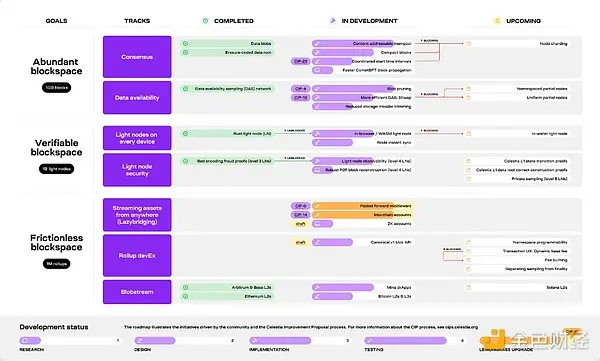
Celestia Mainnet Beta recently released a technical roadmap, with the core goal of expanding to 1GB of Bloquear to improve data throughput. The roadmap is divided into three main workflows: Sufficient Bloquear space, Verifiable Bloquear space, and Barrier-free Bloquear space. To ensure that anyone can verify Bloquear space on any device, the Celestia community is working hard to enable lightweight nodes to run in web browsers. Developers can build any type of application to meet the throughput requirements of different use cases while achieving high throughput and unstoppable effects.
金色财经_·2024-09-06 02:34
Cargar más