What is SSV Network? How Distributed Validator Technology (DVT) Enhances Ethereum Staking Security

Last Updated 2026-05-08 10:10:18
Reading Time: 1m
SSV Network is a fundamental component of the Ethereum ecosystem. By leveraging Distributed Validator Technology (DVT), it distributes control over validator nodes among several independent operators, minimizing single point of failure risks and strengthening overall network security. This article provides an accessible overview of SSV Network’s operational mechanisms and highlights its pivotal role within the current Ethereum staking framework.

What Is SSV Network?

What Is SSV Network

(Source: ssv.network)

SSV Network is an infrastructure project within the Ethereum ecosystem, specializing in Distributed Validator Technology (DVT). Its primary goal is to eliminate reliance on a single operator for blockchain validator nodes, enabling collaborative validation through multiple parties.

SSV Network shifts validation tasks that would traditionally be handled by a single node to a process executed by multiple independent nodes, significantly enhancing both network security and stability.

What Is Distributed Validator Technology (DVT)?

In conventional staking systems, a validator is usually controlled by a single node. If that node fails—due to a crash, attack, or private key compromise—the entire validation process can be disrupted.

SSV Network leverages DVT by splitting and distributing the validator’s private key across several nodes:

  • Multiple nodes share validation authority
  • Failure of any individual node does not affect overall operations
  • Improved attack resistance and fault tolerance

This architecture effectively mitigates the risk of Single Point of Failure and represents a major upgrade direction for Ethereum staking infrastructure.

SSV Network’s Role in Ethereum

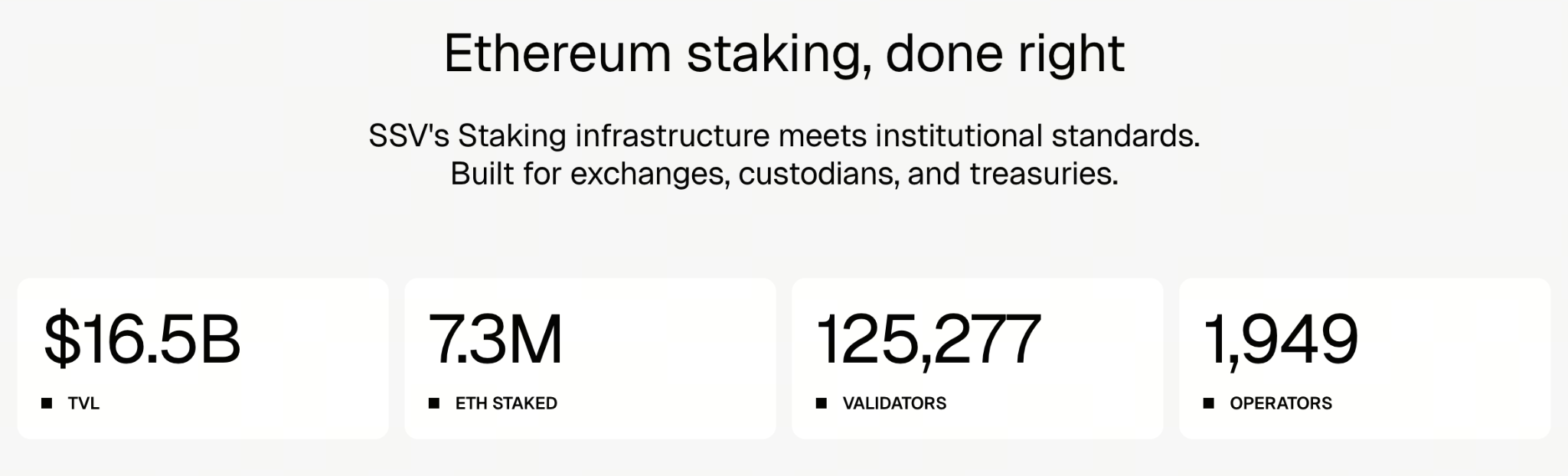
As of this writing, SSV Network is one of the largest DVT solutions in the Ethereum ecosystem, supporting the operation of substantial staked assets.

Network statistics include:

  • Approximately 7.3 million ETH staked via the network
  • Over 120,000 validator nodes active
  • Maintained by about 1,900 node operators worldwide

SSV Network’s Role in Ethereum

(Source: ssv.network)

This decentralized structure further enhances Ethereum’s validation layer, reducing centralization risks.

Why Is This Architecture Important?

As Ethereum transitions to Proof of Stake (PoS), validator node security becomes paramount. SSV Network’s design offers several critical advantages:

  1. Enhanced security The validation process remains operational even if some nodes fail.

  2. Greater attack resistance Attackers must compromise multiple nodes at once, making attacks far more difficult.

  3. Higher degree of decentralization Prevents large institutions or single nodes from dominating network control.

Relationship With Other Staking Services

SSV Network is not a standalone staking platform but a foundational infrastructure component, integrated with various staking protocols and institutional services. As a result, most users interact with SSV technology indirectly through other staking services. Its role as invisible infrastructure makes it a vital yet understated core element in the Ethereum ecosystem.

Summary

SSV Network, through Distributed Validator Technology, has redefined the operation of Ethereum staking. By reducing single-point risks and increasing network security and decentralization, it plays an increasingly critical role as staking scales. This type of infrastructure may soon become standard for future blockchain security architectures.

Author:  Allen
Disclaimer
* The information is not intended to be and does not constitute financial advice or any other recommendation of any sort offered or endorsed by Gate.
* This article may not be reproduced, transmitted or copied without referencing Gate. Contravention is an infringement of Copyright Act and may be subject to legal action.

Related Articles

In-depth Explanation of Yala: Building a Modular DeFi Yield Aggregator with $YU Stablecoin as a Medium
Beginner

In-depth Explanation of Yala: Building a Modular DeFi Yield Aggregator with $YU Stablecoin as a Medium

Yala inherits the security and decentralization of Bitcoin while using a modular protocol framework with the $YU stablecoin as a medium of exchange and store of value. It seamlessly connects Bitcoin with major ecosystems, allowing Bitcoin holders to earn yield from various DeFi protocols.
2026-03-24 11:55:44
The Future of Cross-Chain Bridges: Full-Chain Interoperability Becomes Inevitable, Liquidity Bridges Will Decline
Beginner

The Future of Cross-Chain Bridges: Full-Chain Interoperability Becomes Inevitable, Liquidity Bridges Will Decline

This article explores the development trends, applications, and prospects of cross-chain bridges.
2026-04-08 17:11:27
Solana Need L2s And Appchains?
Advanced

Solana Need L2s And Appchains?

Solana faces both opportunities and challenges in its development. Recently, severe network congestion has led to a high transaction failure rate and increased fees. Consequently, some have suggested using Layer 2 and appchain technologies to address this issue. This article explores the feasibility of this strategy.
2026-04-06 23:31:03
Sui: How are users leveraging its speed, security, & scalability?
Intermediate

Sui: How are users leveraging its speed, security, & scalability?

Sui is a PoS L1 blockchain with a novel architecture whose object-centric model enables parallelization of transactions through verifier level scaling. In this research paper the unique features of the Sui blockchain will be introduced, the economic prospects of SUI tokens will be presented, and it will be explained how investors can learn about which dApps are driving the use of the chain through the Sui application campaign.
2026-04-07 01:11:45
Navigating the Zero Knowledge Landscape
Advanced

Navigating the Zero Knowledge Landscape

This article introduces the technical principles, framework, and applications of Zero-Knowledge (ZK) technology, covering aspects from privacy, identity (ID), decentralized exchanges (DEX), to oracles.
2026-04-08 15:08:18
What is Tronscan and How Can You Use it in 2025?
Beginner

What is Tronscan and How Can You Use it in 2025?

Tronscan is a blockchain explorer that goes beyond the basics, offering wallet management, token tracking, smart contract insights, and governance participation. By 2025, it has evolved with enhanced security features, expanded analytics, cross-chain integration, and improved mobile experience. The platform now includes advanced biometric authentication, real-time transaction monitoring, and a comprehensive DeFi dashboard. Developers benefit from AI-powered smart contract analysis and improved testing environments, while users enjoy a unified multi-chain portfolio view and gesture-based navigation on mobile devices.
2026-03-24 11:52:42