On June 23 local time, Iran's Permanent Representative to the United Nations Office at Geneva, Baghaei, officially confirmed: The Strait of Hormuz is now fully open to global merchant ships for 60 days, with no transit fees charged during this period. Previously, the US and Iran finalized a roadmap in Bürgenstock, Switzerland, to sprint toward a final agreement within 60 days, establishing a high-level committee to coordinate progress and simultaneously forming special working groups on sanctions lifting, nuclear issues, and dispute monitoring. A dedicated liaison hotline for the Strait of Hormuz has been opened, enabling rapid response to emergencies.
This series of events marks a technical détente window in the months-long regional standoff that began with the US-Israel joint strikes on Iran in February 2026. For global commodity markets, the reopening of the strait means far more than the physical opening of a waterway—it signifies that the 'war premium' that previously supported oil prices is being systematically stripped from pricing models.
According to data from commodity data and analytics platform Kpler, as more oil is shipped out of the Persian Gulf, crude oil futures have fallen to their lowest levels since the US-Iran conflict began. Reuters cited shipping data that on Wednesday, three oil tankers were leaving the Strait of Hormuz, carrying a total of about 5 million barrels of crude oil. US Energy Secretary Wright said that 72 vessels passed through the Strait of Hormuz in the past 24 hours, transporting approximately 20 million barrels of crude oil.
The logic behind the dissipation of the geopolitical risk premium is clear: when the Strait of Hormuz, the world's most critical crude oil transport chokepoint, is reopened, the market's panic pricing of supply disruptions loses its core support. But the question remains: is this dissipation of the premium a one-time pulse, or will it trigger a deeper restructuring of asset pricing logic?
The Pricing Logic Shift Behind Crude Oil's 4.5% Single-Day Plunge
On June 25, international oil prices plummeted. NYMEX WTI crude oil futures fell 4.56% to $69.87 per barrel, the lowest since March 2; ICE Brent crude oil futures fell 4.45% to $73.38 per barrel. The intraday low of $73.22 was close to the closing price on February 27, the day before the US-Israel airstrikes on Iran.
This is not a simple news-driven decline. From a price structure perspective, Brent crude has fallen more than 40% from its wartime peak. Dong Chao, senior crude oil analyst at Shenwan Futures, analyzed that this round of decline mainly involves two logics: first, a rapid reversal of geopolitical expectations, with the geopolitical premium of $20 to $25 per barrel formed by the previous conflict being quickly absorbed; second, a significant increase in supply expectations, as OPEC+ has raised production quotas three times in a row, with a cumulative increase of 650,000 barrels per day.
Based on the crude oil geopolitical risk premium index (GPR Index) constructed from Shanghai Ganglian terminal data, the dissipatable panic premium (alpha) has been reduced to zero, and the current premium is entirely structural residual (beta), with no short-term panic that can be dissipated. Model calculations show that the current geopolitical premium in Brent oil prices is only $6.67.
This means oil prices are undergoing a paradigm shift from 'geopolitical pricing' to 'supply-demand fundamental pricing'. The risk compensation previously priced in due to the geopolitical conflict is being largely eliminated. However, whether the market's pricing of this process is overly optimistic remains a question worth observing.
Gold Breaks Below $4,000: Why Safe-Haven Assets are Under Pressure Simultaneously
Oil is not the only asset impacted. As of June 25, spot gold (London) fell 3.17% to $3,991.7 per ounce; COMEX gold futures fell 3.21% to $4,016.4 per ounce. Spot gold broke below the $4,000 mark for the first time since November 2025. It has retreated about 30% from its historical high of $5,598.75 at the beginning of the year. Silver's decline was even steeper, with spot silver (London) falling 6.79% to $57.374 per ounce.
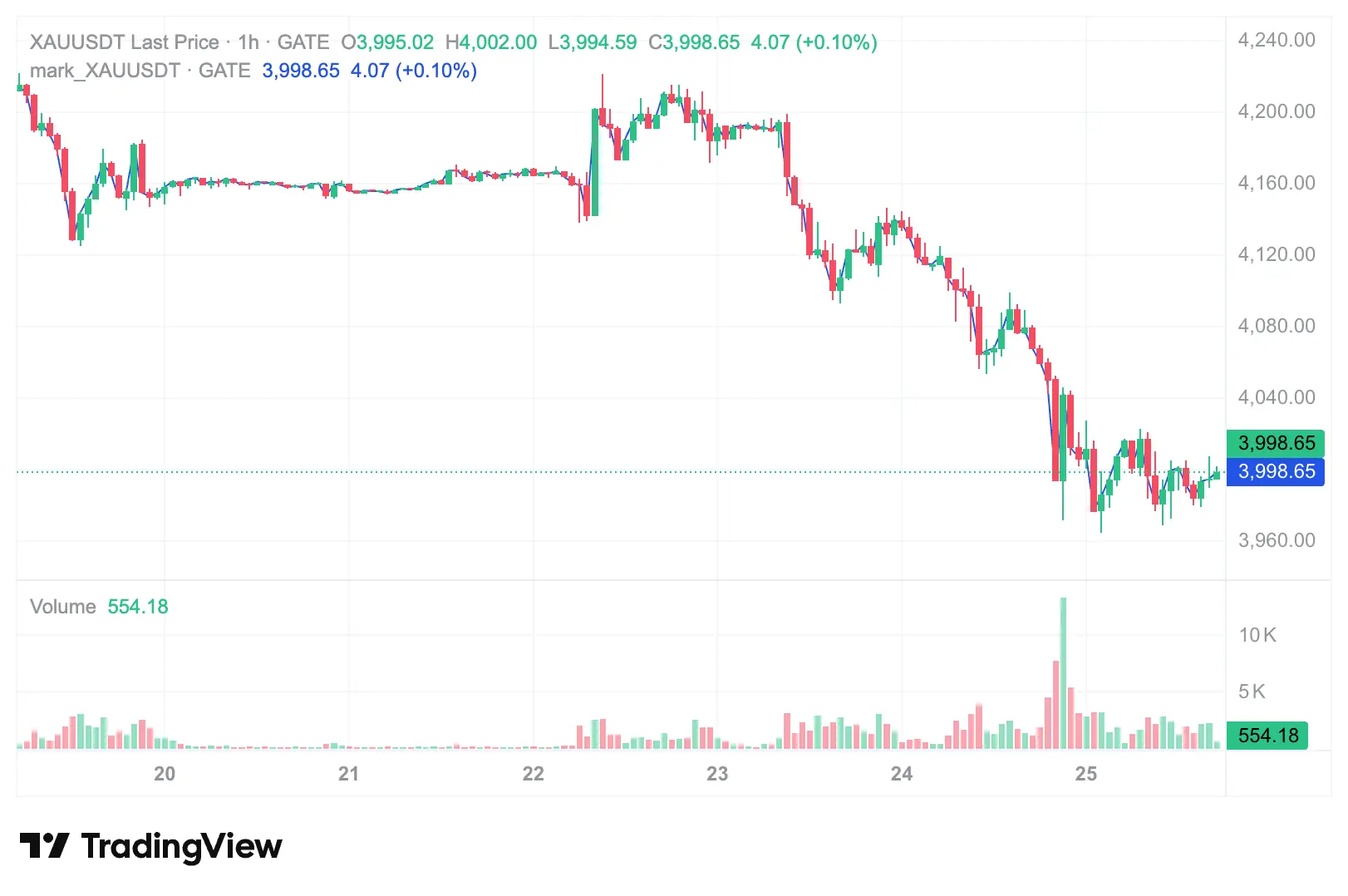
The synchronous decline of gold and crude oil reveals a frequently overlooked correlation: geopolitical risk premium is not unique to crude oil. When the US-Iran conflict intensified, gold, as a traditional safe-haven asset, was priced with a 'conflict premium'; when signs of détente appear, this premium also faces clearing. A deeper transmission mechanism is that falling oil prices ease inflation expectations, thereby weakening the demand for gold as an inflation hedge.
As of June, gold prices have fallen more than 20% from their peak, entering a bear market by market convention. One of the main factors putting pressure on gold is precisely the earlier US-Iran war—rising energy prices pushed up inflation, increasing market expectations of a Fed rate hike. Now that oil prices have fallen, this logic is operating in reverse.
Bitcoin Breaks Below $60,000: Reconfirmation of Risk Asset Attributes
The crypto market has not been spared either. Bitcoin once fell to $59,023.98 on June 25, the lowest level since October 10, 2024. As of press time, Gate data shows BTC is temporarily trading at $61,712, with the 24-hour decline narrowing to 1.5%.
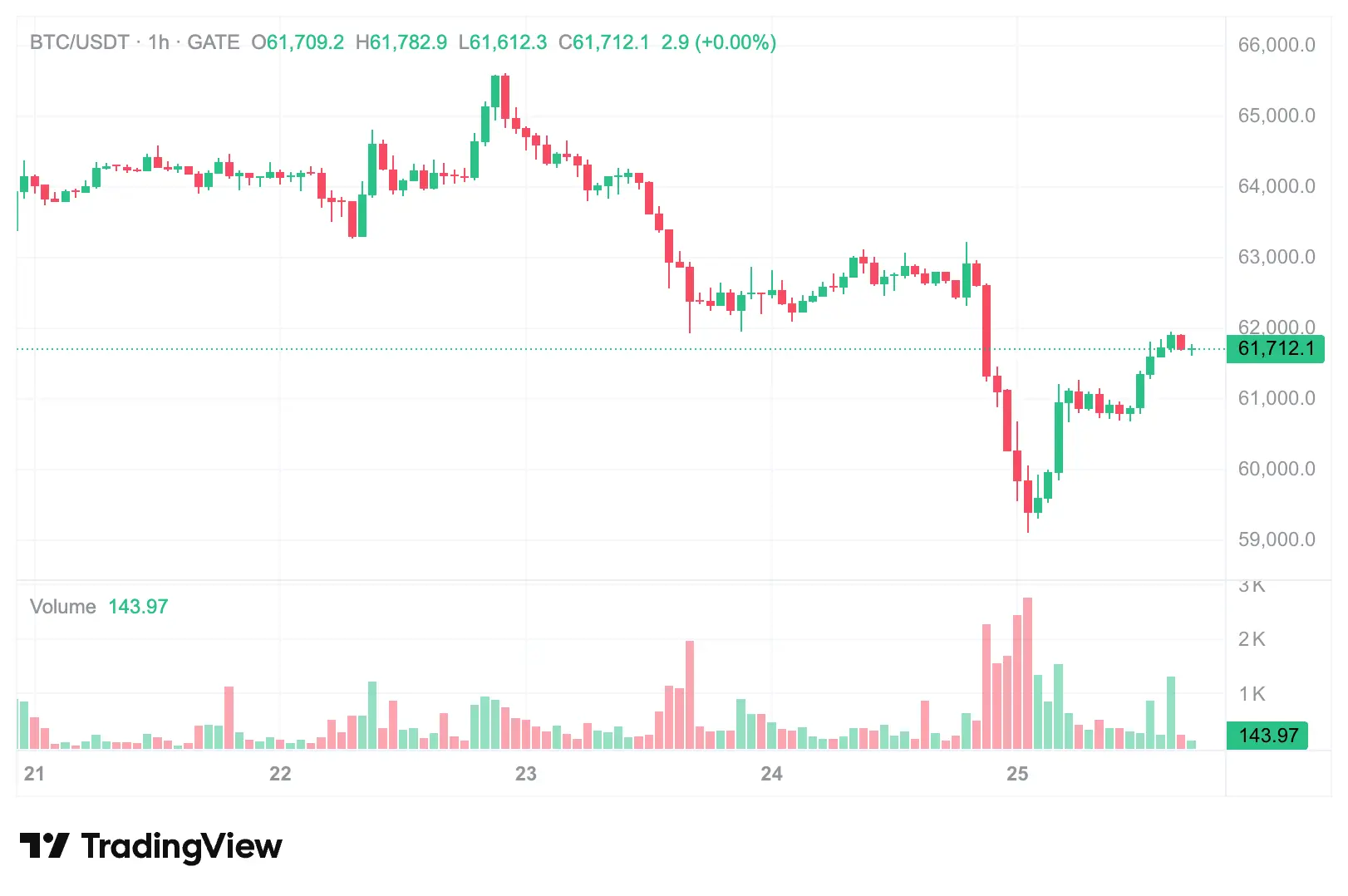
This trend has significant structural implications. After the US-Iran conflict broke out in late February 2026, Bitcoin fell from $73,000 to below $60,000 within a few weeks. Now that the geopolitical situation has eased, Bitcoin has not only failed to rebound but has extended its decline—a pattern that itself suggests Bitcoin behaves more like a risk asset in geopolitical crises rather than a safe-haven asset like gold.
The decline of Bitcoin is happening in sync with the adjustment of tech stocks, with major tech companies experiencing large-scale capital outflows. Analysts point out that the impact of geopolitical factors (related to US-Iran) is weakening, and market focus is shifting to macro data (employment, CPI) and corporate earnings. This further confirms the judgment that Bitcoin's pricing logic has shifted from the 'digital gold' narrative more toward a risk asset framework. When the geopolitical risk premium fades from global asset pricing, Bitcoin not only fails to attract safe-haven inflows but is instead pressured by changes in overall risk appetite.
Transmission Chain and Differentiation Logic of the Three Major Assets
Crude oil, gold, and Bitcoin have all weakened simultaneously under the same event driver, but their transmission mechanisms differ significantly.
Crude oil has the most direct transmission: the reopening of the Strait of Hormuz means the risk of supply disruption is removed, and trapped tankers are departing successively. Washington has granted Tehran a 60-day sanctions waiver, allowing Iran to sell oil during negotiations. Iran's current crude oil exports are about 1.5 million barrels per day, and independent political analysts expect Iran to restore daily production to 1.6 million barrels within 4 to 8 weeks. The sharp shift in supply expectations has directly suppressed prices.
Gold has a more circuitous transmission path: falling oil prices → lower inflation expectations → changes in real interest rate expectations → the benefit of lower gold holding costs is offset by the fading of safe-haven demand. Gold's break below the $4,000 mark was also dealt a double blow by a stronger dollar and rising expectations of further interest rate hikes.
Bitcoin's transmission involves an overall change in risk appetite. When geopolitical risks recede and the market shifts from 'risk-off mode' to 'risk-on mode', funds did not flow into Bitcoin but rather into traditional risk assets. Bitcoin moves lower with risk assets and is highly correlated with AI-themed stocks. This trend indicates that Bitcoin in the current macro environment is closer to high-beta assets like tech stocks than to safe-haven assets like gold.
There is also a deeper correlation among the three: crude oil prices are the anchor of global inflation. Falling oil prices ease inflation pressure and provide policy space for central banks. But at the same time, this also means that the narrative logic that previously drove flows into gold and Bitcoin due to anti-inflation demand is weakening.
How the Uncertainty of the 60-Day Window Affects Subsequent Pricing
Although the market is pricing in 'peace', the fragility of this agreement should not be ignored.
The agreement was essentially a crisis management move where both sides took what they needed. The US side was eager to promote détente, as the blockage of the Strait of Hormuz kept international oil prices high, and domestic inflation pressure directly affected the midterm election outlook. For Iran, years of sanctions plus military confrontation have put enormous pressure on finances and livelihoods, and resuming oil exports and unfreezing assets can quickly revive the economy.
But the consensus currently focuses on technical areas such as the economy and navigation, while the core nuclear issue has not yet entered substantive negotiations. Baghaei explicitly refuted the claim that 'Iran agreed to expand IAEA inspections', stating that such discussions would be left for the next stage. The biggest external variable is Israel—the Lebanon-Israel ceasefire is the first litmus test for the agreement's implementation. Once fighting in southern Lebanon reignites, Iran could restart the strait blockade at any time.
The memorandum of understanding states that shipping will be free through the Strait of Hormuz for 60 days after signing, but if Iran reinstates controls or charges transit fees after 60 days, it could trigger further Western sanctions or military responses. Both countries have hardliners holding sway at home, and any minor disturbance could lead to reversals.
For investors, this means the current market's 'peace pricing' may be overly optimistic. The geopolitical risk premium index shows that the market, in a frenzy of peace, has temporarily 'forgotten' the long-term structural damage the conflict has caused to oil prices. Strait transit data is volatile—on June 19, the transit time for a single passage surged to 141.5 hours, only to fall back to 5 hours the next day—indicating that the risks in the waterway are far from eliminated.
From Zero Geopolitical Premium to Structural Pricing Reconstruction
The US-Iran agreement on a 60-day roadmap and the official reopening of the Strait of Hormuz mark a technical détente in the months-long Middle East standoff. The impact of this event on global asset pricing goes far beyond a single-day crash in oil prices.
From a broader perspective, we are witnessing a turning point in pricing logic: geopolitical risk is rapidly being stripped from commodity pricing. WTI crude falling below $70, gold losing the $4,000 mark, and Bitcoin dipping to $60,000—the rare synchronous weakness of the three points to a core driver: a concentrated clearance of the geopolitical risk premium.
But market pricing is never one-way. The rapid decline in oil prices currently masks the real picture of the shipping market—some oil companies recently inquired about chartering very large crude carriers (VLCCs) for Iraqi crude, with quotes nearly three times pre-conflict levels. Futures reflect expectations; shipping reflects currently deployable capacity and risk premiums. Global commercial crude oil inventories have decreased by 310 million barrels, refined product consumption has accounted for 430 million barrels, and countries have also released 140 million barrels from strategic reserves, bringing total inventories back to low levels seen at the start of 2024. A stock gap of up to 700 million barrels cannot be filled in the short term.
The restoration of oil and gas production capacity in the Middle East is far more complex than 'resuming production as soon as the strait opens'; it is actually a gradual recovery curve that may span up to a year. It will take Iraq 6 to 12 months to fully return to full production capacity. The structural repair timeline for some damaged refineries may extend into 2027.
The upcoming 60-day window is both a litmus test for the US and Iran to verify each other's commitment to implementation and a key observation period for global markets to reassess asset pricing logic in the 'post-geopolitical premium era'. The window of peace is hard-won, but turning it into real structural change will require bridging a trust gap far deeper than the Strait of Hormuz.
FAQ
Q: What is the specific content of the US-Iran 60-day agreement?
A: The two sides finalized a roadmap to sprint toward a final agreement within 60 days, establishing a high-level committee to coordinate progress and simultaneously forming special working groups on sanctions lifting, nuclear issues, and dispute monitoring. A dedicated liaison hotline for the Strait of Hormuz was opened, enabling rapid response to emergencies. Iran confirmed that the strait is fully open to global merchant ships for 60 days, with no transit fees charged during this period. The US Treasury issued an oil export waiver permit, and Iran's $12 billion in frozen overseas assets began to be unfrozen in batches.
Q: Why did crude oil, gold, and Bitcoin fall simultaneously?
A: The common driver of their synchronous weakness is the concentrated clearance of the geopolitical risk premium. Crude oil directly benefits (or suffers) from the removal of supply disruption risk; gold's safe-haven demand fades as the conflict eases, while falling oil prices ease inflation expectations; Bitcoin's decline further confirms its risk asset attribute rather than a safe-haven asset.
Q: What is the specific amount of the geopolitical risk premium?
A: Based on quantitative analysis of the geopolitical risk premium index, the geopolitical premium of $20 to $25 per barrel formed by the previous conflict is being quickly absorbed. The dissipatable panic premium has been reduced to zero, and the current premium is entirely structural residual. Brent crude has fallen more than 40% from its wartime peak.
Q: How likely is the agreement to fail after 60 days?
A: The agreement itself has multiple uncertainties. The nuclear issue has not entered substantive negotiations; Israel is the biggest external variable, and the Lebanon-Israel ceasefire is the first litmus test for the agreement's implementation; both countries have hardliners at home; the memorandum of understanding mentions that if Iran reinstates controls or charges transit fees after 60 days, it could trigger further Western sanctions or military responses.
Q: What does this mean for crypto asset investors?
A: Bitcoin's performance in geopolitical crises is closer to risk assets than safe-haven assets. When geopolitical risks recede, Bitcoin does not attract safe-haven inflows but is under pressure due to changes in overall risk appetite. Investors should monitor the progress of US-Iran technical negotiations, as each negotiation signal could become a catalyst for cross-asset price repricing.


