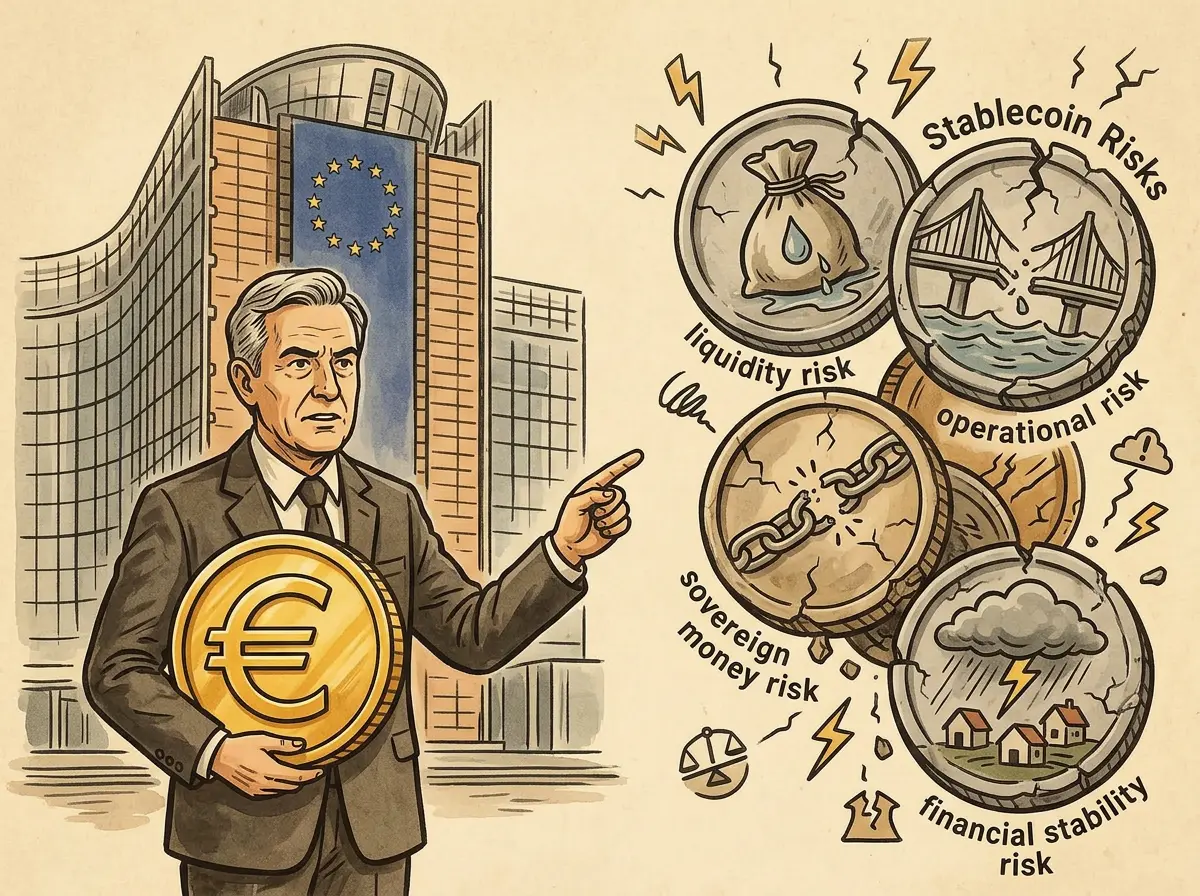
European Central Bank (ECB) Executive Board member Isabel Schnabel said on June 1 at a meeting of the Bank of Korea in Seoul that stablecoins pose multiple risks to financial stability and monetary policy, and the ECB’s best response is to ensure a public currency anchor. Schnabel noted that while private-currency innovations such as stablecoins may bring “significant benefits,” they could increase the risk of bank runs in the financial system and weaken the transmission effect of interest-rate decisions.
Schnabel’s key remarks
In her speech, Schnabel said: “The dominance of the US dollar will be strengthened—this is not necessarily because economic fundamentals are stronger, but because of network effects, economies of scale, and first-mover advantages.”
She also said: “Even for regions with good monetary credibility, the continued dominance of dollar stablecoins—if it strengthens US dollar settlement and global holdings of liquidity—may also lead to negative consequences over time. From Europe’s perspective, this could ultimately limit the role of the euro in emerging tokenized financial forms and in the broader international monetary system.” She also pointed out that many of stablecoins’ advantages come from the underlying technology, not from the tools themselves.
IMF data and the confirmed market backdrop
IMF data shows that the US dollar’s share in global foreign-exchange reserves has fallen to below 57% last year, compared with about 70% around the turn of the century. At present, the overwhelming majority of stablecoins are pegged to the US dollar. Stablecoin usage is relatively low but growing rapidly. Analysts’ models indicate that stablecoin usage is expected to further and quickly grow.
Federal Reserve Governor Waller’s opposing stance
Directly contrasting with Schnabel’s remarks, Federal Reserve Governor Christopher Waller said the day before Schnabel’s speech that the global spread of stablecoins can expand the influence of US central bank policy, and he criticized CBDCs, calling them “stupid stuff.”
FAQ
How does the ECB’s digital euro strategy address stablecoin expansion?
Schnabel confirmed that the ECB relies on the digital euro as a retail CBDC, and tokenized central bank money as a wholesale CBDC. Its goal is to ensure that public currency continues to serve as an anchor for the financial system, countering the impact of private stablecoin expansion on monetary-policy transmission and the euro’s standing.
Why did Schnabel specifically highlight the impact of dollar stablecoins on the euro?
Schnabel said that because the vast majority of stablecoins are pegged to the US dollar, rising usage could reinforce the US dollar’s network effects, economies of scale, and first-mover advantages, limiting the euro’s role in tokenized finance and the international monetary system over time.
In what areas do Waller of the Federal Reserve and ECB Schnabel’s positions directly oppose each other?
Waller believes that the global spread of stablecoins can expand the influence of US central bank policy and criticizes CBDCs; Schnabel believes that stablecoins pose risks to financial stability and monetary-policy transmission, and advocates for the digital euro as the ECB’s response strategy.


