
On June 12, the U.S. Court of Appeals for the Second Circuit rejected FTX founder Sam Bankman-Fried’s appeal, upholding the jury’s guilty verdict and the 25-year prison sentence; the court found that there were no major legal defects in the trial that would warrant overturning the judgment. The three arguments raised by SBF’s legal team—including issues related to the admission of evidence, issues regarding jury instructions, and the exclusion of some defense evidence—were all not accepted by the appeals court.
Appellate Court’s Ruling Confirming the Convictions and Rejecting the Defense Claims
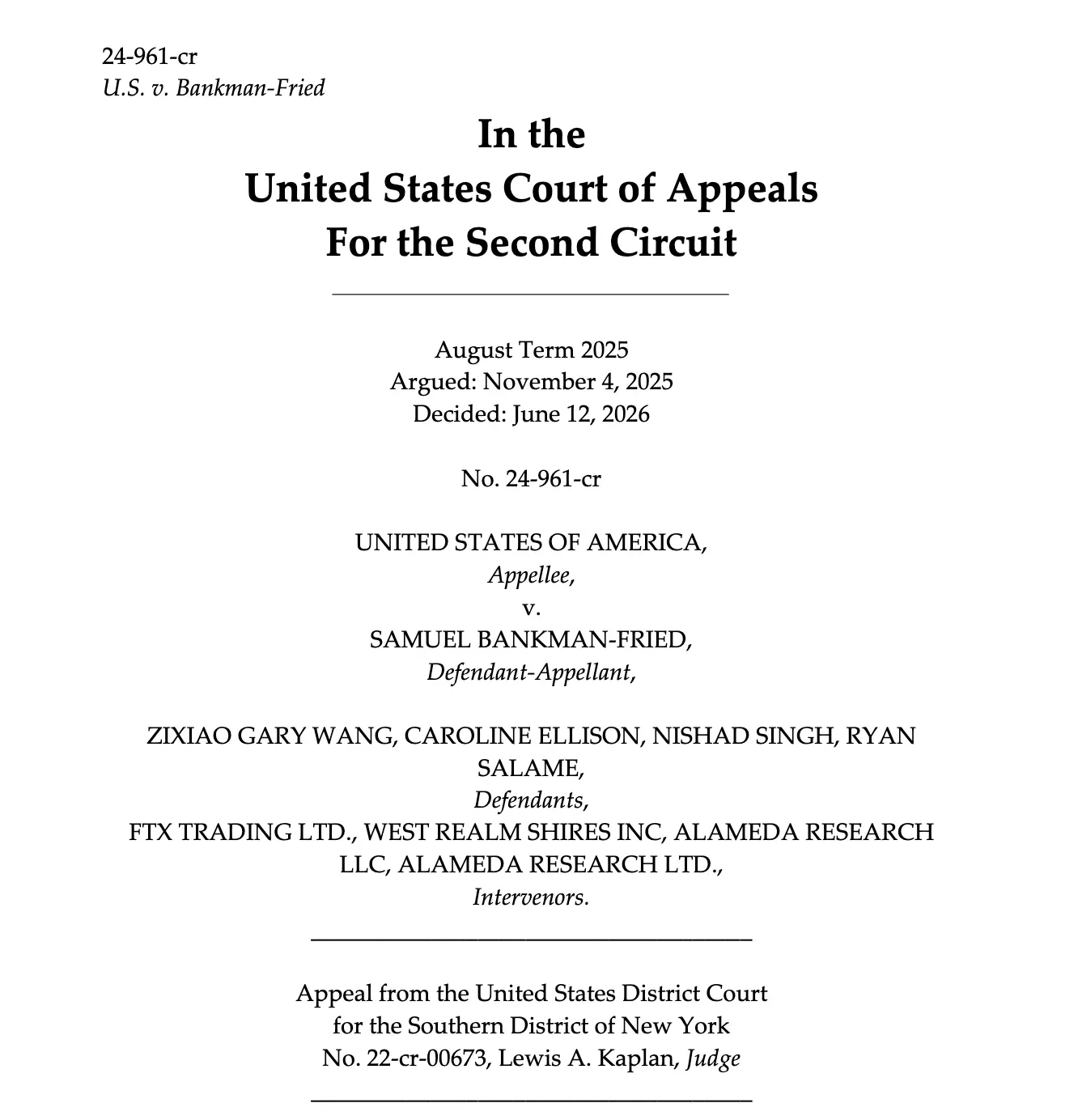 (Source: Justia)
According to the judgment, the appellate court upheld the following charges:
· Wire fraud
· Securities fraud
· Commodities fraud
· Conspiracy to commit money laundering
The appeals court confirmed that none of the three arguments raised by SBF’s defense attorneys were sufficient to overturn the original verdict:
· The trial judge’s exclusion of certain defense evidence does not constitute a major procedural defect
· There is no key issue with the jury instructions that would affect fairness
· The trial judge’s decision to admit relevant evidence complied with procedural rules
The court held that the evidence presented by the prosecution was sufficient to support the jury’s guilty verdict; whether the crimes were established should be determined based on the facts at the time the conduct occurred, rather than on any possible compensatory outcomes that might arise later.
Findings Confirming the Misappropriation of Client Funds: Alameda Research’s Uses and the Bankruptcy Funding Shortfall
The appellate court’s written decision confirmed that during the original proceedings, the prosecution presented a large body of documents, financial materials, internal communications, and testimony from relevant witnesses showing that FTX customer funds were moved to Alameda Research over a long period of time, with uses including: investments, repayment of debts, risk trading, political donations, and other expenses.
The court found that the jury had ample grounds to determine that SBF knew the flow of the funds and the associated risks, yet continued to approve and carry out the related operations, thereby constituting fraud and conspiracy crimes. The written decision also noted that the massive funding shortfall that emerged when FTX filed for bankruptcy was directly linked to the misappropriation of customer assets.
Confirmation of Next Legal Avenues: Supreme Court Filing and Legal Community Assessment
Under the current judicial process, SBF can still file an appeal to the U.S. Supreme Court. Legal circles generally assess that because the appeals court has clearly determined there were no major procedural disputes in the case, the likelihood that the Supreme Court will accept the case is limited.
Some legal experts pointed out that if the Supreme Court ultimately does not accept the case, SBF’s legal options would be greatly narrowed, and the focus could shift to seeking a sentence reduction or other special legal procedures. In recent months, SBF has continued to speak to the public through media interviews, hoping to prompt outside parties to reconsider the case, but based on the current judicial process, U.S. courts’ stance in support of the original verdict appears to be quite consistent.
Frequently Asked Questions
What claims did SBF’s defense raise, and why did the appeals court reject all of them?
According to the written judgment, SBF’s defense attorneys raised three claims: issues with the trial judge’s admission of evidence, issues with jury instructions, and issues regarding the exclusion of some defense evidence. The appeals court found that the relevant disputes were insufficient to change the outcome of the case, and that the evidence presented by the prosecution during the original trial was enough to support the jury’s guilty verdict; therefore, the original verdict was upheld.
Why was the defense’s argument that “because customers might be repaid in the future there is no harm” rejected?
The appeals court stated clearly that whether a crime is established should be determined based on the facts at the time the conduct occurred, not on possible compensatory outcomes that may occur later; therefore, the defense’s argument about subsequent repayment does not affect the determination of the criminal facts.
What is SBF’s next legal avenue?
SBF can still file an appeal to the U.S. Supreme Court (certiorari petition), but legal circles generally believe the likelihood of acceptance is limited because the appeals court has clearly determined that there were no major procedural disputes in the case. If the Supreme Court does not accept the case, legal experts say the focus may shift to seeking a sentence reduction or other special legal procedures.


