Information Pressure in the Crypto Market
Compared to traditional financial markets, the crypto market updates information at a faster pace. Factors such as market prices, trading volumes, on-chain data, and market sentiment can all impact market direction in a short period. With the market operating 24/7, traders must continuously monitor changes to make timely trading decisions.
In this environment, artificial intelligence is being used to process large volumes of market data, assisting traders in data analysis and market assessment. AI’s advantage lies in its ability to handle multiple data sources simultaneously and quickly identify key signals that may affect the market, thus improving overall decision-making efficiency.
Information that needs to be monitored in the crypto market typically includes:
- Market price and trading volume changes
- Capital inflow and outflow conditions
- On-chain transfers and large address behaviors
- Market sentiment and news events
- Price differences between exchanges
When this information is integrated, AI can establish a more comprehensive perspective for market observation, rather than relying solely on price fluctuations.
Gate for AI: Building an Intelligent Trading Environment
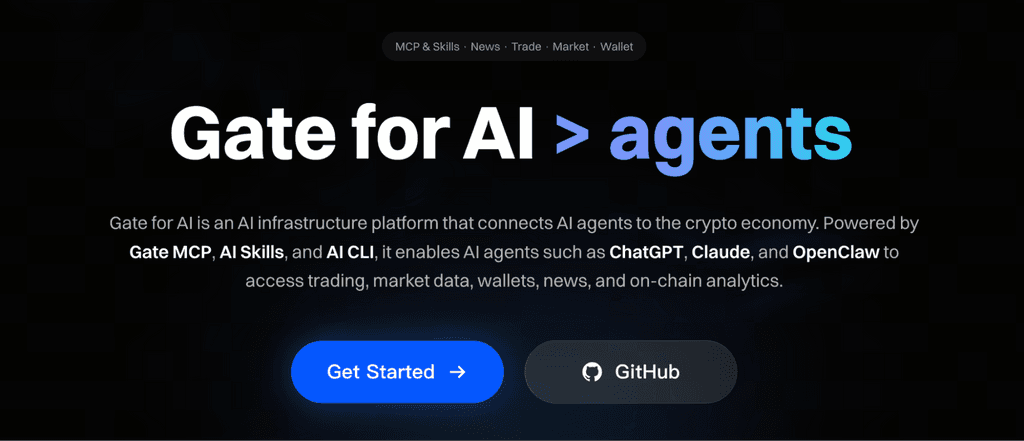
To enhance the role of artificial intelligence in trading, Gate has launched Gate for AI, integrating market analysis, strategy generation, and trade execution within a single system to make trading processes more automated and systematic.
Through modular design, the analysis, strategy development, and trade execution processes—which previously required multiple tools—can now be completed on one platform. This not only reduces operational steps but also shortens the time gap between market analysis and trade execution, making trades more responsive to real-time market changes.
Gate for AI’s system integration mainly includes:
- Market data monitoring system
- Strategy generation and optimization system
- Automated trade execution system
- Risk control and fund management system
With these systems integrated, the trading process can connect data analysis directly to trade execution, forming a complete automated trading workflow.
Core Operational Process of AI Trading Systems
Within Gate for AI’s architecture, AI typically follows a defined process to complete trading decisions, forming a closed loop from market monitoring to strategy execution.
The core process of AI trading systems generally includes several stages:
Real-time Market Monitoring
The system continuously tracks market data such as price trends, trading volume, volatility, and market momentum. Algorithms analyze market changes to identify potential trading signals.
Building Data-Driven Strategies
After market analysis is completed, AI generates trading strategies based on models. These strategies typically combine historical data, technical indicators, and risk control conditions, ensuring that trading decisions are grounded in data.
Automated Trade Execution
When market conditions meet strategy criteria, the system can automatically execute orders, reducing delays from manual operations and making trades closer to real-time market prices.
Continuous Optimization and Adjustment
As the market environment changes, the AI system continuously monitors the market. If trends or volatility shift, the system can automatically adjust strategy parameters to keep trading strategies running smoothly.
AI trading is not a one-time decision but a continuous cycle that includes data analysis, strategy generation, trade execution, and strategy optimization.
Automated Decision-Making and Strategy Optimization
One of Gate for AI’s key features is enabling AI to automatically generate trading strategies based on market data and continuously optimize performance as conditions change. Unlike traditional traders who manually analyze and adjust strategies, AI can make adjustments based on large volumes of historical and real-time market data.
Automated strategy systems typically operate around market data and models, dynamically generating and adjusting strategies. The system automatically builds trading strategies according to market trends and configures position sizes based on user risk preferences. At the same time, it flexibly adjusts trading frequency according to changes in market volatility to adapt to different environments. During strategy execution, the system continuously tracks performance and optimizes relevant parameters, switching to more suitable strategies when there are structural changes in the market.
Through this mechanism of automatic strategy generation and ongoing optimization, trading decisions are built on data and models, forming a more consistent and disciplined decision-making process that effectively reduces emotional interference in trading behavior.
Risk Management and Fund Security Mechanisms
Risk control is a crucial part of automated trading systems because market volatility can increase sharply in a short time. Without risk management mechanisms, automated trading could amplify risks.
Gate for AI typically includes multiple risk management mechanisms such as intelligent stop-losses, risk alerts, and position management to ensure that while pursuing returns, risks are controlled.
Risk controls in automated trading systems usually include:
- Intelligent stop-loss and take-profit mechanisms
- Risk alerts for abnormal market volatility
- Automatic adjustment of positions and risk exposure
- Lowering trading frequency in highly volatile markets
- Multi-layered fund security and trade verification mechanisms
Risk management systems not only protect fund security but are also vital for long-term stable operation of automated trading systems.
Trends in Intelligent Trading
As AI technology advances, future trading systems may integrate more diverse data sources for more comprehensive market analysis—such as on-chain capital flows, cross-market asset movements, social media sentiment, and macroeconomic data.
Future intelligent trading systems will evolve toward higher integration and stronger autonomous decision-making capabilities. On one hand, systems will incorporate more diverse sources of information—including both on-chain and off-chain data—to provide a broader perspective for market analysis. On the other hand, as model capabilities improve, market trend predictions will become more accurate. Based on this foundation, strategy execution will become further automated; AI will not only generate strategies but also proactively adjust risk parameters and position allocations according to market changes.
Additionally, trading systems will move toward personalization by offering more tailored strategy recommendations based on users’ risk preferences and trading goals. As these technologies mature, the role of trading systems will shift from simple analytical tools to intelligent entities capable of direct participation in decision-making and execution.