

Trade
Trading Type
Spot
Trade crypto freely
Pre-Market
Trade new tokens before they are officially listed
Margin
Magnify your profit with leverage
Convert & Block Trading
0 Fees
Trade any size with no fees and no slippage
Alpha
Points
Get promising tokens in streamlined on-chain trading
Leveraged Tokens
Get exposure to leveraged positions simply
Futures
Futures
Hundreds of contracts settled in USDT or BTC
Options
HOT
Trade European-style vanilla options
Unified Account
Maximize your capital efficiency
Demo Trading
Futures Kickoff
Get prepared for your futures trading
Futures Events
Participate in events to win generous rewards
Demo Trading
Use virtual funds to experience risk-free trading
Earn
Launch
CandyDrop
Collect candies to earn airdrops
Launchpool
Quick staking, earn potential new tokens
HODLer Airdrop
Hold GT and get massive airdrops for free
Launchpad
Be early to the next big token project
Alpha Points
NEW
Trade on-chain assets and enjoy airdrop rewards!
Futures Points
NEW
Earn futures points and claim airdrop rewards
Investment
Simple Earn
Earn interests with idle tokens
Auto-Invest
Auto-invest on a regular basis
Dual Investment
Buy low and sell high to take profits from price fluctuations
Soft Staking
Earn rewards with flexible staking
Crypto Loan
0 Fees
Pledge one crypto to borrow another
Lending Center
One-stop lending hub
VIP Wealth Hub
Customized wealth management empowers your assets growth
Private Wealth Management
Customized asset management to grow your digital assets
Quant Fund
Top asset management team helps you profit without hassle
Staking
Stake cryptos to earn in PoS products
Smart Leverage
NEW
No forced liquidation before maturity, worry-free leveraged gains
GUSD Minting
Use USDT/USDC to mint GUSD for treasury-level yields


More
Promotions
Activity Center
Join activities and win big cash prizes and exclusive merch
Referral
20 USDT
Earn 40% commission or up to 500 USDT rewards
Announcements
Announcements of new listings, activities, upgrades, etc
Gate Blog
Crypto industry articles
VIP Services
Huge fee discounts
Proof of Reserves
Gate promises 100% proof of reserves

The era of "lying down and earning" has ended. How will crypto options take on the banner of 2026's returns?
49m ago
PA Daily | Trump Media Group to distribute digital tokens to DJT shareholders; a trader profits millions of dollars amid abnormal BROCCOLI714 market conditions
15h ago
Trending Topics
View More18.02K Popularity
35.9K Popularity
45.61K Popularity
94.46K Popularity
3.46K Popularity
Hot Gate Fun
View More- MC:$3.61KHolders:20.00%
- MC:$3.84KHolders:21.36%
- MC:$3.54KHolders:10.00%
- MC:$3.54KHolders:10.00%
- MC:$3.54KHolders:10.00%





Pin
The paradigm evolution of RWA from the past to the future
Summary
RWA is undergoing a profound paradigm shift - from the experimental phase of Security Token Offerings (STO) to the mature stage of dollar stablecoins backed by U.S. Treasuries, and then to the next generation of financial infrastructure consisting of high-performance public chains and new liquidity solutions for the future.
This paradigm shift not only reflects the evolution of the logic behind Crypto technology, but also mirrors the impending reconstruction and innovation of the financial order.
01 The Evolution of the RWA Paradigm
The paradigm evolution of RWA is essentially the history of the expansion of the blockchain capability stack.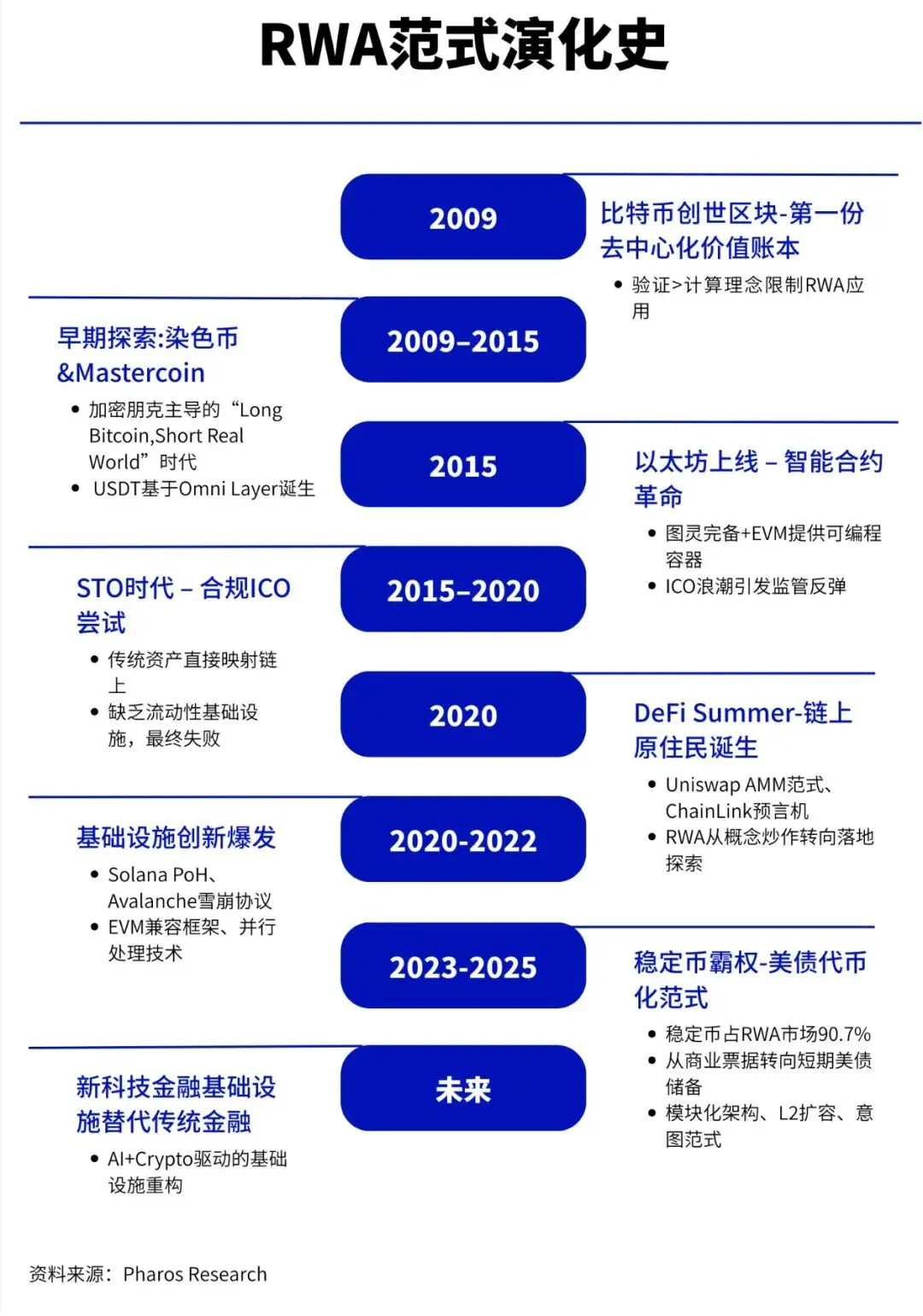
2009-2015: Early RWA Attempts of Colored Coins
In 2009, the Bitcoin genesis block was born, successfully establishing the first decentralized value ledger in human civilization history. However, the vision of Satoshi Nakamoto to build “a P2P electronic currency” led to Satoshi himself and subsequent Bitcoin developers, such as the Bitcoin Core team, adhering to the development philosophy of “verification over computation” and using a non-Turing complete scripting language, making it difficult for the Bitcoin mainnet to serve as an infrastructure for carrying RWA assets to this day.
Moreover, during the early stage of the crypto industry from 2009 to 2015, the concept of RWA itself had not yet matured. During this time, the discourse in the crypto industry was dominated by crypto-punk geeks and advocates of Austrian economics. People were eager to fork the completely open-source Bitcoin mainnet code to innovate in terms of consensus mechanisms, mining algorithms, and signing mechanisms to create digital currencies that confirm transactions faster, distribute more fairly, and better protect personal privacy, joining a rare historical competition in the private currency free market.
However, during the collective frenzy of “Long Bitcoin, Short The Real World,” some industry pioneers like Amir Taaki, co-founder of Colored Coins, and J.R. Willett, founder of Mastercoin (later renamed Omni Layer), recognized the potential of RWA and began exploring the technical route to allow users to create and trade Coins representing physical assets such as stocks, bonds, and real estate on the Bitcoin mainnet. Tether launched USDT based on Omni Layer, becoming one of the earliest centralized dollar stablecoins. However, due to insufficient programmability and a lack of liquidity support, Colored Coins and Omni Layer gradually faded from the main stage of crypto history after the mainstream technological paradigm shift in the crypto market.
2015-2020: Attempts at Compliant Issuance of STO Assets
In 2015, Vitalik, the editor of Bitcoin Magazine who advocated for a Turing-complete technology route, had a fallout with the Bitcoin community and created Ethereum. This introduced the virtual machine EVM and smart contracts, adding a new execution layer on top of the blockchain consensus layer, providing a programmable container for asset tokenization, which in turn sparked the super wave of ICOs characterized by the free issuance of assets, ultimately triggering a backlash and constraints from the financial regulatory authorities of major sovereign countries.
In this era, STO (Security Token Offering) has become the mainstream paradigm of RWA (Real World Assets) under the name of compliant ICO. However, during this period, due to the lack of sound on-chain liquidity infrastructure, immature oracles serving as the on-chain-off-chain intermediary layer, and a lack of decentralized financial application scenarios, RWA is in a state of conceptual hype, with exit channels primarily choosing traditional financial markets like the US stock market/Hong Kong stock market.
The subsequent failure of STO revealed the fundamental flaw in the early RWA paradigm: trying to replicate the business model of traditional financial assets (stocks, bonds) on-chain, while neglecting that the core advantage of blockchain lies in creating new types of liquidity rather than copying the old financial system.
2020-2022: DeFi Summer gave birth to on-chain natives
When the time came for DeFi Summer in 2020, spurred by the wealth effect of Yield Farming, traditional cryptocurrency trading users and professionals in the fintech field transformed into DeFi Degens, becoming the first generation of true on-chain natives. DeFi protocols and developers, along with users, evolved in collaboration, and new things such as DEX, decentralized pool lending protocols, CDP stablecoin protocols, and decentralized derivatives exchanges emerged like mushrooms after rain. The AMM DEX paradigm of Uniswap completely replaced on-chain CLOBs (Central Limit Order Books) DEXs to become the on-chain liquidity infrastructure, while the mainnet launch of ChainLink's oracles became a fundamental component for price feeding and risk management in DeFi protocols. At this time, RWA transitioned from the stage of formal conceptual hype to the stage of practical exploration, and the classic architecture of off-chain asset side - intermediary layer oracle - on-chain liability side began to take shape.
During the innovation-active period from 2020 to 2022, while there was a Cambrian explosion at the application layer and intermediate layer, the consensus layer and execution layer were also undergoing rapid evolution. Innovations in the consensus layer during this phase included: Solana's PoH consensus algorithm, the HotStuff Byzantine consensus algorithm adopted by Sui and Aptos, and the Avalanche snow protocol consensus algorithm, among others; innovations in the execution layer included: the EVM-compatible framework for L1 blockchains and SVM supporting state parallel processing. The rapid finality and fast state execution brought about by the evolution of the consensus and execution layers laid a solid technological foundation for the vigorous growth of RWA in the next cycle.
2023-2025: Establishment of US Dollar Stablecoin Hegemony
The period from 2023 to 2025 is a cycle of explosive growth for broad RWA (including stablecoins). During this time, the tokenization of U.S. Treasury bonds (primarily expressed in the form of USD stablecoins) will replace STO as the new paradigm for RWA.
In the early stages, the correlation between stablecoins and RWA was very weak. At that time, cryptocurrency practitioners never envisioned that stablecoins would one day become the mainstream expression paradigm of RWA. The asset side of centralized stablecoins was mainly comprised of commercial paper, while decentralized stablecoins were primarily based on crypto-native assets. In 2022, under the severe social impact of the consecutive collapses of the algorithmic stablecoin Luna and the cryptocurrency exchange FTX, the Biden administration in the United States demanded that the SEC impose strict regulations on the cryptocurrency sector. Under regulatory pressure, the asset side of stablecoin operators/protocols gradually evolved into an investment portfolio primarily consisting of short-term U.S. Treasury bonds, which have extremely high liquidity and very low risk. Starting from H1 2023, stablecoins began to be viewed by practitioners in the cryptocurrency industry as a subclass example of the broader RWA concept under the tokenization of U.S. Treasury bonds.
Taking USDT as an example, it was initially claimed to be 100% backed by dollar reserves, but the actual reserves included a large amount of commercial paper (short-term unsecured debt). The first reserve disclosure on March 31, 2021, showed that about 65.39% of the reserves were in commercial paper, with cash accounting for only 3.87%. The rest included trust deposits (24.20%), repurchase agreements (3.6%), and government bonds (2.94%) [1]. This disclosure sparked controversy in the market regarding its transparency and risk management. As regulatory pressure increased, Tether began to reduce its holdings of commercial paper. A report in May 2022 indicated that the proportion of commercial paper decreased from $24.2 billion in the first quarter of 2021 to $20 billion, and further dropped to zero in 2023 after the USDC depegged due to the Silicon Valley Bank crisis, shifting towards increasing cash, short-term deposits, and US Treasury holdings, with Tether's short-term US Treasury reserve size reaching approximately $105.3 billion as of September 2, 2025 [2].
On the technical level, the modular design concept aimed at solving the “impossible triangle paradox” of blockchain has swept the entire industry. The architecture of on-chain settlement and off-chain execution is popular, with Rollup L2s represented by Arbitrum and Base quickly and efficiently increasing the supply of block space (Celestia, Bitcoin L2), providing technical support for the scale expansion of RWA, especially stablecoins. The technological advancements of Baas/Raas such as Cosmos SDK and OP Stack (for example, the Vote Extensions in Cosmos SDK ABCI++ 2.0 allow blockchains to submit and verify external data during the consensus process) and cost compression have paved the way for the emergence of RWA/stablecoin Appchains like Pharos. The cross-chain intent standard ERC-7683 jointly formulated by Uniswap and Across, the intent paradigm represented by Cowswap, chain abstraction DEXs represented by Infinex and Particle, and liquidity solutions represented by GTE and Kuru, further enhance the liquidity acquisition capabilities and capital efficiency of RWA.
In 2025, the RWA market will present a pattern of “stablecoins devouring everything.” According to data from RWA.xyz, stablecoins account for as much as 90.7% of the broad RWA assets, becoming the absolute main body of RWA.
The Trump administration, as the first cryptocurrency government, prioritized the clarification of stablecoin regulation to the same level as establishing a national Bitcoin reserve, viewing stablecoins as a new solution to strengthen dollar hegemony, marginally increase demand for U.S. Treasury bonds, and compete for discourse power in the global financial order. The U.S. GENIUS Act (Establishing National Innovation for Stablecoins Act) sets the gold standard for stablecoin reserves as “cash + highly liquid Treasury bonds.” U.S. Vice President Vance candidly stated at the 25th Bitcoin Conference: “Stablecoins are a multiplier of U.S. economic strength.” U.S. Treasury Secretary Bessent has often expressed optimistic expectations in major public venues about the scale of stablecoins rising to $2 trillion or more within a few years.
The evolution path from RWA being dominated by STO to being dominated by stablecoins indicates that the ultimate form of RWA is not merely the simple on-chain of assets, but rather the gradual replacement of the old industrial era financial infrastructure, composed of SWIFT, foreign exchange markets, bond markets, and stock exchanges, by a new technological financial infrastructure driven by AI and Crypto in the new era of technological acceleration. This is precisely the vision and goal of Project Crypto, recently announced by SEC Chairman Atkins, aimed at ensuring the United States maintains its financial leadership in the future.
This will inevitably catalyze a new round of exponential growth on the demand side for block space, forcing a new paradigm innovation on the supply side of block space: high-functional L1/L2 such as Monad, MegaETH, and Pharos achieve millisecond-level finality and TPS of 100,000 through decoupling state execution from state final confirmation, supporting state parallel processing, and optimizing database throughput with entirely new blockchain architecture designs; Solana introduces a new consensus algorithm Alpenglow, further optimizing the block voting and validation process, aiming to help Solana realize the vision of the next-generation Nasdaq. Ethereum presents the “simplified L1” approach, returning to Bitcoin's development philosophy, accelerating the ZK-ification, statelessness, and achieving finality for L1/L2 states of the Ethereum mainnet, aiming to become the foundational settlement layer of modern finance.
02 RWA The current structural reality
Current Structure and Future Trends of RWA Off-Chain Assets
Traditional industry professionals have many very “wild” imaginations about RWA, such as tokenizing certain industrial parks, certain hydropower stations, and other non-standard real-world assets that seriously lack market fair prices and mature risk management mechanisms through RWA to exit in the crypto market. However, the current market structure for RWA off-chain assets is primarily composed of stablecoins, private credit, tokenized U.S. Treasuries, tokenized commodities, institutional alternative investment funds, and tokenized U.S. stocks, with other non-standard real-world assets accounting for almost 0% of the market share. The reason for this market structure is that it is an equilibrium state reached through multiple rounds of market cycles of market forces and technological realities.
The following are the main category details of the structure of RWA off-chain assets as of September 2, 2025 [3]:
• Stablecoins: The total market size of stablecoins is $273.18 billion, with a monthly trading volume of $2.82 trillion and 33.02 million active addresses, while the number of addresses holding stablecoins is 191 million. Among them, 99% of stablecoins are pegged 1:1 to the US dollar. The top 5 stablecoins are USDT, USDC, USDS, USDE, and BSC-USD, with market shares of 60.79%, 25.33%, 4.58%, 3.43%, and 1.68%, respectively. The reason why USDT and USDC, the two leading stablecoins, have about 75% of their off-chain assets in US Treasury bonds has led to stablecoins being viewed as a unique tokenization of RWA for US Treasury bonds. The issued stablecoins are mainly concentrated on the Ethereum and Tron blockchains, with stablecoin sizes of $155.5 billion and $78.4 billion, respectively. The stablecoin size of Solana, ranked third, has drastically dropped to $11.1 billion.
• Private Credit: The total loan scale of private credit is $29.58 billion, with an average yield of 9.75% and a total of 2,583 transactions. The top 3 entities in the private credit sector are Figure, Tradable, and Maple, with loan scales of $15.30 billion, $5.02 billion, and $4.08 billion, respectively. Figure is the largest non-bank home equity line of credit (HELOC) provider in the U.S., utilizing blockchain and AI technology to provide consumers with fast online loan services. Tradable is a fintech company that securitizes private credit, allowing it to be traded in the market, and provides an on-chain asset platform for asset management institutions. Maple is a CeDeFi platform that offers digital asset loans and yield products to institutional and individual accredited investors.
• Tokenization of U.S. Treasury: Strictly speaking, the tokenization of U.S. Treasury consists of 100% U.S. Treasury assets off-chain, with most of the income from holding U.S. Treasury distributed to token holders. The total scale of U.S. Treasury tokenization is $7.46 billion, with an average yield of 4.08%, and a total of 52,793 holders. The top 5 U.S. Treasury tokenization projects are BUIDL issued by Securitize, WTGXX issued by WisdomTree, BENJI issued by Franklin Templeton, OUSG issued by Ondo Finance, and USDY, with scales of $2.39 billion, $880 million, $740 million, $730 million, and $690 million respectively.
• Commodities Tokenization: Currently, commodities tokenization is essentially equal to gold tokenization. Gold tokenization introduces a quality commodity asset into the crypto market that is uncorrelated with core crypto assets like BTC and ETH, allowing institutions and professional investors to diversify the risks of their crypto investment portfolios. Currently, the total scale of commodities tokenization is $2.39 billion, with a monthly trading volume of $958 million, monthly active addresses of 7,866, and holding addresses of 83,700. Among them, the gold tokenization project PAXG issued by Paxos has a market capitalization of $975 million, with a market share of 40.80%; the gold tokenization project XAUT issued by Tether has a market capitalization of $8.54 million, with a market share of 35.75%.
• Institutional Alternative Investment Funds: The RWA transformation of private equity and hedge funds can provide greater transparency, lower fees, and better liquidity. Currently, the total scale of institutional alternative investment funds is $1.75 billion, with a total of 27 products. Centrifuge, Securitize, and Superstate rank the top three in this segment with market shares of 40.31%, 37.34%, and 11.95%, respectively.
• Tokenization of US stocks: The current total scale of tokenization of US stocks is $342 million, with a monthly trading volume of $164 million and 62,600 holding addresses. The US stock tokenization product issued by Securitize, Exodus Movement Inc. Class A, has a market capitalization of $226 million and a market share of 79.34%. Backed, which collaborates with Kraken, Coinbase, and Bybit to issue US stock tokenization products, has a total of 71 products (S&P500, T-bills, TSLA, AAPL, etc.), with a total issuance scale of $88 million and a monthly trading volume of $163 million.
From the above data, it can be observed that the off-chain asset side of RWA mainly consists of standard assets with high liquidity and high credibility (U.S. Treasury bonds hold a monopolistic position), supplemented by private credit. The main forms of the on-chain expression are transaction medium stablecoins and interest-bearing stablecoins (YBS). Currently, the core business logic of RWA is to bring the aforementioned real-world assets from off-chain to on-chain for yield generation and to diversify investment portfolio risks.
However, as the new generation of high-performance public chains (represented by Monad, MegaETH, Pharos, etc.), new paradigms for liquidity creation (such as Intent-Centric, CLOB and AMM integration, etc.), and new oracle technologies (like Chainlink and Redstone's high-frequency pricing feed capabilities) enter the mature stage of their lifecycle, the core business logic of RWA will evolve to primarily selling volatility. Specifically, tokenizing high-frequency trading of on-chain US Treasuries, tokenizing US stocks, tokenizing financial derivatives, and participating in their global pricing will become the new dominant paradigm in the next cycle of RWA.
Robinhood submitted a proposal to the SEC in April 2025, requesting the establishment of a federal framework to tokenize real-world assets (RWA), aimed at modernizing the U.S. securities market. Specifically, it seeks to treat tokenized assets, such as stocks and bonds, as legally equivalent to their traditional forms rather than as derivatives. The federal framework includes a hybrid liquidity system with off-chain matching to enhance speed and on-chain settlement to improve transparency, as well as KYC/AML compliance tools. However, before the CLARITY Act is passed by the U.S. Congress in the second half of this year, Robinhood's proposal lacks practical market feasibility.
Therefore, Robinhood has chosen to launch tokenized US stock trading services in the EU on June 30, allowing EU users to trade over 200 types of tokenized US stocks and ETFs through blockchain technology. These tokenized assets are issued based on Ethereum L2 Arbitrum and will be migrated to the Robinhood Chain, which is isomorphic to Arbitrum, in the future.
Components and Functions of the RWA Middleware
From the perspective of blockchain technology, the RWA middleware mainly addresses the issues of consistency, finality, and message passing between off-chain assets and on-chain liabilities. From the perspective of business models, the RWA middleware primarily tackles the issues of off-chain security, trustworthiness, compliance, and on-chain liquidity, availability, and application scenarios.
The RWA middleware stack consists of off-chain custodial entities, state settlement layers, oracles, application layers, interoperability protocols, on-chain liquidity layers, and more.
• Off-chain asset custody entities: Off-chain asset custody entities are responsible for managing the underlying assets (such as the safekeeping of physical assets) and for the compliant, transparent, and trustworthy minting of RWA asset mapping Tokens. Currently, the top 5 narrow RWA off-chain asset custody entities are Securitize, Tradable, Ondo Finance, Paxos, and Superstate, with market shares of 28.0%, 16.0%, 10.6%, 6.9%, and 6.7%, respectively.
•Settlement Layer: The settlement layer is generally acted by L1/L2 blockchains, responsible for the consistency and final confirmation of RWA asset status. Currently, the top 5 networks used as settlement layers for RWA in a narrow sense are Ethereum, Zksync Era, Stellar, Aptos, and Solana, with market shares of 59.4%, 17.7%, 3.5%, 3.4%, and 2.8%, respectively. The market share distribution of RWA settlement layers is vastly different compared to the market share distribution of familiar DEX trading volumes, TVL, transaction counts, etc. This is related to the fact that the current RWA business types are mainly B-end businesses. A large and active retail investor group prefers to participate in volatility gaming. Therefore, for Solana, Sui, and the new generation of high-performance public chains, how to accelerate the transition of the RWA paradigm from yield generation to selling volatility is a new challenge that they urgently need to address. Only by solving this new challenge can they better adapt to this new version of the system environment characterized by clearer regulatory policies and the integration of currency and stocks.
• Oracle: The oracle is responsible for providing secure and reliable off-chain data, ensuring that the on-chain representation of RWA is synchronized with the real world. For example, RedStone's RWA Oracle provides price feed services for $20 billion worth of RWA on the Solana chain (including Apollo's ACRED and BlackRock's BUIDL); Chainlink offers RWA asset Proof of Reserve (PoR) services for platforms/protocols like Backed, Superstate, 21BTC, ARK 21Shares (ARKB), and Solv. Currently, the scenarios of oracles in the RWA sector mainly serve off-chain asset yield generation and on-chain asset lending, liquidation, and spot trading. In the future, if expanded to high-frequency trading scenarios, there is optimization potential for oracles in terms of price feed speed, time granularity, and costs.
• Application Layer: The application layer provides use cases such as lending, LST, Loop, interest tokenization, and vaults for on-chain liabilities, enhancing the yield and liquidity of RWA assets. Current mainstream DeFi protocols’ support and integration for RWA assets are still in the early stages and relatively conservative. However, RWA public chains like Plume and Pharos are actively building a complete set of application layer components for RWA.
• Interoperability Protocols: Currently, the most active demand for cross-chain interoperability in the RWA sector is for stablecoin cross-chain transfers, which has led to Chainlink's CCIP protocol achieving a high market share in this niche. However, with the improvement of chain abstraction DEXs, intent-centric infrastructure, and the evolution of RWA off-chain asset structures, intent-based cross-chain bridges like Wormhole and Across may become the frontrunners.
• On-chain liquidity layer: The creation of RWA on-chain liquidity has always been a form of financial engineering within the system. It requires spot liquidity for easy swaps, futures liquidity for risk hedging, AMM-based liquidity for cold starts and long-tail assets, as well as CLOB-based liquidity to enhance capital efficiency and reduce transaction costs. The most fashionable and complete on-chain liquidity layer today consists of DEX LP Pools, aggregator trading routes, intent DEX Solvers, and intent aggregation of chain-abstract DEX. It is important to note that the optimization of on-chain liquidity is no longer limited to the execution layer of the blockchain stack, but delves into the consensus layer for TX ordering and block finality performance and mechanism optimization, such as Celestia's new narrative of CLOB on Blobs and Solana's new consensus algorithm Alpenglow.
RWA On-chain Liabilities: Transaction Medium Stablecoins, YBS, RWA Equity Assets
The liability side is the financial abstraction layer that users directly interact with, and its main forms of RWA are expressed as transaction medium stablecoins, interest-bearing stablecoins (YBS), and RWA equity asset Tokens.
Transaction medium stablecoins mainly include USDT and USDC, which are issued by centralized entities and maintain their vast on-chain and off-chain liquidity networks. They feature accessibility, low transfer costs, fast confirmation, and programmability. There is an essential difference between transaction medium stablecoins and Central Bank Digital Currencies (CBDC); the essence of transaction medium stablecoins is a token that maps fiat cash on-chain, while the essence of CBDC is a new form of fiat cash. The Trump administration in the United States clearly opposed CBDC while supporting stablecoins, whereas the EU and China chose to promote CBDC while restricting stablecoins. In this cycle, the application scenarios for stablecoins, in addition to previously mentioned functions as a transaction medium in the crypto market, value storage, cross-border payments, and helping the U.S. to reduce debt, have also expanded to new scenarios such as PayFi and supply chain finance, like Huma's cross-border settlement financing and JD.com's stablecoin supply chain finance. The main battleground for traditional stablecoin competition in the next cycle will be the A2A micropayment scenario. Tether and Circle have respectively invested in and incubated Stable and Arc to ensure they maintain their leading position in the stablecoin track in the AI era.
To protect the traditional banking industry from impact, the GENIUS stablecoin bill prohibits compliant stablecoins from paying interest to stablecoin holders, which in turn gives YBS, which primarily adopts the DeFi product paradigm and operates in a regulatory sandbox, room to survive. YBS earnings typically come from DeFi lending, market-neutral strategies, staking rewards, or interest income from RWA. RWA YBS includes traditional financial assets such as U.S. Treasury bonds and structured credit, which, after being tokenized on-chain, can serve as collateral or investment objects for stablecoins. This combination not only enhances the stability of stablecoins but also provides DeFi users with yield opportunities similar to traditional finance.
RWA equity asset Tokens are equity Tokens of real-world assets (such as private credit, commodities, US Treasury bonds, and US stocks) that are tokenized on the blockchain. Previously, RWA equity asset Tokens had low demand for DeFi composability and on-chain liquidity. However, after the clarification of cryptocurrency regulations, embedding RWA equity asset Tokens into DeFi Lego and pursuing stronger on-chain liquidity has become a new trend. For example, AAVE recently launched an RWA lending platform that supports borrowing stablecoins against collateralized permitted RWA assets. In the future, equity asset Tokens of US Treasury bonds, US stocks, and commodities will be legally equivalent to off-chain assets in terms of asset nature, further enhancing the demand for DeFi composability and on-chain liquidity.
Observing the real market structure of RWA, we find that the RWA that has successfully “gone on-chain” at this stage are basically standardized assets like U.S. Treasury bonds, private credit, gold, and U.S. stocks, which have high liquidity and fair effective market prices. At this stage, what RWA can do more is to encapsulate standardized assets and abstract them into on-chain Tokens.
This is due to the technical bottlenecks of oracles in handling the pricing and ownership of non-standard assets, which limits the RWA (Real World Asset) conversion of a vast amount of non-standard real-world assets (such as real estate, industrial parks, land, forests, mines, etc.). For non-standard assets like real estate and minerals, how is the price determined? How is ownership verified? Existing oracle technology still struggles to handle reliable price assessment and ownership verification for non-standard assets. Moreover, putting non-standard assets on-chain usually requires the establishment of a legal entity (SPV) to hold the actual assets, and the tokens on the chain often only represent rights to income, rather than true property rights.
The future of RWA is not simply about “putting everything on the chain”. A more realistic path is to find a balance between regulatory compliance and technological innovation through the abstraction of compliance layers (encapsulating real assets with legal entities) + enhancing on-chain liquidity (high-performance public chains + hybrid market-making models of CLOB\AMM), thereby leveraging the trillion-level value of non-standard assets. The large-scale explosion of non-standard asset RWA may have to wait until oracle technology matures and regulatory sandboxes are effectively run, with expectations for rapid growth likely occurring after 2026.
03 Conclusion
RWA 1.0 simply tokenizes traditional assets such as real estate, industrial parks, and artworks. This idea is inherently flawed because it assumes that blockchain is a magic machine for creating liquidity.
The current RWA 2.0 is a stablecoin paradigm that uses U.S. Treasury bonds as the core reserve of assets, achieving significant scale success in transaction medium, cross-border transfers, and value storage and preservation. However, it lacks sufficient compatibility with traditional financial infrastructure, resulting in severe friction during on/off ramp processes.
The future of RWA 3.0 is to create a new financial primitive aimed at an AI and Crypto-driven era of sovereign individual capitalism using high-performance blockchain, RWA-friendly oracles, AMM+CLOB hybrid models, and intent-centric technologies.
What we are about to witness is not only a technological and financial innovation, but also a significant historical process of restructuring the global capital order.
Reference Source
[1] Coindesk,
[2] Tether,
[3] RWA.xyz,
Source: