On October 15, 2025, Vitalik Buterin made a rare public statement for a specific project, and this time he chose the rising star in the ZK track — Brevis. This ZK computing layer, claimed to be the “greatest hope for Ethereum scalability x100,” quickly became the market focus due to its astonishing performance, achieving an average proof time of 6.9 seconds with the zkVM Pico Prism under a cluster of 64 RTX 5090 GPUs. However, behind the halo of Vitalik's endorsement and the $7.5 million funding, its undisclosed Token economic model and highly hardware-dependent technical path pose core challenges that the project cannot avoid.
What is Brevis?
Brevis is an off-chain computing engine built on zero-knowledge proofs, positioned as the “unlimited computing layer for Web3 and everything.” It aims to solve the long-standing “impossible triangle” problem in the blockchain field - how to achieve large-scale complex computations while maintaining decentralization and security.
The core value proposition of the project is:
- Off-chain computation, on-chain verification: Allows developers to run complex computations (such as data processing, machine learning inference) off-chain and generate compact ZK proofs for quick verification on-chain.
- Accessibility of Historical Data: By utilizing ZK co-processor technology, smart contracts can reliably access and compute any on-chain historical data.
- Generic Architecture: Supports the development of general-purpose programs using the Rust language, providing infrastructure for advanced applications such as ZKML and cross-chain validation.
Core Innovation Analysis: The Paradigm Revolution of ZK Co-Processors
The technological breakthroughs of Brevis are reflected in three key areas:
Performance Breakthrough zkVM Architecture
-
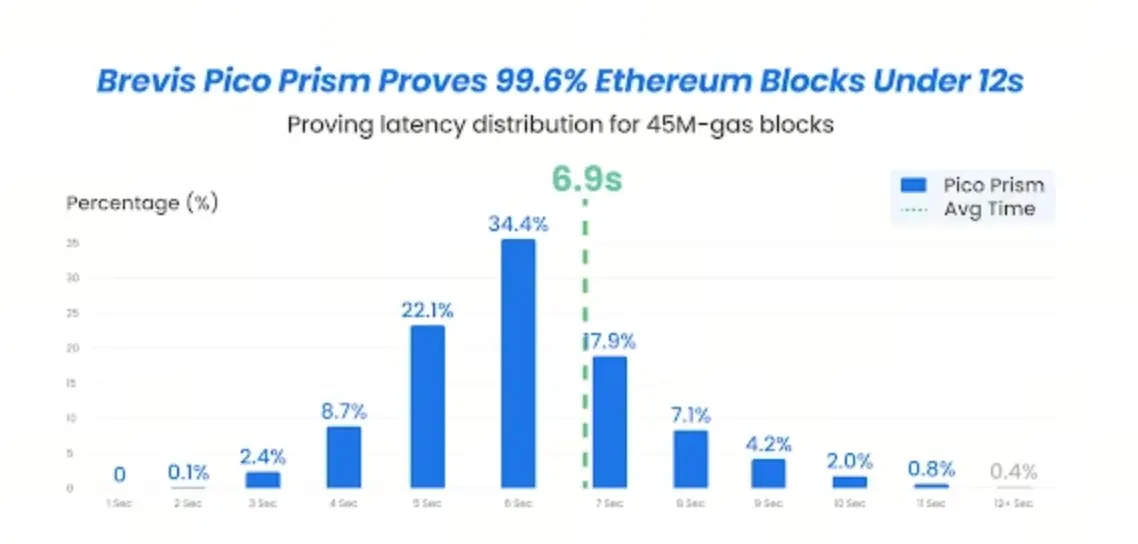
Pico Prism zkVM achieves 99.6% of ZK proof tasks completed within 12 seconds under high-end hardware configuration, with an average of only 6.9 seconds.
-
Compared to traditional methods, it is 3.4 times faster, with hardware costs cut in half, directly addressing the redundant computation issue of Ethereum node validators.
-
Future goals support “mobile verification blockchain network,” significantly reducing the participation threshold.
coChain AVS integrated with EigenLayer
- Provide cryptoeconomic security for ZK proofs through the EigenLayer re-staking mechanism.
- Significantly reduce co-processing costs while maintaining decentralized trust.
- Achieving ZK proof security and secure sharing with the Ethereum mainnet
Developer-Friendly Application Ecosystem
- SDK supports “three-step integration”: specify data, run computation, on-chain verification.
- Complex applications can be built without deep ZK expertise, significantly lowering the development threshold.
- Dynamic DeFi incentives, RWA transparent rewards, perp DEX loyalty programs and other practical use cases are now supported.
Financing Information
Although Brevis has completed its token financing, key details of its token economic model remain confidential.
Known Information:
- Completed $7.5 million seed round financing in November 2024
- The financing was co-led by Polychain Capital and Yzi Labs.
- IOSG Ventures, Nomad Capital, Bankless Ventures and other well-known institutions participated in the investment.
- This round of financing is a Token financing, but the specific valuation has not been disclosed.
Critical Doubt and Core Suspense:
- Token details temporarily missing: According to existing public information, the total supply, allocation ratio, TGE timing, initial circulation, FDV, and other key information of Brevis's token have not been disclosed. Investors are making decisions in an information vacuum.
- Confidentiality of Financing Valuation: As a Token financing, the lack of valuation information prevents the market from assessing whether the project's pricing is reasonable, and it is also unable to predict the potential selling pressure of future Token issuance.
- VC Concentrated Holdings Risk: A luxurious investment lineup may provide endorsement, but it also means that there could be concentrated institutional selling pressure when the tokens are unlocked in the future.
Ecosystem Support and Market Heat
Brevis shows strong momentum in ecological construction and market recognition:
- Top-notch Technical Endorsement: Received public support from Vitalik Buterin, highly aligned with the Ethereum 2025 roadmap, including key goals such as 99% coverage and sub-10 second proof.
- Strong Institutional Support: Top cryptocurrency funds such as Polychain and Yzi Labs lead the investment, with participation from professional institutions like IOSG and Bankless Ventures, providing ample funding and resources.
- Significant ecosystem adoption: Over 72.9 million proofs generated, integrated with 100+ partners, including top projects like PancakeSwap, Frax, MetaMask.
- Actual Value Creation: Driven a $4 billion TVL growth, proving that its technology indeed addresses market demands.
- Active Community Building: Attracting community participation through Proving Grounds activities, a preliminary user base has been established.
Brevis Interaction Tutorial: Step-by-Step Participation in ZK Track Newcomer Airdrop
For users who wish to participate in the Brevis ecosystem and potentially receive future airdrop rewards, you can currently interact through the Proving Grounds event launched by the official team. Here is a detailed operation guide:
Preparation
- Visit the official website
- Prepare your wallet address (supports mainstream EVM wallets)
- Prepare X (Twitter) account and Discord account
Detailed Operation Steps
Phase 1: Basic Training (2025.10.13 - 11.2)
- Initial Setup
- Connect the wallet, and the system will automatically create an account.
- Bind X account and Discord account
- Enter the invitation code to receive a 50 points initial reward
- Social Tasks (Can be completed daily)
- Daily Check-in: Earn 10 Sparks daily, with an additional bonus of 200 points for consecutive check-ins of 7 days, 14 days, or 30 days.
- Social Interaction: Like and retweet Brevis official tweets, each task earns 100 Sparks, and accumulating to complete gives a milestone bonus of 500 points.
- Invite Friends: For each valid user invited (with points exceeding 100), you can earn 200 Sparks, with a maximum of 10 people you can invite.
- Community Tasks
- Follow the official social media: including X account @brevis_zk and Discord community
- Join community discussions and participate in technical learning
- All tasks will have their points updated within 24 hours after completion.
Phase 2: Practical Operation (Starts on 2025.11.3)
- On-chain interaction
- Interact with dApps integrated with Brevis
- Including but not limited to: DEX trading, lending protocols, staking operations, etc.
- Earn more Sparks points through real on-chain actions
- Developer Participation
- Visit the official documentation
- Build ZK applications using SDK and Pico zkVM
- Writing code in Rust + Solidity callback can create ZK applications
Important Notes
- Uniqueness Requirement: 1 wallet address corresponds to 1 X account and 1 Discord account
- Points Rules: Sparks points will serve as an important basis for future airdrops, but the specific conversion rules have not been announced.
- Schedule: Phase 1 focuses on community building, while Phase 2 emphasizes on-chain interactions. Users are encouraged to actively participate in both phases.
- Security Reminder: Participate only through official links, and do not disclose your private keys or mnemonic phrases.
Expected Returns and Strategy Recommendations
- Time Investment: About 5-10 minutes daily to complete basic tasks
- Cost Estimate: Phase 1 has almost zero cost, Phase 2 requires a small amount of Gas fee for on-chain interaction.
- Optimization Strategy: Start participating early to maximize continuous sign-in rewards, actively invite high-quality users to improve rankings.
- Risk Warning: The qualifications and quantity for participation are ultimately determined by the project party, and participation does not guarantee rewards.
Potential Opportunities and Core Risks Coexist
Potential Opportunity:
- Technological Leading Advantage: The proof generation speed is 3.4 times faster than traditional methods, establishing a significant performance barrier in the ZK track.
- Clear Market Demand: Off-chain verifiable computation is a core infrastructure demand in the fields of DeFi, GameFi, AI, and others.
- Top Ecological Positioning: Deeply aligned with the Ethereum development roadmap, expected to become the standard for ZK co-processors.
- Robust Partner Network: Collaboration with leading DeFi protocols demonstrates the maturity of the product.
- Clear first-mover advantage: There are currently no competitors with equivalent technical strength in the ZK co-processor track.
Core Risks:
- Token economic model not disclosed: The lack of token information is the biggest obstacle to investment decisions.
- High Dependency on Advanced Hardware: The 6.9 seconds proof time relies on a cluster of 64 RTX 5090 GPUs, raising doubts about actual deployment costs and scalability.
- Missing Team Background Information: According to existing public information, the specific background, technical experience, and past achievements of core team members have not been disclosed in detail
- Intensified Competitive Environment: The ZK track is highly competitive, with multiple teams developing similar solutions.
- Technical Implementation Complexity: The ZK technology itself is still in a rapid development stage and may have undiscovered security vulnerabilities.
- Market expectations are too high: Vitalik's endorsement has raised market expectations, and any technological or business progress that falls short of these expectations could trigger a sharp correction.
- Airdrop Uncertainty: The correlation between interaction activity points and the final airdrop results is not explicitly guaranteed, posing a risk of investing time without any returns.
Conclusion and Strategy Recommendations
Brevis represents the forefront of technological exploration in the ZK infrastructure field, with its performance data and ecological adoption proving the effectiveness of the technology. However, investment decisions must remain highly cautious until the details of the token economy and the team background are clarified.
- For high-risk tolerant investors (aggressive): If you firmly believe that ZK co-processors are the next key infrastructure, you may consider accumulating early points and airdrop eligibility by participating in the Proving Grounds community activities. However, it is essential to strictly control your positions, only invest funds that you can afford to lose entirely, and be prepared for long-term lock-up to cope with potential market fluctuations. It is recommended to view the investment as a bet on the infrastructure of the ZK track, rather than a short-term trade.
- For investors with moderate risk tolerance (conservative type): It is strongly recommended to adopt the strategy of “waiting for key information disclosure”. The primary task is to wait for the project to publish the complete Token economic model and team background information. At the same time, closely monitor its mainnet adoption rate, the actual optimization progress of proof generation costs, and cooperation dynamics with new leading projects. Participation in Phase 1's zero-cost social tasks to accumulate points can be moderately undertaken, but no financial investment should be made for now.
- For conservative investors: It is recommended to clearly avoid investment at this stage. The project has high technical complexity, opaque token information, and strong hardware dependency, with multiple uncertainties exceeding the tolerance range for conservative investments. It can be included in the technology watchlist, but no capital allocation should be made.
Summary: Brevis is a typical technology-driven infrastructure project, and its technological achievements are impressive. However, the investment value entirely depends on whether the team can translate its technological advantages into a sustainable business ecosystem and reasonable Token value accumulation. Until the uncertainties surrounding the Token economic model and the team's background are resolved, maintaining a technology-optimistic yet cautious investment attitude is the only rational choice. Participating in interactive activities as an opportunity to understand the project and accumulate potential airdrop qualifications is worthwhile, but one should rationally consider the cost-benefit ratio.
Disclaimer: The information on this page may come from third parties and does not represent the views or opinions of Gate. The content displayed on this page is for reference only and does not constitute any financial, investment, or legal advice. Gate does not guarantee the accuracy or completeness of the information and shall not be liable for any losses arising from the use of this information. Virtual asset investments carry high risks and are subject to significant price volatility. You may lose all of your invested principal. Please fully understand the relevant risks and make prudent decisions based on your own financial situation and risk tolerance. For details, please refer to
Disclaimer.
Related Articles
Charles Schwab will pilot direct trading services for Bitcoin and Ethereum in the second quarter
Charles Schwab Wealth Management announced that its subsidiary will provide direct trading services for Bitcoin and Ethereum via Schwab Crypto accounts, with plans to test and launch in 2026. A waiting list is now open, but external cryptocurrency deposits or withdrawals are not supported.
GateNews2h ago
The Ethereum Foundation’s staked amount reaches 46k ETH, having completed two-thirds of its target
Gate News message, on April 5, the Ethereum Foundation increased its staked ETH holdings; it has now reached about two-thirds of its preset target of 70k ETH staked, or roughly 46k ETH. This move is intended to strengthen the blockchain’s core infrastructure and support network security. The Ethereum Foundation plans to continue staking the remaining approximately 23k ETH; the rewards earned are typically used to fund research, grants, and protocol upgrades. Currently, the total staked supply across the Ethereum network has reached tens of millions of coins.
GateNews2h ago
ETH 15-minute surge of 1.15%: ETF net inflows accelerate and large whale accumulation converges to drive the rally
2026-04-04 19:00 to 19:15 (UTC), the ETH price saw a significant spike. Within 15 minutes, the return rate recorded +1.15%. The price range was between 2055.26 and 2079.75 USDT, and the intraday amplitude reached 1.19%. Market attention increased markedly, with trading activity and on-chain large transfers expanding in tandem, triggering rapid fluctuations in the short-term price action.
The primary drivers behind this move are accelerated net inflows into ETFs and institutions concentrating their positioning in the spot market, which directly pushed the ETH price higher. The data show that BlackRock ETHB
GateNews7h ago
Ethereum's Vitalik Buterin Warns Against AI Agent Security Risks, Shares His Private LLM Stack
Ethereum co-founder Vitalik Buterin has moved entirely off cloud AI services and detailed his fully local, sandboxed artificial intelligence (AI) setup in a blog post published this week.
Key Takeaways:
Ethereum co-founder Vitalik Buterin abandoned cloud AI in April 2026, running Qwen3.5:35B loca
Coinpedia7h ago
Tom Lee's Bitmine Acquires 40,000 ETH Worth $82.07 Million
Gate News message, Tom Lee's Bitmine purchased an additional 40,000 ETH valued at $82.07 million from centralized exchanges today. The transaction marks another significant ETH accumulation by the firm.
GateNews12h ago


