One is the darling of institutional capital, and the other is the king of high-frequency applications. The essence of competition among public chains has shifted from technical performance to the capture of ecological value.
In 2025, the world of cryptocurrency is witnessing an exciting duel between two giants. Solana and Ethereum—these two blockchain platforms, which are fundamentally different in architectural philosophy, ecosystem strategy, and value proposition—are engaged in a comprehensive competition about the future of blockchain.
Data shows that Solana processed 2.9 billion transactions in August 2025 alone, a figure that is comparable to Ethereum's entire transaction history since its launch in 2015. Meanwhile, Ethereum continues to defend its position as the “settlement layer for everything” with its total locked value (TVL) exceeding $94 billion and a massive influx of institutional investment.
01 Technical Architecture Differences: The Philosophical Collision Between Proof of History and Proof of Stake
The fundamental differences between Solana and Ethereum (Solana vs Ethereum) stem from their completely different technical architecture designs, which directly determine the trade-offs between performance, security, and decentralization for both.
Consensus Mechanism Innovation
Solana adopts a unique hybrid consensus mechanism that combines Proof of History (PoH) and Proof of Stake (PoS).
PoH is essentially a cryptographic clock that orders transactions through timestamps, allowing the network to process a large number of transactions in parallel without waiting for global consensus.
This design allows Solana to achieve a block time of 400 milliseconds and an approximate finality time of 12 seconds.
In comparison, Ethereum has fully transitioned to the Proof of Stake (PoS) consensus mechanism after completing the merge in 2022.
It maintains the characteristics of sequential transaction processing, with a block time of about 12 seconds and a finality time of 6 minutes. Ethereum is working to address scalability challenges through its layered roadmap, focusing on Layer 2 scaling solutions and future sharding technology.
Performance Comparison
The direct result of the two architectures is reflected in the performance metrics:
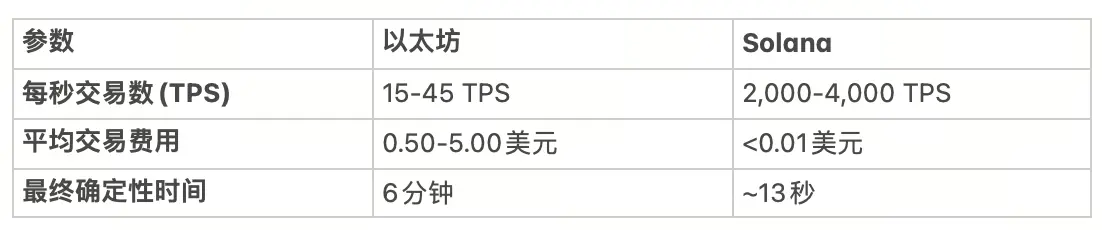
Solana's high throughput and low transaction costs give it a significant advantage in application scenarios that require high-frequency interactions. In contrast, Ethereum has improved transaction speeds to 40-60 TPS through its Layer 2 scaling solutions, such as Arbitrum and Optimism, while reducing Gas fees by 70%.
02 Ecosystem Comparison: Differentiation between Institutional Fortresses and Consumer Main Chains
In 2025, the ecosystems of Solana and Ethereum (Solana vs Ethereum) have shown distinctly different development paths and user groups.
Ethereum: The Financial Fortress of Institutional Assets
Ethereum is increasingly becoming the fusion layer between traditional finance and decentralized finance. With the passage of the U.S. “GENIUS Act,” stablecoins have been incorporated into the federal regulatory framework. Ethereum, with its solid compliance foundation and institutional-grade infrastructure, has become the preferred choice for institutional capital entering the crypto world.
Data shows that by July 2025, the total amount of RWA (Real World Assets) issued on-chain will exceed $40 billion, with over 70% occurring on the Ethereum mainnet and its Layer 2 networks.
Many institutional products, including BlackRock's BUIDL and Franklin Templeton's BENJI, have chosen Ethereum as their underlying settlement layer.
At the same time, the Ethereum spot ETF is also steadily advancing, with institutions like Grayscale and VanEck actively preparing related products. This institutional adoption further solidifies Ethereum's status as the “Wall Street token.”
Solana: A Paradise for High-Frequency Consumption Applications
Solana has successfully positioned itself as the preferred platform for high-frequency trading and consumer applications. Its extremely low transaction costs (an average of $0.00025) and high throughput provide an ideal infrastructure for applications that require a large amount of user interaction.
In 2025, the number of active addresses on Solana reached 83 million, doubling from the same period last year. Its ecosystem revenue also reached $148 million, a year-on-year increase of 92%.
In the Meme coin sector, Solana has established an absolute dominant position. As of July 2025, Solana's highest market cap Meme project BONK reached $2.67 billion, followed by PENGU and TRUMP at $2.32 billion and $2.2 billion respectively.
The total market capitalization of these three has exceeded that of the long-standing champion Dogecoin.
03 Online Activities and Income: The Logic Behind User Growth
The network activity data of Solana and Ethereum reveals different value capture models and growth trajectories for the two platforms.
On-chain activity explosion
2025 will be a breakthrough year for Solana. According to Grayscale's research, Solana is currently leading all smart contract platforms in terms of user numbers, transaction volume, and transaction fees.
The ecosystem currently generates about $425 million in fees per month, equivalent to an annualized amount of over $5 billion.
These data not only reflect the usage of the network but also demonstrate Solana's ability to translate on-chain participation into real economic value.
Although Ethereum lags behind in actual transaction volume, its on-chain transaction volume reached $320 billion in August 2025, setting the highest level since May 2021.
This is mainly due to institutional funds flowing into spot ETFs and enterprise-level accumulation of Ethereum. BlackRock's iShares Ethereum Trust increased by $262.6 million in the last week of August.
Developer Ecosystem Competition
Developers are the lifeblood of the blockchain ecosystem, and in this regard, the two show different growth trends:
Ethereum has the largest and most mature developer community in the blockchain space. Its monthly active developer count remains above 50,000, which is four times that of Solana.
Solana has shown strong performance in attracting new developers. In 2024, it became the preferred blockchain for new developers, with 7,625 new developers exploring the platform, surpassing Ethereum's 6,456.
04 Scalability Roadmap: Different Paths of Modularization and Microcontrollers
In response to the growing user demand, Solana and Ethereum have adopted vastly different scaling strategies.
Solana's monolithic blockchain approach
Solana chooses to adhere to a monolithic blockchain architecture, optimizing the underlying layer to achieve maximum performance. The Agave V3.0 upgrade, launched at the end of 2025, increases transaction throughput by 30-40%, enabling Solana to handle over 65,000 TPS.
This upgrade has also improved the network's ability to process complex transactions by increasing the computation units per block and redesigning the program cache. The upcoming Alpenglow upgrade is expected to reduce the block finalization time from 12.8 seconds to 100-150 milliseconds.
The Modular Path of Ethereum
Ethereum adopts a layered approach, improving throughput through Layer 2 scaling solutions such as Optimism and Arbitrum. The Pectra and Fusaka upgrades in 2025 introduced technologies like Verkle Trees and PeerDAS.
Verkle Trees reduce the node storage requirements by 90%, while PeerDAS enables Ethereum to scale to 50 blobs per block—an increase of 4 times compared to the pre-upgrade level.
This modular architecture allows Ethereum to achieve high throughput through Layer 2 while maintaining the security and decentralization of the base layer.
05 Investment Value Analysis: Asset Allocation for Different Risk Preferences
In the investment field, Solana and Ethereum (Solana vs Ethereum) have formed different value propositions, attracting investors with different risk preferences.
Capital allocation strategy of institutions
On-chain data shows that since the second quarter of 2025, large institutions have adopted differentiated allocation strategies:
Grayscale continued to increase its holdings of ETH from May to July (a total of 172,000 coins, approximately $640 million), primarily for the construction of its spot ETH ETF's underlying position.
Trading firms like Jump Trading frequently adjust their positions on the Solana chain, accumulating nearly 280,000 SOL through multiple addresses.
Two listed companies - DeFi Development Corp and Upexi - have continuously announced their increased holdings of SOL, with a total holding of over one million coins and a total market value of nearly 500 million USD.
Token Economics and Yield Opportunities
The token economic models of both provide investors with different value accumulation mechanisms:
SOL supply increases by about 4-4.5% annually, while the staking yield is around 7%, which means the actual reward rate is about 2.5-3%.
Ethereum has about 27% of the total supply staked, over 32 million ETH. This reduces the market circulation and creates scarcity, which historically has been a factor supporting price increases.
In terms of price predictions, top analysts forecast that Ethereum's price by the end of 2025 will be between $3,500 and $4,200. Meanwhile, Solana has risen by 10% over the past year, showing strong momentum.
06 Risks and Challenges: Obstacles on Each Path
Despite the promising outlook, both networks face unique challenges and risk factors.
The network stability and decentralization of Solana
Solana has experienced several network outages during its relatively short operational history. Its technical architecture has high hardware requirements for validators, and some critics argue that this affects the level of decentralization of the network.
However, the Agave V3.0 upgrade solves the validator diversity issue directly by supporting multiple clients. As of the third quarter of 2025, over 50% of testnet validators have migrated to Agave v3.0.0.
Ethereum's scalability and cost
Despite the Layer 2 solutions, Ethereum still faces high transaction costs, especially during times of network congestion. Its sequential transaction processing model limits the throughput of the base layer, making it less competitive in high-frequency use cases.
In addition, the Layer 2 ecosystem of Ethereum faces fragmentation issues, and the interoperability and user experience between different solutions are still not ideal.
Conclusion
Looking ahead, the competitive landscape between Solana and Ethereum (Solana vs Ethereum) may become further complicated. Industry analysts believe we are witnessing market stratification: Ethereum is becoming a “structural asset allocation,” while Solana is a “short-cycle volatility tool.”
For developers and investors, it may be more reasonable to view these two platforms as complementary rather than competitive - they serve different use cases and user needs, together forming a diverse blockchain ecosystem.
In terms of technological evolution, both are also learning from each other—Solana is focused on enhancing network stability and decentralization, while Ethereum is improving scalability through continuous upgrades.
The blockchain field in 2025 is vast enough to accommodate the simultaneous prosperity of multiple successful platforms.


