


RLUSD supply is 1.26 billion USD! Ripple stablecoin is rapidly expanding on Ethereum.
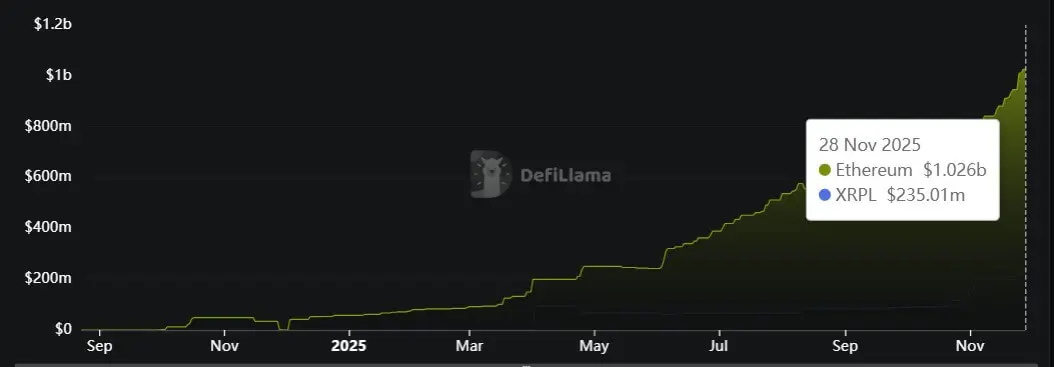
Ripple's RLUSD stablecoin is rapidly expanding on Ethereum, rather than on its native XRP Ledger (XRPL). Data shows that the total circulating supply of RLUSD skyrocketed to $1.26 billion within 12 months of its launch. Of this, approximately $1.03 billion (accounting for 82% of the total supply) is on Ethereum, while the remaining $235 million is on XRPL.
Embarrassing supply distribution of 82% vs 18%
(Source: DefiLlama)
The total Circulating Supply of RLUSD skyrocketed to 1.26 billion USD within 12 months of its launch, a growth rate that is quite remarkable in the stablecoin market. However, the supply distribution reveals a rather ironic reality: approximately 1.03 billion USD (accounting for 82% of the total supply) is located on Ethereum, while the remaining 235 million USD is on XRPL. This means that the stablecoin launched by Ripple is predominantly running on a competitor's blockchain.
This distribution is extremely awkward for Ripple. For a long time, Ripple has positioned XRPL as the ideal blockchain for cross-border payments and applications for financial institutions, criticizing Ethereum for its high gas fees and network congestion issues. However, when Ripple itself launched a stablecoin, the market voted with its feet, choosing Ethereum over XRPL. This result not only slaps Ripple's market positioning in the face but also highlights the serious deficiencies of XRPL in terms of DeFi infrastructure.
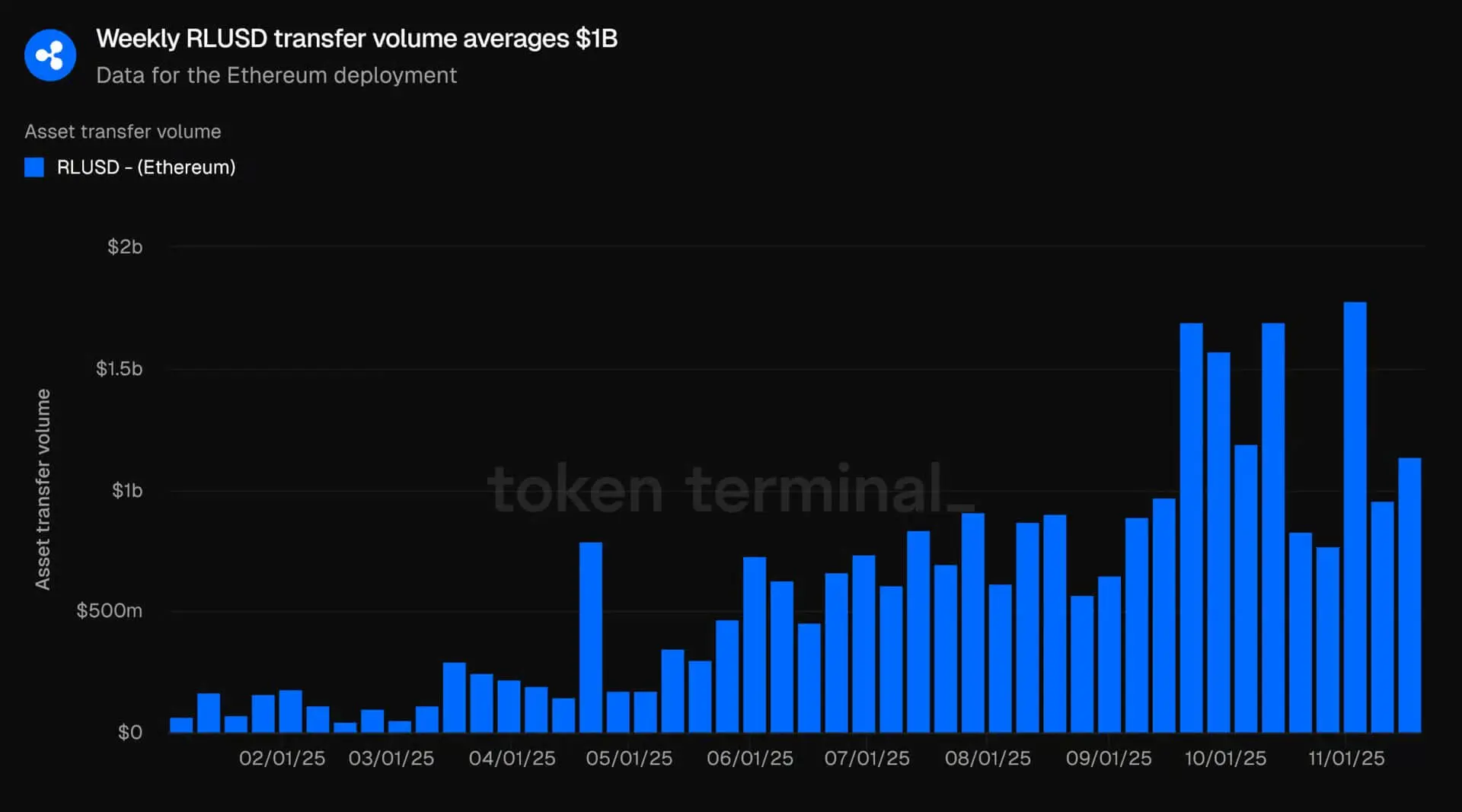
In absolute terms, $1.03 billion vs $235 million, the supply of RLUSD on Ethereum is 4.4 times that of XRPL. This gap continues to widen. According to data from Token Terminal, the weekly transfer volume of RLUSD on Ethereum currently averages around $1 billion, a significant increase compared to the average of $66 million at the beginning of the year. This sustained growth trend indicates that RLUSD on Ethereum is achieving real product-market fit rather than just initial hype.
For XRP holders and the XRPL community, this supply distribution is undoubtedly a blow. Many are hoping that RLUSD can drive the prosperity of the XRPL ecosystem, attracting more developers and users. However, the reality is that the success of RLUSD primarily benefits the Ethereum ecosystem, while the XRPL has only gained marginal benefits. This outcome may raise questions within the community about Ripple's strategy.
The Crushing Advantage of Ethereum DeFi Ecosystem
(Source: DefiLlama)
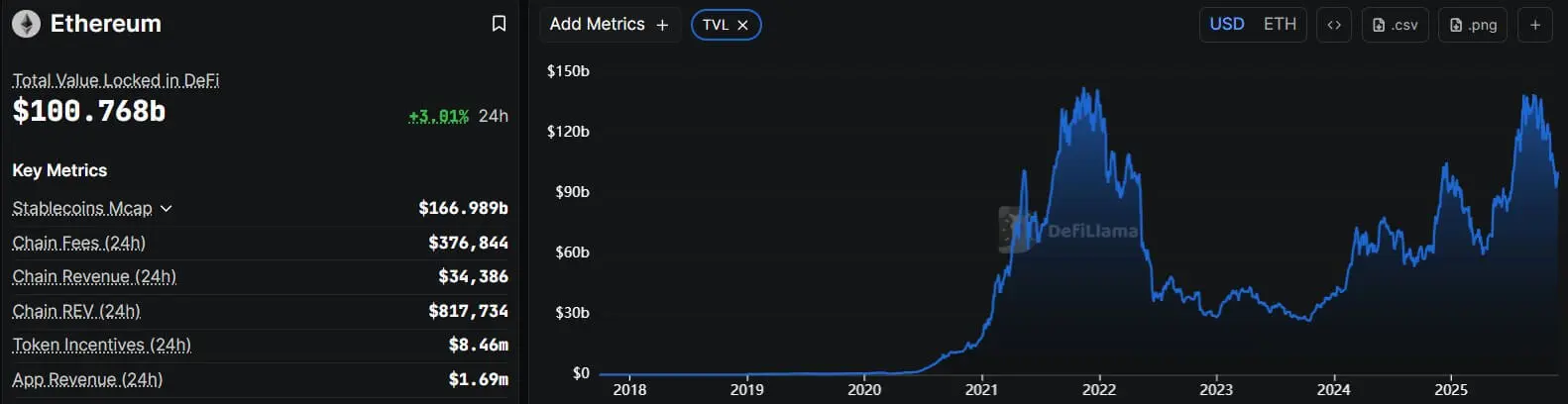
The main reason for this difference is the maturity of the underlying financial system. On Ethereum, RLUSD enters an environment where USD liquidity is already well established. According to data from DeFiLlama, Ethereum continues to lead all blockchains in terms of Total Value Locked (TVL) and stablecoin supply, providing a ready-made ecosystem for the development of new assets.
Therefore, any new stablecoin that can connect to major DeFi protocols such as Aave, Curve, and Uniswap can immediately benefit from existing routing engines, collateral frameworks, and risk models. The presence of RLUSD on Aave and Curve confirms this. The USDC/RLUSD liquidity pool on Curve currently has approximately 74 million USD in liquidity, placing it among the larger stablecoin liquidity pools on the platform.
For institutional funding departments, market makers, and arbitrage departments, this level of trading depth is non-negotiable. It ensures low slippage execution for multi-million dollar trades, thus facilitating basis trading and yield farming strategies that drive the modern cryptocurrency capital market. When an institution wants to swap 50 million RLUSD for USDC, the transaction can be completed with minimal slippage in Curve's $74 million liquidity pool. However, on the XRPL, the lack of sufficient liquidity pools can result in significant price impacts for such large transactions.
Ethereum operates as the standard ERC-20 token, which means that RLUSD automatically gains support from the entire Ethereum ecosystem. Wallets like MetaMask, custodians like Coinbase Custody, accounting software, tax tools, DeFi aggregators like 1inch, all of these tools natively support ERC-20 tokens. Developers do not need to make any special adaptations for RLUSD, and users do not need to learn new operating procedures. This “plug-and-play” feature greatly reduces the adoption threshold.
Structural Friction and Regulatory Paradox of XRPL
On the other hand, XRPL is still in the early stages of building the DeFi infrastructure. Its protocol-level Automated Market Maker (AMM) will not go live until 2024. Therefore, all liquidity pools related to RLUSD on the ledger, such as the USD/RLUSD trading pair created in January 2025, still face issues of insufficient depth and limited subsequent trading volume. Additionally, the design of XRPL AMM has not attracted the same high density of liquidity providers as seen in the EVM ecosystem.
Although the design choices of XRPL are technically robust, they present significant resistance to users. To hold RLUSD on the native ledger, users typically need to maintain a certain XRP balance to meet reserve requirements and establish specific trust lines with the issuer. If the issuer has enabled the RequireAuth setting (which is intended for strict compliance and fine-grained control), the account must first be explicitly whitelisted to receive tokens.
Therefore, although Ripple points out that these features are attractive to banks that require explicit control, they hinder natural adoption. Essentially, the compliance tools that make XRPL appealing to regulated entities are precisely those features that slow down the distribution speed between wallets. In a market where capital seeks the path of least resistance, the operational burden of trust lines diminishes XRPL's competitiveness in defining high-frequency, automated capital flows in DeFi.
This is a classic “compliance paradox”: features designed to meet regulatory requirements hinder the natural adoption of the market. Banks may appreciate the whitelisting and permission controls of XRPL, but DeFi users and market makers are deterred by these frictions. Ripple must find a better balance between compliance and usability, otherwise RLUSD will continue to make Ethereum its primary habitat.
10 Billion Turnover Verification of Real Demand
(Source: Token Terminal)
Critics may argue that the Ethereum supply of RLUSD is merely a “vanity metric,” with a large amount of Ethereum being minted yet sitting idle. However, a deep analysis of on-chain transfer data refutes this view. RLUSD demonstrates a true product-market fit with Ethereum, characterized by fast transaction speeds and high usage frequency.
According to data from Token Terminal, the weekly transfer volume of RLUSD on Ethereum is currently averaging around 1 billion USD, showing significant growth compared to the average of 66 million USD at the beginning of the year. The data indicates that there will be a noticeable structural change in the first half of 2025, displaying a steadily rising trend, followed by a “readjustment” to a higher bottom in the second half of the year.
It is crucial that market activity in recent weeks has concentrated around this higher level rather than retreating after a peak. From a market structure perspective, an upward baseline typically signifies a transition from the distribution phase to the utility phase. This means that the token is being used for ongoing, periodic flows of funds, such as institutional settlements and commercial payments, rather than isolated speculative events.
The trading volume also confirms this point. The average weekly trading volume of Ethereum is currently 7,000 transactions, up from 240 in January. The number of transfers has grown in sync with the trading volume, which is an important health indicator. If the trading volume rises while the number of transfers remains unchanged, it indicates that the market is dominated by a few individuals with large amounts of capital. Conversely, the simultaneous growth of the number of transfers and trading volume indicates that market participation is increasing.
In addition, holder data shows a good state of risk diversification. According to Etherscan data, as of the end of November 2025, Ripple's RLUSD has attracted about 6,400 holders on the Ethereum chain, up from just 750 at the beginning of the year. Although the supply growth is driven by “bulk” issuance rather than batch issuance, the number of holders has shown a smooth upward trend. From 750 to 6,400, an increase of more than 8 times, indicating that RLUSD is gaining an increasingly broad user base.
Strategic Dilemmas and Future Pathways Facing Ripple
Currently, Ripple finds itself in an awkward position: in order to realize its ambition of becoming a top stablecoin issuer, it must rely on the infrastructure of its biggest competitor. This dependency is not only commercially unpleasant but also poses strategic risks. If the Ethereum community or core developers take a hostile stance against RLUSD for some reason, Ripple will face a potential threat to 82% of its Circulating Supply.
The basic forecast for the next six months is that the Ethereum supply of RLUSD will increase from approximately 1 billion USD to between 1.4 billion and 1.7 billion USD. This forecast is based on the assumption that Curve liquidity will be maintained in the range of 60 million to 100 million USD, and that demand from centralized exchanges (CEX) and over-the-counter (OTC) trading will continue to grow. Under this trajectory, the liquidity pool of XRPL may accumulate more liquidity over time, but it will still only account for a small portion of the total issuance.
At the same time, if XRPL wants to implement a more aggressive “catch-up” strategy, active market intervention is required. If Ripple or its partners commit to launching a multi-month AMM reward program and successfully hide the trust line configuration behind a one-click wallet interface, then the native ledger could potentially start to erode Ethereum's leading advantage. With these measures, the liquidity of XRPL could reach 500 million USD and account for 25% of the total supply.
However, the downside risks of native ledgers are real. If Ethereum consolidates its leading position, and the Curve USDC/RLUSD liquidity pool exceeds 150 million USD, the network effects may become difficult to overcome. In this scenario, Ethereum may indefinitely retain 80% to 90% of the circulating supply. This lock-in effect is extremely common in technology platforms; once a platform establishes dominance, later entrants, even with superior technology, find it hard to shake it.
Despite the imbalance on the books, the overall trend of RLUSD brings Ripple just a step away from major market levels. Token Terminal indicates that if the market cap of RLUSD grows tenfold from its current level, Ripple will solidify its position as the world's third-largest stablecoin issuer, behind the existing Tether and Circle. Taking this into consideration, the growth of RLUSD largely depends on whether Ripple can leverage its success on Ethereum to eventually launch its native chain.
Related Articles
ETH drops 1.02% in 15 minutes: whale sell-offs and leverage liquidations drive short-term pressure
Continuing to rise! Bitcoin briefly breaks above $74,000, Ethereum surpasses $2,200, and the entire network experiences $570 million in liquidations.
Data: If ETH drops below $2,050, the total long liquidation strength on major CEXs will reach $786 million.
Who Is Tom Lee? The Ethereum Saylor Behind Bitmine
"Maji" ETH long position increased to 6,050 tokens, now with an unrealized profit of $670,000.
Matrixport's whale-associated ETH and BTC long positions have a floating profit of over $22 million