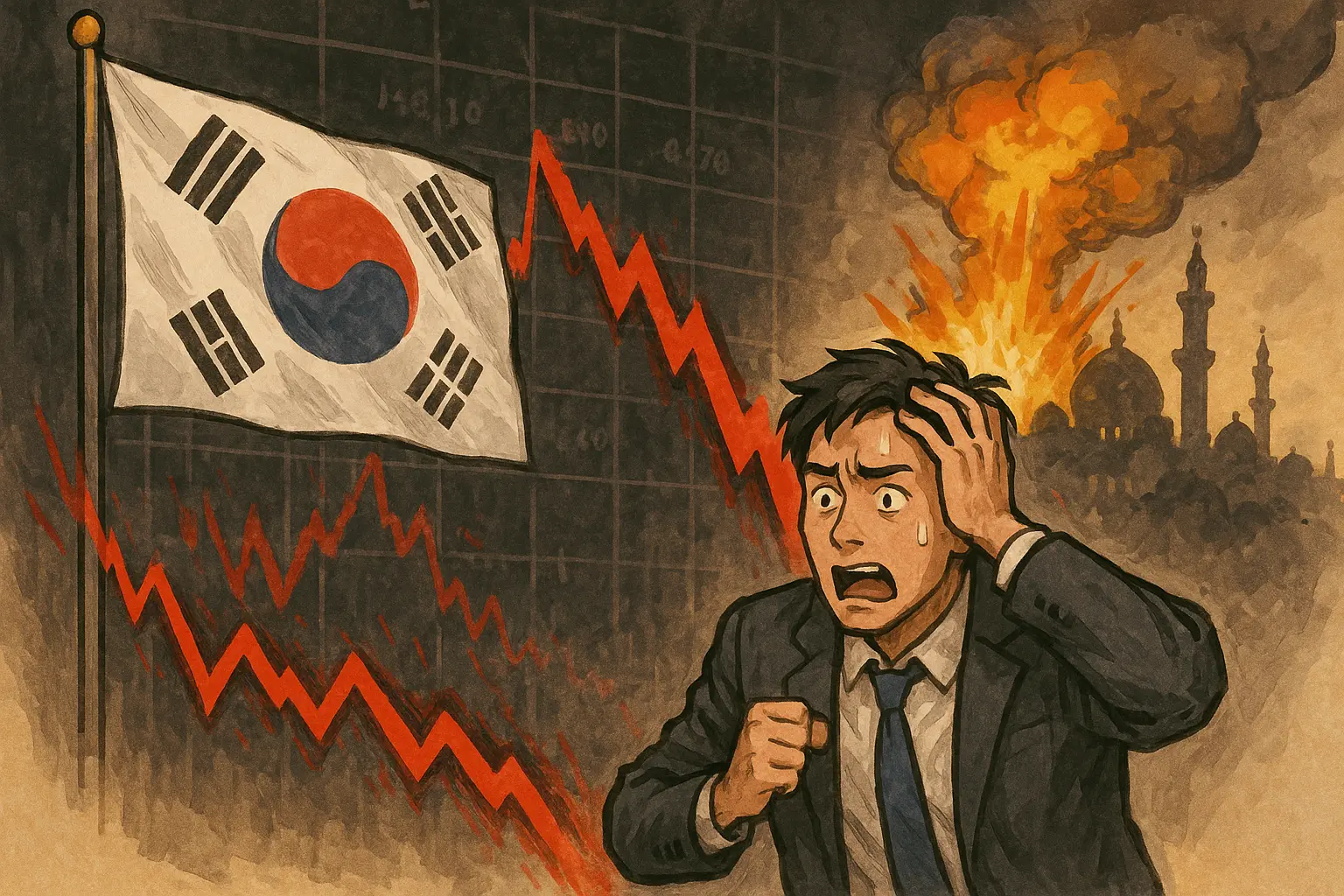
The escalation of the Middle East conflict caused the Korean stock market to plummet on Wednesday, with the Korea Composite Stock Price Index (KOSPI) and the KOSDAQ both falling over 10% during Seoul morning trading, triggering a circuit breaker and marking the worst single-day performance since August 2024. Cryptocurrency researchers describe this as a “black swan event” and note that global stock market capitalization has evaporated by $3.2 trillion over the past four days.
Heavy dependence on oil is the fundamental reason for Korea’s deep impact
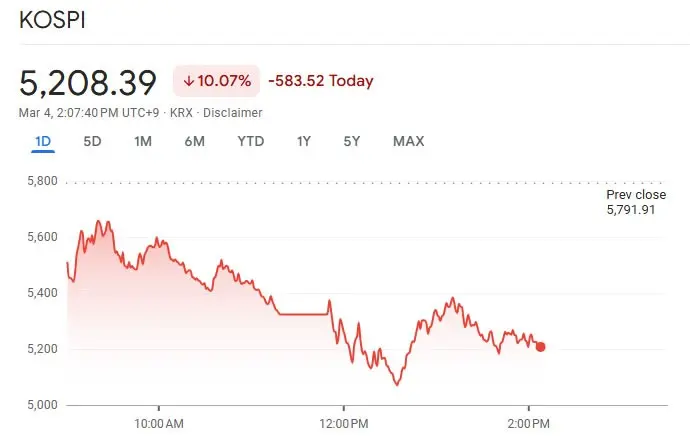
(Source: Google Finance)
Jim Bianco, CEO of Bianco Research, pointed out the core logic behind Korea’s intense reaction in this crisis: “Korea relies on 94% of its oil imports, with 75% coming from the Middle East. Therefore, it’s understandable why ‘oil-dependent’ Korea would panic.” Watanabe Securities’ chief strategist, Kazuaki Shimada, also analyzed that investors chose to sell off the previously outperforming Korea Composite Stock Price Index and the Nikkei Index to lock in profits.
On the same day, Japan’s Nikkei and TSE indices both fell nearly 4%; Hong Kong’s Hang Seng Index dropped 3%; China’s Shanghai Composite Index declined 1.3%. Thailand, another major importer of Middle Eastern oil, also saw its stock market fall 7.8% that day.
Oil surge and the Strait of Hormuz crisis
The core of the global market panic is the direct threat to worldwide oil supply posed by the Middle East conflict. According to OilPrice, since the U.S.-Israel airstrikes began on February 28, Brent crude has risen 14% to $82 per barrel, and WTI crude has increased 12% to $75. After Iran threatened to block the Strait of Hormuz, Trump stated on Truth Social, “If necessary, the U.S. Navy will begin escorting oil tankers through the Strait of Hormuz as soon as possible,” claiming the U.S. has “almost unlimited” weapons supplies and that the war could “go on forever.”
Cryptocurrency analyst Lee Seong-hoon said, “This is not just a war. It is the most serious geopolitical shock since 1973.” He also pointed out that Korea’s stock market trading halt was due to “the crash being too fast for the system to handle.”
Key data impacts of the Middle East crisis on global markets
- Korean stock market: KOSPI and KOSDAQ both plunged over 10%, triggering a circuit breaker, marking the largest single-day drop since August 2024.
- Other major Asian markets: Nikkei and TSE indices each fell nearly 4%; Thailand’s stock market dropped 7.8%; Hong Kong’s Hang Seng fell 3%; Shanghai Composite Index declined 1.3%.
- Oil market: Brent crude rose 14% since February 28 to $82 per barrel; WTI increased 12% to $75.
- Global market cap loss: Over the past four trading days, global stock market capitalization has evaporated about $3.2 trillion.
- Cryptocurrency market: Total market cap only decreased 0.5% to $2.39 trillion (according to CoinGecko), showing relative resilience.
Frequently Asked Questions
What is the circuit breaker mechanism, and what triggered it in Korea this time?
The circuit breaker is a protective measure that automatically pauses trading when stock prices fall rapidly, aiming to prevent panic selling from spiraling out of control. Korea’s circuit breaker was triggered when both KOSPI and KOSDAQ fell over 10% in a short period, reaching the thresholds set by the Korea Exchange. Cryptocurrency researchers describe this as due to “the crash being too fast for the system to respond.”
Why does the threat of the Strait of Hormuz blockade have such a profound impact on Korea?
The Strait of Hormuz is one of the world’s most critical oil transportation routes. Korea relies on imports for 94% of its oil, with 75% coming from the Middle East. If supply is disrupted, energy costs will soar, directly impacting Korea’s manufacturing sector and overall economy. This is the fundamental reason for Korea’s intense market reaction during this crisis.
Why has the cryptocurrency market been relatively resilient during this stock market crash?
According to CoinGecko, the total cryptocurrency market cap only declined 0.5% that day, showing relative stability compared to stocks. However, the crypto market has still fallen about 21% year-to-date. This slight fluctuation may reflect that the market has already priced in geopolitical risks early on, rather than cryptocurrencies being recognized as a safe haven asset.
Disclaimer: The information on this page may come from third parties and does not represent the views or opinions of Gate. The content displayed on this page is for reference only and does not constitute any financial, investment, or legal advice. Gate does not guarantee the accuracy or completeness of the information and shall not be liable for any losses arising from the use of this information. Virtual asset investments carry high risks and are subject to significant price volatility. You may lose all of your invested principal. Please fully understand the relevant risks and make prudent decisions based on your own financial situation and risk tolerance. For details, please refer to
Disclaimer.
Related Articles
Crypto Market Plunges As Extreme Fear Controls Investor Sentiment
The global crypto market is notably bearish, with a 2.93% drop in market capitalization to $2.32T. Bitcoin and Ethereum saw decreases of 3.07% and 4.01%, respectively. Meanwhile, notable gainers include $XBTC, $TRUMP, and $PEPE. DeFi TVL and NFT sales also declined significantly, while key investments from YZi Labs and Kazakhstan's central bank emerged.
BlockChainReporter3h ago
Bitcoin Correction Halts Institutional Demand as ETFs Witness $348.83 Million Withdrawals - U.Today
Bitcoin ETFs experienced a significant withdrawal of $348 million amid declining institutional demand, reflecting a bearish sentiment in the market. Despite these outflows, BlackRock's ETF maintained its dominance.
UToday5h ago
Kazakhstan's Central Bank Will Invest Up to $350 Million in Crypto Assets: Reuters
Kazakhstan’s central bank plans to invest up to $350 million in cryptocurrencies and related assets, focusing on high-tech firms and financial products. This initiative aims to diversify investments and is linked to the development of Alatau City, a future smart city.
Decrypt5h ago
U.S. Ethereum Spot ETF experienced a net outflow of $23.5 million this week
Gate News Report, March 7, according to Farside monitoring data, U.S. Ethereum spot ETF has experienced a net outflow of $23.5 million this week.
GateNews7h ago
70% of assets heavily invested in Bitcoin! Mexican billionaire urges "buy quickly during the dip," and the wealthy dad is also increasing his holdings
Mexican billionaire Ricardo Salinas Pliego is heavily investing in Bitcoin, believing it can hedge against inflation and symbolize personal freedom. Robert Kiyosaki warns that a stock market crash is imminent and continues to increase his holdings in Bitcoin and precious metals, remaining confident. They both believe that Bitcoin has long-term value potential, and the current price dip is a good buying opportunity.
区块客8h ago
Citibank promotes "Bitcoin Banking": Striving to launch "Institutional-Grade Custody" and "Cross-Asset Collateral" services this year
Citigroup is pushing for the banking of Bitcoin, planning to deeply integrate it into the traditional financial system, with institutional-grade crypto custody services expected to launch in 2026. By simplifying Bitcoin transaction processes and reducing operational friction, Citigroup aims to attract more institutions to adopt digital assets further. Additionally, the bank is exploring the applications of stablecoins and blockchain deposit tokens, hoping to provide traditional financial institutions with more convenient ways to utilize capital.
区块客8h ago


