The US Office of the Comptroller of the Currency (OCC) has issued an interpretive letter confirming that national banks can act as riskless principals in facilitating cryptocurrency transactions, without having to include these assets on their balance sheets. The guidance confirms that facilitating crypto transactions for customers falls within the scope of “banking business,” citing 12 USC §24 as the legal basis. Banks may act as principals in transactions with customers while simultaneously hedging with another customer, a structure similar to traditional riskless principal transactions in established markets.
Operating Logic of the Riskless Principal Model
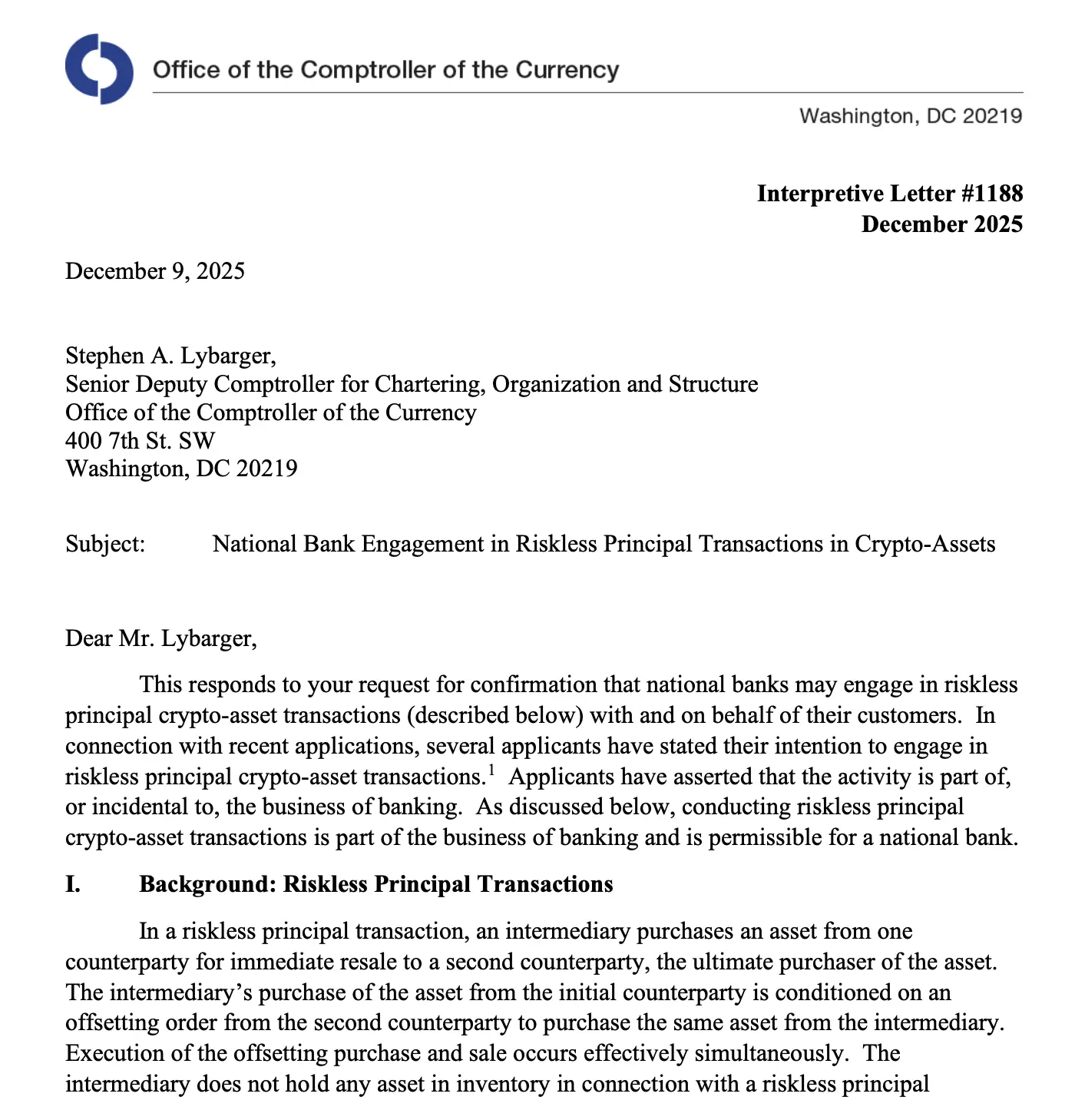
(Source: Office of the Comptroller of the Currency)
The “riskless principal transaction” model described in the OCC letter represents a key breakthrough for banks entering cryptocurrency trading. Traditionally, if a bank wanted to offer crypto services, it would have to include these assets on its balance sheet, triggering a series of regulatory requirements such as capital adequacy and risk-weighted asset calculations. Under the new model, banks act solely as intermediaries: upon receiving a buy order from client A, the bank immediately hedges the trade with client B or a market counterparty, so the bank itself never holds the crypto asset and thus bears no market risk.
This structure has been in operation in traditional financial markets for decades. Foreign exchange trading, commodity futures brokering, and even equity market making use similar models. Banks earn the bid-ask spread and transaction fees, rather than taking on asset price fluctuation risk. Applying this mature model to crypto trading enables banks to provide regulated crypto brokerage services to clients without significantly increasing their risk exposure.
The document states: “Some applicants have discussed how engaging in riskless principal crypto asset transactions would benefit the clients and business of their proposed banks, including by providing additional services in a growing market.” According to the OCC, this move will allow customers “to transact crypto assets through regulated banks, rather than through unregulated or lightly regulated channels.” This shift means that in the future, retail and institutional investors may be able to trade Bitcoin and Ethereum directly through mainstream banks like JP Morgan, Bank of America, or Wells Fargo, without having to register for an account at a crypto exchange.
Three Major Compliance Requirements for Banks Conducting Crypto Trading
Confirm Asset Legality: Banks must verify that the crypto assets being traded comply with federal and state law and are within the bank’s chartered authority.
Establish Risk Monitoring Procedures: Banks must implement procedures to monitor operational, compliance, and market risks, especially counterparty credit risk.
Distinguish Securities from Non-Securities Assets: Crypto assets that meet the definition of a security must comply with existing securities laws, while non-security assets are subject to this guidance.
The letter states: “The primary risk in riskless principal transactions is counterparty credit risk (especially settlement risk), and managing counterparty credit risk is an integral part of banking, in which banks have substantial experience.”
From Operation Choke Point 2.0 to a Major Policy Reversal
During the Biden administration, some industry groups and lawmakers accused US regulators of pursuing what they called “Operation Choke Point 2.0,” claiming it subjected banks and companies dealing with crypto to increased scrutiny. Many banks, fearing regulatory backlash, proactively severed ties with crypto businesses, and the collapses of Silvergate Bank and Signature Bank further fueled the panic.
Since President Trump took office in January, promising support for the industry, the federal government has moved in the opposite direction, adopting a more relaxed stance toward digital asset activities. OCC head Jonathan Gould, on the eve of the letter’s release, stated that crypto companies seeking federal bank charters should be treated the same as traditional financial institutions. He believes the banking system “is capable of evolving,” and “there is no reason to treat digital assets differently from traditional banking,” as traditional banks “have provided custodial services electronically for decades.”
The deeper logic behind this policy shift is that the Trump administration wants to bring crypto into the regulated financial system, rather than allowing it to continue developing in a gray area. By allowing national banks to offer crypto trading services, regulators are effectively expanding their oversight while also providing greater protection for investors.
Cryptofication of the $30 Trillion Banking System
The US Treasury market is about $30 trillion in size, and the national banking system manages an even larger pool of assets. Once these banks fully open up to crypto trading, it will inject unprecedented liquidity and compliance into the market. Currently, most retail investors access the crypto market through exchanges like Coinbase and Binance, but these platforms fall short of traditional banks in terms of security, insurance, and dispute resolution mechanisms.
When giants like JPMorgan and Bank of America begin offering crypto brokerage services, several major changes will occur. First, trust will increase: banks are strictly regulated and enjoy federal deposit insurance, so investors are more willing to trade through familiar banking channels. Second, integration and convenience: investors can manage fiat, stocks, and crypto in a single bank account, eliminating the need to transfer between multiple platforms. Third, compliance transparency: banks will automatically handle tax reporting and anti-money laundering checks, greatly reducing the administrative burden on investors.
The agency’s guidance also distinguishes crypto assets that meet the definition of securities, noting that riskless principal trading involving securities is already clearly permitted under current law. This means that even if certain crypto assets are deemed securities by the SEC, banks can still offer trading services, provided they comply with securities laws.
Disclaimer: The information on this page may come from third parties and does not represent the views or opinions of Gate. The content displayed on this page is for reference only and does not constitute any financial, investment, or legal advice. Gate does not guarantee the accuracy or completeness of the information and shall not be liable for any losses arising from the use of this information. Virtual asset investments carry high risks and are subject to significant price volatility. You may lose all of your invested principal. Please fully understand the relevant risks and make prudent decisions based on your own financial situation and risk tolerance. For details, please refer to
Disclaimer.


