Tether-supported Bitcoin vault company Twenty One Capital Inc. listed on the NYSE this week, with its share price dropping nearly 20% on the same day, resulting in a poor performance on its first trading day after merging with special purpose acquisition company Cantor Equity Partners Inc. Although the stock rebounded over the next two days, it remains 75% below the all-time high set one week after the announcement of the merger in April.
The Collective Slip-up in the Bitcoin Vault Listing Wave

(Source: NYSE, LinkedIn)
Twenty One Capital’s poor start is not an isolated case but a reflection of the overall digital asset management company (DAT) industry’s 2025 predicament. Another Bitcoin management firm, ProCap Financial Inc., began trading Monday after completing a SPAC merger, with its stock plunging over 14% on the first day. Even the initially more established Bitcoin accumulation company Strategy Inc. has fallen more than 35% this year, far surpassing Bitcoin’s approximately 1% decline. This underperformance relative to the underlying asset reveals fundamental market doubts about the DAT business model.
One of the key indicators DAT observers focus on is mNAV (market net asset value), which tracks the ratio of a company’s market cap to its token holdings. If mNAV falls below 1 (which has happened to several DATs this year), it indicates the company’s value is less than its token holdings, rendering most of its investment logic invalid. Such valuation discounts are extremely rare and typically occur only when the market perceives serious issues or imminent bankruptcy.
To avoid bankruptcy, companies have adopted various measures. For example, Strategy issued multiple series of preferred shares and established $1.4 billion in cash reserves to ease shareholder concerns. Other companies focus on stock repurchase plans, such as Hyperliquid Strategies, a DAT firm chaired by former Barclays CEO Bob Diamond, which went public on December 3rd in New York and announced on December 8th a plan to buy back up to $30 million worth of stock.
These defensive measures show DAT firms are trying to support their share prices, but the core issue may lie in their business models. Strategy even wrote to MSCI to oppose excluding companies holding over 50% of their assets in cryptocurrencies from indices, a public lobbying effort that reflects the survival pressure faced by DAT companies. If such companies are removed from major indices, passive investment funds will be forced to sell, further exacerbating the downward pressure.
Business Model Dilemma: How Does Holding Bitcoin Make Money?
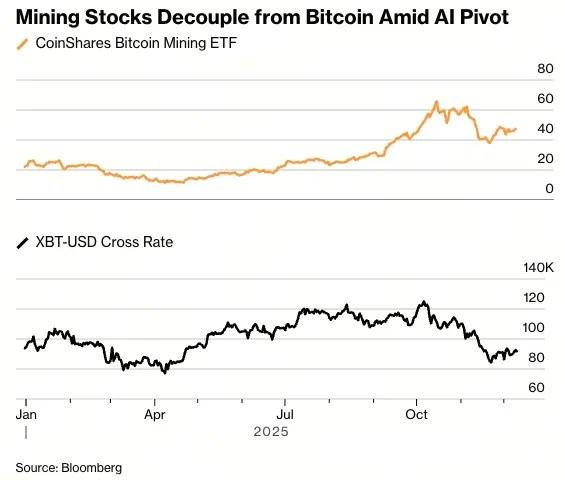
(Source: Bloomberg)
“The real question is, how do they plan to make money from Bitcoin,” said David Bailey, chairman and CEO of Bitcoin asset management firm KindlyMD Inc., in an interview with Bloomberg TV on Tuesday. “Ultimately, you can think of Bitcoin asset management companies as similar to Bitcoin banks. You build an asset-liability sheet, make the capital circulate, and use that capital to generate income without diluting equity.”
This comment hits the core pain point of the DAT industry: lack of reliable income sources. Traditional banks profit through interest rate spreads, fees, investment returns, and diversified channels. But the DAT business model is extremely simple: raise funds via equity financing or debt issuance to buy Bitcoin, then hold and wait for appreciation. This approach is highly attractive during Bitcoin bull markets because stocks can provide leverage (borrowing money to buy coins, amplifying gains for shareholders).
However, when Bitcoin prices stagnate or decline, the weaknesses of this model become apparent. The Bitcoins held by these companies generate no cash flow but require fixed expenses such as employee salaries, office costs, and interest payments. If Bitcoin prices remain flat long-term, the company will face ongoing losses, naturally putting pressure on its stock price. Even worse, when the stock price falls below the value of Bitcoin holdings (mNAV<1), investors prefer to buy Bitcoin directly rather than stocks, since the latter simply offer “discounted Bitcoin exposure.”
Three Survival Challenges for DAT Companies
Single Revenue Model: Relying solely on Bitcoin appreciation cannot generate stable cash flow to cover fixed costs
Fragile Valuation Logic: When mNAV falls below 1, the investment rationale fails, and stocks become “poor substitutes for Bitcoin”
Regulatory Uncertainty: MSCI plans to exclude DATs from indices, forcing passive funds to sell and intensify downward pressure
Mallers stated that Twenty One’s plan is to generate income through providing services that leverage its large cash and Bitcoin reserves. “Lending cash is a straightforward way to profit, and we’re very interested in all kinds of Bitcoin-related credit products,” he said in an interview on Tuesday. This strategy is akin to transforming DAT into a Bitcoin-backed lending platform, but whether it can alleviate downward pressure from Bitcoin prices remains to be seen.
Tether’s $500 Billion Valuation Ambitions and the Reality Gap
Twenty One Capital is backed by stablecoin issuer Tether (a company striving for a $500 billion valuation) and supported by SoftBank Group. During Tuesday’s ceremony, Mallers appeared on the NYSE balcony alongside Tether CEO Paolo Ardoino, with other senior executives present, including the CEO of Tether’s Salvadoran stablecoin project USAT. This high-profile presence indicates Tether’s high hopes for Twenty One, viewing it as a strategic move into traditional capital markets.
However, the 20% plunge on the first day cast a shadow over Tether’s gamble. While Tether makes huge profits through its USDT stablecoin business, continued losses on its investment in Twenty One could harm its reputation in traditional finance. More critically, Twenty One’s failure might undermine Tether’s pursuit of a $500 billion valuation. If Tether cannot even succeed in investing in a Bitcoin vault company, why should investors believe it can support a $500 billion valuation?
For DAT companies, surviving the additional scrutiny faced when offering equity to the public requires effectively communicating their sources of income and value creation. Simply “holding Bitcoin” is no longer enough to convince investors; they need to demonstrate how to generate stable cash flows and returns for shareholders using Bitcoin assets.
Disclaimer: The information on this page may come from third parties and does not represent the views or opinions of Gate. The content displayed on this page is for reference only and does not constitute any financial, investment, or legal advice. Gate does not guarantee the accuracy or completeness of the information and shall not be liable for any losses arising from the use of this information. Virtual asset investments carry high risks and are subject to significant price volatility. You may lose all of your invested principal. Please fully understand the relevant risks and make prudent decisions based on your own financial situation and risk tolerance. For details, please refer to
Disclaimer.
Related Articles
Tether's QVAC Workbench releases version 0.4.1, with multiple upgrades focused on AI localization
Tether CEO Paolo Ardoino announced on the X platform that the smart development platform QVAC Workbench 0.4.1 has been released. The new version enhances the serverless experience, optimizes delegated inference and RAG capabilities, supports more document formats, and has been optimized for mobile devices. It is currently in Alpha testing, with the full mode coming soon.
GateNews6h ago
Mega Financial Chairman: No one can profit from the three major pitfalls of stablecoins? Clearly states "Banks can't find advantages in issuing them"
Mega Financial Holding Chairman Dong Rui-bin pointed out that issuing stablecoins in Taiwan faces three major challenges: insufficient payment demand, limited influence of bank brands, and strict regulatory requirements. The model of banks issuing stablecoins is difficult to profit from, and future legislation will be led by financial institutions, but market demand remains uncertain.
動區BlockTempo8h ago
Circle Faces Upgraded Stablecoin Competition: Tether and Wall Street Enter the Market, Can USDC Continue to Lead?
As competition in the global stablecoin market intensifies, Circle faces challenges from Tether and traditional financial institutions, but its advantages in compliance, partnerships, and technology remain promising. Research predicts that Circle's stock price is expected to rise, while USDC's growth trend and revenue are expanding rapidly. Circle is also exploring the integration of AI and blockchain in payment scenarios, and future competitive dynamics will depend on compliance capabilities and the expansion of its payment network.
GateNews10h ago
Tether mints an additional 50 million USDT on the Plasma chain
Gate News Report, March 10th, according to Whale Alert monitoring, Tether issued an additional 50,000,000 USDT on the Plasma blockchain, worth approximately $50.01 million at current prices.
GateNews03-10 12:58
Tether's BrainWhisperer brain signal decoding accuracy reaches 98.3%, ranking fourth in the Kaggle competition.
The BrainWhisperer project under Tether achieved an accuracy of 98.3% in converting brain signals to text, ranking fourth in the Brain-to-Text '25 competition. The system combines the OpenAI Whisper model and LoRA technology and is currently developing cross-individual signal decoding and non-invasive brain-computer interfaces.
GateNews03-10 08:31


