A new on-chain study published by AMLBot shows that between 2023 and 2025, Tether has frozen over 3.29 billion USDT on the Ethereum and Tron blockchains, and blacklisted 7,268 addresses. This figure far exceeds Circle, as USDC only froze about $109 million related to 372 addresses during the same period, indicating two very different enforcement philosophies shaping the stablecoin market.
According to data shared alongside an updated Dune dashboard, the scale of USDT freezing is about 30 times larger than USDC, both in value and number of wallets. Notably, the Tron network alone accounts for up to 1.75 billion USDT frozen, reflecting Tron’s central role in P2P transactions, cross-border payments, and the Asian market.
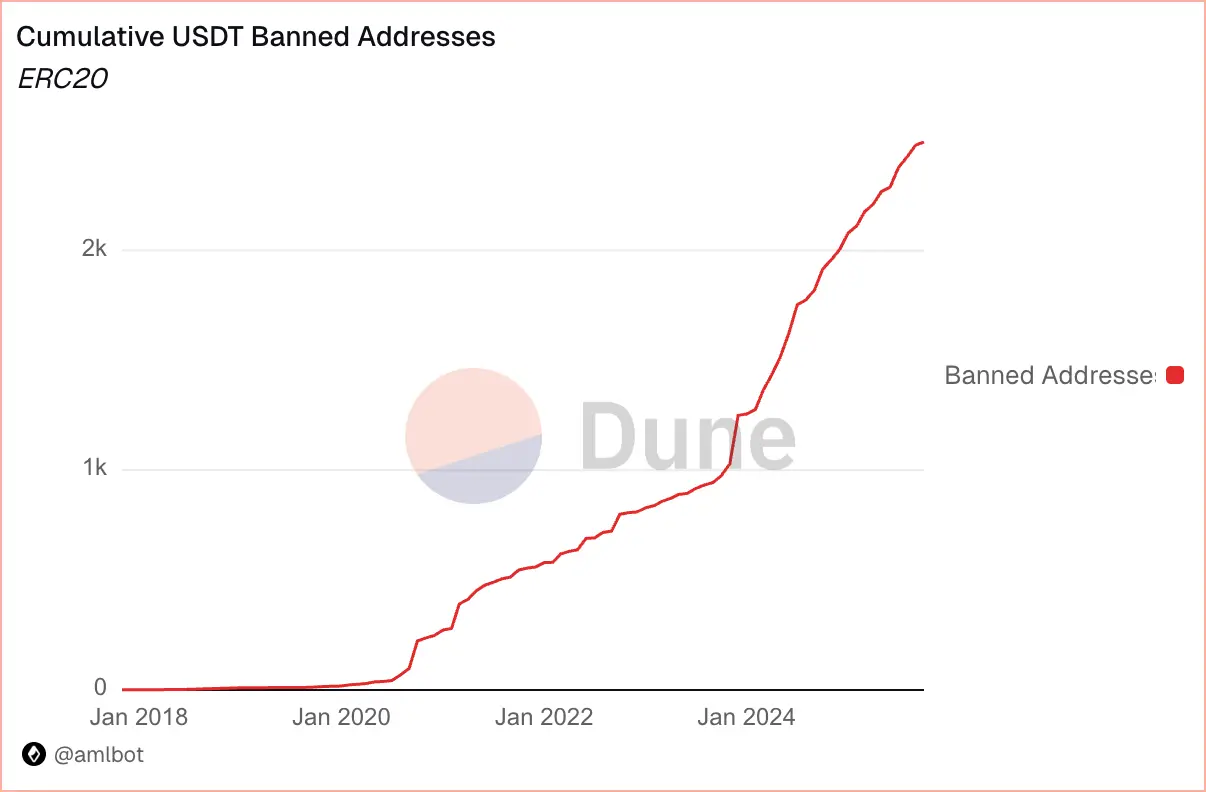
Tether pursues an active cooperation model with authorities, currently working with over 275 law enforcement agencies across 59 jurisdictions. The company can restrict wallets not only after court orders but also based on notices related to hacks or ongoing investigations. By July 2024, the total value of frozen USDT exceeded $130 million, including $29.6 million on Tron related to Cambodia’s Huione Group, which is under sanctions.
A major difference for USDT is the burn and reissue mechanism. After investigations are complete, frozen tokens can be destroyed and replaced with “clean” tokens to compensate victims or authorities. AMLBot recorded significant USDT burning activity toward the end of 2025, with over $25 million in value burned in just one month. However, this approach has also been controversial. In April 2025, a Texas-based company sued Tether after $44.7 million was frozen at the request of Bulgarian police, claiming that international legal procedures were not fully followed.
In contrast, Circle adopts a more cautious approach. USDC freezes typically occur only when there is clear legal basis such as court orders or sanctions lists, with fewer cases and usually in batches. When an address is frozen, the funds remain locked until a new legal decision is made, and there is no burn-and-reissue mechanism.
The report was published amid Circle’s efforts to expand into heavily regulated markets, recently partnering with Bybit to make USDC the default stablecoin on their platform. Meanwhile, recent scam incidents have highlighted the value of quick intervention, making Tether’s “strong hand” approach seen by some users as a practical safeguard, despite ongoing concerns about centralization.
Thach Sanh
Disclaimer: The information on this page may come from third parties and does not represent the views or opinions of Gate. The content displayed on this page is for reference only and does not constitute any financial, investment, or legal advice. Gate does not guarantee the accuracy or completeness of the information and shall not be liable for any losses arising from the use of this information. Virtual asset investments carry high risks and are subject to significant price volatility. You may lose all of your invested principal. Please fully understand the relevant risks and make prudent decisions based on your own financial situation and risk tolerance. For details, please refer to
Disclaimer.
Related Articles
Delphi Digital: Sufficient collateral backing for stablecoins does not mean immunity from bank runs; the risk has shifted to the issuer level
Delphi Digital analysis points out that although Tether and Circle's stablecoins are backed by short-term Treasury bills and cash equivalents, they are not completely safe and still face bank run risks. The USDC depegging event in early 2023 demonstrated that stablecoin risks have shifted to issuers, highlighting the dangers posed by their centralization.
GateNews23h ago
Boris Johnson criticizes Bitcoin as a Ponzi scheme, with crypto industry leaders collectively refuting the claim
Former British Prime Minister Boris Johnson characterized Bitcoin as a "Ponzi scheme" and warned investors, particularly elderly individuals, to exercise caution using personal examples. Industry figures such as Michael Saylor quickly refuted the claim, pointing out that Bitcoin lacks a centralized operator, which is a key characteristic of Ponzi schemes. These remarks sparked widespread discussion and reignited controversy over the definition of Bitcoin.
MarketWhisper23h ago
Tether Announces Major AI Breakthrough, QVAC Serverless Intelligence May Usher in Open Source Era
Tether CEO Paolo Ardoino announced that a major breakthrough from the AI division will be released this week, marking progress in decentralized intelligent infrastructure. The QVAC platform aims to enable AI models to run locally on consumer-grade devices with efficient inference and task automation capabilities. Supported by Tether's financial resources, QVAC continues to iterate and involves multiple cutting-edge technologies, though its future breakthroughs still require observation of actual results.
MarketWhisper03-16 02:56
Tether CEO Paolo Ardoino Teases 'True Breakthrough' in Decentralized AI
Tether CEO Paolo Ardoino announced on March 15, 2026, that the company's AI division will release what he described as a "true breakthrough" in the coming week, marking the next phase of the stablecoin issuer's decentralized intelligence strategy.
CryptopulseElite03-16 02:53
Gate Daily Report (March 16): "Super Central Bank Week" Interest Rate Decisions Incoming; US Reveals Iran Conflict Resolution Timeline
Bitcoin (BTC) staged a strong rebound over the weekend, trading around $72,490 as of March 16. A "Super Central Bank Week" is upon us, with the shadow of Iran conflict looming over global interest rate decisions. U.S. Energy Secretary Lyte stated that the Iran conflict will end "in the coming weeks," after which oil supply will rebound and energy prices will decline. The International Energy Agency revealed that emergency reserve oil will soon begin flowing into the global market.
MarketWhisper03-16 01:36
Tether hints at a new "AI breakthrough," advancing the decentralized intelligence strategy
Tether's CEO announced a significant AI breakthrough coming soon, following the release of QVAC Workbench 0.4.1. This platform enables on-device AI operation without cloud servers, supported by Tether's substantial profits primarily from U.S. Treasury bonds.
TapChiBitcoin03-16 01:02


