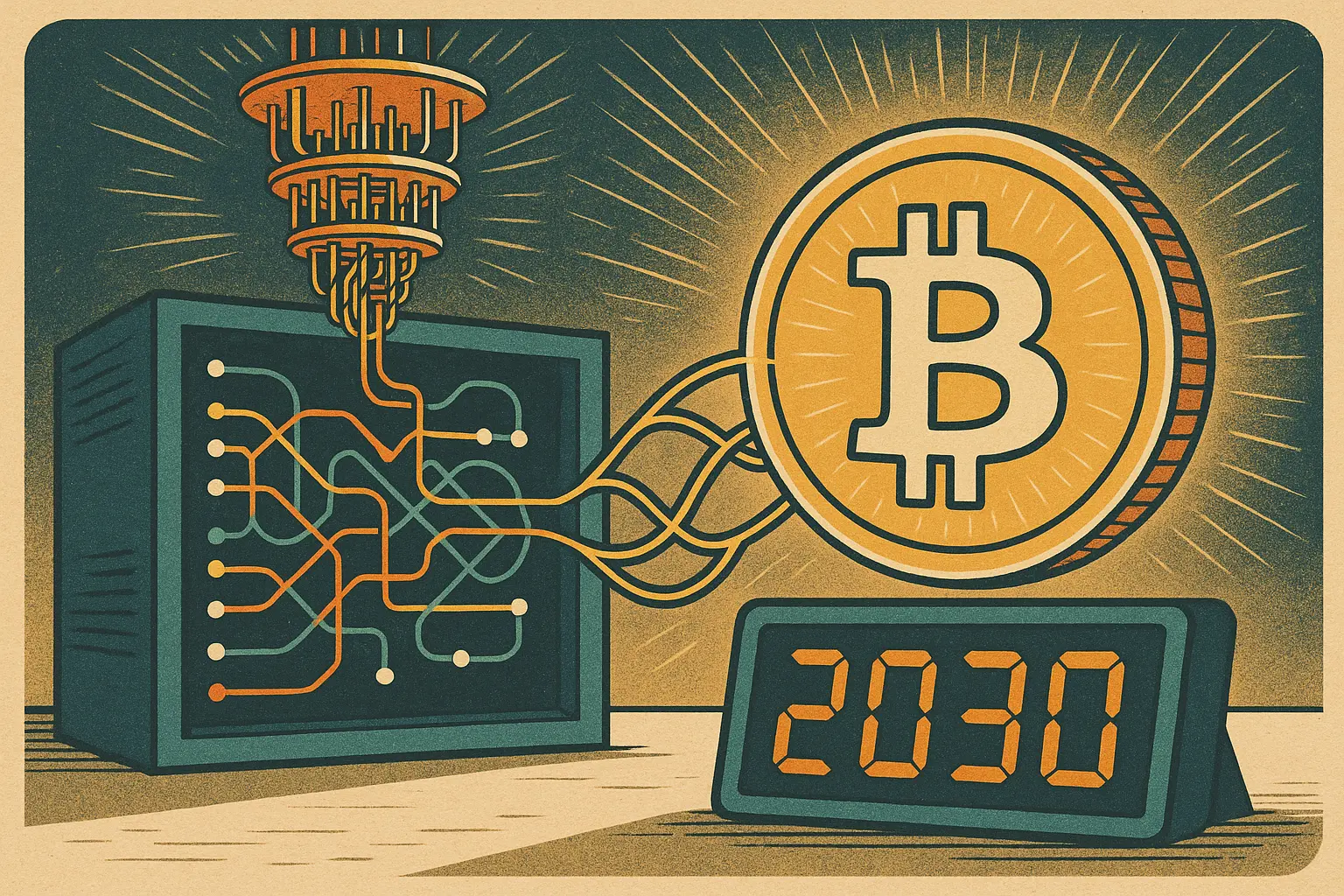
Google releases Willow quantum chip sparking panic in the crypto community, with influencers shouting “Bitcoin will go to zero by 2026.” But the truth is: cracking Bitcoin requires 2,300 to 2,600 logical qubits, while traditional architectures need 2 million to 20 million physical qubits. Willow has only 105 qubits, a gap of four orders of magnitude, making Bitcoin relatively secure before 2030.
The Real Timeline of Quantum Threats: 2030 Is the Critical Year
When discussing the threat of quantum computing, it’s essential to understand the huge gap between “being able to break” and “actually breaking.” Bitcoin’s secp256k1 elliptic curve encryption relies on computational complexity. Quantum computers running Shor’s algorithm can theoretically break it, but the key question is: “How many qubits are needed?”
Cracking Bitcoin requires about 2,300 to 2,600 logical qubits and hundreds of billions of quantum gate operations. However, qubits are highly susceptible to noise and require error correction. Under traditional surface code architectures, creating one logical qubit may need 1,000 physical qubits. In other words, breaking Bitcoin could require 2 million to 20 million physical qubits.
Willow’s chip has only 105 physical qubits, four orders of magnitude below the threat threshold. This is akin to the leap from crystal radios to modern smartphones. Companies like IBM, IonQ, QuEra have aggressive roadmaps, but even optimistic projections suggest reaching thousands of logical qubits only around 2029 to 2033. IonQ plans to reach about 1,600 logical qubits by 2028, and IBM aims for a fault-tolerant 200-logical-qubit quantum computer by 2029.
The real danger window is between 2030 and 2035. As quantum computers capable of breaking cryptography (CRQC) may emerge during this period, Bitcoin must upgrade its protocols beforehand. In 2023, Oded Regev from New York University proposed an improved version of Shor’s algorithm, reducing quantum steps by about 20 times, but still requiring thousands of logical qubits. An even more significant variable is quantum low-density parity-check codes (qLDPC), which could theoretically reduce error correction overhead from 1,000:1 to 10:1, but require entirely new hardware architectures.
Is Your Bitcoin Safe? The Life-and-Death Difference Between Two Types of Addresses
The threat of quantum computing does not affect all Bitcoin addresses equally. To understand the risk, it’s crucial to distinguish between two address types, as their security levels differ vastly.
Modern Bitcoin addresses (P2PKH, starting with 1, 3, or bc1) use double hashing of the public key (SHA-256 + RIPEMD-160). The public key itself is not revealed until a transaction is initiated. Attackers have only about 10 minutes from when the transaction enters the mempool to when it’s confirmed in a block, to intercept the public key, run quantum algorithms to derive the private key, and construct higher-fee replacement transactions to steal funds. This “transmission attack” is extremely challenging even with CRQC.
However, in 2009–2010, Satoshi Nakamoto and early miners used P2PK scripts, directly exposing the raw public key in blockchain data. Attackers could scan the entire blockchain history offline, extract millions of BTC’s raw public keys, and run Shor’s algorithm on a quantum computer to derive private keys. This is a classic “collect now, decrypt later” scenario.
Extreme Risks Facing P2PK Addresses
Scale of Exposure: Estimated 2 million to 4 million BTC, including about 1.1 million BTC in Satoshi’s wallets
Attack Type: Offline cracking, no need to wait for transactions, can prepare years in advance
Time Window: Once CRQC appears, these funds could be stolen within hours
Governance Dilemma: If Satoshi’s addresses are not moved, the community may be forced to freeze or destroy these assets via soft fork
Satoshi’s 1.1 million BTC has become the biggest gray rhino in Bitcoin. After quantum-resistant upgrades are deployed, the network must decide what to do with these unmoved P2PK old coins. If private key holders do not sign and migrate to new addresses, once CRQC arrives, hackers could steal these coins and dump the market. The community might be forced to violate the principle of “private property is inviolable,” freezing these assets, which could cause a split even more severe than BCH/BTC.
Bitcoin’s Triple Defense System Is on Its Way
Faced with potential threats, the Bitcoin developer community is not sitting idly. Quantum-resistant technologies are moving from theory to engineering practice, and a triple defense system is being built.
The first layer is P2TSH (Pay-to-Tapscript-Hash), a new transaction output type proposed in BIP-360. This scheme leverages the existing Taproot structure, removing the vulnerable “key path” susceptible to quantum attacks, leaving only the “script path.” Since the script path is hashed, quantum computers cannot see its internal structure. This upgrade is backward compatible and can be implemented via soft fork.
The second layer is the Commit-Delay-Reveal (承諾-延遲-披露) emergency mechanism. If a quantum computer suddenly appears, users send a transaction containing the hash of a new quantum-safe address but without the old public key and signature. The protocol enforces a waiting period (e.g., 144 blocks, about 1 day). After the delay, users send a second transaction revealing the old public key and signature to unlock funds and transfer to the new address. Even if a quantum attacker sees the public key during the “disclosure” phase, the prior “commitment” with timestamp prevents them from rewinding the blockchain to insert their own transaction.
The third layer involves hash-based Lamport signatures and Winternitz one-time signatures (WOTS). As the Bitcoin community increasingly advocates restoring OP_CAT opcode, developers can directly embed logic in Bitcoin scripts to verify WOTS signatures, enabling permissionless quantum-resistant upgrades without hard forks. NIST’s standardized post-quantum algorithms (like SPHINCS+) are also being discussed for integration into Bitcoin proposals.
The advent of quantum computing does not spell the end of Bitcoin but signals a countdown to a technological upgrade. The critical window is between 2030 and 2035, and Bitcoin must complete protocol upgrades before then. History advances through crises; whether Bitcoin can survive in the quantum era depends on whether the community can complete this no-retreat upgrade before the threat materializes.
Disclaimer: The information on this page may come from third parties and does not represent the views or opinions of Gate. The content displayed on this page is for reference only and does not constitute any financial, investment, or legal advice. Gate does not guarantee the accuracy or completeness of the information and shall not be liable for any losses arising from the use of this information. Virtual asset investments carry high risks and are subject to significant price volatility. You may lose all of your invested principal. Please fully understand the relevant risks and make prudent decisions based on your own financial situation and risk tolerance. For details, please refer to
Disclaimer.


