Bitcoin (BTC) has fallen back from its weekly high, currently around $95,550 on January 16. Russia opens cryptocurrency trading to retail investors, allowing them to purchase up to 300,000 rubles worth of cryptocurrencies annually. The US Treasury Department accepts a routine debt repurchase of $2 billion, and cryptocurrency accounts welcome this move.
Macro Events & Crypto Hotspots
-
Russia opens cryptocurrency trading to retail investors. The legislative draft announced on January 13 allows retail investors to buy up to 300,000 rubles (about $3,800) worth of cryptocurrencies annually after passing a risk test. Transactions will be conducted on licensed platforms in Moscow and Saint Petersburg, with domestic payments settled in rubles, and international use supported during sanctions. If approved at the spring session, implementation could start as early as July 2026, following the legalization of mining and global cryptocurrency trading in Russia in 2024.
-
The US Treasury Department conducts a $2 billion routine debt repurchase. The department conducts weekly bond buybacks, accepting competitive bids for $2 billion of inactive bonds maturing between 2046 and 2055. This liquidity support program was restarted in May 2024 to help traders operate in a market with a total size of $28 trillion, trading less liquid securities without issuing new bonds. Crypto accounts welcome this as a positive capital injection, though skeptics see it as routine maintenance with minimal market impact, as Bitcoin remains around $96,000.
News Highlights
-
Interactive Brokers launches 24/7 USDC account deposit service, plans to add RLUSD and PYUSD options next week.
-
Kaito will gradually phase out Yaps and the incentive leaderboard, and launch Kaito Studio.
-
Polygon cuts nearly 30% of staff after acquisition to promote stablecoin payment business transformation.
-
X cancels post rewards and bans “InfoFi” apps from incentivized posting to attract users.
-
State Street launches digital asset platform to enter the tokenized deposit and stablecoin markets.
-
Ripple invests $150 million in LMAX to promote RLUSD stablecoin settlement applications in the institutional market.
-
MetaMask officially integrates Tron network, supporting native TRX and USDT operations.
-
CME will launch ADA, LINK, and XLM futures on February 9.
-
Fogo airdrop officially launched, FOGO is now listed on ValiantTrade exchange.
Market Trends
-
Latest Bitcoin news: $BTC has fallen back from its weekly high, currently around $95,550, with $8.192 billion in liquidations in the past 24 hours, mainly long positions.
-
US stocks rose on January 15 after two days of decline, driven by optimistic earnings reports from Morgan Stanley and Goldman Sachs. The Dow Jones Industrial Average increased by 292.81 points, or 0.60%, to 49,442.44; the S&P 500 rose by 17.87 points, or 0.26%, to 6,944.47; the Nasdaq increased by 58.27 points, or 0.25%, to 23,530.02.
(Source: Gate)
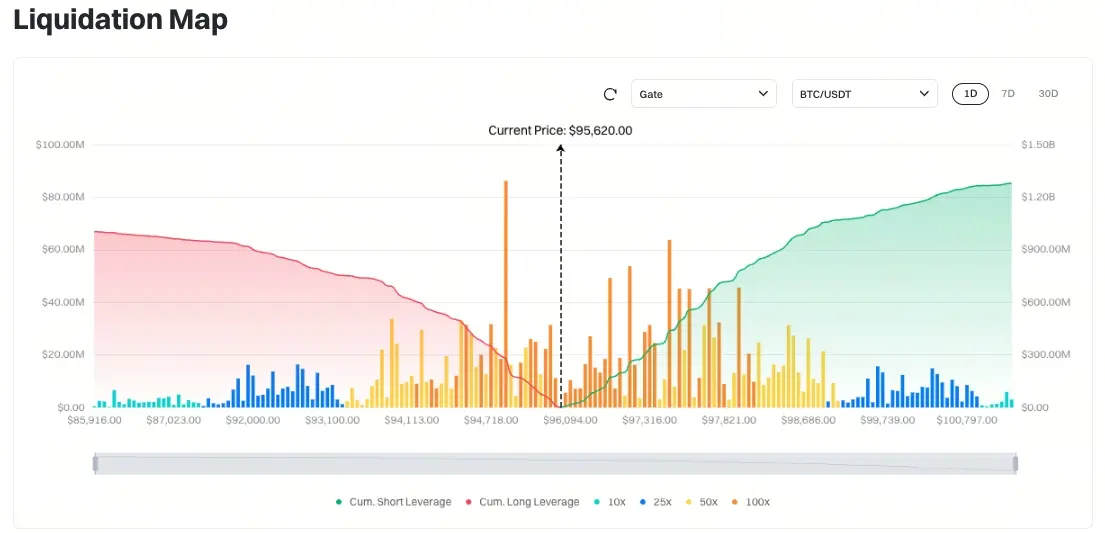
- According to Gate’s BTC/USDT liquidation map, with the current price at $95,620.00 USDT, if it drops near $94,875, the total long liquidation exceeds $275 million; if it rises near $97,398, the total short liquidation exceeds $436 million. Short liquidations are significantly higher than longs, so it is advisable to control leverage ratios reasonably to avoid large-scale liquidations during market fluctuations.
(Source: Coinglass)
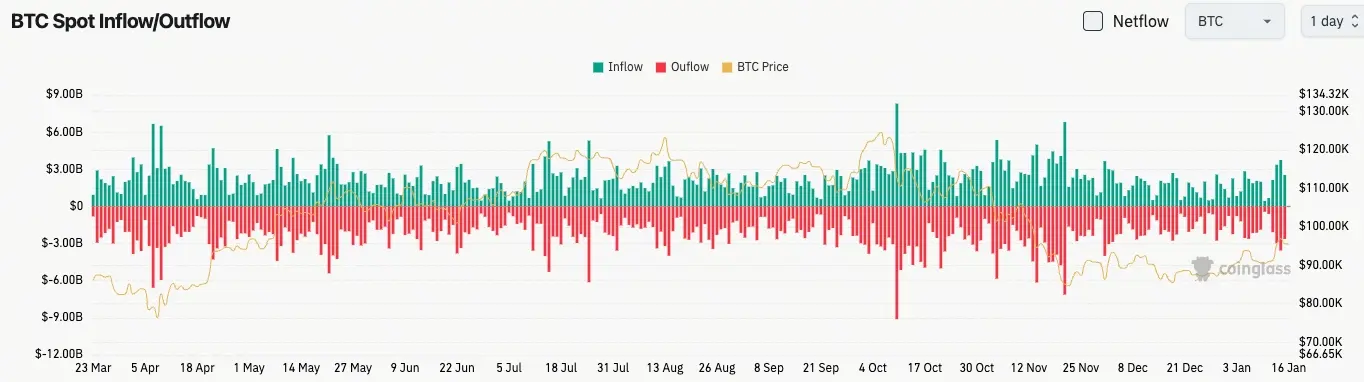
- In the past 24 hours, spot inflow was $2.54 billion, outflow was $2.62 billion, net outflow $0.8 billion.
(Source: Coinglass)
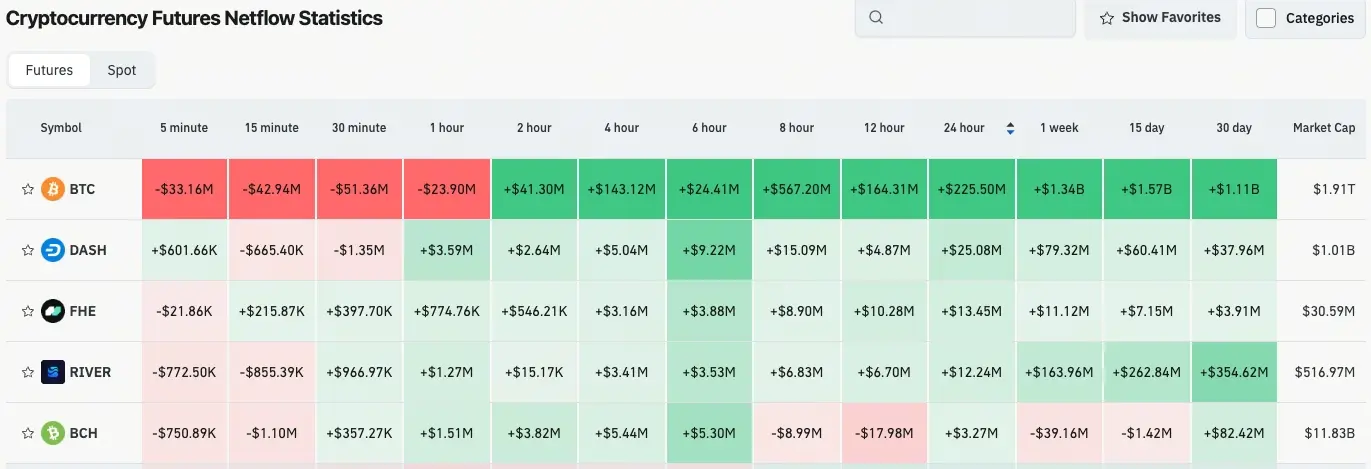
- In the past 24 hours, net outflows led in contracts trading for $BTC, $DASH, $FHE, $RIVER, $BCH , indicating trading opportunities.
Selected Opinions from X KOL
Phyrex Ni (@Phyrex_Ni): “Yesterday was not synchronized, today is again not synchronized. Yesterday US stocks fell, Bitcoin rose, and today BTC fell while US stocks rose. As I mentioned yesterday, there are no fundamental issues with US stocks, mainly due to falling credit card rates and bank sector earnings reports. There are no real negative signals for AI, only related to financial and tech sectors.”
“The recent pullback in Bitcoin might be due to Coinbase and others withdrawing support for the ‘CLARITY Act,’ leading the Senate Banking Committee to delay the bill’s review. Coinbase’s CEO announced this early this morning, but the market only reacted after US stock markets opened. From this perspective, it could be institutional investors selling.”
“The main reason is the policy delay, especially since recent rises were partly caused by the ‘CLARITY Act.’ Now that it’s delayed, uncertainty increases. This isn’t a big negative, and the bill may still be amended, but the next two days are crucial—will BTC continue to follow US stocks or falter?”
“Looking at Bitcoin data, the high trading volume in Coinbase over two days has not continued, which worries me about a potential sharp decline in buying power. However, US stocks have started rebounding today. If investors are patient, I believe the trend won’t be too bad. But if recent bottom-fishers are betting on the bill, it could be tough.”
“The chip structure remains very stable. The support levels I mentioned yesterday are a bit messy now, and adjustments are needed because most are short-term chips. Stable support will take more time to establish. As before, early-loss investors still show little price sensitivity.”
Today’s Outlook
-
US January NAHB Housing Market Index, previous value 39.
-
UK Bank of England Governor Bailey attends the “2026 Belleraggio Conference.”
Disclaimer: The information on this page may come from third parties and does not represent the views or opinions of Gate. The content displayed on this page is for reference only and does not constitute any financial, investment, or legal advice. Gate does not guarantee the accuracy or completeness of the information and shall not be liable for any losses arising from the use of this information. Virtual asset investments carry high risks and are subject to significant price volatility. You may lose all of your invested principal. Please fully understand the relevant risks and make prudent decisions based on your own financial situation and risk tolerance. For details, please refer to
Disclaimer.


