Bitcoin rebounded after falling near $76,000, with RSI dropping below 30 into oversold territory. MicroStrategy’s Michael Saylor posted “More Orange” hinting at continued buying, with $1 billion in liquidations completed and selling pressure released. Bitcoin held the $78,000 support level, with short-term targets of $84,000 to $86,000.
Oversold Signal Triggers Technical Rebound Expectations
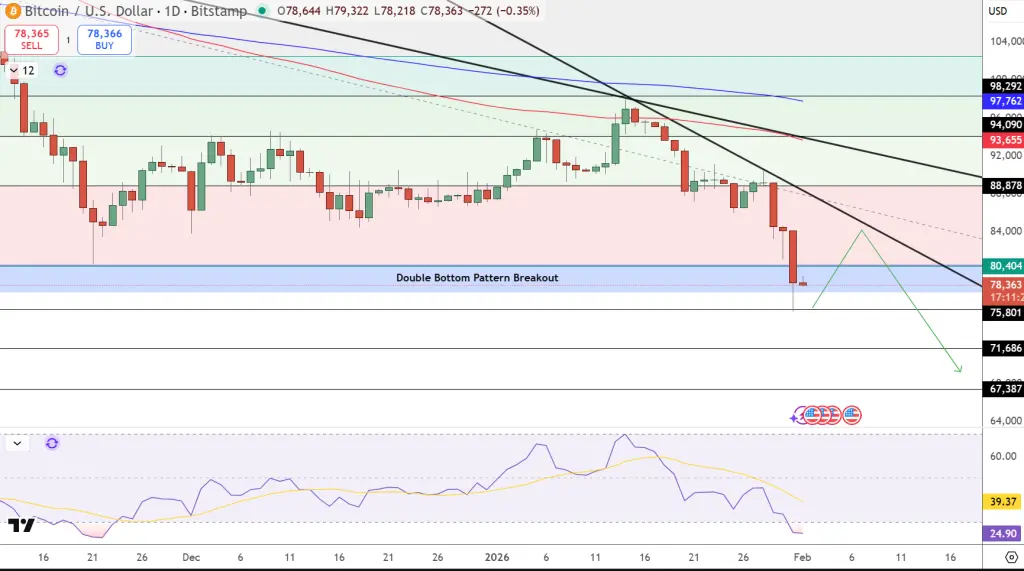
(Source: TradingView)
From a technical perspective, why did Bitcoin rebound today? The key indicator is the Relative Strength Index (RSI), which has fallen below 30, indicating the market has entered oversold territory. RSI measures the momentum of price changes, ranging from 0 to 100. When RSI drops below 30, it is generally seen as a oversold signal, suggesting selling pressure has been overextended and a technical rebound may occur.
In trending markets, RSI entering oversold does not necessarily mean an immediate reversal, but it does signal weakening selling momentum. Over the past 24 hours, Bitcoin declined about 6% to 7%, briefly touching the $76,000 to $77,000 range during weekend low-volume trading. This rapid decline caused RSI to plunge sharply. When RSI begins to recover from oversold levels, it often attracts dip-buying, forming a short-term rebound.
Currently, Bitcoin’s price has fallen back to the $78,000 to $80,400 range, which previously formed a double bottom pattern. A double bottom is a classic bullish reversal pattern. If the price can find support here and test a third time without breaking below, the likelihood of a rebound increases significantly. Looking at volume distribution, there is heavy historical trading activity around $78,000, indicating many investors’ cost basis is in this zone, motivating defensive buying on dips.
The daily chart shows Bitcoin has broken below the long-term downtrend line, indicating sellers still dominate. Recently, Bitcoin attempted to rebound to $98,000 but was blocked by the 100-day and 200-day moving averages, initiating a new downtrend. However, when prices reach extreme oversold levels, technical rebounds—often called “dead cat bounces” or “oversold rebounds”—can occur even in a downtrend. While they may not change the long-term trend, they offer profit opportunities for short-term traders.
MicroStrategy’s Continued Buying Signals Provide Institutional Support
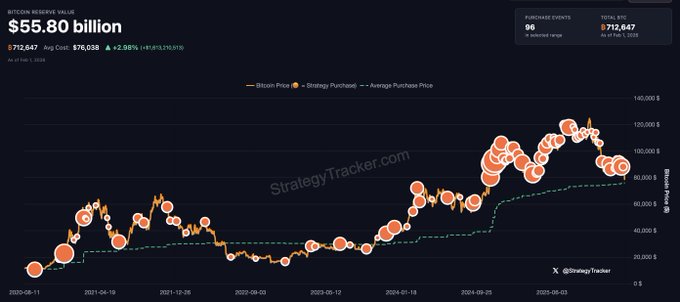
(Source: StrategyTracker)
To understand why Bitcoin rebounded today, MicroStrategy’s actions are a key institutional factor. CEO Michael Saylor posted an image titled “More Orange” on social media platform X on Sunday. Over recent months, this billionaire has repeatedly used similar phrases hinting at upcoming Bitcoin acquisitions. Such public signals can stabilize market sentiment during panic periods, as they show major institutional buyers remain optimistic about the long-term outlook despite price declines.
MicroStrategy currently holds 712,647 BTC, with an average cost basis of $76,037 per coin. Bitcoin was trading around $78,000 on Sunday, and the company’s unrealized gains have narrowed to less than 3%. Despite limited profit margins, MicroStrategy has expressed willingness to increase Bitcoin holdings, sending a strong confidence signal to the market. When prices approach institutional cost bases, holders often buy defensively to protect their positions—this behavior is known as “cost support” in technical analysis.
To raise funds for the next acquisition phase, MicroStrategy increased dividends on its Series A perpetual deferred preferred stock (STRC) by 25 basis points, bringing the yield to 11.25% as of February 2026. An 11.25% yield is well above typical corporate bonds, reflecting both the company’s capital needs and the inherent volatility of its Bitcoin-centric model. This active financing also suggests MicroStrategy plans to buy heavily at current or lower prices.
Threefold Impact of MicroStrategy’s Buying on Bitcoin Price
Direct Buying Support: Since the launch of STRC in November, sales of this product have been used to purchase over 27,000 BTC.
Market Confidence Boost: Continued participation by institutional buyers reduces retail panic sentiment and stabilizes market expectations.
Cost Support Formation: The average cost basis of $76,037 acts as a psychological support level, motivating MicroStrategy to defend near this level.
Notably, the company recently celebrated the 2,000-day milestone since adopting the “Bitcoin Standard.” This long-term commitment is especially important during volatile periods, as it shows MicroStrategy is not a short-term speculator but a strategic long-term holder. When such holders add to their positions during dips rather than reduce, it often signals a near-term bottom.
End of Liquidation Wave Releases Selling Pressure for Rebound
Another key reason for Bitcoin’s rebound today is the near-completion of the liquidation wave. Over $1 billion in leveraged positions were liquidated in the past 24 hours. While this large-scale liquidation caused sharp price declines, it also thoroughly released accumulated selling pressure. Liquidation events serve as a “clearing out” in crypto markets; when over-leveraged long positions are forcibly closed, the market structure becomes healthier, creating conditions for a rebound.
Various factors have dampened market sentiment, including President Trump nominating Kevin Warsh as Federal Reserve Chair, which lowered expectations for ultra-loose US monetary policy; a strengthening dollar putting pressure on risk assets; ongoing geopolitical uncertainties, including developments in US-Iran tensions; and continued ETF outflows and institutional de-risking. These negative factors have concentrated in the short term, causing Bitcoin’s reputation as “digital gold” to be questioned as it declines alongside gold and silver.
However, after negative factors are fully priced in and large-scale liquidations occur, markets often enter a “bad news fully priced” phase. Bitcoin’s decline follows a turbulent January, with gold and silver also falling after their historic late-year rally. This synchronized decline indicates a broad risk-off sentiment, not just weakness in Bitcoin alone. When overall risk appetite bottoms and rebounds, high-volatility assets like Bitcoin tend to rebound more strongly.
$78,000 Support Level Determines Short-term Direction
From a technical perspective, $78,000 is a critical level for Bitcoin’s rebound today. The current price is in the $78,000 to $80,400 range, which corresponds to the neckline of the double bottom pattern. If the price can hold above $78,000, it will confirm a higher low, an early sign of trend reversal. Conversely, if it breaks below $78,000, it may test $75,800, and if selling accelerates, possibly $71,600.
There are two main scenarios. In the optimistic case, the price rebounds to the $84,000 to $86,000 zone, where previous support has turned into resistance, and the descending trendline now acts as resistance. Breaking through this zone could pave the way toward $94,000. In the pessimistic case, failing to reclaim $84,000 could lead to retesting support at $75,800.
To achieve a genuine recovery, Bitcoin needs to complete three steps: first, hold above $78,000; second, form a higher low and rise above $86,000; third, break above the 100-day and 200-day moving averages. Only by completing these steps can a true trend reversal be confirmed rather than just a technical rebound.


