Tether announces open-source Bitcoin mining system in El Salvador, integrating operational layers and lowering barriers, reshaping the mining industry competition and community sovereignty ecosystem through decentralized architecture.
El Salvador Forum Shock Release, Tether Turns to Decentralized Infrastructure
Leading stablecoin Tether officially ventures into Bitcoin infrastructure industry, announcing at the 2026 Plan ₿ Forum held in El Salvador that its Bitcoin mining operating system (Mining OS) will be fully open-sourced. This move is seen as a strategic shift for the company, which has a market capitalization of over $120 billion, aiming to break the long-standing monopoly of industrial-scale mining operations’ “black box” proprietary software.
Tether CEO Paolo Ardoino announced this news yesterday (2/3), emphasizing that the system has been made available to the global mining community, hoping to reduce entry barriers through transparency and open-source collaboration. This decision continues Tether’s vision proposed last June, when the company advocated that Bitcoin miners should be able to participate in competition without relying on expensive third-party vendors.
Read More
Tether open-sources Bitcoin mining system! Empowering small and medium miners to control their rigs and break the monopoly ecosystem
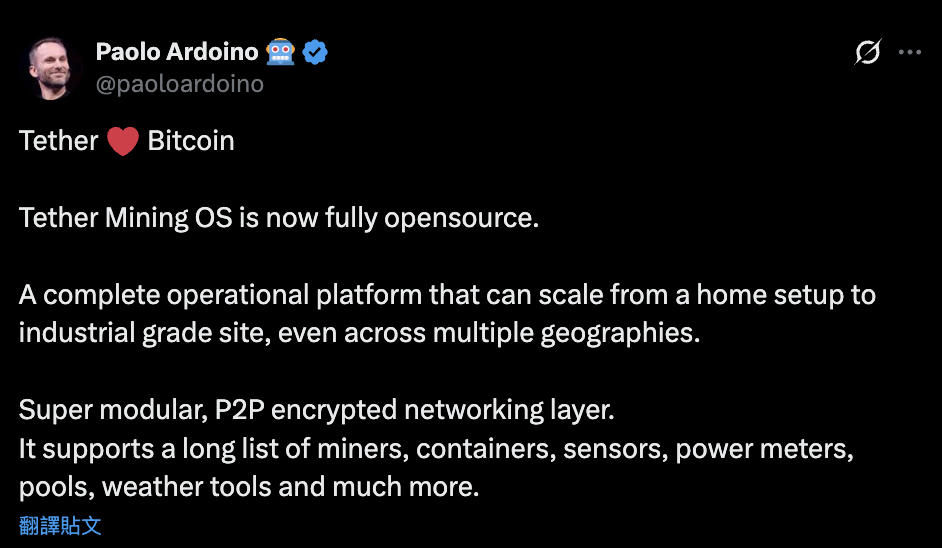
Image source: X/@paoloardoino Tether CEO Paolo Ardoino emphasizes that the system is now open to the global mining community, aiming to lower entry barriers through transparency and open-source collaboration
Unify Mining Nervous System, Integrate Disorganized Hardware Operations
Current mining operations often face software fragmentation issues: hash rate monitoring, power transformer management, and cooling systems usually run on unrelated systems. The emergence of Mining OS provides a single operational layer, described as the “nervous system” for miners, capable of achieving end-to-end complete visualization management. The system covers mining hardware performance, energy efficiency, device health monitoring, and site-level infrastructure management.
Its core technical feature is its self-hosted, peer-to-peer (P2P) architecture built on the Holepunch protocol, ensuring internal communication is encrypted and free from any centralized services, backdoors, or third-party dependencies.
Ardoino points out that Mining OS is highly modular and expandable, allowing both small hobbyists with just a few machines and industrial farms managing multiple regions with gigawatt-scale power to use the same system for efficient management.
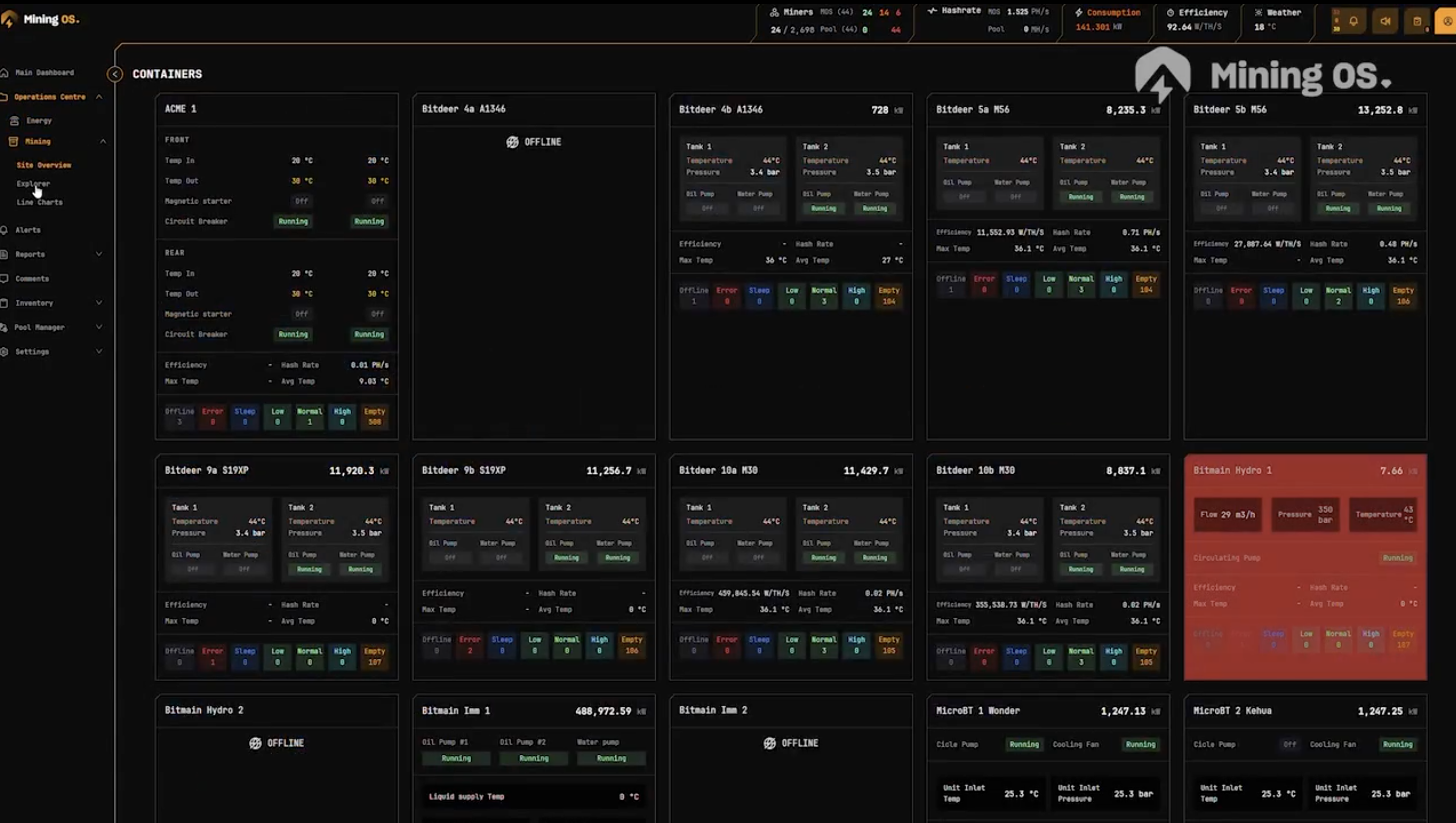
Image source: Mining OS Mining OS interface
Mining SDK Debuts Simultaneously, Lowering Developer Barriers
In addition to the operating system itself, Tether also unveiled the underlying framework supporting Mining OS: Mining SDK. This software development kit offers pre-built modular components (called workers), simple APIs, and UI development tools, enabling developers and mining enterprises to quickly build custom dashboards or internal management tools. The SDK aims to eliminate the need for developers to write infrastructure code from scratch, significantly reducing software development time and costs.
While Mining OS is ready for immediate deployment, the SDK is positioned as a collaborative project, with plans to finalize the version in the coming months in partnership with the open-source community. By open-sourcing the code, Tether hopes to shift the competitive focus of the mining industry from “closed technology access” disputes to a pure pursuit of “operational efficiency,” thereby strengthening the overall resilience of the Bitcoin network.
Rearranged Competition Landscape, Tether Demonstrates Diversification Ambition
Tether’s open-sourcing of Mining OS places it alongside well-known crypto companies like Jack Dorsey’s Block, jointly promoting open-source mining technology.
Notably, Block’s software is mainly optimized for its own hardware, whereas Tether’s Mining OS emphasizes hardware-agnostic compatibility, supporting most infrastructure on the market. This signifies another successful expansion beyond stablecoin $USDT. Looking back at 2025, the company earned over $10 billion in profit and invested heavily in AI, DeFi, tokenized physical assets like gold, and Bitcoin infrastructure development.
With Mining OS licensed under Apache 2.0, miners worldwide can freely use, improve, and optimize this system, further reducing dependence on proprietary software vendors. This is not only a technological advancement but also an important milestone in reclaiming mining sovereignty for the community.
Read more about “Tether” news
Dividing Gold into Smaller Units! Tether Gold Mimics Bitcoin’s “Satoshi,” Introducing Scudo Pricing System
Tether Launches Password Management Tool! PearPass Uses Decentralized Design to Avoid Cloud Data Leaks
Tether to Launch Cryptocurrency Wallet App! Integrates Local AI Assistant, Supports Only Bitcoin and 3 Stablecoins
Disclaimer: The information on this page may come from third parties and does not represent the views or opinions of Gate. The content displayed on this page is for reference only and does not constitute any financial, investment, or legal advice. Gate does not guarantee the accuracy or completeness of the information and shall not be liable for any losses arising from the use of this information. Virtual asset investments carry high risks and are subject to significant price volatility. You may lose all of your invested principal. Please fully understand the relevant risks and make prudent decisions based on your own financial situation and risk tolerance. For details, please refer to
Disclaimer.
Related Articles
Tether's QVAC Workbench releases version 0.4.1, with multiple upgrades focused on AI localization
Tether CEO Paolo Ardoino announced on the X platform that the smart development platform QVAC Workbench 0.4.1 has been released. The new version enhances the serverless experience, optimizes delegated inference and RAG capabilities, supports more document formats, and has been optimized for mobile devices. It is currently in Alpha testing, with the full mode coming soon.
GateNews14h ago
Mega Financial Chairman: No one can profit from the three major pitfalls of stablecoins? Clearly states "Banks can't find advantages in issuing them"
Mega Financial Holding Chairman Dong Rui-bin pointed out that issuing stablecoins in Taiwan faces three major challenges: insufficient payment demand, limited influence of bank brands, and strict regulatory requirements. The model of banks issuing stablecoins is difficult to profit from, and future legislation will be led by financial institutions, but market demand remains uncertain.
動區BlockTempo16h ago
Circle Faces Upgraded Stablecoin Competition: Tether and Wall Street Enter the Market, Can USDC Continue to Lead?
As competition in the global stablecoin market intensifies, Circle faces challenges from Tether and traditional financial institutions, but its advantages in compliance, partnerships, and technology remain promising. Research predicts that Circle's stock price is expected to rise, while USDC's growth trend and revenue are expanding rapidly. Circle is also exploring the integration of AI and blockchain in payment scenarios, and future competitive dynamics will depend on compliance capabilities and the expansion of its payment network.
GateNews18h ago
Tether mints an additional 50 million USDT on the Plasma chain
Gate News Report, March 10th, according to Whale Alert monitoring, Tether issued an additional 50,000,000 USDT on the Plasma blockchain, worth approximately $50.01 million at current prices.
GateNews03-10 12:58
Tether's BrainWhisperer brain signal decoding accuracy reaches 98.3%, ranking fourth in the Kaggle competition.
The BrainWhisperer project under Tether achieved an accuracy of 98.3% in converting brain signals to text, ranking fourth in the Brain-to-Text '25 competition. The system combines the OpenAI Whisper model and LoRA technology and is currently developing cross-individual signal decoding and non-invasive brain-computer interfaces.
GateNews03-10 08:31


