

Trade
Trading Type
Spot
Trade crypto freely
Pre-Market
Trade new tokens before they are officially listed
Margin
Magnify your profit with leverage
Convert & Block Trading
0 Fees
Trade any size with no fees and no slippage
Alpha
Points
Get promising tokens in streamlined on-chain trading
Leveraged Tokens
Get exposure to leveraged positions simply
Futures
Futures
Hundreds of contracts settled in USDT or BTC
Options
HOT
Trade European-style vanilla options
Unified Account
Maximize your capital efficiency
Demo Trading
Futures Kickoff
Get prepared for your futures trading
Futures Events
Participate in events to win generous rewards
Demo Trading
Use virtual funds to experience risk-free trading
Earn
Launch
CandyDrop
Collect candies to earn airdrops
Launchpool
Quick staking, earn potential new tokens
HODLer Airdrop
Hold GT and get massive airdrops for free
Launchpad
Be early to the next big token project
Alpha Points
NEW
Trade on-chain assets and enjoy airdrop rewards!
Futures Points
NEW
Earn futures points and claim airdrop rewards
Investment
Simple Earn
Earn interests with idle tokens
Auto-Invest
Auto-invest on a regular basis
Dual Investment
Buy low and sell high to take profits from price fluctuations
Soft Staking
Earn rewards with flexible staking
Crypto Loan
0 Fees
Pledge one crypto to borrow another
Lending Center
One-stop lending hub
VIP Wealth Hub
Customized wealth management empowers your assets growth
Private Wealth Management
Customized asset management to grow your digital assets
Quant Fund
Top asset management team helps you profit without hassle
Staking
Stake cryptos to earn in PoS products
Smart Leverage
NEW
No forced liquidation before maturity, worry-free leveraged gains
GUSD Minting
Use USDT/USDC to mint GUSD for treasury-level yields


More
Promotions
Activity Center
Join activities and win big cash prizes and exclusive merch
Referral
20 USDT
Earn 40% commission or up to 500 USDT rewards
Announcements
Announcements of new listings, activities, upgrades, etc
Gate Blog
Crypto industry articles
VIP Services
Huge fee discounts
Proof of Reserves
Gate promises 100% proof of reserves

From start to giving up, why I stopped doing Web3 payments.
2025-12-23 09:51
The Year of the New Token's Demise
2025-12-23 08:41
Trending Topics
View More19.17K Popularity
50.67K Popularity
60.24K Popularity
91.24K Popularity
4.07K Popularity



Pin
Taproot VS Drivechain: A Different Exploration of Bitcoin Scaling
Source: LayerTwo Labs
In November 2021, Bitcoin underwent its only code upgrade since 2017: the Taproot upgrade. This upgrade is like quicklime spilling into a calm lake, slowly heating the entire lake, causing the heat to bubble continuously.
16 soft upgrades in the first 7 years of Bitcoin and only 2 soft upgrades in the next 7 years of Bitcoin; The SegWit soft fork upgrade took 20 months and the Taproot soft fork upgrade took 46 months.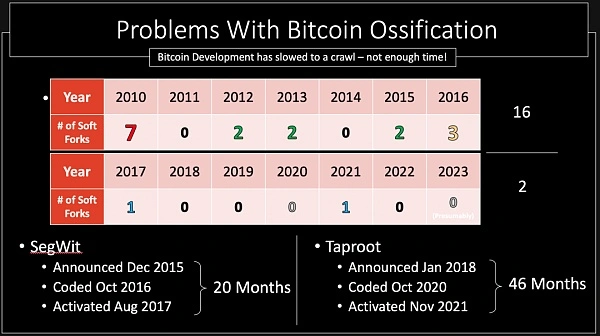
In 2023, the Bitcoin ecosystem is uncharacteristically active, and related innovations have sprung up everywhere, from the Ordinals protocol in March, to the discussion of Drivechain in the entire Bitcoin community in September, BitVM, Taproot Asset, etc. in October, the Bitcoin ecosystem seems to gather energy to return to the center of the stage, and also highlights the strong attraction of the king of cryptocurrencies and the possibility of being an open source software.
Major Bitcoin ecosystems in recent times
1、Ordinals
Ordinals is to use Segregated Witness upgrade, pictures, text, audio and video, and even code and other data, as long as the size is less than 4MB, into the Segregated Witness area of Bitcoin transactions, and through a number, indexer to distinguish and track each Bitcoin Satoshi, so as to achieve the issuance and trading of NFT assets on the Bitcoin mainnet, and then the BRC20 token based on Ordinals appeared. In April of this year, the Ordinals-based NFT and BRC20 Token hype reached its peak, attracting the attention of the entire crypto circle.
2、Babylon
Babylon aims to bring Bitcoin security to PoS networks and DApps, allowing Bitcoin holders to stake Bitcoin to improve the security of PoS chains and DApps and help users earn money.
Babylon’s Bitcoin staking protocol uses cryptography to convert Bitcoin stakers’ attacks on PoS network consensus into partial or partial confiscation of their Bitcoin staked on the Bitcoin network. And the penalty will only be triggered when the attack does occur, ensuring the absolute security of the honest staker’s assets, so that Bitcoin can become the same staking asset as the PoS native token without the need for Bitcoin cross-chain.
The core technology is called “extractable one-time signature” (EOTS), and when used, the same key can only be signed once. If signed twice, the key can be decoded. The underlying signature algorithm of this technology is based on Bitcoin’s native signature algorithm, so it is supported by the existing Bitcoin network.
3、BitVM
The idea, just released by Zerosync team Robin linus, is described as “no need to change the existing Bitcoin consensus, or even any upgrades, to implement any computation on Bitcoin,” according to the white paper, through Op-Rollup, Proof of Fraud, and Taproot Leaf and Bitcoin.
According to crypto analyst @tmel0211, the core point of the BitVM proposal is that various program instructions similar to binary circuits are implemented through taproot address matrices or taptrees, which are equivalent to complete contract execution. The smallest unit instruction is indeed done by Bitcoin full nodes, and the infinite superposition of taproot addresses, the possibility of infinite combinations, can superimpose a lot of complex calculations. In a way, it is not an exaggeration to say that it is a Turing-complete machine. But unlimited superposition of taproot addresses will only increase cost consumption, theoretically it is possible to achieve everything in Turing, but it is impractical.
For now, BitVM is still under discussion.
4、Taproot Asset
Recently released by the Lightning Labs team, Taproot Assets is a new protocol based on the Bitcoin blockchain, which leverages Bitcoin’s latest upgrade, Taproot, to achieve greater privacy and scalability, providing developers with core capabilities for publishing, sending, receiving and discovering assets on the Bitcoin blockchain. These assets can be deposited into the channels of the Lightning network and can be transferred through the existing Lightning network.
Taproot assets is based entirely on UTXOs, writing “simple code” into scripts at Taproot addresses, executing it as a UTXO spending conditional instruction. In the asset issuance scenario of Taproot Assets, you can specify this simple opcode as rules such as the total amount of token issuance, the issuance time, and the issuance object, and you can access a set of multi-signature addresses to jointly trigger the opcode.
It is not difficult to find that the important basis for the emergence of these ecosystems is Segwit and Taproot upgrades.
Segwit and Taproot upgrade
Taproot is an upgrade to the Bitcoin network that went live on November 14, 2021. Since the advent of SegWit, the Taproot and Schnorr signatures have been a highly anticipated upgrade to Bitcoin’s technology.
The Taproot upgrade consists of 3 different Bitcoin improvement proposals (BIP340[1] [2]、BIP341 [3]、BIP342 These include: Taproot, Tap and its core, a new digital signature scheme called “Schnorr Signature”. Taproot aims to change the way Bitcoin Script works, improving privacy, scalability and security, bringing many benefits to Bitcoin users, such as increased transaction privacy and reduced transaction fees. It will also allow Bitcoin to perform more complex transactions, broadening use cases to compete with Ethereum, especially smart contract functionality and the network’s support for decentralized finance (DeFi) and non-fungible tokens (NFTs).
In a way, combined with the previous Segwit upgrade, the Taproot upgrade opens the door to more complex contracts for Bitcoin.
Segwit was a 2017 update that effectively isolated Bitcoin transactions into two parts by adding a “witness data” section that could support arbitrary data.
The implementation of Segregated Witness (SegWit) brought two significant changes to the Bitcoin network:
Segwit & Taproot VS Drivechain
Simply put, Segwit and Taproot are through changes to block data and signature methods, so that UTXO or blocks can write more diverse data, and then through some off-chain operations, to achieve specific functions, to a certain extent enhance the ability of the Bitcoin network to implement more complex contracts.
But the undeniable underlying fact is that Bitcoin’s capabilities are limited by its underlying limitations, coupled with block size and block time, the expansion potential is very limited. **
We’ve seen this problem during the Ordinals boom, with a large number of BRC20 transactions congesting the Bitcoin network and skyrocketing transaction fees to hundreds of dollars a piece, causing discontent in the community.
BitVM’s vision of Bitcoin Turing-complete, the application of a single taproot address script to implement the minimum programming unit, can not exceed the execution logic framework of Bitcoin such as hashlock, timelock, can not exceed the limited storage conditions, on this basis to achieve complex contracts need to combine a large number of addresses for taptree construction, the greater the cost, and slow.
Compared with Taproot and these on-chain scaling solutions, Drivechain’s layered, “off-chain scaling” scheme has greater possibilities and lower costs.
Also does not touch the consensus mechanism of Bitcoin, **Drivechain only needs to add 6 new block messages designed in BIP300 to the block, use computing power hosting addresses, supplemented by BIP-301’s blind merger mining scheme, you can achieve large-scale sidechain expansion of Bitcoin at low cost, sidechains have the security of the Bitcoin mainnet, and very freely designed high scalability. ** In theory, the possibilities offered by Drivechain are endless.
Logically, Taproot Asset is the same idea, with assets on the Bitcoin mainnet, but transactions on the Lightning Network. In fact, they can all use Drivechain to achieve, becoming a sidechain in the Drivechain architecture, which can achieve more functions than transactions and transfers. The Layer 2 Labs team itself is already promoting the construction of 7 Drivechain sidechains, and sidechains such as RSK are also interested in transferring to the Drivechain system after Drivechain is activated.
Adam Back, founder of Blockstream and inventor of POW consensus[4] In a Twitter account of Layer 2 Labs, he said: “If some new features and extensibility can be introduced at Layer 1, then Bitcoin can be solidified to some extent while continuing to innovate on Layer 2.” Bitcoin needs scalability and modularity in order to innovate and adopt new features faster. Technologies like the Lightning Network have helped, but there is more work to be done to address scalability and user needs, and technical solutions are needed to provide users with better options, such as accessing real UTXOs on sidechains or drivechains. Recognizing that Bitcoin adoption is likely to grow rapidly and that technology needs to keep up to accommodate increased demand, they are very much looking forward to Drivechain’s performance. ”
**Bitcoin is a security-first cryptocurrency and a programmable software application. ** The BTC community has been resilient, and after years of stagnation in innovation, just opening up a little block space and supporting more data types has brought the community’s enthusiasm and high attention from the market, and it is foreseeable what scale Bitcoin will take by storm after having more potential space.
As a fan of Bitcoin, Layer 2 Labs is looking forward to this day and is eager to work with the developers of the Bitcoin ecosystem to achieve mass adoption of Bitcoin.