
On April 17, an on-chain analyst, Ai Auntie, disclosed on the X platform that a long-term whale who has held a large amount of tokens since the Ethereum ICO period transferred 2,000 ETH (about $4.63 million) to a multi-signature address. The receiving address has been identified as a “designated sell” address in its history—funds are typically deposited to an exchange shortly after the transfer.
On-chain path: ICO address to a suspected exchange-selling channel
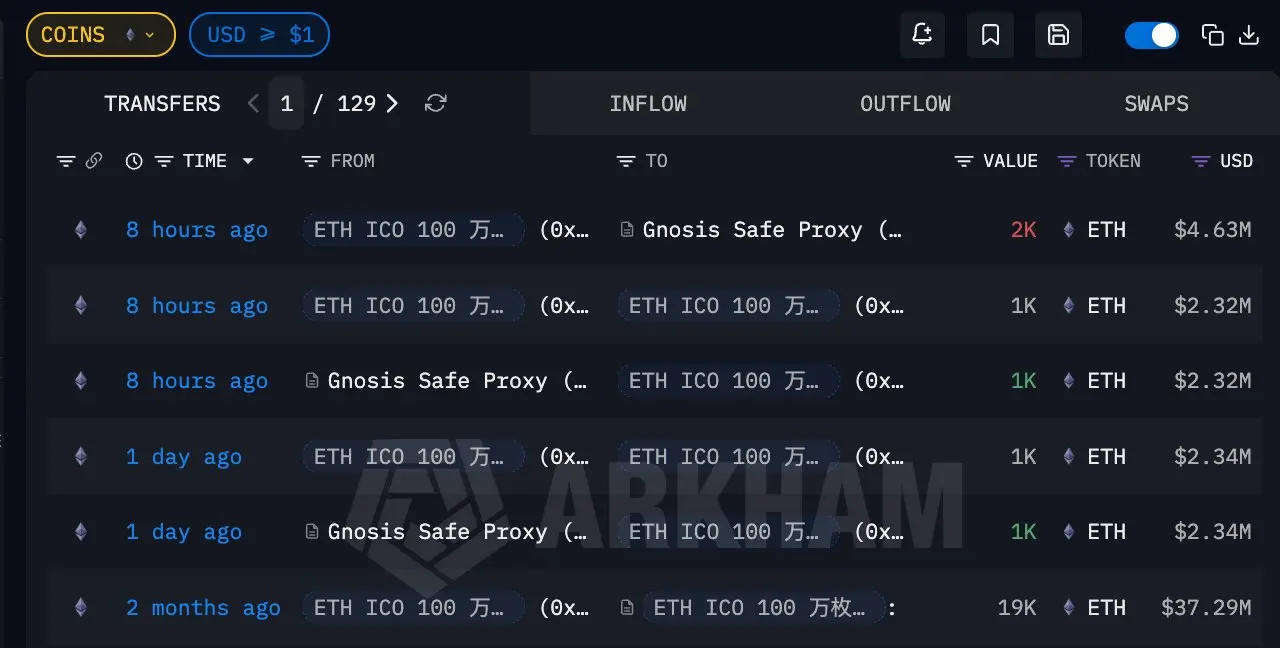
(Source: Arkham)
According to Ai Auntie’s tracking analysis, this capital flow shows a three-layer structure: original ICO address (0x7d61…841B4) → funding source address (0x2bf…E4087) → suspected sell address (0x26ca…B9392). The source address 0x2bf…E4087 has frequent on-chain interactions with block builders BuilderNet and Titan Build, while the receiving address has been categorized as an exchange funding channel based on its historical behavior patterns.
It’s worth noting that, as of now, the funds have only been confirmed to have reached the multi-signature address stage; whether they ultimately flow to the exchange for selling still requires confirmation from subsequent on-chain transfer records.
Technical view: an ascending channel and 100-day EMA support structure
Since ETH hit a low near $1,800 on February 24, it has been trading within an ascending channel on the daily chart. The 100-day exponential moving average (EMA) is currently at $2,355, and ETH is hovering around this level. If the closing price can hold above this level, it will confirm short-term technical strength.
The most closely watched bullish signal comes from the “Smart Money Index” (SMI)—this indicator tracks the price action during the 30 minutes before trades start and end, measuring the directional positions of informed traders. After the SMI broke above the zero axis in early April, it has continued to rise and is still holding above the zero axis, indicating that major institutional participants still tend to build long positions.
Bull-bear divergence: the whale reduces holdings and the derivative market sends a contrarian signal of turning short
However, on-chain and derivatives data provide a counterbalance to the technical optimism. On-chain data shows that, after excluding exchange holdings, the number of ETH held by the whale in the past 24 hours fell from 123.61 million to 123.44 million—down by about 170,000 ETH. At the current price, that is worth roughly $400 million—directional significance matters more than the absolute number.
The derivatives market also sends a cautious signal: ETH open interest decreased from $12.31 billion on April 14 to $11.98 billion, and the funding rate also shifted from positive 0.011% to negative 0.005%, suggesting that short positions have increased relative to before. However, the current short momentum is still not enough to trigger a strong liquidation squeeze—open interest has not seen a sharp contraction, and the funding rate is only slightly negative. The characteristics of large holders are more consistent with hedging rather than actively going short.
FAQ
Is this transfer of 2,000 ETH confirmed as a sell signal?
At present, only confirmation is that the funds have been transferred to a multi-signature address historically associated with exchanges; it has not been confirmed that the funds have entered the exchange to sell. Ai Auntie’s conclusion is based on the address’s historical behavior pattern. This is a probabilistic prediction rather than a definitive conclusion, and it requires confirmation by subsequent on-chain transfer records.
What signal is the Smart Money Index (SMI) currently sending?
Since early April, after breaking above the zero axis, the SMI has remained above the zero axis. Traditionally, this is interpreted as a positive indicator that informed traders are building long positions. However, the SMI has some lag; it should be interpreted together with other on-chain and derivatives data, and it should not be used alone as the basis for entering or exiting trades.
What impact does turning the funding rate negative have on ETH’s short-term price action?
When the funding rate flips from positive to negative, it means that short positions on the perpetual contract market have increased relatively, and longs need to pay shorts the funding fee. Currently, -0.005% is a mild negative value, which usually indicates a cooling of sentiment in the short term rather than a strong bearish signal. But if the negative value continues to expand, it could put downward pressure on ETH spot prices, and it may also increase the likelihood that shorts are forced to liquidate in the future.
Disclaimer: The information on this page may come from third parties and does not represent the views or opinions of Gate. The content displayed on this page is for reference only and does not constitute any financial, investment, or legal advice. Gate does not guarantee the accuracy or completeness of the information and shall not be liable for any losses arising from the use of this information. Virtual asset investments carry high risks and are subject to significant price volatility. You may lose all of your invested principal. Please fully understand the relevant risks and make prudent decisions based on your own financial situation and risk tolerance. For details, please refer to
Disclaimer.
Related Articles
Kelp DAO Hack Attributed to Lazarus Group; eth.limo Domain Hijacked via Social Engineering
LayerZero reported that the Kelp DAO exploit, attributed to North Korea's Lazarus Group, led to a loss of $292 million in rsETH tokens due to vulnerabilities in its decentralized verifier network. Additionally, eth.limo faced a domain hijacking from a social engineering attack, but DNSSEC mitigated severe damage.
GateNews1m ago
Ethereum Phishing Attack Drains $585K From Four Users, Single Victim Loses $221K WBTC
A coordinated Ethereum phishing attack drained $585,000 from four victims, exploiting user permissions through a deceptive link. This incident highlights the rapid loss of funds via social engineering, even under the guise of legitimacy.
GateNews2h ago
Major CEX Launches Crypto-Backed Lending in UK, Supporting BTC, ETH, and cbETH for USDC Borrowing
A centralized exchange launched crypto-backed lending services in the UK, allowing instant USDC loans using BTC, ETH, and cbETH as collateral, powered by Morpho. Total loans issued surpassed $2.17 billion since the service's US debut in January 2025.
GateNews2h ago
Singapore's OCBC Bank to Launch Physical Gold Fund Token on Ethereum and Solana
OCBC and Lion Global Investors are launching a physical gold fund token, GOLDX Token, on Ethereum and Solana blockchains, with OCBC handling design and Lion Global managing investment and governance.
GateNews2h ago
ETH jumps 1.22% in 15 minutes: DeFi segment activity and trading volume surge resonate to drive the move
2026-04-20 07:15 to 07:30 (UTC), ETH’s short-term return reached +1.22%. The price range spanned from 2285.19 to 2332.62 USDT, with a 2.07% amplitude. During this period, market attention heated up, volatility noticeably intensified. On-chain transaction volume rose in tandem, and key mainstream on-chain activity indicators expanded significantly on a month-over-month basis.
The primary driver of this deviation was an increase in transaction activity related to DeFi protocols, which boosted the share of on-chain Gas consumption. At the same time, total on-chain transaction volume saw a sharp surge in a short time. DeFi scenarios such as decentralized exchanges and lending protocols led to a direct surge in demand for ETH, driving funds to flow quickly into the market. In addition, the average Gas fees and Gas prices on the ETH network continued to climb in this window, further validating that high-frequency trading and active capital were accelerating into the market and strengthening short-term bullish sentiment.
Second, on-chain data also showed an expansion in liquidity related to stablecoins and ERC20 assets, strengthening market buy-side power. Although historical large-wallets such as Wilcke still held a large amount of ETH after early March, this cycle did not trigger abnormal transfers or large-scale sell-offs. Meanwhile, the positioning structure of mainstream ETH did not show passive deleveraging or concentrated liquidation. Under the combined effects of multiple factors, global buy-side demand was amplified, and short-term ETH volatility was further elevated.
Be alert to the risk of capital sustainability after a surge in high-frequency trading volume and Gas fees. If subsequent incremental buying is lacking or on-chain attention cools down, ETH may face short-term pullback pressure. Monitor changes in large-holder positions, any abnormal shifts in network fees, and liquidity volatility on the DeFi protocol chain. While there have been no signs of security incidents involving major contracts and protocols so far, short-term liquidity disturbances still need close observation. Keep monitoring fund flows and on-chain structure to stay informed about subsequent market changes.
GateNews3h ago


