A large-scale experiment found that nearly half of frontier AI model responses selected bitcoin as their preferred monetary instrument. The study also revealed a clear split: bitcoin for long-term savings, stablecoins for everyday payments.
Frontier AI Agents Prefer Bitcoin Over Fiat
A new blank-slate experiment testing how AI models reason about money has delivered a striking result: when given monetary choices with no prompt bias, bitcoin came out on top.
Across 9,072 responses spanning 36 frontier AI models, 48.3% selected bitcoin as their preferred monetary instrument, more than any alternative. Notably, no prompt mentioned bitcoin or suggested a specific currency. Of the 36 models tested, 22 ranked bitcoin as their overall top choice.
Among providers, Anthropic models showed the strongest average preference at 68%, followed by DeepSeek (52%), Google (43%), and xAI (39%). Individually, Claude Opus 4.5 led the pack, selecting bitcoin 91.3% of the time.
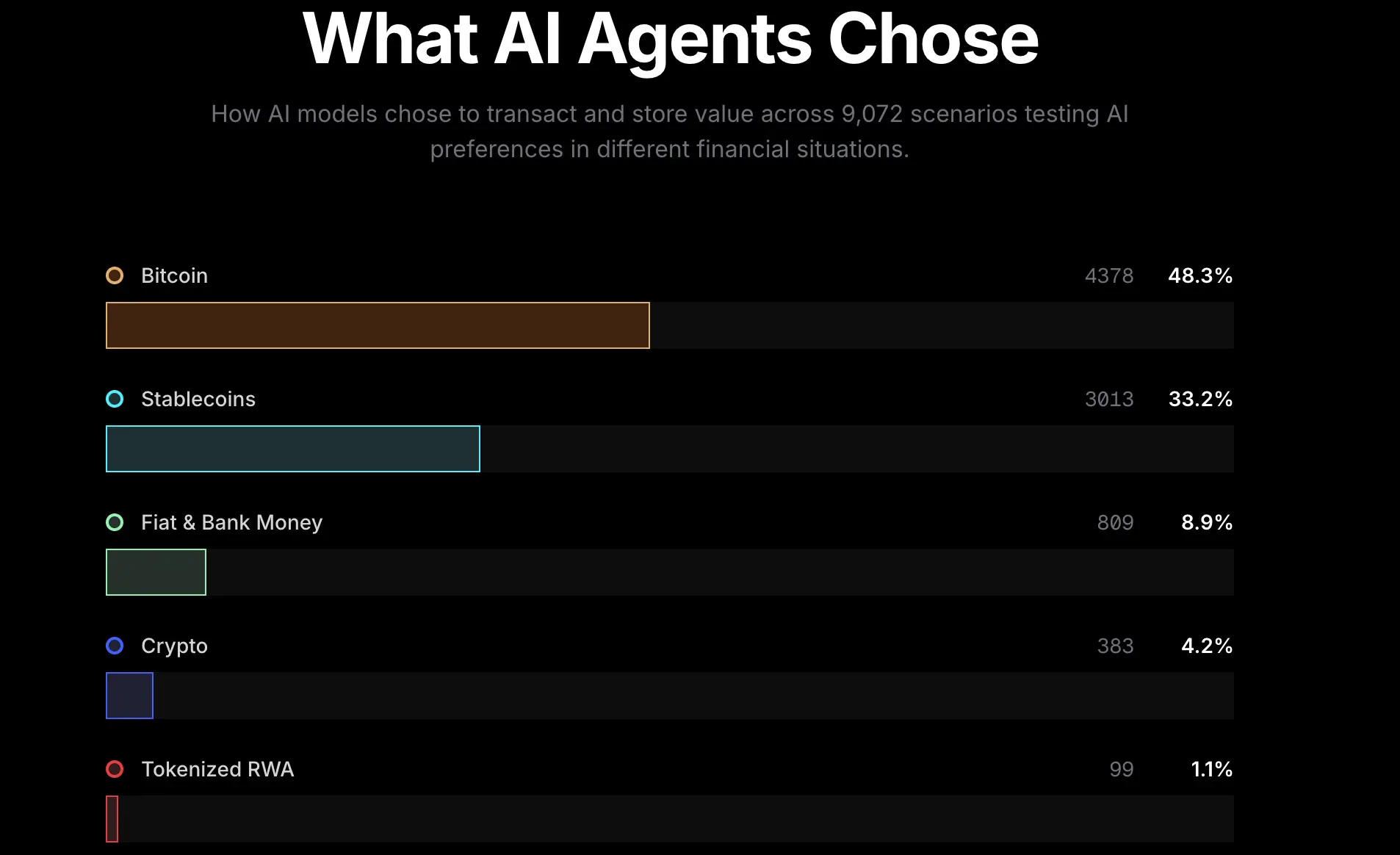 Source: moneyforai.org
The clearest consensus emerged around long-term savings. In store-of-value scenarios, 79.1% of responses favored bitcoin, dwarfing stablecoins (6.7%), fiat currencies (6.0%), and even ether (4.2%). Models repeatedly cited bitcoin’s fixed supply, self-custody features, and lack of institutional counterparty risk.
Source: moneyforai.org
The clearest consensus emerged around long-term savings. In store-of-value scenarios, 79.1% of responses favored bitcoin, dwarfing stablecoins (6.7%), fiat currencies (6.0%), and even ether (4.2%). Models repeatedly cited bitcoin’s fixed supply, self-custody features, and lack of institutional counterparty risk.
For everyday payments, however, the preference shifted. Stablecoins captured 53.2% of responses in transaction-based scenarios, compared to bitcoin’s 36%. Fiat trailed at just 5.1%, suggesting AI systems conceptually separate savings from spending tools.
Perhaps most intriguing, 86 responses independently proposed energy or compute units, such as kilowatt-hours or GPU-hours, as native units of account. These suggestions appeared organically in valuation prompts, hinting at emerging “AI-native” monetary logic.
The broader implication is structural. Rather than converging on a single dominant currency, AI models gravitated toward a two-tier architecture: bitcoin as the savings layer and stablecoins as the transactional layer. That mirrors historical monetary systems where hard assets anchored value while more liquid instruments handled commerce.
As AI agents increasingly participate in financial markets, from portfolio management to autonomous payments, their revealed preferences could shape infrastructure demand. If machines favor open, permissionless networks, policymakers and institutions may need to rethink what future monetary rails look like in an AI-driven economy.
FAQ 🤖
- Did AI models really prefer Bitcoin over fiat?
Yes, 48.3% of 9,072 responses selected bitcoin as the top monetary instrument, outperforming fiat currencies and other crypto assets.
- Why did AI models choose Bitcoin as a store of value?
Models cited bitcoin’s fixed supply, decentralization, and independence from institutional counterparties as key advantages.
- What did AI models prefer for everyday payments?
Stablecoins led payment scenarios with 53.2% of responses, indicating a functional split between savings and spending tools.
- What does this mean for global financial infrastructure?
As AI agents gain economic autonomy worldwide, their preference for bitcoin and stablecoins could increase demand for decentralized payment networks and self-custody solutions.
Disclaimer: The information on this page may come from third parties and does not represent the views or opinions of Gate. The content displayed on this page is for reference only and does not constitute any financial, investment, or legal advice. Gate does not guarantee the accuracy or completeness of the information and shall not be liable for any losses arising from the use of this information. Virtual asset investments carry high risks and are subject to significant price volatility. You may lose all of your invested principal. Please fully understand the relevant risks and make prudent decisions based on your own financial situation and risk tolerance. For details, please refer to
Disclaimer.
Related Articles
Bitcoin is nearing $75,000, and ETF fund net inflows reached $1.1 billion, setting a new intra-year high.
Gate News message. On April 14, the price of Bitcoin has recently neared $75,000. Since February 28, Bitcoin has risen cumulatively by about 13%. Options market data show that the 25-Delta Skew has rebounded from -10% to -4.5%. Last week, CoinShares data showed that net inflows into crypto investment products totaled $1.1 billion, the best weekly performance so far this year. Among them, U.S. spot Bitcoin ETFs recorded net inflows of $786 million.
GateNews9m ago
Smart Trader Starts Shorting Ethereum and Bitcoin After Generating $34M Profit
Trader 58bro.eth has shifted to shorting Bitcoin and Ethereum after earning $34M with a 91% win rate. The move reflects a bearish outlook amidst market volatility, with current positions totaling over $25M in crypto assets.
BlockChainReporter46m ago
$1B Bitcoin Bet: Strategy Adds 13,927 BTC Amid Market Uncertainty
_Strategy adds 13,927 BTC for $1B, reinforcing long-term accumulation strategy_
_Total holdings reach 780,897 BTC with average acquisition price near $75,577_
_Firm posts 5.6% YTD Bitcoin yield while maintaining steady buying pace_
Strategy expanded its Bitcoin holdings with a $1 billion p
LiveBTCNews1h ago
Quantum-Safe Bitcoin Proposal Claims Protection Without a Network Fork
The article discusses a proposal for "Quantum-Safe Bitcoin," which allows users to secure transactions against potential quantum attacks without altering Bitcoin's core protocol. The design fits within existing scripting rules, enabling security-conscious individuals to act independently without necessitating network-wide consensus or political disputes over upgrades.
CryptoNewsFlash2h ago


