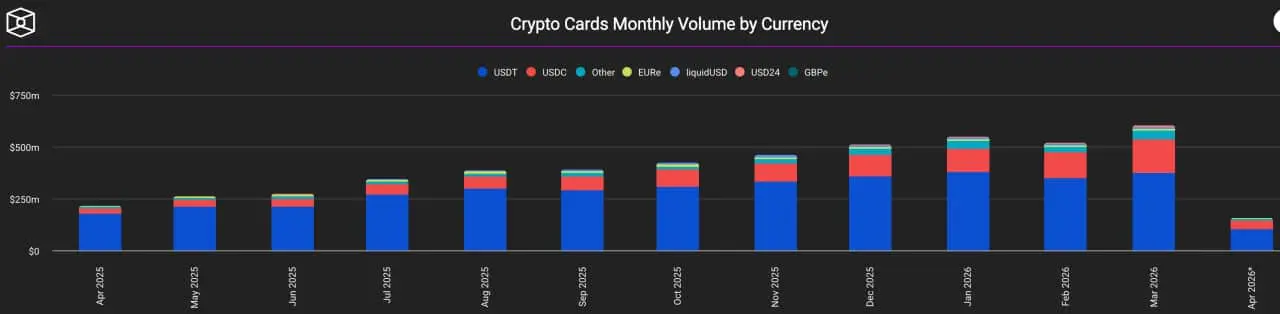
Crypto-linked card spending reached $600 million in monthly volume in March 2026, more than tripling from $187 million recorded a year prior – a 211% annual increase that signals structural rather than cyclical adoption across point-of-sale payment infrastructure.
Cumulative card volume across the period has now reached $6.5 billion across 21.4 million transactions, with Visa processing $581.8 million, or approximately 97%, of March’s total. The figures mark crypto debit and prepaid cards’ emergence as a meaningful real-world payments channel, not merely a retail novelty.
The structural significance of the $600 million figure lies less in its absolute scale than in what it represents architecturally: a reduction in the friction cost of converting onchain balances into everyday purchasing power, without routing through the cumbersome off-ramp infrastructure – exchange withdrawals, bank transfers, settlement delays – that historically made crypto spending impractical at the point of sale.
 Source: TheBlock
We suspect the sustained growth rate, averaging upward over six consecutive quarters, reflects a user base that has graduated from speculative holding to active payment utility.
DISCOVER: Meme coin supercycle: Top performers this week
Crypto Card Volume Mechanics: What $600 Million Monthly Represents in Structural Terms
The mechanism functions as follows: crypto-linked debit and prepaid cards allow users to denominate balances in stablecoins or other digital assets, which are then converted at the point of sale through card network rails – primarily Visa – into local fiat currency before settling with the merchant.
The user experiences a standard card transaction; the settlement layer is entirely onchain. This architecture eliminates the explicit off-ramp step while preserving compatibility with existing merchant acceptance infrastructure, which is why Visa’s 97% share of March volume is less a market concentration story than a reflection of how deeply the Visa network is embedded in global point-of-sale acceptance.
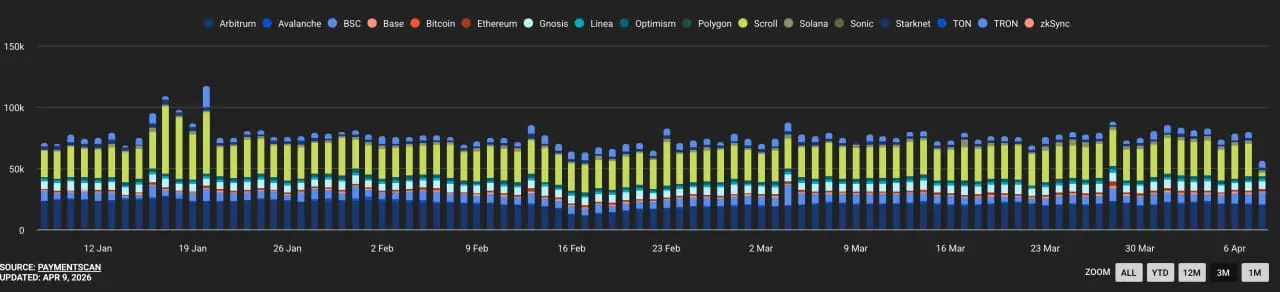
TRON captured 35% of March payment volume by blockchain, with BNB Chain accounting for 15% – a distribution that reflects the fee economics driving issuer and user choices rather than any ideological preference for those networks over Ethereum.
 Source: Theblock
Southeast Asia accounted for approximately 60% of global stablecoin payment volume in the period, and local card issuance grew 83 times between 2024 and 2025, according to research context compiled alongside
That geographic concentration matters for interpreting the volume figure: a substantial portion of the $600 million monthly total reflects users in markets where crypto cards function not as a convenience layer atop conventional banking but as a primary financial access mechanism.
Emerging issuers – including KAST, Tria, and the Solana-based Pengu Card, which enables USDC and USDT spending at an estimated 150 million merchants globally – have expanded the competitive field beyond earlier market leaders.
U.S. merchant adoption reached 39% in the period, suggesting the domestic market is absorbing crypto card infrastructure at a pace that was not visible in prior years. The $600 million monthly figure, taken together with the cumulative $6.5 billion in transaction history, represents a payments channel with enough transactional depth to attract serious issuer and network investment – a threshold that point-of-sale crypto spending had not previously cleared.
EXPLORE: Crypto breakout alerts this week
nextDisclaimer: Coinspeaker is committed to providing unbiased and transparent reporting. This article aims to deliver accurate and timely information but should not be taken as financial or investment advice. Since market conditions can change rapidly, we encourage you to verify information on your own and consult with a professional before making any decisions based on this content.
Disclaimer: The information on this page may come from third parties and does not represent the views or opinions of Gate. The content displayed on this page is for reference only and does not constitute any financial, investment, or legal advice. Gate does not guarantee the accuracy or completeness of the information and shall not be liable for any losses arising from the use of this information. Virtual asset investments carry high risks and are subject to significant price volatility. You may lose all of your invested principal. Please fully understand the relevant risks and make prudent decisions based on your own financial situation and risk tolerance. For details, please refer to
Disclaimer.
Related Articles
Circle quietly wires USDC into crypto’s new settlement spine
Circle's new USDC Bridge aims to turn cross‑chain transfers into a near‑invisible backend plumbing layer for on‑chain dollars, replacing fragmented bridges with a single bank‑style ledger experience operated end‑to‑end by Circle itself.
Summary
Circle has launched a native USDC Bridge, a burn‑a
Cryptonews8h ago
Newly Created Wallet Deposits $1.99M USDC to Hyperliquid, Opens 5x Leveraged ASTER Long
Gate News message, April 18 — According to Onchain Lens, a newly created wallet deposited $1.99 million USDC to Hyperliquid and opened a 5x leveraged long position in ASTER.
GateNews11h ago
Circle faces a class action lawsuit from Drift; USDC freeze obligations spark legal debate
Representing more than 100 members, Joshua McCollum, a Drift Protocol investor, filed a lawsuit against Circle on Wednesday in the U.S. District Court for the District of Massachusetts. The lawsuit alleges that in the April 1 theft incident involving approximately $280 million worth of Drift Protocol, Circle allowed the attacker to transfer roughly $230 million USDC to Ethereum via a cross-chain transfer protocol.
MarketWhisper04-17 02:45
Circle Faces Class Action Lawsuit Over $230M Unblocked USDC in Drift Protocol Attack
Circle faces a class action lawsuit for failing to freeze $230 million in stolen USDC after the Drift Protocol attack. Plaintiffs argue that Circle's protocols allowed attackers to move and convert the stolen funds without intervention, raising concerns about the company's responsibilities in monitoring cross-chain transfers.
GateNews04-17 01:46
New Wallet Deposits $7.45M USDC to HyperLiquid and Purchases 169,838 HYPE
Gate News message, a newly created wallet deposited $7.45M USDC into HyperLiquid and bought 169,838 HYPE at $43.86. Of that, 10,000 HYPE has been sent for staking.
GateNews04-17 00:34
Drift Protocol Switches From USDC to USDT, Secures $127.5M Recovery Support From Tether
Drift Protocol announced a recovery plan backed by $150 million after a $280 million exploit, transitioning from USDC to USDT, impacting 128,000 users. The plan links user balance restoration to ongoing trading, following criticism of Circle's response to the hack.
GateNews04-16 20:31


