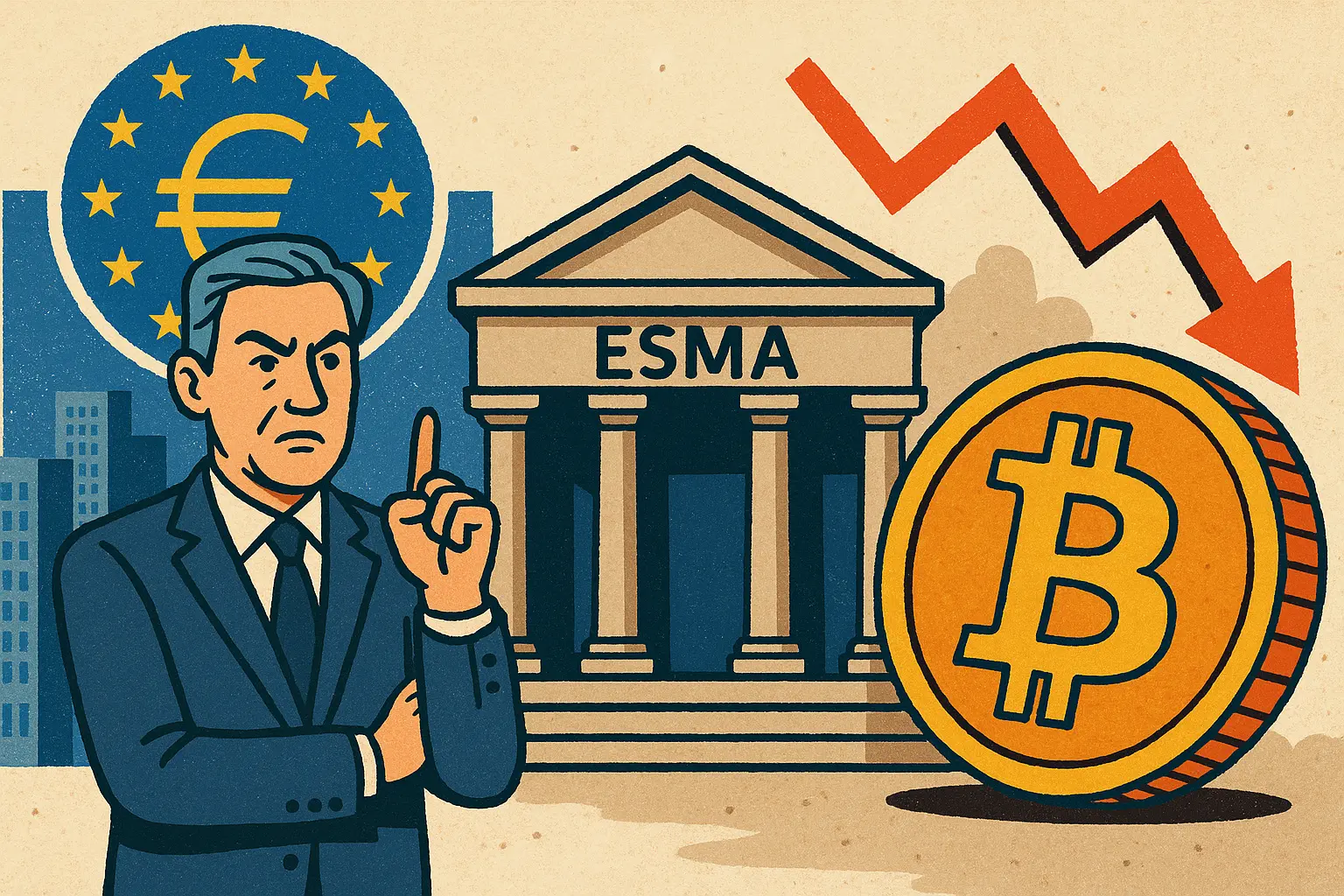
The European Central Bank (ECB) formally endorses the European Commission’s proposal to transfer regulatory authority over crypto-asset service providers (CASPs) from national regulators of member states to the European Securities and Markets Authority (ESMA), based in Paris, marking an important political endorsement for the ongoing process of centralizing crypto regulation in Europe. At the same time, the ECB also requires obtaining a non-voting seat on the ESMA board to ensure its technical expertise can continue to contribute to the development of relevant standards.
Policy implications of the ECB’s endorsement: moving from fragmented oversight to a unified EU framework
Under the current system, crypto-asset service providers must obtain local regulator licenses separately in each EU member state where they operate, leading to a “fragmented” situation characterized by overlapping compliance requirements and differing regulatory standards across countries. The European Commission’s proposal aims to authorize ESMA to take unified responsibility across the entire EU for issuing licenses to cryptocurrency firms, implementing policy, and monitoring the market.
In its formal opinion issued under the EU legislative procedure, the ECB describes the proposal as “an ambitious step toward deeper integration of EU capital markets and financial supervision,” and fully supports it. France and Germany have long advocated for centralized oversight, arguing that a unified framework helps prevent “regulatory arbitrage” between member states and keeps Europe’s regulatory process aligned with the United States and China. Member states such as Ireland and Luxembourg, which host a large number of international crypto companies, previously expressed concerns about losing regulatory autonomy, and the ECB’s public position is expected to strengthen the legislative momentum for adopting unified rules.
Core conditions attached by the ECB to the centralized supervisory framework
While supporting the centralized framework, the ECB also提出 clear requirements at the implementation level:
The ECB’s main attached conditions
ESMA resource allocation prioritized: The ECB explicitly warns that if ESMA does not have sufficient staffing levels and financial resources to take on new responsibilities, its effective enforcement capacity will be seriously affected
Phased transition mechanism: It recommends adopting a step-by-step approach, smoothly transitioning from national-level regulation to EU-level regulation to reduce compliance uncertainty for both crypto firms and regulatory bodies
ECB non-voting seat: Requires obtaining a non-voting seat on the ESMA board so that the ECB’s technical expertise can continue to participate in the development of crypto-asset technical standards and guidelines
The overall bill still needs to be considered through a dual review process by the governments of EU member states and the European Parliament. This procedure is expected to take several months. If it is ultimately approved, this change will reshape how Europe’s cryptocurrency industry is regulated and is expected to set the tone for global crypto regulatory trends.
Bitcoin market reaction: regulatory pressure suppresses bullish sentiment
The signal of strengthened regulation has already triggered an initial reaction at the market level. Traders generally believe that stricter regulatory barriers may dampen the speculative activity that usually drives up the price of Bitcoin and increase compliance costs for crypto businesses.
Market data from prediction markets shows that market confidence in Bitcoin reaching $100,000 before December 31, 2026 has fallen to 35.5%, while the probability of reaching $150,000 is only 9.5%. The largest single-day decline in Bitcoin recently occurred at 4:02 a.m., when it fell by about 3 percentage points. Traders view the sell-off at this specific time as corroborated by the market’s immediate reaction to regulatory news.
Frequently asked questions
How does the centralized supervisory framework supported by the ECB affect existing crypto-asset businesses?
After the proposal is approved, crypto-asset service providers only need to obtain a single EU-level license issued by ESMA to operate across the EU market, without applying for licenses individually in each member state. However, unified standard compliance requirements are expected to be more stringent, which may increase the overall compliance burden on small and medium-sized operators.
Why is ESMA suited to lead EU crypto regulation?
ESMA is the EU’s main securities market regulator, responsible for ensuring financial stability and transparency in capital markets. It already has cross-member-state regulatory operating frameworks and enforcement experience. Choosing ESMA rather than creating a new institution helps leverage its existing cross-border regulatory infrastructure and shortens the adaptation period from national-level oversight to EU-level oversight.
Why does the ECB’s stance trigger negative reactions in the Bitcoin market?
Some of the price momentum in the crypto market comes from speculative activity; stricter regulation usually means higher compliance thresholds and greater market scrutiny, which tends to suppress speculative sentiment overall. Prediction market data shows that market confidence in Bitcoin reaching $100,000 by the end of 2026 has fallen to 35.5%, indicating that regulatory policy direction is one of the core factors influencing short-term market sentiment.
Disclaimer: The information on this page may come from third parties and does not represent the views or opinions of Gate. The content displayed on this page is for reference only and does not constitute any financial, investment, or legal advice. Gate does not guarantee the accuracy or completeness of the information and shall not be liable for any losses arising from the use of this information. Virtual asset investments carry high risks and are subject to significant price volatility. You may lose all of your invested principal. Please fully understand the relevant risks and make prudent decisions based on your own financial situation and risk tolerance. For details, please refer to
Disclaimer.
Related Articles
DeFi Hack Triggers $9 Billion in Outflows from Aave as Stolen Tokens Used as Collateral
A recent hack draining nearly $300 million from a crypto project led to a liquidity crisis on Aave, causing users to withdraw around $9 billion. Concerns over collateral quality prompted mass withdrawals, highlighting risks in DeFi lending.
GateNews35m ago
Crypto Expert Claims Altseason Peak Is Just Starting, XRP Could Lead With Explosive Gains
Crypto expert claims altseason peak is just starting.
The price of XRP could lead with explosive gains soon.
Several altcoin assets are showing steady bullish signals.
The crypto market has seen very slow growth in altcoin prices this bull cycle. While the price of Bitcoin (BTC), the
CryptoNewsLand35m ago
Tensions around the Strait of Hormuz have been fluctuating, and Bitcoin falls below $74,000
The Strait of Hormuz blockade triggers a major shock in the crypto market: after Bitcoin first breaks above $78,000, it then falls back to $74,000, and the market remains in panic. This article provides an in-depth analysis of the transmission mechanism between geopolitical shocks and crypto market price action.
GateInstantTrends1h ago
Crypto Jack Warns Bitcoin May Drop to $48K Amid Geopolitical Tensions
Crypto trader Crypto Jack warns investors to sell Bitcoin, predicting a decline to $48,000 amidst US-Iran tensions and negative financial signals, before a potential recovery in May based on seasonal trends.
CryptoFrontier2h ago
Bitcoin’s fourth halving rally is slowing down, analysts say: BTC may have entered a “new normal”
Investment firm Galaxy analyst Alex Thorn noted that Bitcoin’s advance during this halving cycle has been lower than historical records, with volatility declining, and the market may be entering a new normal. Compared with the past three halvings, the fourth time’s price change is no longer significant. While the passage of U.S. spot ETFs has catalyzed the rally, the market’s ongoing conditions still need to be watched closely.
ChainNewsAbmedia3h ago
ETH jumps 1.22% in 15 minutes: DeFi segment activity and trading volume surge resonate to drive the move
2026-04-20 07:15 to 07:30 (UTC), ETH’s short-term return reached +1.22%. The price range spanned from 2285.19 to 2332.62 USDT, with a 2.07% amplitude. During this period, market attention heated up, volatility noticeably intensified. On-chain transaction volume rose in tandem, and key mainstream on-chain activity indicators expanded significantly on a month-over-month basis.
The primary driver of this deviation was an increase in transaction activity related to DeFi protocols, which boosted the share of on-chain Gas consumption. At the same time, total on-chain transaction volume saw a sharp surge in a short time. DeFi scenarios such as decentralized exchanges and lending protocols led to a direct surge in demand for ETH, driving funds to flow quickly into the market. In addition, the average Gas fees and Gas prices on the ETH network continued to climb in this window, further validating that high-frequency trading and active capital were accelerating into the market and strengthening short-term bullish sentiment.
Second, on-chain data also showed an expansion in liquidity related to stablecoins and ERC20 assets, strengthening market buy-side power. Although historical large-wallets such as Wilcke still held a large amount of ETH after early March, this cycle did not trigger abnormal transfers or large-scale sell-offs. Meanwhile, the positioning structure of mainstream ETH did not show passive deleveraging or concentrated liquidation. Under the combined effects of multiple factors, global buy-side demand was amplified, and short-term ETH volatility was further elevated.
Be alert to the risk of capital sustainability after a surge in high-frequency trading volume and Gas fees. If subsequent incremental buying is lacking or on-chain attention cools down, ETH may face short-term pullback pressure. Monitor changes in large-holder positions, any abnormal shifts in network fees, and liquidity volatility on the DeFi protocol chain. While there have been no signs of security incidents involving major contracts and protocols so far, short-term liquidity disturbances still need close observation. Keep monitoring fund flows and on-chain structure to stay informed about subsequent market changes.
GateNews3h ago


