Crypto mining pool operator Foundry Digital announced that its Foundry Zcash mining pool has rapidly accumulated about 29.2% of the Zcash network’s hashrate since coming online at the beginning of this month through partnerships with multiple institutional mining customers. This entry directly compressed the share of the original leading mining pool, ViaBTC: its share fell from 68.1% on February 27 to around 37% today.
Mining Pool Launch Details: An Institutional, Compliance-Focused Mining Solution
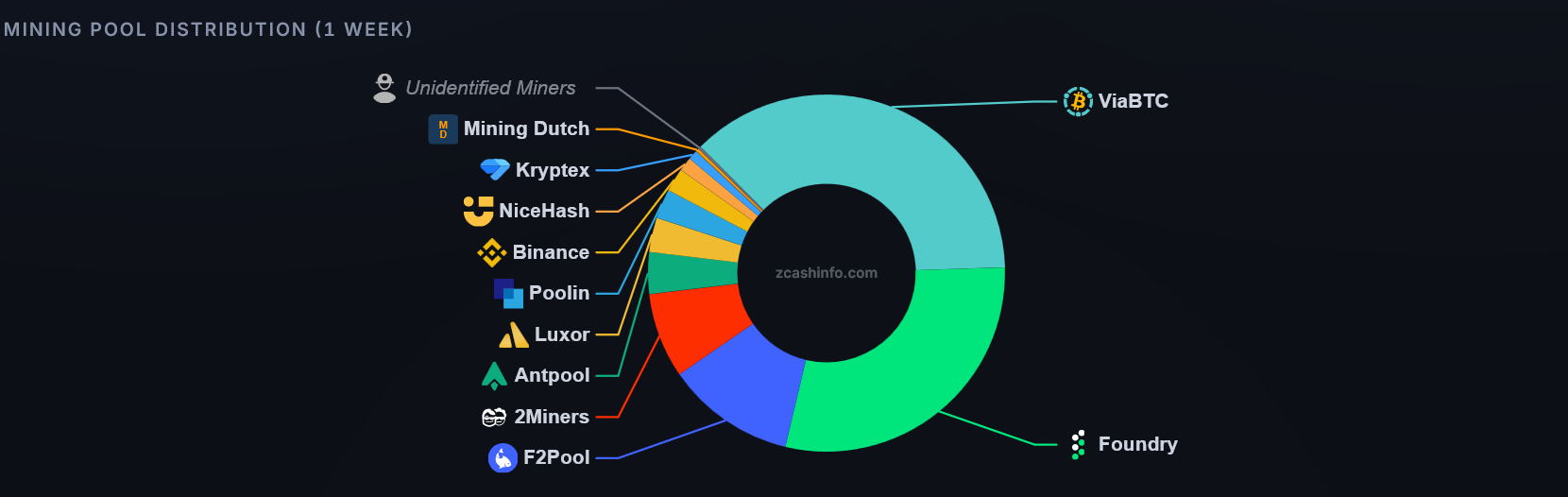 (Source: ZcashInfo)
In its announcement, Foundry said that institutions and public miners are seeking a “compliant, purpose-built Zcash mining solution,” highlighting the clear institutional market positioning of this rollout. Foundry also launched a Zcash block explorer showing that the pool has mined 2,344 blocks since it went live.
According to on-chain data from Zcashinfo.com, the Foundry pool began accumulating hashrate around March 4—about a week earlier than the first official announcement—indicating that back-end preparation was completed before the public notice.
Key Parameters for Zcash Mining
Block Time: About one new block every 75 seconds
Block Reward: 1.25 ZEC per block, or about $458 based on the current market price
Foundry Hashrate Share: 29.2% (first month)
ViaBTC Hashrate Share: Down from 68.1% to about 37%
Eliminating Concentration Risk: Coinbase’s 2023 Security Warning Revisited
Foundry’s entry improved the Zcash network’s security at the structural level. In September 2023, Coinbase flagged ViaBTC’s dominance in hashrate as a potential network security risk—in a proof-of-work (PoW) system, a single mining pool controlling more than 50% of hashrate could, in theory, manipulate transaction confirmation order, creating the possibility of a “51% attack.”
Foundry’s entry compressed ViaBTC’s share from over 65% to 37%, breaking the long-standing pattern of extreme hashrate concentration and delivering a positive improvement to Zcash’s decentralization. Foundry did not disclose which specific institutional miners it brought in.
ZEC Market Performance: Institutional Endorsement Plus a Privacy Narrative Drive a Strong Rally
Over the past year, ZEC has surged by 1,050%, making it one of the best-performing proof-of-work tokens. In the month after Foundry first announced its plan to establish a Zcash mining pool, ZEC rose 77.2% in that single month, indicating that the institutional entry signal had a direct catalytic effect on the token price.
At present, ZEC’s market cap is $6.2 billion, ranking as the fifth-largest proof-of-work token by market capitalization—behind Bitcoin (BTC), Dogecoin (DOGE), Bitcoin Cash (BCH), and Monero (XMR). Zcash uses zk-SNARK zero-knowledge proof technology, which allows transactions to be shielded, making transaction amounts and addresses invisible to the outside world. This privacy protection capability forms a scarce technical barrier in the cryptocurrency market.
Frequently Asked Questions
How did the Foundry Zcash mining pool reach 29% hashrate within its first month?
By bringing in institutional mining customers, Foundry made full use of the institutional network it had accumulated through its Bitcoin mining pool business to achieve a rapid hashrate expansion. On-chain data shows that the mining pool began accumulating hashrate around March 4—about a week earlier than the official announcement—meaning the actual setup and staking preparation time was longer than what was publicly disclosed.
What specific impact does the decline in ViaBTC’s hashrate have on Zcash network security?
ViaBTC’s hashrate share declining from about 65% to 37% means the Zcash network is no longer in a high-risk state where a single mining pool could mount a “51% attack.” Hashrate dispersion increases the decentralization of transaction confirmation, reducing the theoretical possibility that any single participant could control the network—an underlying structural improvement to Zcash’s security.
Why was ZEC able to achieve a gain of over 1,000% in the past year?
ZEC’s strong rally was driven by multiple factors together: the renewed resurgence of the privacy-coin narrative, institutional mining pools entering the market such as Foundry boosting market confidence, and the underlying fundamentals supporting the broader crypto bull market. In the same month that Foundry announced its entry plan, ZEC’s one-month gain reached 77.2%, confirming that institutional endorsement had a direct catalytic effect on the privacy coin’s price.
Disclaimer: The information on this page may come from third parties and does not represent the views or opinions of Gate. The content displayed on this page is for reference only and does not constitute any financial, investment, or legal advice. Gate does not guarantee the accuracy or completeness of the information and shall not be liable for any losses arising from the use of this information. Virtual asset investments carry high risks and are subject to significant price volatility. You may lose all of your invested principal. Please fully understand the relevant risks and make prudent decisions based on your own financial situation and risk tolerance. For details, please refer to
Disclaimer.


