
Genius, a multi-chain trading terminal supported by YZi Labs, opened token-airdrop claims on April 14, and released its whitepaper and roadmap, announcing that the Shuttle Labs team and investor tokens will be locked for at least one year. The GENIUS token surged by over 850% in a short period before and after the airdrop, with its fully diluted valuation (FDV) briefly exceeding $820 million, before falling back to about $716 million after profits were taken.
Roadmap Core: Three Key Directions Take On the BNB Spot Liquidity Pattern
The Genius whitepaper positions it as a “unified on-chain trading interface layer,” aiming to achieve execution quality on par with centralized exchanges while maintaining non-custodial protection. The roadmap reveals three main development directions:
Ghost Mode Privacy Layer: Separates transaction execution entirely from the user’s primary wallet address, enabling traders to complete on-chain operations while protecting their main wallet identity; designed specifically for users with higher privacy needs.
GeniusFi (PropAMM): Plans to launch in BNB Chain an actively managed liquidity AMM, managed proactively by professional market makers to actively manage liquidity depth; directly competing with PancakeSwap’s roughly $700 billion/year spot trading volume, making it the most clearly positioned competitive product in the roadmap.
BNB Binary Options: Introduces capital-efficient directional exposure tools, providing precise risk-management choices for large capital, and plans to ultimately expand into major equities and commodities markets.
Airdrop Design: Refund Mechanism Protects Users, Lockup Commitment Stabilizes the Market
Token Lock Commitment: The Shuttle Labs team and investor tokens will be locked for at least 1 year, preventing early holders from quickly selling off
Refund Time Window: Within 48 hours after TGE (Token Generation Event), users may destroy all their GENIUS airdrop allocations to receive net-fee refund
Refund Calculation Basis: Based on net fees, the platform has already returned more than $7 million to the community and paid more than $1.3 million in referral incentives, all of which have been deducted from the refundable amount
Refund Scope Limitation: Only covers fees collected by Genius itself; fees from third-party agreements (such as PancakeSwap) are not included in the refund scope
Users Fully in Control: Whether holding GENIUS or applying for a refund is entirely decided by the user; the platform imposes no constraints
The core logic behind the refund mechanism is to provide exit protection to users who take a wait-and-see stance on GENIUS’s long-term value, while filtering out purely speculative airdrop hunters, thereby improving the overall conviction quality of long-term token holders.
GENIUS Token Market Performance: Liquidity Risk Behind the Surge
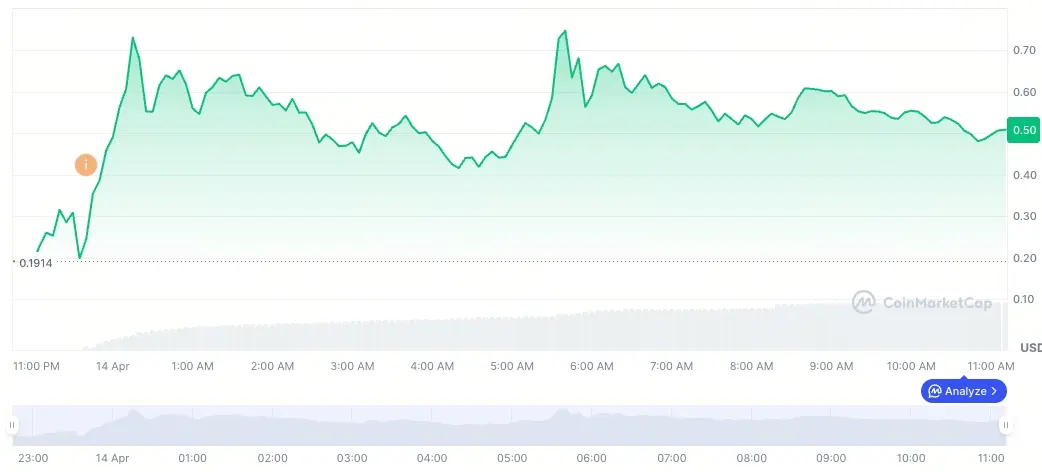 (Source: CMC)
GENIUS has a maximum supply of 1 billion tokens. The Genius Points (GP) airdrop is the primary distribution channel currently, and the Q1 rewards campaign has allocated 200 million GP to active users. This 850% surge coincides with the closing phase of the first-quarter rewards campaign, as well as the launch of integration functions that route directly from the Genius interface to trading venues such as Hyperliquid and Aster, attracting a large amount of speculative capital.
However, CoinGecko data shows that the size of GENIUS on-chain liquidity pools is currently only about $500k. In such thin liquidity conditions, the high-leverage GENIUS perpetual futures contract listed on Aster could significantly amplify two-way volatility when market sentiment reverses, so investors need to remain cautious about liquidity risk.
Frequently Asked Questions
What is Genius, and how does it differ from typical DEXs?
Genius is a multi-chain trading terminal that allows users to trade spot, perpetual contracts, and presale tokens on more than 10 blockchain networks through a single interface, developed with support from YZi Labs. Its core difference is the cross-chain unified execution layer, rather than a single-chain AMM model; it aims to replicate the execution quality and user experience of centralized exchanges while providing non-custodial protection.
What is the practical significance of the refund mechanism for the GENIUS airdrop?
The refund mechanism allows airdrop users who are uncertain about GENIUS’s long-term value to burn all their allocations within 48 hours after the TGE in exchange for a net-fee refund. While giving users choice, this design also helps filter out short-term arbitrageurs, making the remaining token holders more inclined toward long-term holding, thereby optimizing the composition of token holders and improving market stability.
Can the GENIUS token’s 850% price increase be sustained?
The current on-chain liquidity pool size of about $500k is significantly low relative to an FDV of more than $700 million, meaning that even a small outflow of capital could create a substantial impact on the price. The token’s longer-term price trend will depend to a greater extent on the real-world rollout progress of roadmap products such as GeniusFi, as well as the continued growth of the user base of the Genius terminal.
Disclaimer: The information on this page may come from third parties and does not represent the views or opinions of Gate. The content displayed on this page is for reference only and does not constitute any financial, investment, or legal advice. Gate does not guarantee the accuracy or completeness of the information and shall not be liable for any losses arising from the use of this information. Virtual asset investments carry high risks and are subject to significant price volatility. You may lose all of your invested principal. Please fully understand the relevant risks and make prudent decisions based on your own financial situation and risk tolerance. For details, please refer to
Disclaimer.
Related Articles
BNB Foundation Completes 35th Quarterly Token Burn, Destroying 1.569M BNB Worth $1.02B
The BNB Foundation completed its 35th token burn, destroying 1.569 million BNB and reducing the total supply to approximately 134.8 million BNB. The goal is to lower the supply to 100 million BNB, supporting the ecosystem's long-term health.
GateNews19h ago
Nine newly created wallets withdrew 87.76 million BNB from a certain CEX, worth $14.9 million
Gate News update: On April 13, according to Lookonchain monitoring, within the past 24 hours, 9 newly created wallets withdrew 87.76 million BNB from a certain CEX, worth $14.90 million.
GateNews04-13 05:30
Suspected BNB Life market manipulators extracted 57.88 million tokens, with on-chain holdings reaching 11.7% of the total supply
According to on-chain analysts monitoring, suspected BNB Life market manipulators have withdrawn 57.88 million BNB Life tokens from a certain CEX through multiple wallets, and the price has surged significantly recently. The market manipulator currently holds about 116.9 million BNB Life tokens, representing 11.7% of the total supply.
GateNews04-13 04:10
BNB Chain Flags Critical Update Ahead of April 28 Hard Fork - U.Today
The Osaka/Mendel hard fork on BSC will launch on April 28, requiring node operators to update to BSC v1.7.2. The upgrade enhances block construction, transaction handling, and introduces a gas limit cap for improved network stability.
UToday04-13 01:37
Whale address enai.bnb withdrew 41k RAVE tokens from Aster two days ago; it is now the 9th-largest holder on the BSC network
On-chain analysts monitored that the whale address enai.bnb bought 46,336.76 tokens on the second day after RAVE went live, holding them until 48 days ago before transferring to Aster. It is now the BSC network’s TOP 9 holder. If it hasn’t sold yet, the return on investment could be as high as 462%.
GateNews04-12 11:01


