The price of Pi Coin (PI) is currently fluctuating around the threshold of 0.188 USD after several sessions of sideways accumulation in a contracted range. However, the 8-hour chart is reflecting a similar cash flow structure to the period before the market recorded a strong increase of 76% earlier this month.
During the period from February 28 to March 4, the price moved within a narrow range while institutional cash flow significantly increased, triggering a notable breakout. Currently, three important technical signals indicate that the selling pressure in the current price area may be nearing an end.
Cash flow shows signs of accumulation returning
The Chaikin Money Flow (CMF) indicator – a measure of buying and selling pressure by volume – has maintained an upward trend on the 8-hour chart since March 24, with the current value at 0.09, above the neutral threshold. This reflects that large cash flow is leaning towards net buying, despite the price volatility lacking a clear trend.
On the flip side, the Money Flow Index (MFI) continues to weaken to 37.51, indicating that retail cash flow remains cautious and has not confirmed the support zone.
This structure previously appeared in late February when the price moved sideways around 0.164 USD amidst rising CMF and falling MFI. When the MFI created a bottom and reversed upwards in phase with the CMF, the market triggered a strong acceleration.
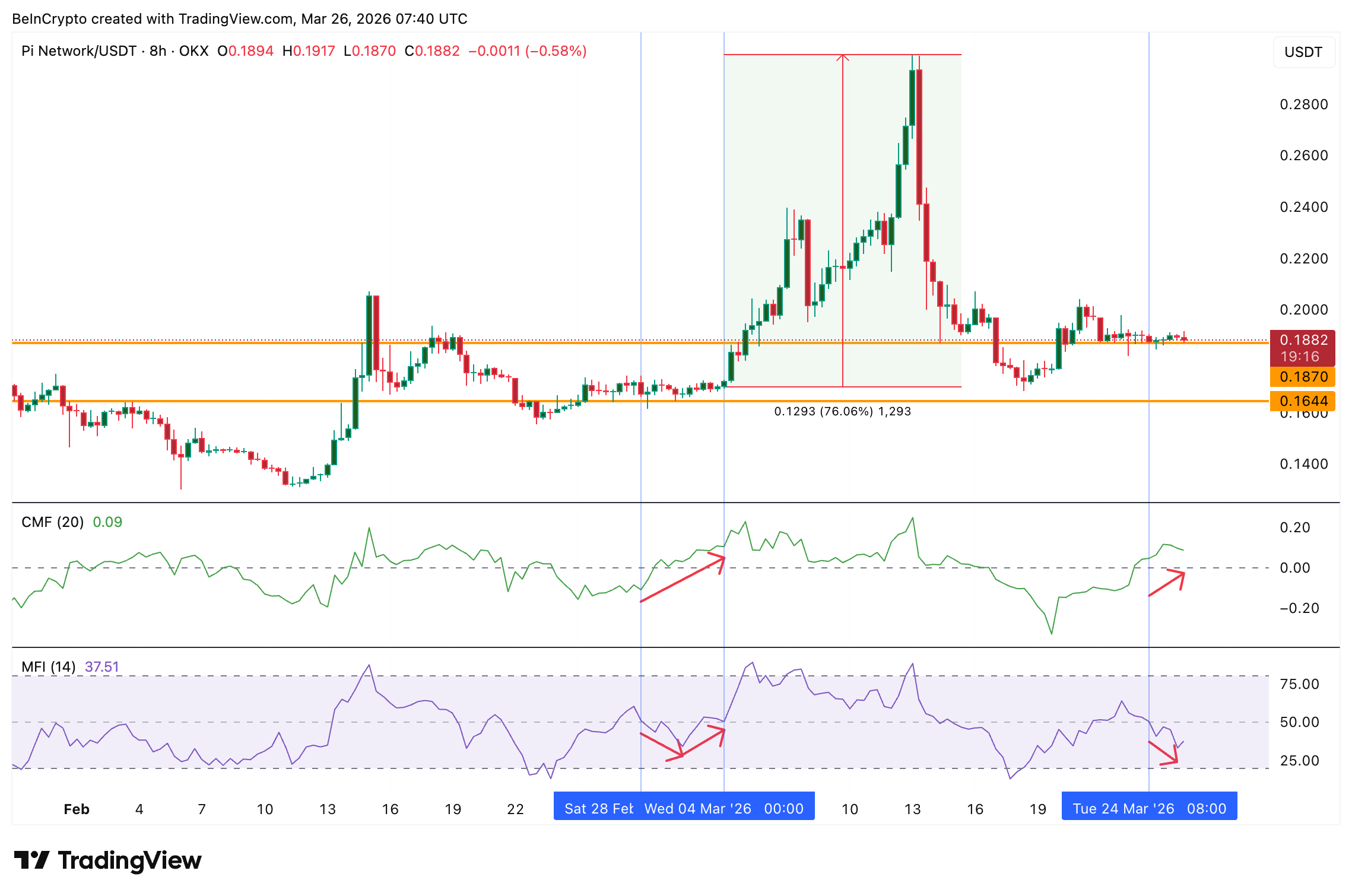 Set up CMF and MFI | Source: TradingViewA notable difference this time is that the CMF has early maintained above 0, indicating that the demand from large cash flow is stronger right from the accumulation phase. However, the MFI’s failure to confirm a bottom means that the signal still needs additional conditions to be fulfilled.
RSI divergence strengthens the potential for a bottom
From March 14 to March 26, the price of Pi Coin tested the 0.187 USD area twice, forming a double bottom pattern on the 8-hour chart. At the same time, the RSI indicator recorded a higher low after the previous low, creating a bullish divergence – a signal that selling pressure is gradually weakening.
This divergence is still in the process of completion and requires an 8-hour candle to close higher to confirm the short-term bottom.
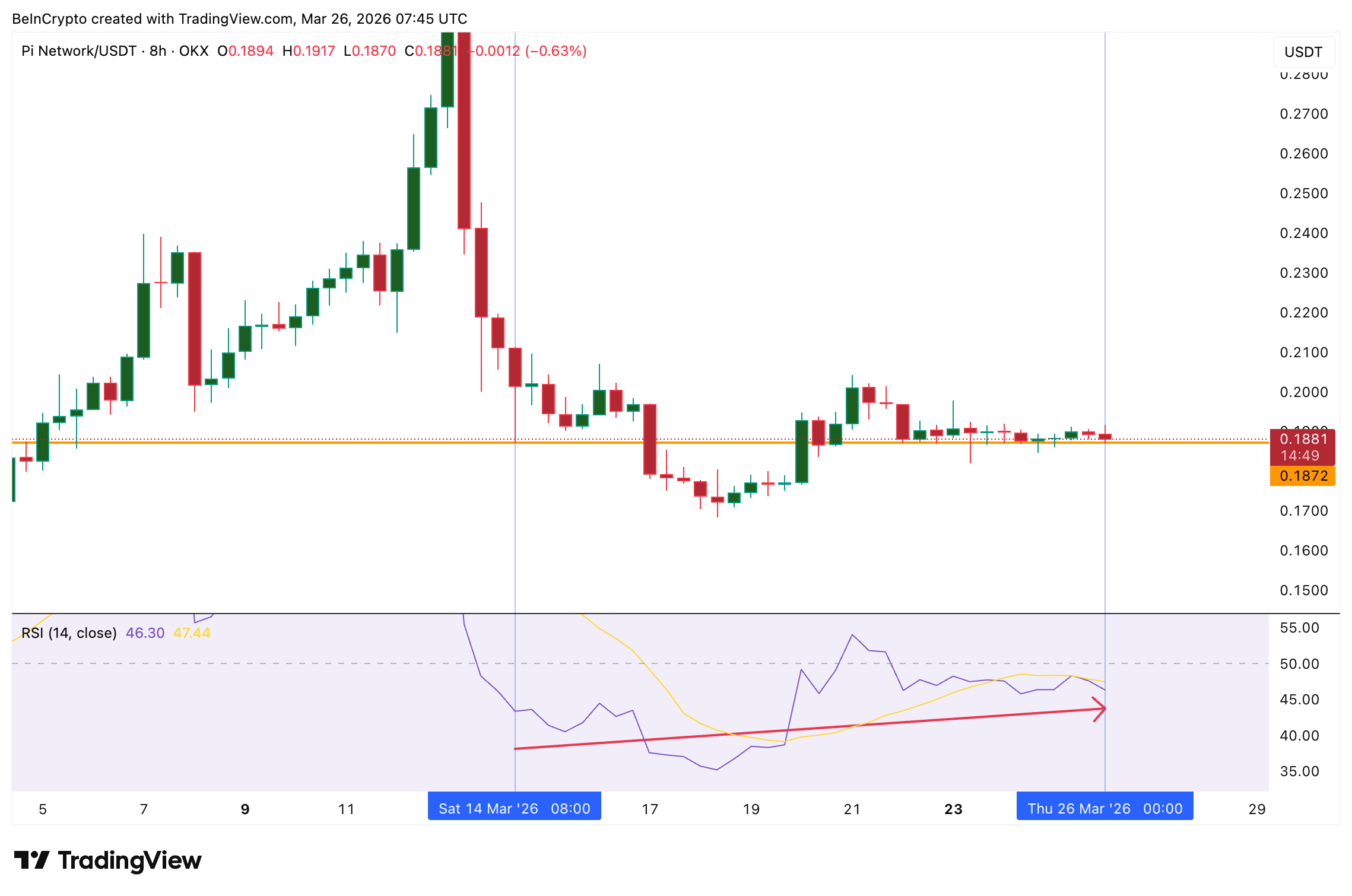 Bullish divergence of RSI | Source: TradingViewNotably, the 20-period EMA just crossed below the 200-period EMA at the 0.190 USD area. Bearish crossovers occurring right at the bottom often associate with a state of “selling exhaustion,” when selling pressure finally withdraws from the market, paving the way for a potential reversal.
The convergence of the two EMA lines at the same price level also creates a pivotal resistance-support zone. If the price decisively breaks above the 0.190 USD mark, the technical structure could shift towards a more positive direction.
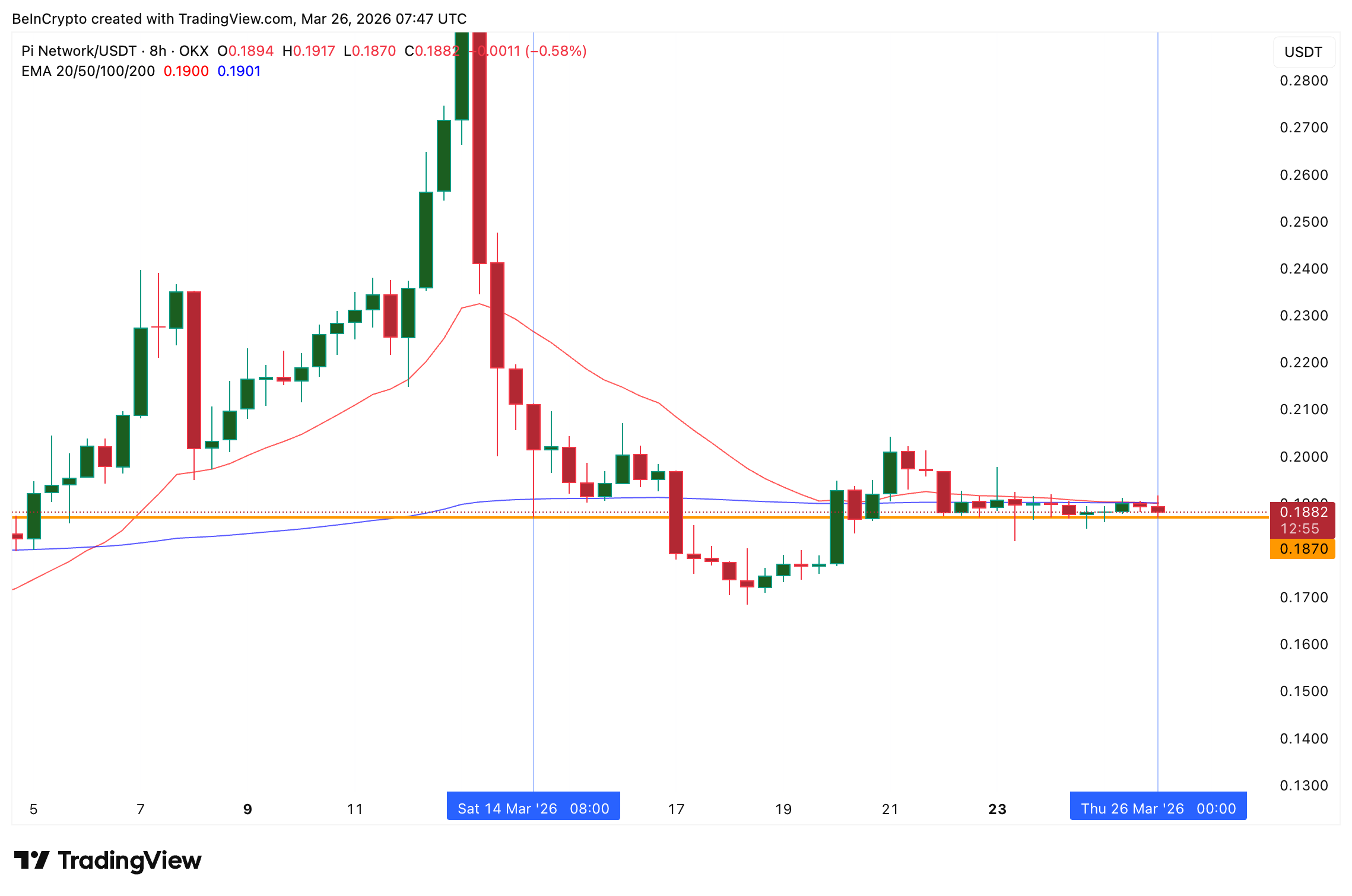 PI line crossing EMA | Source: TradingViewWhen combining the RSI divergence, the CMF remaining positive, and the EMA crossover signal being completed, the market is approaching a relatively clear confirmation cluster for a bottoming.
Expectation to extend to 0.240 USD if the structure breaks
The 8-hour chart is currently forming an inverse head and shoulders pattern, with the right shoulder around 0.182 USD. The neckline coincides with the 0.5 Fibonacci level at 0.200 USD – simultaneously an important psychological zone.
A breakout and solid close above 0.200 USD will complete the pattern, thereby opening a target increase of about 20%, corresponding to a price range of 0.240 USD.
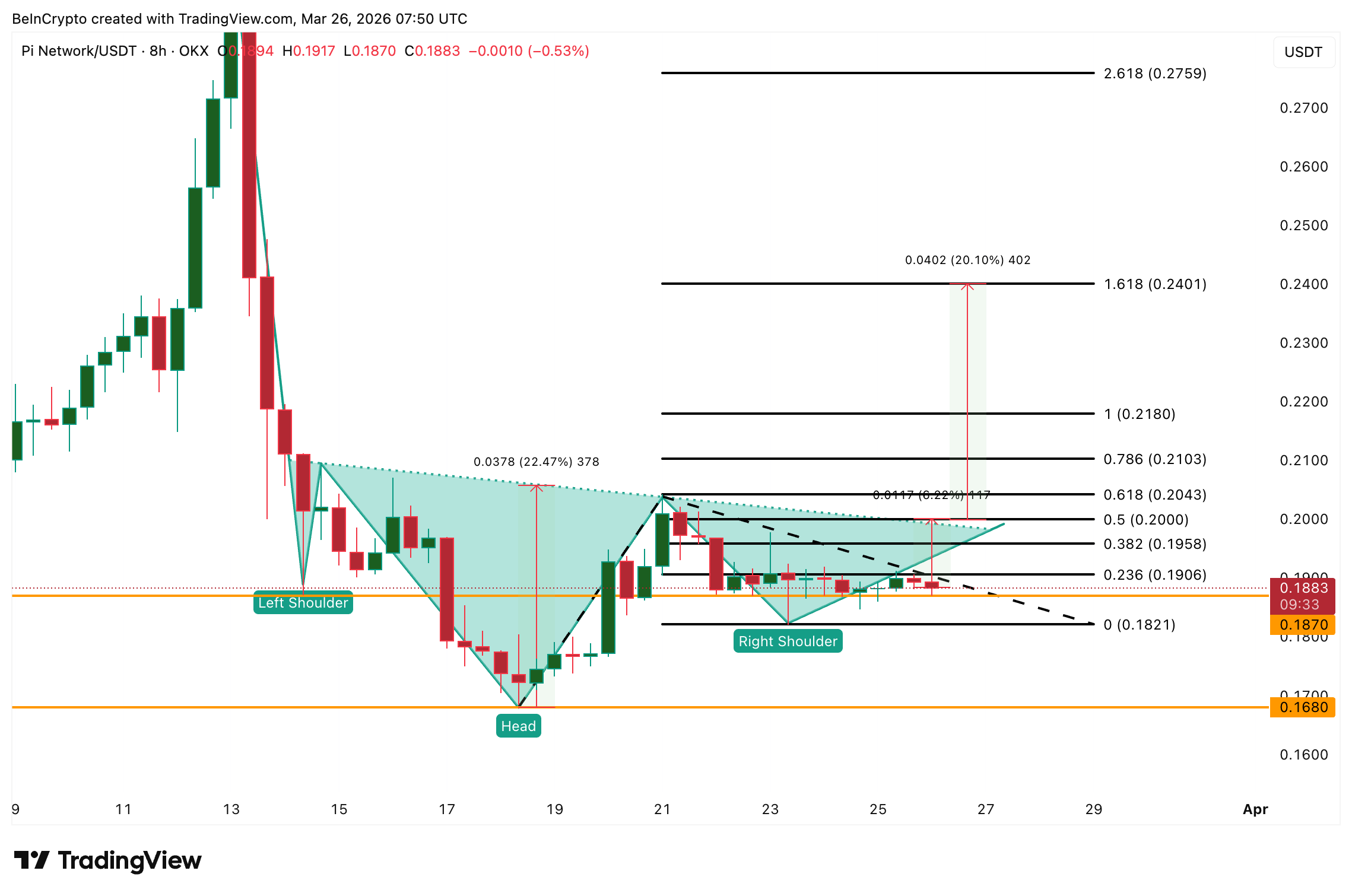 Price analysis of Pi Coin | Source: TradingViewPreviously, the 0.190 USD area – where the 20 EMA and 200 EMA converge – serves as the nearest resistance that needs to be surpassed. Upon successfully conquering this level, the Fibonacci levels of 0.210 USD and 0.218 USD will successively become intermediate targets.
On the downside, the 0.187 USD area remains a crucial support level. Losing this level will weaken the double bottom structure and the bullish divergence. However, the inverse head and shoulders pattern remains valid if the price stays above the 0.168 USD area. A drop below this threshold will completely negate the bullish scenario.
Overall, the market is nearing a decisive point: breaking above 0.200 USD will confirm the bottom and open up room for a rise to 0.240 USD, while dropping below 0.168 USD will trigger the risk of deeper correction.
Disclaimer: The information on this page may come from third parties and does not represent the views or opinions of Gate. The content displayed on this page is for reference only and does not constitute any financial, investment, or legal advice. Gate does not guarantee the accuracy or completeness of the information and shall not be liable for any losses arising from the use of this information. Virtual asset investments carry high risks and are subject to significant price volatility. You may lose all of your invested principal. Please fully understand the relevant risks and make prudent decisions based on your own financial situation and risk tolerance. For details, please refer to
Disclaimer.
Related Articles
Pi Network 18 million users complete KYC, and 26.5 million PI are issued to verifiers
Pi Network distributes 26.5 million PI tokens to more than 1 million community members who have completed KYC verification, to accelerate user identity verification and strengthen the decentralized model. 18 million already-verified users have laid the groundwork for the ecosystem’s development, but the key lies in how to convert these users into active participants. With the protocol upgrade, Pi Network is moving toward the open network phase, and smart contract support signals richer application scenarios.
MarketWhisper12h ago
Pi Network price hits a new 7-week low as a wave of 60 million token unlocks comes in
Pi Network's native token PI fell to $0.165 in April, hitting a 7-week low and leaving market sentiment weak. The unlock peak will release more than 60 million PI, adding downward pressure. Despite the core team recently publishing technical updates, it failed to improve market confidence and instead drew community criticism due to KYC access issues and the ongoing slide in price. Increased future supply could further drive prices lower.
MarketWhisper14h ago
Pi Network Distributes 26.5M PI to 1M KYC Validators
Pi Network has taken another step forward in building its ecosystem. The project recently distributed 26.5 million PI tokens to more than 1 million KYC validators.
These rewards were given to users who helped verify identities on the network. This process is important. Because it ensures that
Coinfomania04-13 13:30
Pi Network PIRC baseline protection mechanism sparks controversy, implying a “quasi-stablecoin” logic
Pi Network member Daniel F raised a logical contradiction in the PIRC token design, noting that if it has a 23.8% floor protection, it would need to behave like a stablecoin, which conflicts with its high volatility on CEX. This floor is based on Pi’s price calculations; if Pi itself fluctuates significantly, it will be unable to effectively protect holders. Daniel emphasized the importance of transparency, but the project team did not respond to it, leading the community to continue speculating about the reasons for its silence.
MarketWhisper04-13 02:23
Pi Network Major Transformation: 210 Ecosystem Applications Deployed, 23k Developers Ready
The Pi Network ecosystem is accelerating its transition, with more than 210 active applications and 23,000 developers actively participating in Pi Studio, spanning multiple areas such as payments, community engagement, education, and gaming. The ecosystem’s diversity shows indicators of healthy development, and developers’ engagement is driving ongoing application optimization. In the future, improving the usefulness of the mainnet will be a key challenge, including issues that need to be urgently addressed such as scalability, security, and user adoption rates.
MarketWhisper04-13 02:06


