
A team of analysts led by Nikolaos Panigirtzoglou, Managing Director at JPMorgan Chase, reported on Wednesday that the trading volume of Hyperliquid’s WTI crude oil perpetual futures contract (CL-USDC) experienced a sharp increase, with daily trading volume reaching approximately $1.7 billion in mid-March. Open interest rose to about $300 million, making it the third-largest product by trading volume on Hyperliquid.
Geopolitical Conflicts as Triggers: Why Hyperliquid Oil Contracts See a Sudden Surge in Trading Volume
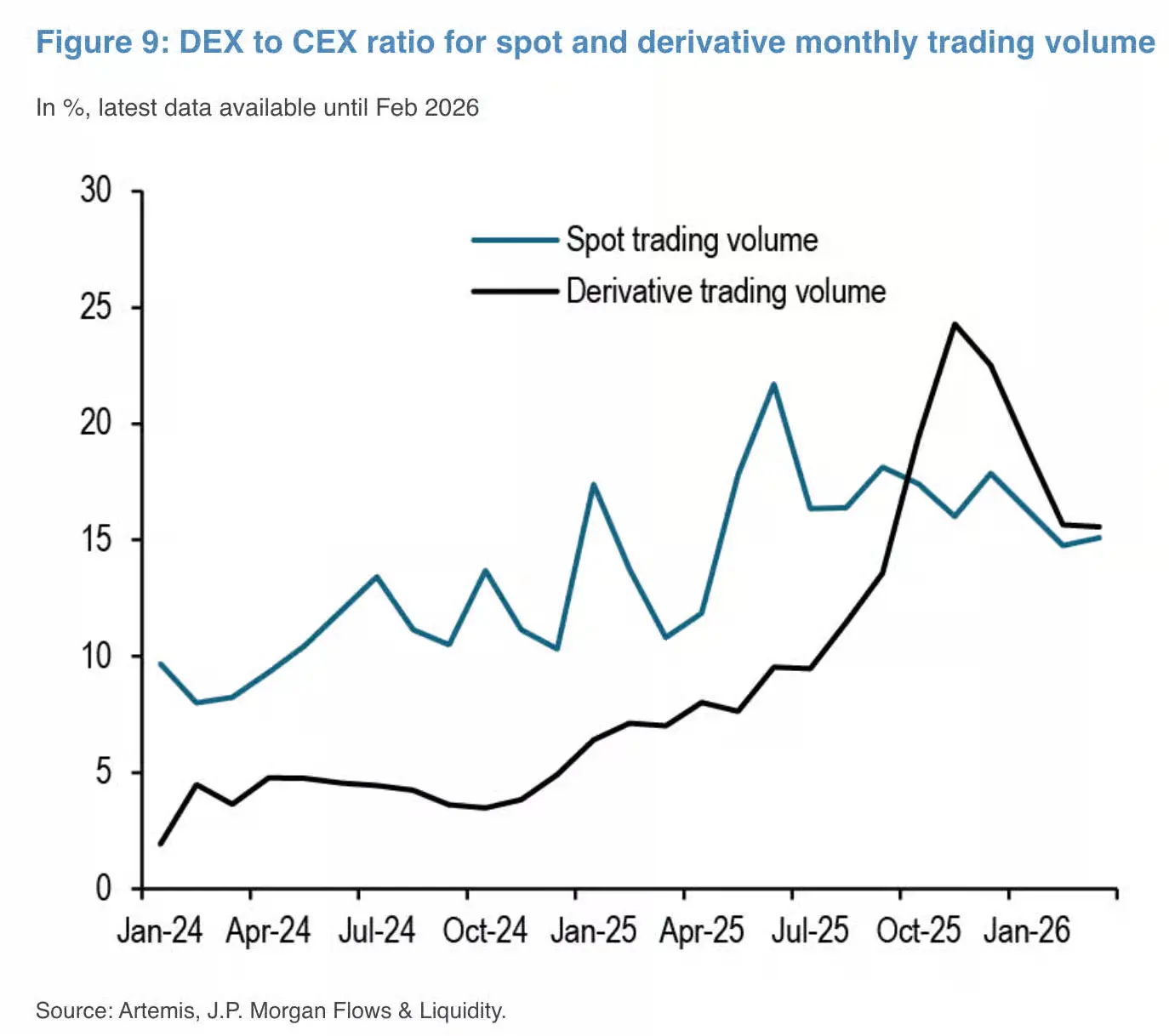
(Source: JPMorgan Chase)
Traditional commodity exchanges are closed during weekends and outside trading hours, which prevents them from reflecting the impact of sudden geopolitical events on oil prices in real time. When the Iran crisis escalated over the weekend, traders were unable to hedge oil risks through conventional channels like CME and turned to Hyperliquid’s 24/7 perpetual futures contracts.
The CL-USDC contract uses USDC stablecoin as collateral, offering up to 20x leverage. Compared to traditional futures margin requirements, it has lower barriers, providing traders seeking oil exposure with immediate entry options. JPMorgan analysts note that the demand for asset exposure during traditional market closures is a key driver behind the continuous growth in Hyperliquid’s trading volume.
Hyperliquid’s Technical Advantages: Three Key Features Attracting Professional Traders
JPMorgan’s report highlights Hyperliquid’s technical differentiation from most DEXs:
- On-Chain Limit Order Book: Provides precise pricing, narrower bid-ask spreads, and order types familiar to traditional traders, unlike the AMM models used by many DEXs.
- Sub-Second Final Trade Confirmation: Execution speeds are close to those of centralized exchanges (CEX), meeting the needs of algorithmic and high-frequency trading strategies.
- Portfolio Margin Mechanism: Allows unified risk management across multiple positions, significantly improving capital efficiency—typically a feature only available on advanced CEX platforms.
Analysts believe these technical features position DEXs as “professional trading venues” connecting traditional markets with crypto markets, which is a core advantage enabling Hyperliquid to continue capturing derivatives market share from CEXs.
Traditional Exchanges’ Response: The Accelerating Wave of 24/7 Trading Sweeps Mainstream Financial Markets
JPMorgan analysts state that the trend of DEXs gaining market share in crypto derivatives continues and may further expand into other asset classes beyond commodities. In response, traditional exchanges are also deploying around-the-clock trading capabilities: CME Group plans to launch 24/7 crypto futures and options on May 29; Nasdaq is advancing a 23-hour trading day for stocks, expected to be implemented in late 2026, and has received SEC approval to trade some tokenized securities; Cboe Global Markets has proposed near five-day, 24-hour stock trading services.
However, JPMorgan analysts point out that most traditional exchanges mainly focus on standardized derivatives and have not yet offered the high-leverage perpetual futures structures common on DEXs like Hyperliquid. There remains a significant gap in product flexibility and structure between the two.
Frequently Asked Questions
Q: What type of exchange is Hyperliquid?
Hyperliquid is a decentralized exchange built on its own Layer 1 blockchain, centered around an on-chain limit order book architecture, supporting perpetual futures trading. The platform offers various contracts, including cryptocurrencies and commodities, with sub-second trade confirmation and a portfolio margin mechanism.
Q: Why do non-crypto investors choose Hyperliquid to trade oil?
Traditional commodity exchanges are closed during weekends and outside trading hours, making it impossible to hedge sudden risks in real time. Hyperliquid provides 24/7 perpetual futures contracts, allowing traders to gain exposure to oil and other commodities at any time, serving as an essential supplement during traditional market closures.
Q: Can traditional exchanges replace Hyperliquid’s 24/7 functionality?
Currently, most traditional exchanges mainly offer standardized contracts and have not yet provided the high-leverage perpetual futures structures typical of DEXs like Hyperliquid. While CME Group and Nasdaq are working to extend trading hours, their product structures and flexibility still differ significantly. JPMorgan believes DEXs still have considerable growth potential.
Disclaimer: The information on this page may come from third parties and does not represent the views or opinions of Gate. The content displayed on this page is for reference only and does not constitute any financial, investment, or legal advice. Gate does not guarantee the accuracy or completeness of the information and shall not be liable for any losses arising from the use of this information. Virtual asset investments carry high risks and are subject to significant price volatility. You may lose all of your invested principal. Please fully understand the relevant risks and make prudent decisions based on your own financial situation and risk tolerance. For details, please refer to
Disclaimer.
Related Articles
XRP Consolidation Signals Reset as Bullish Setup Emerges
XRP has recently rebounded to $1.39 after trading between $1.20 and $1.40 due to improved market sentiment. A significant drop in futures open interest reflects reduced speculation, while technical indicators suggest a potential bullish breakout, targeting $1.50 and possibly $1.80.
CryptoNewsLand4h ago
SUI Volume Surges 37% as Price Stabilizes Near Key Base
Key Insights
SUI trading volume surged by 37%, signaling renewed participation as the price stabilizes near 0.97, reflecting a transition from prolonged downtrend conditions
Futures inflows and bullish long-short ratios indicate rising speculative interest, while liquidation trends show
CryptoNewsLand5h ago
$773M Crypto Liquidations Hit Shorts on April 18
On April 18, 2026, crypto markets saw $773 million in liquidations, primarily affecting short traders (77% of losses) due to a sudden price rise. This incident highlighted the risks of leverage in trading, leading to forced position closures.
CryptoFrontier9h ago
Newly Created Wallet Deposits $1.99M USDC to Hyperliquid, Opens 5x Leveraged ASTER Long
Gate News message, April 18 — According to Onchain Lens, a newly created wallet deposited $1.99 million USDC to Hyperliquid and opened a 5x leveraged long position in ASTER.
GateNews20h ago
BTC falls 0.49% in 15 minutes: fragile long leverage and active sell-off pressure resonate to weigh on the short term
From 18:00 to 18:15 (UTC) on 2026-04-17, the BTC price fluctuated and trended downward within the 77097.4 to 77573.2 USDT range. Over these 15 minutes, the return rate recorded -0.49%, and the amplitude reached 0.61%. During this period, market trading was active; short-term volatility was amplified, and trading attention increased significantly. The main driver behind this abnormal move is that the overall leverage structure is bearish and long positions are fragile. At present, the BTC perpetual contract funding rate has remained negative for 11 consecutive days, indicating that the bears have the upper hand in the market. In addition, futures open interest (OI) is about 628.3 billion USDT, which is at a historical high. During the anomaly window, trading volume increased noticeably. On-chain data shows large amounts of BTC flowing from long-term holder addresses to exchanges, suggesting that active sell orders may have triggered longs to passively reduce positions, amplifying downward price pressure. Moreover, institutional positioning enthusiasm in the mainstream contract market has cooled off; liquidity boundaries have tightened, causing large-trade activity to have an amplified effect on market volatility. In the options market, implied volatility rose to 39.81%, increasing demand for downside protection and reflecting a defensive posture among market participants. Macro-environment volatility and some capital flowing into safe-haven assets, together with the recent regulatory uncertainty-related historical events, reinforced the move, pushing overall market risk appetite lower. Current BTC leverage risks still remain. If, in the future, there are concentrated sell-offs, volatility may be further amplified. It is recommended to continue monitoring sustained high OI levels, the persistence of negative funding rates, and on-chain transfers of large amounts of funds, and to stay alert for whale behavior and any disruptions to market sentiment caused by macro-policy developments. For subsequent price action, please watch key support levels, institutional and whale on-chain moves, and relevant global market news, and guard against short-term risks.
GateNews04-17 18:17


