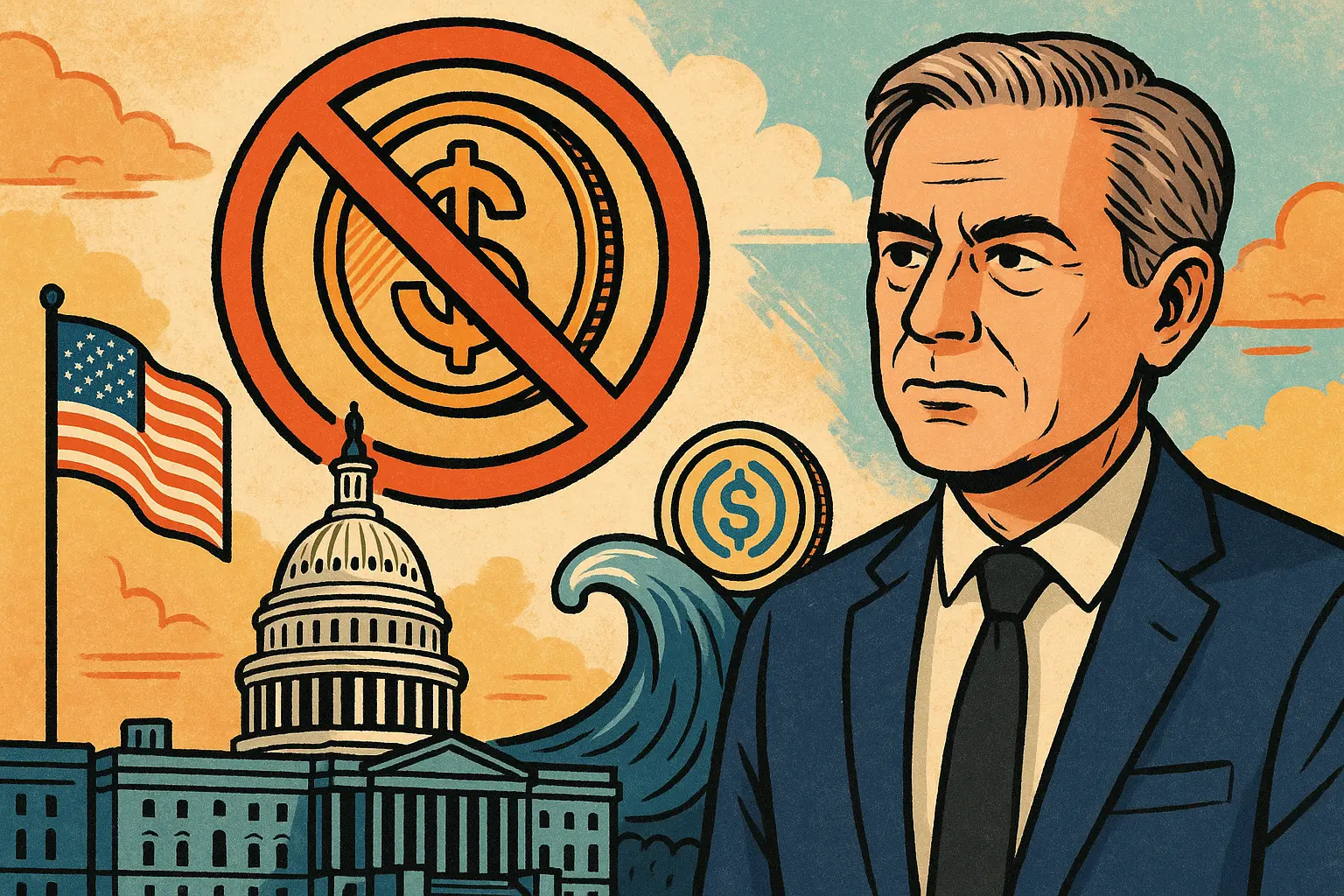
Takatoshi Shibayama, head of Asia-Pacific for the hardware wallet company Ledger, stated that if the United States ultimately enforces broader bans on stablecoin yield payments, it “will definitely trigger” extensive discussions among overseas stablecoin issuers, institutions, and regulators about how to be the first to offer such yield opportunities to users.
Impact of the US Stablecoin Yield Ban on Competitive Dynamics
 (Source: YouTube)
In an interview, Shibayama pointed out that if the US establishes a ban on stablecoin yields, it will create a clear market differentiation opportunity at the policy level. He said, “If the situation in the US changes, I believe it will definitely lead to many discussions between stablecoin issuers and regulators, allowing them to pass on yields or rewards to their user base.”
Shibayama emphasized that even outside the US, most stablecoins currently do not offer yields or rewards to users, mainly “to protect the interests of banks.” He cited Australia as an example, noting that Australia has granted regulatory exemptions to stablecoin issuers, making it one of the more proactive regulatory frameworks.
This stance directly relates to Ledger’s business— as a leading provider of self-custody solutions for digital assets, the stablecoin usage patterns of its clients will be directly affected by yield policies. If overseas markets open up stablecoin yields first, it could accelerate institutional shifts toward non-USD denominated or non-US issued stablecoins.
Asian Institutions’ Forking Strategy: Tokenization Instead of Cryptocurrency
Beyond the stablecoin yield issue, Shibayama also analyzed the latest patterns of Asian institutions adopting crypto technology, revealing a significant strategic divergence. He pointed out that since last year, there has been a “partial decoupling of cryptocurrencies and other blockchain segments” in Asia, showing two distinct behavioral models among institutions:
Preferences of traditional financial institutions (focusing only on blockchain):
-
Tokenization of financial products
-
Issuance or integration of stablecoins
-
Infrastructure and settlement efficiency improvements
Areas actively excluded by traditional financial institutions:
Shibayama’s comment was straightforward: “These institutions have carefully selected what they want to gain from blockchain technology and have excluded cryptocurrencies—such as Bitcoin and Ethereum—from their discussions.”
However, he noted that asset management firms are “a bit different,” with some still considering launching crypto products to expand the range of offerings to clients. Their main consideration is that currently, there are no strict regulations mandating the use of regulated custodians, but even so, they are becoming “more selective” when choosing custodial providers and clearly “prefer regulated custodians.”
Frequently Asked Questions
Why is the US discussing banning third-party platforms from offering stablecoin yields?
The core of this debate lies in the conflict of commercial interests between the banking industry and crypto firms. Banking lobbies argue that if stablecoins can offer yields higher than traditional deposits, it could lead to large-scale deposit shifts, threatening the stability of traditional banks’ funding pools. Therefore, they actively promote legislation to prohibit crypto platforms from offering stablecoin interest to users, aiming to protect the competitive advantage of existing financial institutions.
How is Ledger’s business in Asia directly related to this issue?
Ledger mainly provides hardware cold wallets and enterprise-grade crypto asset custody solutions. As Asian institutions increasingly favor tokenization and stablecoin applications, the demand for compliant, secure self-custody infrastructure is rising. Shibayama’s analysis reveals market trends that can help Ledger assess whether Asian institutional clients are more inclined toward tokenization infrastructure rather than traditional crypto asset management services.
Is the strategy of “only tokenizing and avoiding cryptocurrencies” sustainable for Asian institutions?
Shibayama’s observations reflect the mainstream stance of traditional Asian financial institutions—leveraging tokenization to gain blockchain efficiency while avoiding the volatility and regulatory uncertainties associated with crypto markets. However, as Bitcoin ETFs become more widespread globally and institutional crypto asset frameworks mature, whether this “use only technology without holding assets” purely tool-based approach can be maintained long-term remains an industry question to watch.
Disclaimer: The information on this page may come from third parties and does not represent the views or opinions of Gate. The content displayed on this page is for reference only and does not constitute any financial, investment, or legal advice. Gate does not guarantee the accuracy or completeness of the information and shall not be liable for any losses arising from the use of this information. Virtual asset investments carry high risks and are subject to significant price volatility. You may lose all of your invested principal. Please fully understand the relevant risks and make prudent decisions based on your own financial situation and risk tolerance. For details, please refer to
Disclaimer.
Related Articles
ETH 15-minute drop of 0.72%: Large addresses transferring to and net outflows of funds from the main players triggered a sell-pressure resonance
2026-04-14 16:45 to 2026-04-14 17:00 (UTC), within the 15-minute window ETH’s return recorded -0.72%. The price range fluctuated from 2329.63 to 2351.42 USDT, with a swing of 0.93%. During this period, market capital outflows accelerated markedly, volatility intensified, market sentiment turned cautious, and attention rose rapidly.
The main driver of this anomaly is that on-chain large addresses (whales) centralized and transferred ETH to exchanges, releasing a large sell signal. The net outflow of funds from the main capital totaled as much as -61.80 million USD,
GateNews1h ago
ETH rose 1.06% in 15 minutes: global political stimulation and a coordinated boost to risk appetite and on-chain activity together drove the move
From 15:30 to 15:45 (UTC) on 2026-04-14, the ETH price range was 2340.75 to 2367.0 USDT. Within 15 minutes, the return rate reached +1.06%, and the amplitude was 1.12%. Market volatility intensified, and on-chain and social attention rose in tandem. Short-term trading activity increased significantly, and investor sentiment shifted to optimism.
The main driving force behind this market move is the direct impact of an international political event on risk appetite. The United States announced a blockade of the Strait of Hormuz in the Middle East region related to the White House, creating a stark contrast with peace signals reportedly coming from Iran, and it triggered uncertainty and panic sentiment in the market.
GateNews2h ago
Ethereum Foundation Launches $1M Security Audit Subsidy Program
The Ethereum Foundation has launched the Trillion Dollar Security Initiative, offering up to $1 million in audit subsidies for developers to enhance security and accessibility in the Ethereum ecosystem, encouraging professional audit service adoption.
GateNews2h ago
Bitmine gets promoted to the NYSE main board! Tom Lee: US stocks may be at a bottom, with selling pressure on Ether easing
Bitmine has officially moved from the NYSE American board to the main board, marking an important milestone for the company. Despite a sharp decline in its stock price, it has still increased the share repurchase plan to $4 billion. The company holds a large amount of Ether, and it expects that a rebound in the crypto market will help enhance its assets and stock price performance.
CryptoCity2h ago
Fed Chair Nominee Kevin Warsh Discloses Crypto Investments Including Compound, Solana, and Ethereum L2s
Kevin Warsh, nominee for Federal Reserve Chair, has disclosed early-stage investments in various crypto infrastructure projects, including DeFi and layer-2 networks. His portfolio, small and illiquid, suggests indirect venture capital exposure rather than direct trading assets.
GateNews3h ago


