
Blockchain security firm PeckShield monitoring shows that Hyperliquid’s liquidity vault HLP, a decentralized derivatives exchange, lost about $1.5 million over the past 24 hours. The attacker accumulated and built approximately $15 million worth of FARTCOIN long positions, and deliberately triggered a “suicidal” forced liquidation in a low-liquidity environment, forcing an on-paper loss of about $3 million.
Attack Tactics Breakdown: How the ADL Mechanism Is Systematically Exploited
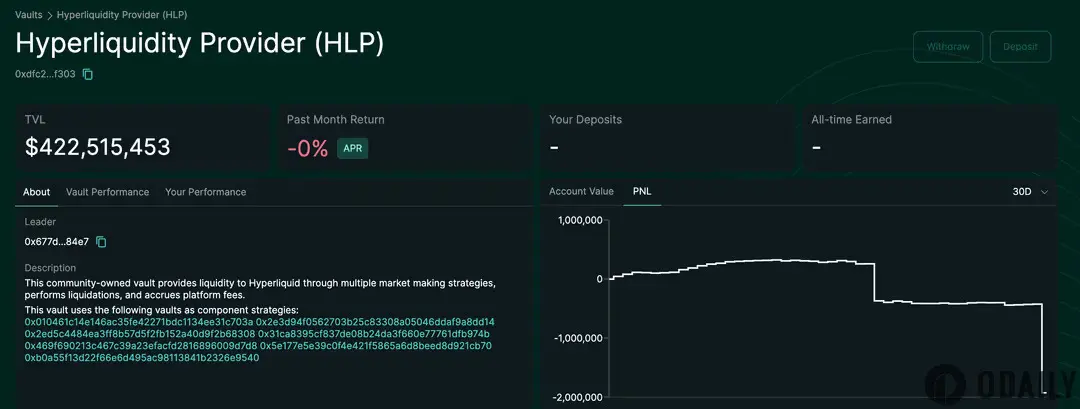 (Source: Hyperliquid)
On-chain analyst 0xMacroGuy on the X platform broke down in detail the operational logic behind this attack, revealing a new attack pattern targeting low-liquidity tokens and the ADL mechanism:
The Four-Step Execution Path of the “Suicidal Liquidation” Attack
Step 1 (Creating a Toxic Position): In four wallets, the attacker established high-leverage long positions for the FARTCOIN token, which has extremely poor liquidity, with a total size of $15 million
Step 2 (Intentionally Burning It): The attacker actively pushed the open positions into a losing state, burned its own margin, and triggered the forced liquidation conditions
Step 3 (Triggering ADL): After the positions were liquidated, Hyperliquid’s ADL mechanism was activated, forcing the system to transfer the toxic positions to the HLP liquidity vault
Step 4 (HLP Absorbs the Bad Debt): HLP was forced to absorb the attacker’s remaining bad positions and bad debt losses, with an on-paper loss of about $3 million
Actual Losses and Potential Hedging-Arbitrage Opportunities
There are some discrepancies in the data for this incident. PeckShield’s report puts the direct loss at about $1.5 million, while analyst 0xMacroGuy’s assessment shows that HLP lost about $1.2 million within 24 hours (about a 0.35% drawdown). The on-paper loss reached $3 million, but the analyst pointed out that the attacker may hold offsetting hedge positions elsewhere—while intentionally burning margin, it could realize a large net profit through cross-venue hedging.
This makes the nature of this incident closer to a carefully designed arbitrage operation rather than merely destructive behavior. Based on the latest data, the HLP vault’s total value locked (TVL) is reported at $420 million, and the annualized return over the past month is 0%.
ADL Mechanism Design Logic and Structural Risks
The ADL (automatic deleveraging) mechanism is the final line of defense for derivatives platforms after the insurance fund is depleted to prevent a market collapse. When position losses exceed the insurance fund’s capacity, the system automatically liquidates positions from the profitable side to cover the shortfall. The original intent of this mechanism is to maintain market stability, but this attack revealed a key vulnerability: in low-liquidity token markets, attackers can systematically exploit the ADL mechanism to shift their own losses to the liquidity vault, while completing hedging profits in external markets.
This is not the first time Hyperliquid has faced a similar issue. In March 2025, Hyperliquid encountered a similar liquidation manipulation incident mediated by the JellyJelly token; at that time, it took more controversial intervention measures to resolve the problem.
Frequently Asked Questions
What is a “suicidal liquidation” attack?
The attacker deliberately establishes high-leverage positions on a low-liquidity token, then intentionally pushes them into losses and triggers forced liquidation, activating the ADL mechanism and forcing HLP to take on toxic positions. At the same time, the attacker makes offset hedges in other places, thereby shifting losses and potentially realizing net profits.
What is the actual impact of this incident on Hyperliquid’s HLP?
PeckShield’s report shows that HLP’s direct loss is about $1.5 million, while analyst 0xMacroGuy estimates it at about $1.2 million (0.35% drawdown). The on-paper loss is about $3 million, but the attacker may achieve offsetting gains through cross-venue hedging. HLP TVL currently remains at $420 million.
Why was FARTCOIN chosen as the attack vehicle?
FARTCOIN has low-liquidity characteristics, which is a key condition for this type of attack. In low-liquidity markets, establishing and liquidating large positions causes a greater impact on the market price, making the ADL mechanism easier to trigger, and also making toxic positions harder to be absorbed and digested normally.
Disclaimer: The information on this page may come from third parties and does not represent the views or opinions of Gate. The content displayed on this page is for reference only and does not constitute any financial, investment, or legal advice. Gate does not guarantee the accuracy or completeness of the information and shall not be liable for any losses arising from the use of this information. Virtual asset investments carry high risks and are subject to significant price volatility. You may lose all of your invested principal. Please fully understand the relevant risks and make prudent decisions based on your own financial situation and risk tolerance. For details, please refer to
Disclaimer.
Related Articles
A huge Ethereum whale moves 2,000 ETH, seemingly preparing to sell
On April 17, an on-chain analyst, Ai Auntie, disclosed on the X platform that a long-term whale who has held a large amount of tokens since the Ethereum ICO period transferred 2,000 ETH (about $4.63 million) to a multi-signature address. The receiving address has been identified as a “designated sell” address in its history—funds are typically deposited to an exchange shortly after the transfer.
MarketWhisper3h ago
ORDI Liquidations Hit $36.6M in 24 Hours, Short Positions Account for Two-Thirds
In the past 24 hours, ORDI saw $36.6 million in total liquidations, with shorts at $24.27 million and longs at $12.33 million. The largest single liquidation was $879,629, marking a significant spike compared to the weekly average.
GateNews4h ago
Bitcoin Hovers Near $75K as Whales Accumulate 270K BTC Over 30 Days, Largest Since 2013
Bitcoin nears $75,000, driven by significant whale accumulation of 270,000 BTC and low exchange reserves. Despite fluctuations and negative funding rates, it rebounded after geopolitical news, with futures inflows increasing since March.
GateNews9h ago
XRP Consolidation Signals Reset as Bullish Setup Emerges
XRP has recently rebounded to $1.39 after trading between $1.20 and $1.40 due to improved market sentiment. A significant drop in futures open interest reflects reduced speculation, while technical indicators suggest a potential bullish breakout, targeting $1.50 and possibly $1.80.
CryptoNewsLand12h ago
Ripple's RLUSD Approved as Futures Collateral on Bitrue; Deloitte Confirms Full Reserve Backing
Ripple's RLUSD stablecoin is now collateral for futures trading on Bitrue, enhancing capital efficiency and reducing volatility exposure. Verified by Deloitte as fully backed, RLUSD also aims to modernize Ghana's tax systems for small enterprises through blockchain technology.
GateNews14h ago
BTC dips 0.50% over 15 minutes: high-leverage liquidation in the derivatives market triggers a passive pullback in spot
2026-04-16 13:30 to 13:45 (UTC), the BTC price fluctuated within the range of 74481.3 to 75000.0 USDT, with a return of -0.50% over 15 minutes and a swing of 0.69%. During this round of abnormal movement, market attention increased, shown by intensified short-term volatility, but it did not trigger widespread panic.
The main driver of this abnormal movement is localized forced liquidation under the high-leverage positioning environment in the derivatives market. Existing data shows that BTC perpetual futures open interest has been running at consistently high levels; leverage has accumulated in the market. Within the abnormal-movement window, long leverage is passively deleveraged, which triggers a liquidation cascade and, in turn, causes the spot price to passively dip. ETF fund flows remain neutral, contrasting with net outflows of large on-chain funds, further confirming that this price decline is mainly driven by endogenous risk release within the derivatives market.
In addition, daily-level data shows that large addresses (\u003e$10M) continue to record net outflows, with a total amount of -12,987.03 BTC. This should have provided support for the price, but during the abnormal movement period, no large-scale concentrated sell-off or a surge in on-chain activity has been observed. On the ETF side, mainstream ETF fund flows show no significant abnormal movement, indicating that institutions have not engaged in trend-based selling. Spot and derivatives trading volumes remain high. The position structures of some top platforms are highly concentrated, and with multiple factors resonating simultaneously, the effect of localized forced liquidation is amplified, which then transmits to the spot market.
The market is still in a high-leverage operating phase. Investors should be alert to the risk of a new round of forced liquidation pressure brought on by amplified future volatility. Focus on indicators such as the exchanges’ BTC net inflow/outflow, minute-level large transfers, derivatives market positions, funding rates, and liquidation volume. If there is a sudden change in fund flows on the derivatives or ETF side, there may be systemic downside risk. In the short term, the risk of sharply fluctuating market conditions is prominent, and investors should closely monitor subsequent market data and on-chain developments.
GateNews16h ago


