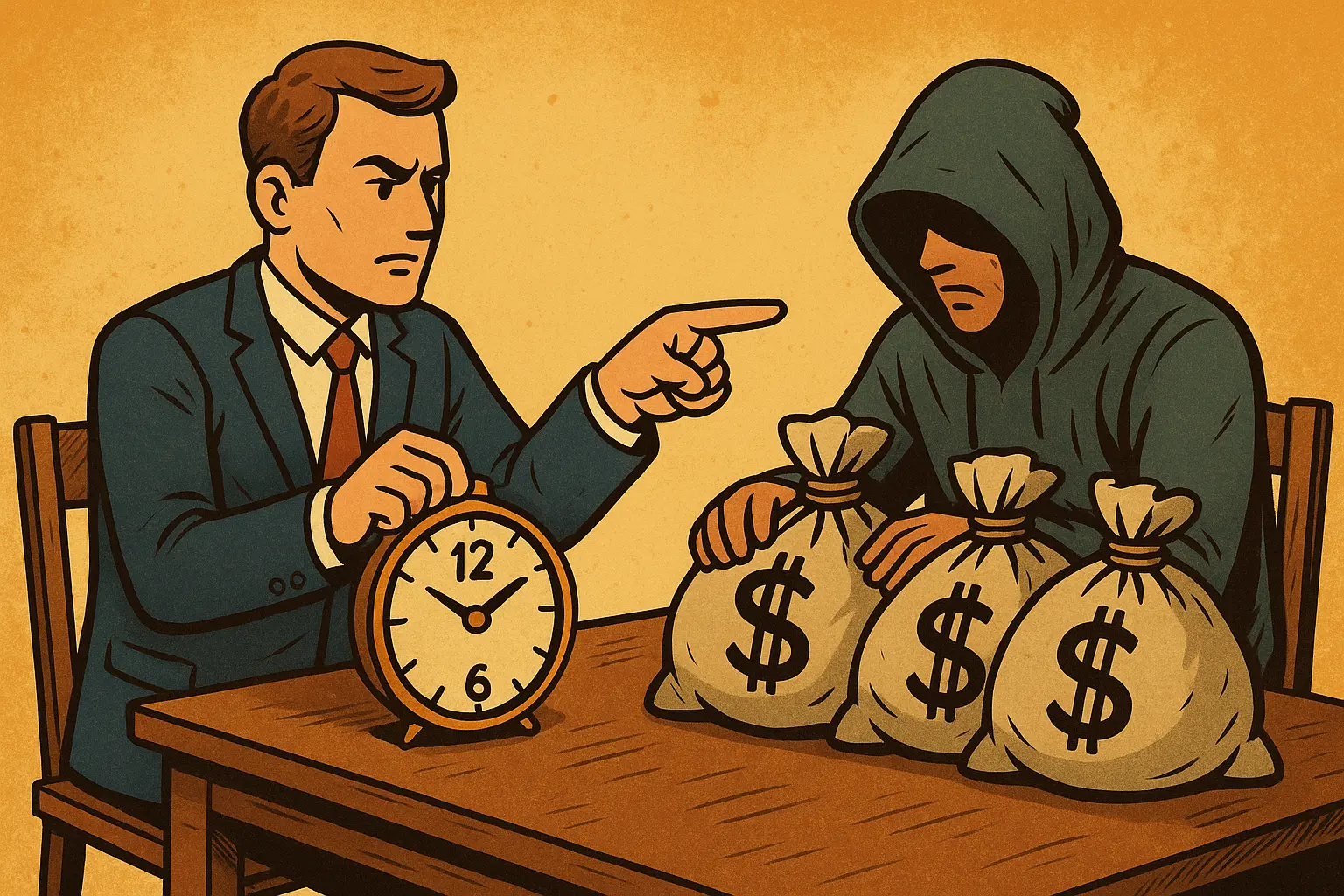
Resolv Labs announced on the X platform on March 24 that they have sent on-chain messages to the attacker’s address, officially proposing a settlement plan for the security incident that occurred on March 22. According to the proposal, if the attacker returns approximately 90% of the stolen funds (about $25 million USD in ETH) within 72 hours, they can retain the remaining 10% (about $2.5 million USD) as an incentive for settlement.
Settlement Plan Design: On-Chain Notification and White Hat Incentive Logic
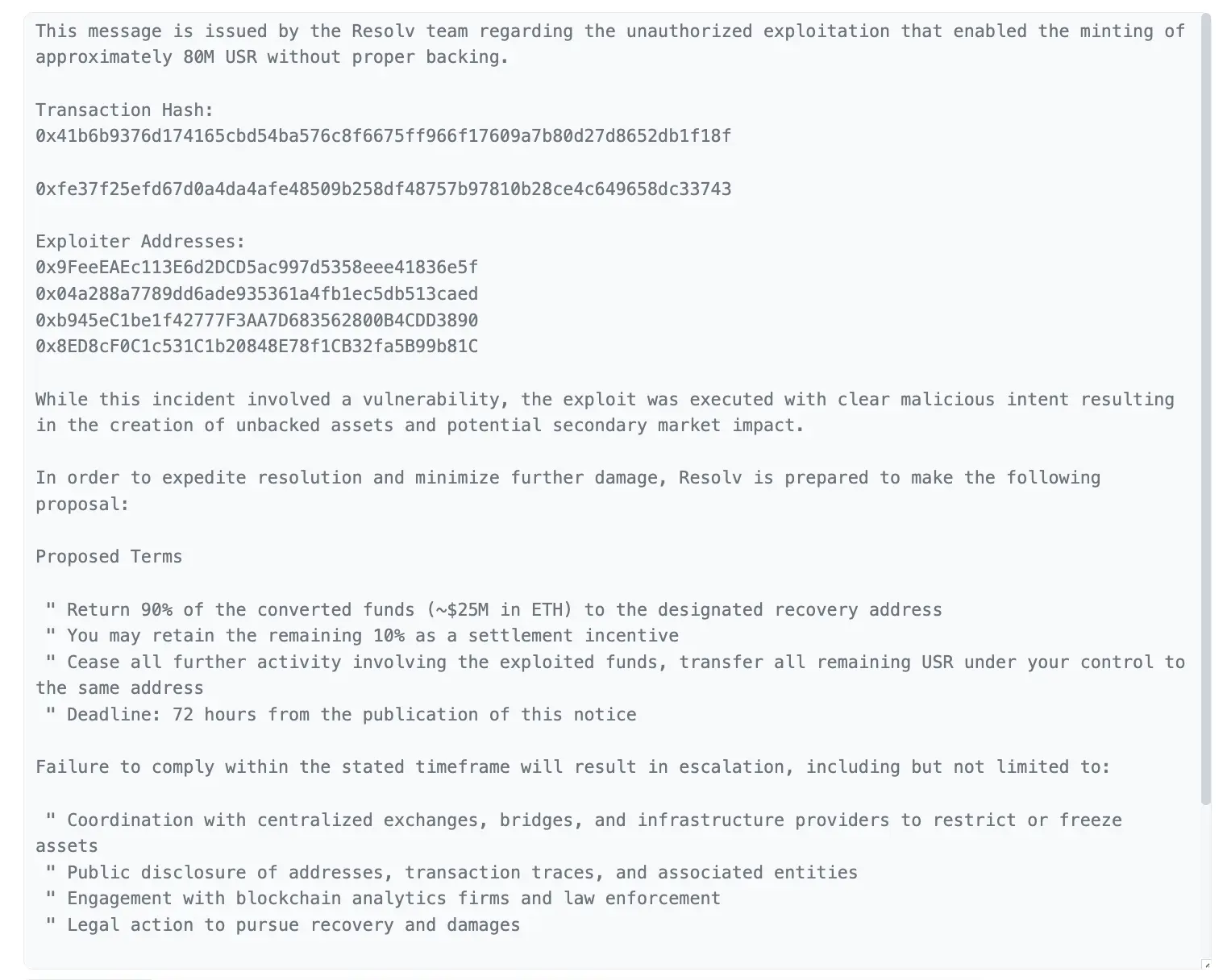 (Source: Resolv Labs)
Resolv’s proposal follows the common “white hat incentive” structure in crypto security incidents: retaining part of the stolen assets in exchange for the attacker voluntarily returning most of the funds, while avoiding legal risks from subsequent law enforcement actions. This plan is directly encoded as an on-chain message sent to the attacker’s address, ensuring transparency and market traceability.
For the attacker, accepting the settlement means securing a certain $2.5 million USD while avoiding the increasing risks of law enforcement pursuit. Refusal will trigger multiple escalation measures simultaneously.
Four Escalation Measures After 72 Hours
Asset Freeze Coordination: Coordinate with centralized exchanges (CEX), cross-chain bridges, and infrastructure providers to freeze assets held by the attacker’s addresses, restricting the transfer and withdrawal of stolen funds.
Public Disclosure of Addresses and Transaction Paths: Publicly reveal the attacker’s wallet addresses and complete fund transfer paths, leveraging community tracking efforts to apply ongoing pressure.
Collaboration with On-Chain Analysis Firms and Law Enforcement: Work with blockchain analysis companies and relevant law enforcement agencies to enhance the chances of identifying the attacker’s true identity.
Legal Action: Take civil or criminal legal actions under applicable legal frameworks.
Background and Latest Recovery Progress
This settlement proposal is the latest development in the Resolv security incident. On March 22, the attacker accessed Resolv’s infrastructure using stolen private keys, minting approximately $80 million USD worth of unauthorized USR tokens, which were subsequently converted into about $25 million USD in ETH for cashing out.
According to Resolv’s latest update on March 23, the relevant smart contracts were quickly paused, and about 9 million USR tokens held by the attacker were burned to reduce further spread. The protocol currently holds about $141 million USD in assets, with the actual impact before pausing confirmed to be only around $500,000 USD in redemptions. The USR supply now consists of 102 million tokens before the incident plus approximately 71 million newly minted illegal tokens. A recovery plan has been initiated, starting from whitelisted users on March 23, allowing redemption of USR tokens before the incident.
Resolv strongly recommends suspending trading of USR and related tokens during the recovery process to avoid interference. Affected users should coordinate directly with RDAL through official channels.
Frequently Asked Questions
Q: What are the settlement terms Resolv proposed to the attacker?
If the attacker returns about 90% of the stolen funds (approximately $25 million USD in ETH) within 72 hours, they can keep the remaining 10% (about $2.5 million USD) as an incentive. If there is no response within the deadline, Resolv will initiate escalation measures such as asset freezing, address disclosure, law enforcement cooperation, and legal actions.
Q: How did the Resolv security incident happen?
The attacker accessed Resolv’s infrastructure using stolen private keys, exploiting a control vulnerability in the USR minting contract, minting about $80 million USD worth of unauthorized USR tokens, and converting approximately $25 million USD into ETH for cashing out. The underlying collateral of the protocol was not directly affected; the issue was limited to the USR issuance mechanism.
Q: What should USR holders pay attention to during the recovery?
Resolv strongly recommends suspending trading of USR and related tokens during the recovery process. Redemption services have resumed from whitelisted users since March 23. Affected users should coordinate directly with RDAL through official channels to ensure the recovery process is not disrupted.
Disclaimer: The information on this page may come from third parties and does not represent the views or opinions of Gate. The content displayed on this page is for reference only and does not constitute any financial, investment, or legal advice. Gate does not guarantee the accuracy or completeness of the information and shall not be liable for any losses arising from the use of this information. Virtual asset investments carry high risks and are subject to significant price volatility. You may lose all of your invested principal. Please fully understand the relevant risks and make prudent decisions based on your own financial situation and risk tolerance. For details, please refer to
Disclaimer.
Related Articles
Fake Ledger Live App Steals $9.5M From 50+ Users Across Multiple Blockchains
A fraudulent Ledger Live app on Apple's App Store stole $9.5 million from over 50 users by compromising wallet information. The incident, involving significant losses for major investors, raises concerns about App Store security, prompting discussions of a possible lawsuit against Apple.
GateNews48m ago
Criticized for freezing USDC too slowly! Circle CEO: We will definitely wait for the court’s order before freezing—refusing to freeze privately/by ourselves without authorization
Circle CEO Jeremy Allaire said the company will not proactively freeze wallet addresses unless it receives a court order or a request from law enforcement. Even amid hacker money-laundering disputes and community backlash, Circle still insists on operating in accordance with the rule of law.
Jeremy Allaire sets Circle’s law-enforcement bottom line
-----------------------------
As the global cryptocurrency market roils, Circle’s CEO Jeremy Allaire, the stablecoin issuer, delivered a clear stance on the most sensitive issue in the market at a press conference in Seoul, South Korea. He pointed out that although Circle has the technical means to freeze specific wallet addresses, unless it receives a court order or a formal instruction from law-enforcement authorities, the company will not take such action on its own.
CryptoCity2h ago
Attacker Exploiting Bridged Polkadot Vulnerability Transfers $269K to Tornado Cash
On April 15, Arkham reported that the attacker who exploited a Bridged Polkadot vulnerability transferred around $269,000 in stolen funds to Tornado Cash, complicating asset tracking.
GateNews3h ago
Bitcoin Developers Propose BIP 361 to Protect Against Quantum Computing Threats
Bitcoin developers have proposed BIP 361 to safeguard the network against quantum computer risks by freezing vulnerable addresses. The proposal includes a phased plan to transition users to quantum-safe wallets, but it has sparked debate on user control and security.
GateNews3h ago
Hackers Exploit Obsidian Plugin to Spread PHANTOMPULSE Trojan with Blockchain C2
Elastic Security Labs revealed that threat actors impersonated venture capital firms on LinkedIn and Telegram to deploy a Windows RAT named PHANTOMPULSE, using Obsidian note vaults for attacks, which Elastic Defend successfully blocked.
GateNews4h ago
Zerion Hot Wallet Loses $100K in AI-Driven Social Engineering Attack by North Korea-Linked Hackers
Zerion confirmed a recent AI-driven social engineering attack by North Korean hackers, resulting in a $100,000 loss from corporate hot wallets. User funds remain safe, and the company has taken precautionary measures. This follows another significant attack on Drift Protocol.
GateNews4h ago


