
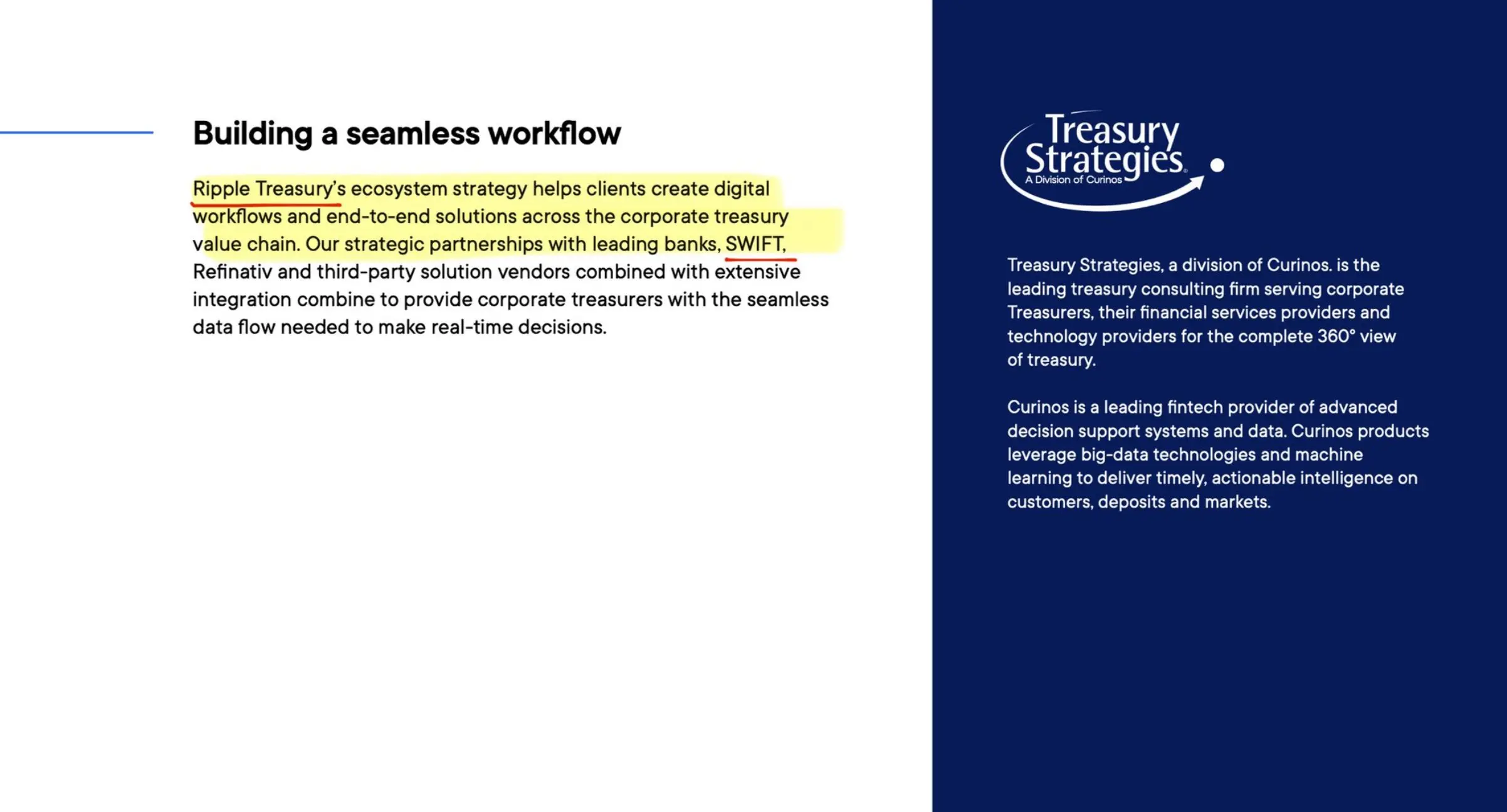
Ripple has formed a partnership with the financial analytics platform NDepth. By integrating NDepth’s bank fee analysis,资金优化 (funds optimization), and financial data insights capabilities, it strengthens Ripple Treasury’s enterprise financial management solution. This integration is designed to maintain compatibility with existing financial infrastructure such as SWIFT, while providing institutional customers with a smoother path to access XRP liquidity.
NDepth Integration: Injecting Analytical Intelligence into Enterprise Treasury Operations
 (Source: Ripple)
NDepth provides three core capabilities in the enterprise treasury domain, which complement Ripple’s cross-border payments infrastructure:
Bank fee analysis: Helps enterprises identify and optimize hidden costs in interbank transactions, improving financial transparency. It is especially valuable in practical cross-border business environments involving multiple currencies and channels.
Funds optimization: Through data-driven decision-making tools, it helps organizations allocate capital optimally among different liquidity pools, reducing the opportunity cost of idle capital.
Financial data insights: Provides cross-system capabilities for aggregating and analyzing financial data, enabling treasury teams to simultaneously monitor capital movements across traditional banking channels and XRP chain channels in a single view.
By integrating these three capabilities, Ripple Treasury expands from a mere payment execution tool into a comprehensive enterprise treasury solution covering analysis, optimization, and monitoring.
Hybrid Mode Strategy: Ripple Works in Parallel with SWIFT, Not in Opposition
Ripple’s market positioning has shifted from the early narrative of “replacing SWIFT” to a cooperative approach of “coexisting with SWIFT.” The integration with NDepth is a concrete implementation of this strategy.
Four Core Design Logics Behind Ripple’s Hybrid Model
Progressive onboarding: Institutions can gradually introduce XRP liquidity channels without discarding existing systems, reducing transformation risk
Dual-track parallel operation: Connect both traditional SWIFT banking infrastructure and XRP blockchain alternative solutions, enabling flexible routing to the optimal path for different scenarios
Plugin-based integration: Introduce blockchain capabilities in a modular way, without requiring systematic system restructuring, making the transition smoother
Expansion of settlement scenarios: Traditional SWIFT core scenarios such as liquidity management, cross-border settlement, and enterprise treasury operations can all gradually introduce XRP as a settlement option
Long-Term Significance for the XRP Ecosystem
This integration is not a direct upgrade to the XRP protocol itself, but rather it systematically expands XRP’s institutional application ecosystem. Each expansion within Ripple’s enterprise customer network increases the real usage frequency of XRP liquidity management and cross-border settlement scenarios.
For XRP holders, the significance of this kind of collaboration lies more in long-term accumulation than short-term catalysts. The truly persuasive value will be built on the foundation of increased actual transaction volume, broader scales of institutional integration, and clear articulation of regulatory frameworks across major markets. Each collaboration strengthens the same core thesis: crypto assets are being systematically integrated into mainstream financial infrastructure rather than building an ecosystem on its periphery.
Frequently Asked Questions
What is Ripple Treasury, and what direct connection does it have with XRP?
Ripple Treasury is Ripple’s enterprise financial management solution for institutional customers. It integrates tools for cross-border payments, liquidity management, and treasury operations, with the underlying settlement network using XRP as a bridging asset. It is Ripple’s core product for bringing XRP into enterprise treasury workflows, directly affecting the real usage frequency of XRP at the institutional level and the market’s depth.
What capabilities that Ripple previously lacked does NDepth bring to Ripple Treasury?
NDepth fills capability gaps in Ripple’s bank fee analysis and funds optimization. These analytical tools enable enterprise treasury teams to quantify the cost differences of XRP routing compared with traditional SWIFT remittances, using data to substantiate XRP’s efficiency advantages—thereby lowering the adoption persuasion threshold for institutional decision-makers.
For institutions still using SWIFT, what does this integration mean?
For SWIFT users that have not yet adopted blockchain payments, this integration provides a transition path with the lowest friction. Institutions do not need to rebuild their existing infrastructure; they can introduce XRP as a supplementary channel in specific settlement scenarios. Ripple’s hybrid mode design ensures that the two systems remain parallel-compatible during the transition period, making a “trial run” style onboarding possible.
Disclaimer: The information on this page may come from third parties and does not represent the views or opinions of Gate. The content displayed on this page is for reference only and does not constitute any financial, investment, or legal advice. Gate does not guarantee the accuracy or completeness of the information and shall not be liable for any losses arising from the use of this information. Virtual asset investments carry high risks and are subject to significant price volatility. You may lose all of your invested principal. Please fully understand the relevant risks and make prudent decisions based on your own financial situation and risk tolerance. For details, please refer to
Disclaimer.


