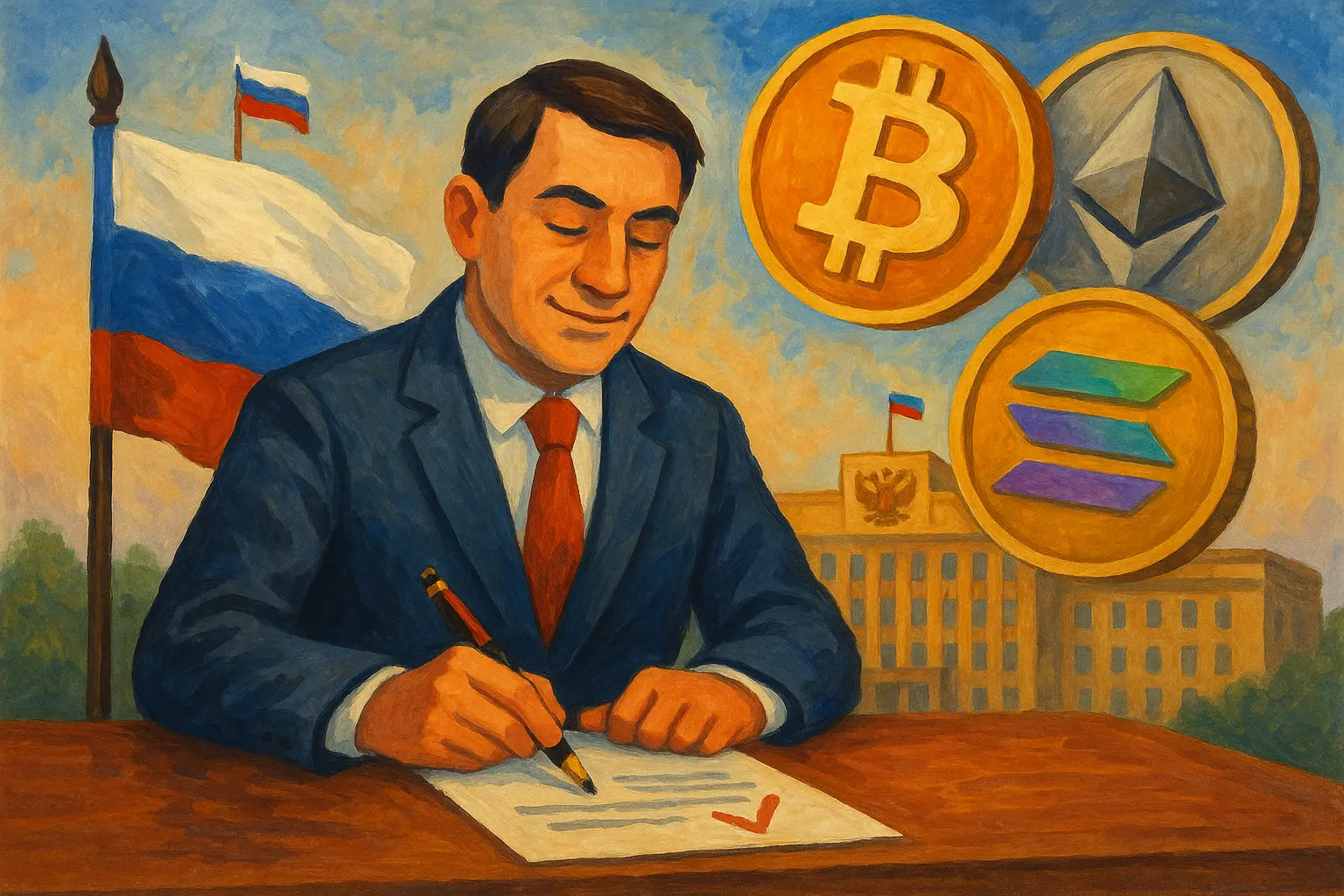
The Russian government’s Legislative Activity Committee has approved the “Bill on Digital Currencies and Digital Rights,” officially establishing a regulatory framework for compliant cryptocurrency trading within Russia. The bill permits Russian cryptocurrency exchanges to list digital assets that meet strict quantitative thresholds based on market capitalization, trading volume, and trading history. Bitcoin (BTC), Ethereum (ETH), and Solana (SOL) have all been confirmed to meet the eligibility criteria.
Three Core Entry Standards: Which Cryptocurrencies Can Enter the Russian Market
The bill sets a set of rigorous quantitative standards that any decentralized or foreign-issued digital currency must meet to obtain trading permission within Russia.
Entry Requirements for Cryptocurrencies into the Russian Regulatory Market
Market Capitalization Threshold: An average market cap exceeding 5 trillion rubles (approximately $600 billion) over the past two years.
Trading Volume Threshold: An average daily trading volume of at least 1 trillion rubles (approximately $120 billion) during the same period.
Trading History Requirement: At least five years of public trading history, including verifiable official closing price records.
According to a copy of the bill disclosed by the business media RBC and data from CoinMarketCap, Bitcoin, Ethereum, and Solana all meet these standards. For example, Solana has been trading since 2020, with a market cap close to $50 billion and a daily trading volume of about $2.8 billion. These indicators will be verified using data from global platforms authorized within the jurisdiction, with the average trading volume threshold on these platforms not falling below 100 billion rubles.
Central Bank Regulatory Powers and Ban on Privacy Coins
The bill authorizes the Central Bank of Russia (CBR) to maintain a list of digital assets permitted for circulation within Russia, while also granting the financial intelligence agency Rosfinmonitoring the authority to blacklist certain cryptocurrencies. Assets listed on the blacklist will be prohibited from trading, and both companies and individuals are forbidden from holding them. Privacy-focused cryptocurrencies are explicitly included in the ban, meaning such assets will not be legally tradable in the Russian market.
The bill also officially classifies cryptocurrencies and stablecoins as “monetary assets,” expanding the scope of legal holders beyond qualified investors to include ordinary Russian citizens.
Investment Limits, Fines, and Criminal Penalties for Citizens
The annual investment limit for ordinary Russian citizens in cryptocurrencies is set at approximately $4,000, while qualified investors are not subject to this restriction. Enforcement introduces tiered penalties: violations by exchanges can result in fines up to 1 million rubles (about $12,000); illegal mining entities face fines up to 2.5 million rubles (about $30,000); and a criminal law amendment proposed by the Ministry of Justice (already approved by the government) stipulates that large-scale illegal mining could lead to imprisonment for up to five years.
The office of Russian Deputy Prime Minister Dmitry Grigorenko confirmed to Forbes Russia that the bill has been passed, noting it is based on the regulatory plan announced by the CBR at the end of December last year. Russia plans to utilize existing financial infrastructure—including banks, brokers, and traditional securities exchanges—to process cryptocurrency transactions, with some institutions already offering crypto derivatives services.
Frequently Asked Questions
Q: Which cryptocurrencies meet Russia’s entry standards?
A: The bill requires an average market cap over the past two years exceeding 5 trillion rubles (about $600 billion), an average daily trading volume of at least 1 trillion rubles (about $120 billion), and at least five years of trading history. According to CoinMarketCap data, Bitcoin, Ethereum, and Solana all meet these three standards.
Q: How can ordinary Russian citizens participate in cryptocurrency investment under the new law?
A: Ordinary Russian citizens can legally trade approved cryptocurrencies, but their annual investment is capped at about $4,000. Qualified investors are not subject to this limit. Privacy-focused cryptocurrencies are explicitly banned, and violations can result in fines or criminal prosecution.
Q: When will the Russian cryptocurrency law officially come into effect?
A: The bill has completed approval by the government’s legislative committee and must be passed by the Russian parliament before July 1, 2026, to become law. It is based on the regulatory plan announced by the CBR at the end of last year.
Disclaimer: The information on this page may come from third parties and does not represent the views or opinions of Gate. The content displayed on this page is for reference only and does not constitute any financial, investment, or legal advice. Gate does not guarantee the accuracy or completeness of the information and shall not be liable for any losses arising from the use of this information. Virtual asset investments carry high risks and are subject to significant price volatility. You may lose all of your invested principal. Please fully understand the relevant risks and make prudent decisions based on your own financial situation and risk tolerance. For details, please refer to
Disclaimer.
Related Articles
Ethereum Foundation: Ketman project identifies 100 North Korean agents within six months
According to an ETH Rangers project recap report published by the Ethereum Foundation on April 17, 2026 (Thursday), within its six-month funding period the Ketman project funded by the Ethereum Foundation identified 100 North Korean IT workers using false identities to infiltrate Web3 organizations, and contacted roughly 53 crypto projects to warn them they may have hired active North Korean agents.
MarketWhisper1h ago
NFT platform Foundation announces shutdown; Snowden’s auction site becomes a thing of the past
NFT platform Foundation co-founder Kayvon Tehranian announced on the X platform on April 15 that the platform will officially cease operations. Earlier this year, Foundation had signed a sale agreement with a buyer, but the buyer backed out before the transaction was completed. After Tehranian reassumed control, he assessed the market situation and announced, "There are no other buyers worth pursuing," officially initiating the wind-down process.
MarketWhisper1h ago
Ethereum Foundation core researcher Josh Stark resigns, without disclosing specific reasons
Ethereum Foundation core researcher and project manager Josh Stark (Josh Stark) announced on the X platform on April 17, 2026 (Thursday) that he will leave the Ethereum Foundation after five years in the role. According to Cointelegraph, Stark did not disclose the specific reasons for his departure. In his X post, he said that there are currently “no plans for the future,” and that he intends to temporarily spend time with his family and friends.
MarketWhisper3h ago
Arthur Hayes-Linked Address Deposits 3,000 ETH to Major CEXs Worth $6.93M
An address linked to Arthur Hayes deposited 3,000 ETH, worth around $6.93 million, to major exchanges. The address now holds 5,278 ETH, valued at approximately $12.33 million, as on-chain actions attract market attention.
GateNews3h ago
A huge Ethereum whale moves 2,000 ETH, seemingly preparing to sell
On April 17, an on-chain analyst, Ai Auntie, disclosed on the X platform that a long-term whale who has held a large amount of tokens since the Ethereum ICO period transferred 2,000 ETH (about $4.63 million) to a multi-signature address. The receiving address has been identified as a “designated sell” address in its history—funds are typically deposited to an exchange shortly after the transfer.
MarketWhisper3h ago
Ethereum NFT Marketplace Foundation Permanently Shuts Down After Failed BlackDove Acquisition
The Ethereum NFT marketplace Foundation has permanently shut down after its acquisition by BlackDove failed. With no plans for restoration, users must withdraw their NFT assets despite a year of continued media service.
GateNews3h ago


