
Stripe and Paradigm Launch Layer 1 Blockchain Tempo, Mainnet Supports Stablecoin Gas and MPP Protocol, Focusing on Real-World Payments and AI Proxy Commerce.
Targeting Real-World Payment Needs, Stripe Teams Up with Paradigm to Launch Layer 1 Payment Blockchain
Jointly incubated by payment giant Stripe and crypto venture firm Paradigm, the Layer 1 blockchain Tempo officially launched its mainnet on March 18. This long-prepared infrastructure signifies deep involvement of traditional fintech forces in blockchain core development, marking a new turning point for the global payment system. Tempo’s design philosophy is highly targeted; it avoids the speculative asset-centric approach of old public chains and instead focuses on high-frequency, large-scale payment scenarios with real-world economic value.
According to official technical documents, Tempo’s network can process tens of thousands of transactions per second, with confirmed settlement times reaching sub-second levels, performance comparable to traditional credit card networks.
The most notable technological innovation is its fee (Gas Fee) mechanism. Unlike Ethereum or Solana, Tempo does not issue a native token for paying fees. Instead, users can settle costs directly with mainstream stablecoins. By integrating automated market makers (AMM) and the TIP-20 standard, transaction costs become highly controllable and transparent, which is crucial for enterprise applications requiring precise financial planning.
Tempo completed a $500 million Series A funding round in October 2025 at a valuation of up to $5 billion, with top investors including Sequoia Capital, Thrive Capital, Ribbit Capital, and others. Before the mainnet went live, the network underwent rigorous testing on the testnet launched in December 2025, attracting financial giants like Visa, Mastercard, UBS, and Klarna to participate in testing.
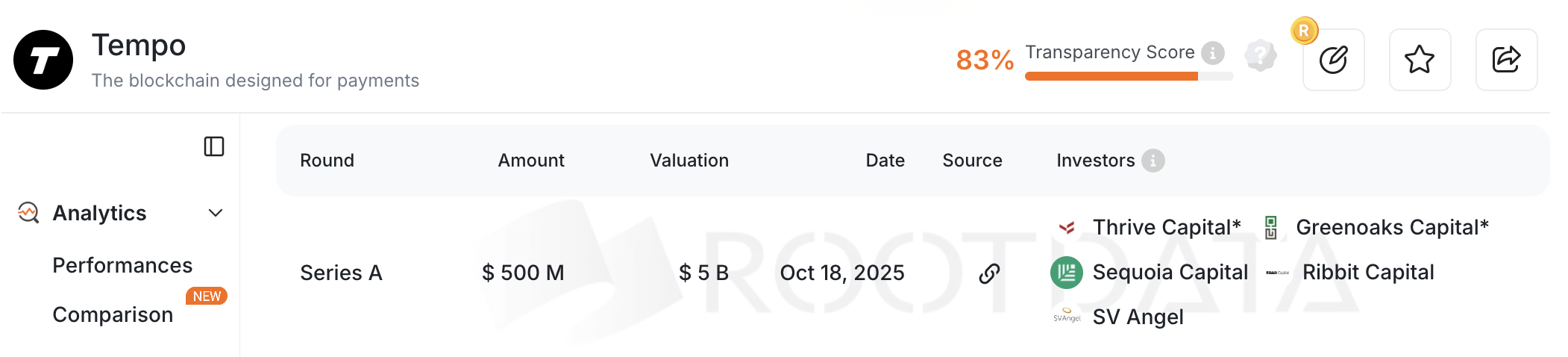
Image Source: Rootdata Tempo was valued at up to $5 billion during its $500 million Series A funding in October 2025
Machine Payments Protocol (MPP): Building Dedicated Financial Tracks for AI Agents
Another major highlight alongside the Tempo mainnet launch is the joint development of the “Machine Payments Protocol” (MPP) by Tempo and Stripe. This is an open payment standard designed for AI agents and automation software, aiming to solve the payment barriers faced by artificial intelligence in executing business tasks.
Traditional payment systems rely on human authorization and manual review, whereas MPP defines a programmable process allowing machines to automatically request, authorize, and settle funds. As AI agents begin autonomously writing code, calling APIs, or handling complex workflows, a dedicated “AI-native economy” payment track becomes essential. McKinsey predicts that by 2030, AI agents could mediate between $3 trillion and $5 trillion in global commercial transactions. MPP is targeting this lucrative market.
The core mechanism of MPP introduces “Sessions,” a new payment primitive similar to OAuth-based digital permission grants. Users or developers set one-time authorizations and spending limits in advance, enabling AI agents to perform continuous, programmatic payments within this framework, avoiding on-chain confirmation for every small API call or computational need.
This model supports “payment streaming,” aggregating thousands of microtransactions into a single settlement, significantly reducing costs and making pay-per-use or resource-based billing feasible at internet scale.
Stripe CEO Patrick Collison described Tempo as “a decentralized, network-scale SWIFT,” and this protocol is a key component in driving that vision.

Image Source: Business Insider Stripe CEO Patrick Collison
Financial Giants and Startups Collaborate, Physical Payment Scenarios Fully Realized
Beyond its technological ambitions, Tempo’s ecosystem breadth and partner strength demonstrate strong market appeal. Currently, over 100 service providers have integrated into Tempo’s payment catalog, including large language model (LLM) providers, developer infrastructure, and data platforms. Notable partners include OpenAI, Anthropic, DoorDash, Shopify, Nubank, and Standard Chartered.
Through the MPP protocol, AI agents can now order sandwiches for delivery at Prospect Butcher Co. in New York, rent headless browsers via Browserbase, or automatically donate to Stripe Climate’s environmental funds. Developers can integrate MPP into existing PaymentIntents APIs with just a few lines of code, greatly lowering the barrier for enterprises to adopt blockchain payments.
In addition to AI payments, Tempo aims to optimize traditional financial bottlenecks. For the $190 trillion global cross-border payments market, Tempo’s design complies with the ISO 20022 international financial messaging standard, enabling enterprises to easily connect on-chain settlement systems with existing financial audit systems. International remittances that previously took 1 to 3 days and involved multiple intermediaries can now be completed in seconds with full traceability.
For platforms making large-scale payouts to millions of sellers or creators worldwide, Tempo’s dedicated payment channels ensure stable throughput during peak times, avoiding common blockchain network congestion and fee spikes.
Industry Competition Heats Up, Stablecoin Settlement Infrastructure Enters a Warring Era
With the launch of the Tempo mainnet, the payment infrastructure war in the crypto market has officially intensified. On the day before Tempo’s launch, Mastercard announced the acquisition of stablecoin infrastructure company BVNK for $1.8 billion, marking the largest deal in the industry’s history—similar to Stripe’s $1.1 billion acquisition of Bridge last year.
Further Reading
Mastercard’s $1.8 Billion Acquisition of BVNK Accelerates Stablecoin Payment Strategy, Integrates Fiat and On-Chain Payment Tracks
Major payment giants have evidently reached a consensus: blockchain is the future underlying infrastructure for global financial clearing. Currently, Tempo faces direct competition from Circle’s Arc chain and Coinbase’s x402 protocol. Arc also targets institutional applications and is supported by BlackRock and Goldman Sachs; Coinbase’s x402 aims to embed stablecoin micro-payments directly into HTTP communication layers.
Tempo’s advantage lies in its deep integration with Stripe’s existing $1.9 trillion transaction ecosystem. Stripe extends its fraud prevention, tax calculation, and accounting features directly into the MPP protocol, allowing enterprises to enjoy traditional financial protections while using blockchain technology.
For developers, this is not just choosing a blockchain but upgrading to a solution that seamlessly connects with existing business logic. Despite current crypto market volatility, the Tempo team believes that structural infrastructure development should not be affected by short-term market fluctuations. While the public debates token prices, Stripe and Paradigm are already building dedicated banking infrastructure for future robots and AI agents.
Read more about “Tempo” news
Why does Stripe want to promote the Tempo chain? CEO: Optimistic about stablecoin settlement potential, with hopes to become mainstream financial infrastructure
Tempo chain emerges! Ethereum core developers switch jobs, Stripe raises $500 million in funding
Stripe incubates the Tempo blockchain! Designed for global payments, claims to process 100,000 transactions per second


