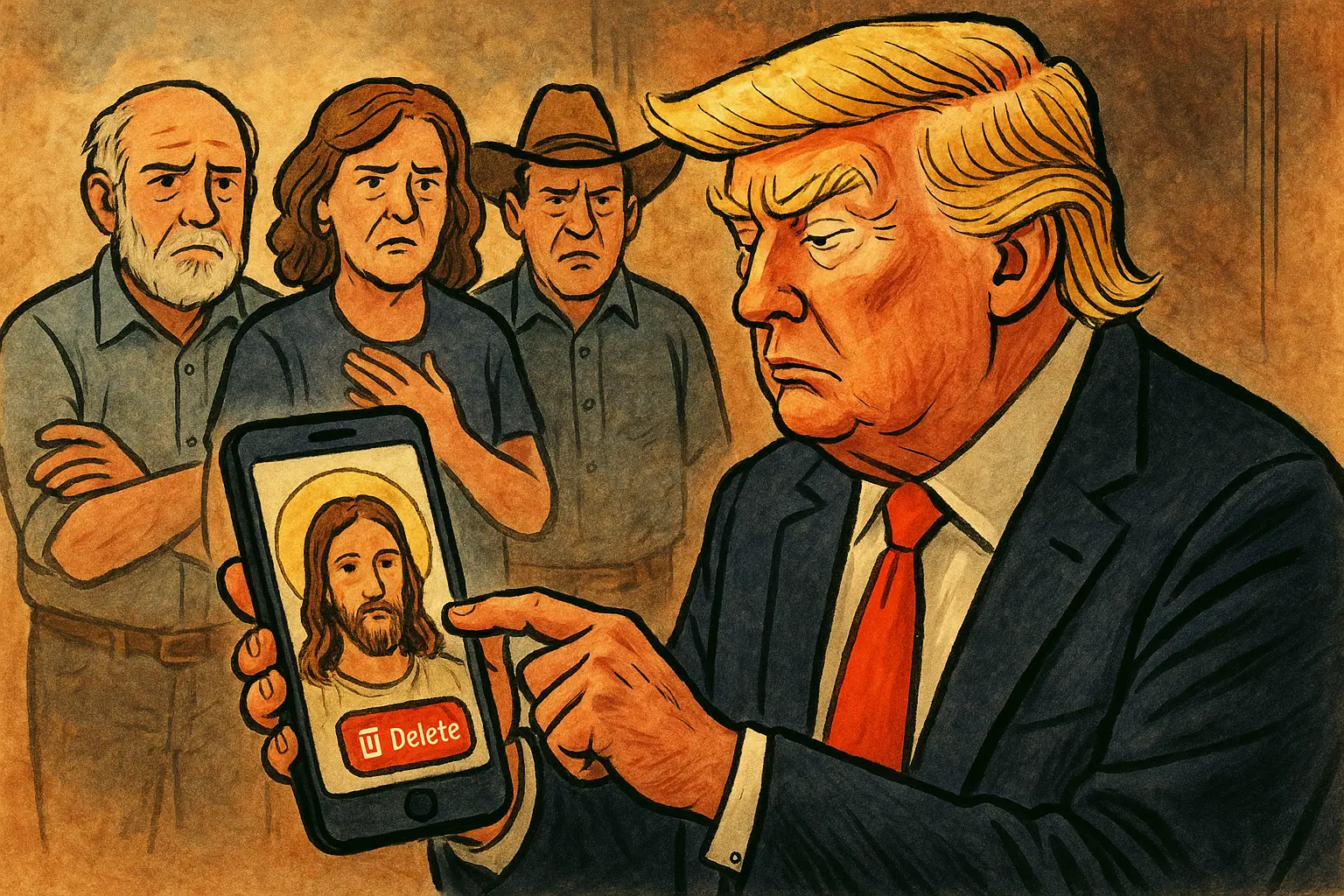
Trump removed an AI-generated Truth Social image showing him in a white robe, glowing hand on a sick man’s forehead — immediately compared to Jesus healing miracles. The post drew swift bipartisan backlash, including from conservative Christians in his own base, hours after he attacked Pope Leo XIV on the same platform.
The Image, the Symbolism, and the Immediate Reaction
The now-deleted post featured Trump dressed in flowing white robes, his hand glowing as it rested on a bedridden man’s forehead. The background was heavily symbolic: the Statue of Liberty, a billowing American flag, fighter jets, an eagle, a uniformed nurse, a woman in prayer, and what appeared to be a soldier in uniform.
The visual composition drew immediate comparisons to iconographic Christian paintings depicting the healing ministry of Jesus Christ. Within hours, voices from across the political spectrum were demanding the post’s removal — with some of the most forceful condemnation coming from figures typically among Trump’s strongest advocates:
Sean Feucht, a Christian activist organizing events for the 250th anniversary of the Declaration of Independence, wrote: “This should be deleted immediately. There’s no context where this is acceptable.”
Riley Gaines, a prominent conservative activist, posted a blunt response: “God shall not be mocked.”
David Brody, a journalist at the Christian Broadcasting Network, wrote: “This goes too far. It crosses the line. A supporter can back the mission and reject this.”
Trump’s Defense: “It’s Me as a Doctor”
Speaking to reporters at the White House several hours after the post disappeared, Trump did not apologize. Instead, he offered an alternative reading of the imagery.
“It’s supposed to be as a doctor making people better,” Trump told reporters. “And I do make people better. I make people a lot better.”
In a separate statement to CBS News, Trump provided a more straightforward explanation for the deletion: “I didn’t want to have anybody be confused. People were confused.”
The White House did not issue a formal apology or clarification beyond Trump’s own remarks.
The Pope Leo XIV Timeline
The timing of the AI Jesus image amplified its political significance. The post went live less than an hour after Trump published a lengthy attack on Pope Leo XIV — the first American-born pontiff — calling him “weak on crime” and “terrible for foreign policy.”
Pope Leo has been a persistent critic of the US and Israeli military operations in Iran, describing the conflict as characterized by “absurd and inhuman violence.” On the same day the image was posted, the Pope stated publicly that he has “no fear” of the Trump administration, describing his public commentary as an expression of his Gospel mission.
When asked about the Pope at the White House, Trump held his ground. “Pope Leo said things that are wrong,” he said. “He was very much against what I’m doing with regard to Iran, and you cannot have a nuclear Iran. Pope Leo would not be happy with the end result.”
A Recurring Pattern on Truth Social
Monday’s AI Jesus post is not an isolated incident. Trump’s Truth Social activity has generated multiple significant controversies in recent months.
In February, a racially offensive clip depicting Barack and Michelle Obama as apes was posted to Trump’s official account. The White House initially dismissed criticism, calling it an “internet meme video” and telling critics to “stop the fake outrage.” After pushback from multiple Republican senators, the clip was removed and a White House official attributed the post to a staffer who had acted “erroneously.”
The recurring dynamic — controversial content appearing on, and then vanishing from, the presidential account — has prompted ongoing scrutiny of content moderation practices on Truth Social and the editorial controls around the president’s official digital presence.
FAQ
Why did Trump delete the AI Jesus image from Truth Social?
Trump told CBS News he removed the post because “people were confused,” stating he did not want the imagery to be misread. He maintained the image depicted him as a doctor, not a religious figure — though the white robe and glowing healing hand directly mirrored iconographic representations of Jesus Christ from centuries of Christian art. No formal apology was issued.
Which critics condemned the AI Jesus image?
Criticism arrived from both sides of the political spectrum, but was particularly notable from within Trump’s own base. Christian activist Sean Feucht called for immediate deletion, stating there was “no context where this is acceptable.” Conservative activist Riley Gaines cited scripture. The Christian Broadcasting Network’s David Brody said the post “crosses the line,” adding that a supporter can endorse a leader’s mission without accepting every post. Trump did not respond to any individual critics.
What was the connection between the post and Pope Leo XIV?
The AI Jesus image was published less than an hour after Trump’s lengthy public attack on Pope Leo XIV, in which he called the first American Pope “weak on crime” and “terrible for foreign policy.” Pope Leo has been a vocal critic of the Iran military campaign. The close timing of the two posts — attacking a Pope and then sharing an image comparing oneself to Jesus — was widely noted by media observers and religious commentators as an ironic and politically damaging sequence.
Disclaimer: The information on this page may come from third parties and does not represent the views or opinions of Gate. The content displayed on this page is for reference only and does not constitute any financial, investment, or legal advice. Gate does not guarantee the accuracy or completeness of the information and shall not be liable for any losses arising from the use of this information. Virtual asset investments carry high risks and are subject to significant price volatility. You may lose all of your invested principal. Please fully understand the relevant risks and make prudent decisions based on your own financial situation and risk tolerance. For details, please refer to
Disclaimer.


