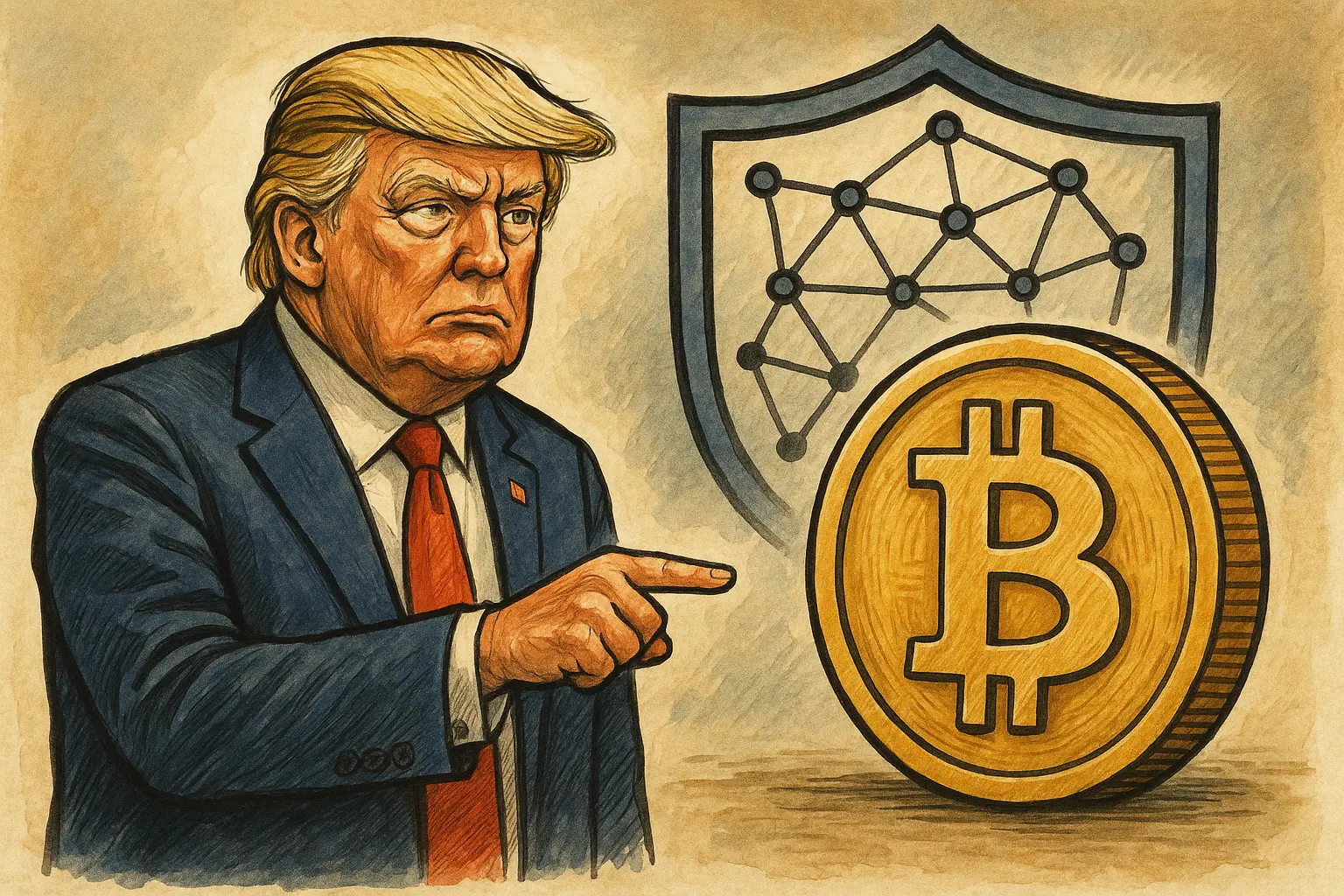
President Donald Trump released the “National Cyber Strategy,” a six-page document that for the first time lists cryptocurrencies and blockchain technology as objects requiring “protection and security.” Alex Thorn, head of research at Galaxy Digital, pointed out that cryptocurrencies and blockchain are explicitly listed as technologies needing protection and security, marking the first time this has appeared in a U.S. cybersecurity strategy.
Cryptocurrencies First Included in Federal Cybersecurity Strategy: Provisions and Historical Significance
 (Source: White House)
The “National Cyber Strategy” mentions cryptocurrencies only once: “We will establish secure technologies and supply chains, protecting user privacy throughout the process from design to deployment, including supporting the security of cryptocurrencies and blockchain technology.”
This statement’s historical significance lies in it being the first time the U.S. government has officially committed to protecting the security of Bitcoin and blockchain technology within the federal cybersecurity policy framework. It continues President Trump’s series of digital asset-friendly policies since his re-election, including approving the establishment of strategic Bitcoin reserves based on Bitcoin, banning the development of U.S. central bank digital currencies (CBDC), and conducting a comprehensive review of digital asset policy frameworks.
Quantum Threats and Post-Quantum Cryptography: Industry Perspectives
Another key provision in the strategy document is the government’s commitment to promote “Post-Quantum Cryptography, Zero Trust architectures, and cloud transformation to accelerate the modernization of federal information systems.” Industry opinions on the threat of quantum computing to Bitcoin vary:
Optimists: Strategy co-founder Michael Saylor believes concerns about quantum threats are exaggerated but acknowledges developers should prepare for technological changes.
Cautious Warnings: Nic Carter, founder of Castle Island Ventures, states that if Bitcoin developers fail to address quantum security issues in time, major institutions holding Bitcoin may eventually lose patience with developers.
Roadmap Action: Ethereum co-founder Vitalik Buterin earlier this year proposed a “Quantum Roadmap” aimed at preparing Ethereum for a future where quantum computing could weaken existing cryptographic protections.
Nic Carter sarcastically commented on the government’s commitment to promote post-quantum cryptography: “It seems they really care about quantum mechanics. No need to worry.” Quantum computers are still experimental, but researchers warn that sufficiently powerful quantum computers could someday crack Bitcoin’s current encryption, necessitating a network-wide migration to new cryptographic standards.
Potential Risks in Cybersecurity Strategy: Signals for Regulating Mixers and Privacy Coins
While the strategy clearly supports cryptocurrency security, another clause could serve as a basis for regulation. Alex Thorn pointed out that the phrase “eliminate criminal infrastructure and cut off financial exit routes and havens” could easily be used as a reason to crack down on mixers, privacy coins, and unregulated exit channels.
Notably, despite overall friendly policies toward cryptocurrencies under Trump, on-chain data shows that Bitcoin millionaire addresses (holding over $1 million worth of Bitcoin) have decreased by about 16% since Trump’s re-election, roughly 25,000 addresses, indicating that policy optimism has not yet translated into continuous growth in Bitcoin wealth among holders.
Disclaimer: The information on this page may come from third parties and does not represent the views or opinions of Gate. The content displayed on this page is for reference only and does not constitute any financial, investment, or legal advice. Gate does not guarantee the accuracy or completeness of the information and shall not be liable for any losses arising from the use of this information. Virtual asset investments carry high risks and are subject to significant price volatility. You may lose all of your invested principal. Please fully understand the relevant risks and make prudent decisions based on your own financial situation and risk tolerance. For details, please refer to
Disclaimer.
Related Articles
Nigel Farage invests 2 million pounds in Bitcoin, becoming the UK’s first openly holding MP
Reform UK leader Nigel Farage bought Bitcoin with roughly £2 million, becoming the first sitting member of Parliament to publicly disclose an investment of this size. The move highlights his party’s support for cryptoassets and could spark debate about the impact on the UK’s crypto policy and potential conflicts of interest. Farage invested via Stack BTC, strengthening his dual political and financial endorsement.
MarketWhisper1h ago
U.S. banks question the White House’s stablecoin yield report, concerned about the risk of deposit outflows
U.S. banks are questioning a White House stablecoin yield report, arguing that it overlooks the impact of stablecoins on deposit outflows, which could lead to higher financing costs and reduced local lending. The two sides are currently negotiating an agreement on the Senate bill, and a ban on paying stablecoin interest is the focus of the dispute.
GateNews1h ago
Banking industry questions the White House’s stablecoin report, allegations that the crisis of community bank deposit outflows was deliberately avoided
The American Bankers Association criticizes the White House’s research framework in its stablecoin report, saying it overlooks the risk of deposit outflows that could be triggered by prohibiting stablecoin yield. The White House report says the ban will have only a minimal impact on bank lending, increasing it by just $2.1 billion, but the ABA believes this issue’s framework fails to reflect the risks that would actually harm community banks and support the local economy. This dispute is also tied to the current cryptocurrency regulatory legislative efforts, shaping the future development of stablecoins and the competitive landscape for banks.
MarketWhisper1h ago
Trump’s net worth jumps 60% to $6.3 billion as business expansion sparks controversy over potential conflicts of interest
Trump’s net worth is estimated at $6.3 billion, up about 60% before his return to the White House. This growth is mainly driven by his family’s expansion into overseas real estate deals and the cryptocurrency sector. Government ethics experts say they are concerned and believe there may be conflicts of interest. The White House and the Trump Organization deny such claims.
GateNews3h ago
Citigroup raises its U.S. stock market rating to “Buy,” favoring defensive stocks
Gate News message, April 14, Citi Group’s strategists raised their rating for the U.S. stock market from "Neutral" to "Buy," aligning with the views of other analysts on Wall Street. Citi said that heightened uncertainty in the war situation has made investors more inclined to choose companies with higher quality and stronger defensiveness. Based on the principles of a "quality/defensive tilt," Citi adjusted its global asset allocation. Meanwhile, Citi downgraded its emerging market stock rating from "Buy" to "Neutral," saying these markets are more vulnerable to energy shocks, and that a stronger U.S. dollar puts additional pressure on them.
GateNews3h ago
Iranian Ambassador to India: Indian oil tankers have not paid the Strait of Hormuz transit fees to Iran
Iran’s ambassador to India, Fattahali, said that Indian tankers passing through the Strait of Hormuz did not pay the transit fee to Iran, and the Indian government also denied having paid any fee. Since the outbreak of the Iran war, Iran has blockaded that route, and there are still 15 Indian vessels stuck in the Persian Gulf.
GateNews5h ago


