
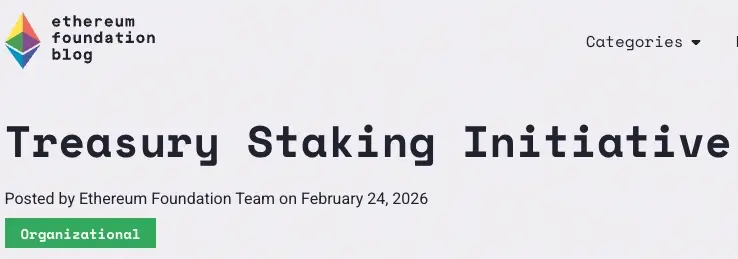
Ethereum co-founder Vitalik Buterin posted on the X platform on March 10, announcing that the Ethereum Foundation (EF) is staking approximately 72,000 ETH using DVT-lite (a simplified version of Distributed Validator Technology). This marks the latest development in EF’s treasury staking plan, which was announced on February 24.
Ethereum Foundation Staking Architecture: The Division of Labor Between Dirk and Vouch
(Source: Ethereum Foundation)
EF’s staking system is built upon two main open-source software components. Dirk functions as a distributed signer, dispersing signers across multiple geographic regions to eliminate single points of failure and improve system resilience; Vouch supports multiple Beacon clients and execution clients, offering various configurable strategies to effectively mitigate risks associated with client centralization.
At the infrastructure level, EF employs Minority Clients and combines managed infrastructure with self-managed hardware across multiple jurisdictions to achieve higher levels of geographic and organizational decentralization. The architecture also utilizes local build modules rather than a proposer-builder separation (PBS) sidecar architecture.
Three Major Technical Advantages of 0x02 Withdrawal Credentials
EF’s staking architecture uses type 2 (0x02) withdrawal credentials, which provide the following advantages over the older 0x01 credentials:
Transferability: Validator balances can be moved between addresses via account merging, accelerating key management changes.
Simplified Key Management: Each validator’s maximum effective balance is 2,048 ETH. Managing approximately 72,000 ETH requires only about 35 signing keys, greatly reducing daily maintenance complexity.
Flexible Exit: Even if a validator goes offline, it can trigger a withdrawal through the withdrawal address, enhancing operational flexibility.
Vitalik’s Core Proposition: Breaking the Myth that Staking Requires Professionals
Beyond technical announcements, Vitalik advocates for broader decentralization. He directly criticizes the idea that “operating nodes is extremely complex and only professionals can do it,” calling this notion “against the principles of decentralization and something that must be broken.”
He describes an ideal model: using Docker containers, Nix images, or similar tools, each node only needs a single click or command-line input. After inputting the same keys across all nodes, the system automatically handles network configuration, initiates Distributed Key Generation (DKG), and begins staking. Vitalik plans to operate in this manner as soon as possible and hopes more ETH holders and institutions will follow suit.
EF’s direct participation in consensus mechanisms allows it to fund ecosystem management with native rewards denominated in ETH, while also setting a benchmark for transparency in validator operations.
Frequently Asked Questions
What is DVT-lite, and how does it reduce staking complexity?
DVT (Distributed Validator Technology) enables a validator to run across multiple machines for redundancy and fault tolerance. DVT-lite is a simplified version designed to lower deployment barriers for institutions, allowing non-technical organizations to set up distributed staking in a near “one-click” manner without requiring deep technical support.
Why did the Ethereum Foundation choose to participate directly in staking?
EF states that direct staking can fund ecosystem management with native ETH rewards. Additionally, by personally managing staking operations and associated risks, EF can serve as a practical operator rather than merely an observer, setting a transparency standard for validator operations.
What does Vitalik mean by “staking nodes don’t need professionals”?
Vitalik advocates lowering the barrier to staking so that any organization can easily do it. The envisioned process involves using Docker or Nix images, inputting the same keys on each node, and allowing the system to automatically discover peers, establish network connections, initiate DKG, and start staking—all without the need for specialized technical personnel.
Disclaimer: The information on this page may come from third parties and does not represent the views or opinions of Gate. The content displayed on this page is for reference only and does not constitute any financial, investment, or legal advice. Gate does not guarantee the accuracy or completeness of the information and shall not be liable for any losses arising from the use of this information. Virtual asset investments carry high risks and are subject to significant price volatility. You may lose all of your invested principal. Please fully understand the relevant risks and make prudent decisions based on your own financial situation and risk tolerance. For details, please refer to
Disclaimer.
Related Articles
Charles Schwab Launches Bitcoin and Ethereum Trading
Charles Schwab launched Bitcoin and Ethereum trading on its Schwab Crypto platform, starting with an employee pilot and expanding to a client waitlist by Q2 2026. The service targets 46 million brokerage accounts at a competitive 0.75% fee, positioning Schwab against existing crypto platforms.
CryptoFrontier1h ago
Justin Sun Announces TRON’s PQ Transition, Criticizes Bitcoin And Ethereum
Justin Sun has launched TRON’s PQ upgrade plan, positioning it as the first major blockchain to adopt quantum-resistant technology, while criticizing Bitcoin and Ethereum for their slower progress in addressing quantum threats.
Blockzeit1h ago
ETH breaks through 2350 USDT
Gate News bot message, the Gate market shows that ETH has broken through 2350 USDT, current price is 2351.81 USDT.
CryptoRadar3h ago
Ethereum Korea Consortium Launches to Build Collaborative Blockchain Ecosystem
The Ethereum Korea Consortium launched on April 16 to shift South Korea's Ethereum focus from consumption to contributions, addressing challenges like market structure and regulatory issues. The initiative aims to enhance development and create a supportive ecosystem.
GateNews5h ago
Traditional Brokerage to Launch Spot Bitcoin and Ethereum Trading in Coming Weeks at 0.75% Fee
A traditional brokerage is set to launch spot cryptocurrency trading for retail clients, offering Bitcoin and Ethereum access. The service will include multiple trading platforms, a 0.75% fee, and additional crypto assets planned for the future, reflecting a trend of traditional finance entering the crypto space.
GateNews5h ago
ETH rises 0.65% in 15 minutes: spot buying led to net capital inflows
Between 2026-04-16 15:00 and 15:15 (UTC), the ETH price recorded a +0.65% return. The highest price in the range was 2330.16 USDT, while the lowest was 2308.58 USDT, with a swing of 0.93%. The short-term rally immediately drew market attention, increasing capital activity; volatility remained moderately elevated, characterized by strengthening spot buying power.
The main driving force behind this unusual move is that buy orders in the spot markets of major trading platforms continued to dominate. Within 15 minutes, the buy volume accounted for 58%–59%, and the total buy volume was about 2.2K–2.6K ETH
GateNews8h ago


