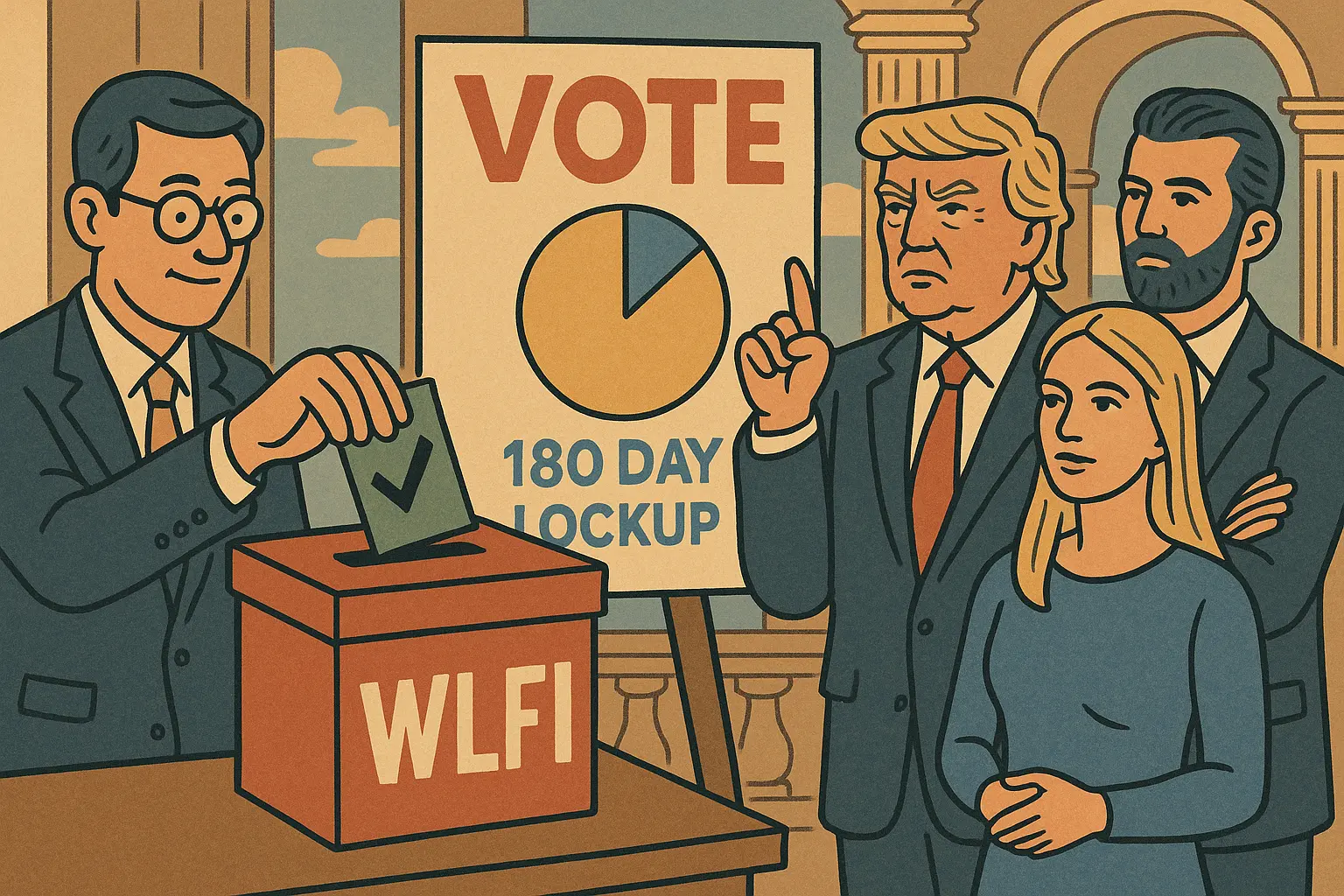
The latest governance proposal from World Liberty Financial (WLFI), a cryptocurrency project under the Trump family, has completed voting. Out of 1,800 ballots cast, 99.12% voted in favor. The new regulation requires WLFI token holders to lock their tokens for at least 180 days to retain governance voting rights; stakers who participate in at least two governance votes during the lock-up period can earn an additional 2% annual percentage yield (APY).
Core Design and Analysis of the New Governance Rules
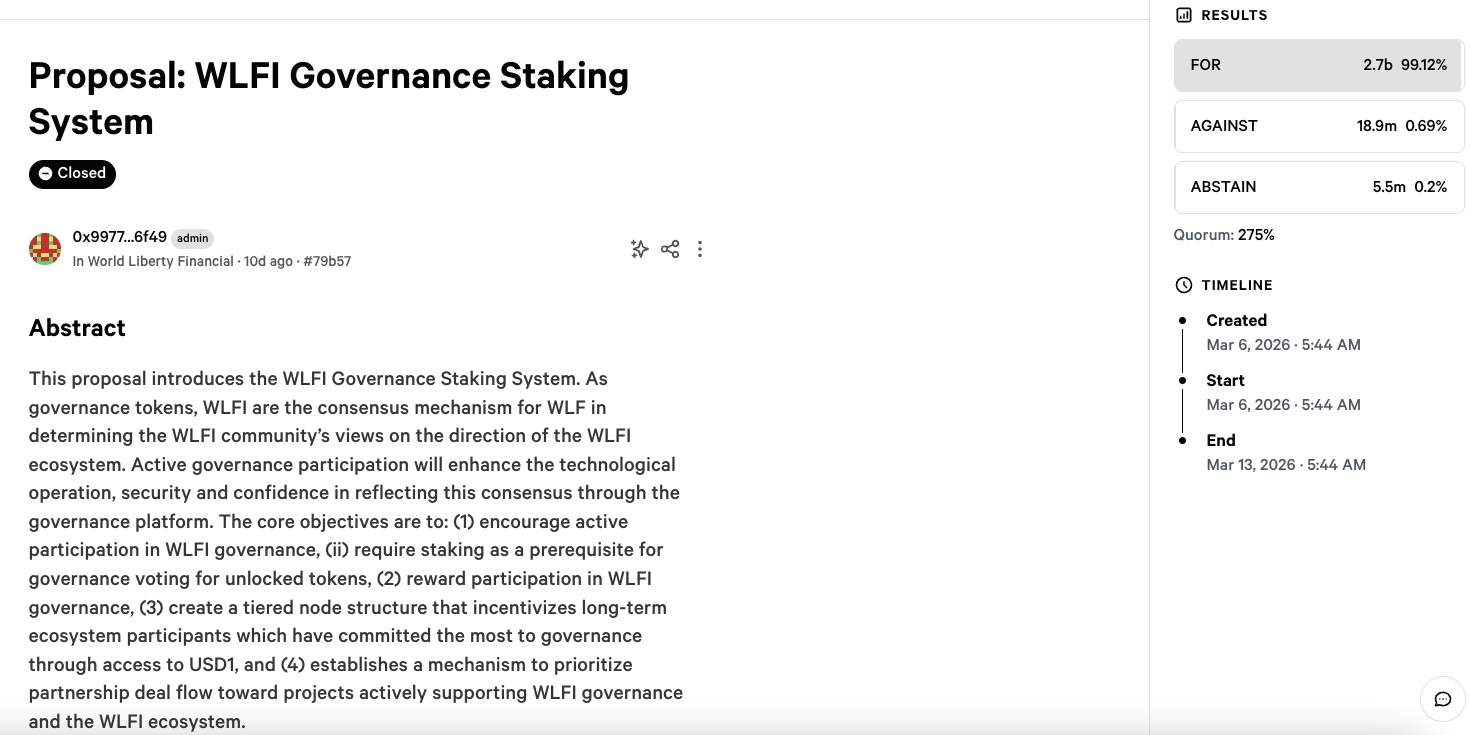
(Source: WLFI)
This approved governance change reshapes WLFI’s decision-making structure on four levels:
Lock-up Threshold: Voting rights are mandatorily tied to a 180-day lock-up, with WLFI stating this aims to ensure that only long-term supporters who agree with the protocol can influence key decisions.
APY Incentive Mechanism: The 2% annual yield is designed to compensate for liquidity loss due to locking tokens, with an additional condition that participants must have completed at least two governance votes to qualify. This aims to improve the typically low voter turnout of 15-25% in DAOs.
Protection for Existing Holders: Tokens already locked are unaffected and can continue to participate in governance votes without re-locking.
Supernode Privileges: Holders staking 50 million WLFI tokens (about $5 million) can gain “direct access” to WLFI’s business development team and senior executives, providing a “guarantee” for potential collaboration opportunities.
It’s worth noting that WLFI spokesperson David Wachsman clarified on Sunday to Reuters that “direct access” is limited to the business development team and executives, not the founders themselves, and this arrangement does not guarantee that a partnership will be established.
WLFI’s Founding Structure and Business Expansion Blueprint
According to WLFI’s “Golden Document,” Eric Trump and Barron Trump are listed as co-founders, along with Steven Witkoff’s sons Zach and Alex. WLFI’s long-term strategic goals are clearly outlined along multiple parallel tracks:
Financial Ecosystem Development: Centered around its own stablecoin USD1, integrating DeFi applications and supporting a stablecoin ecosystem aimed at maintaining the US dollar’s dominance. In January, WLFI applied for a national trust bank license from the Office of the Comptroller of the Currency (OCC) to expand the legal scope of USD1, and is currently awaiting approval.
Asset Tokenization Exploration: CEO Zach Witkoff hinted at tokenizing real-world assets such as real estate, oil, and natural gas. The project is also evaluating the feasibility of establishing a publicly listed company holding WLFI tokens.
Governance Progress Record: To date, WLFI has completed six off-chain snapshot votes. Past proposals include increasing USD1’s value with unlocked WLFI tokens and promoting free trading of governance tokens.
Frequently Asked Questions
Why do 76% of votes come from only 10 addresses? Does this raise concerns about governance centralization?
Yes, this data directly exposes the high concentration of WLFI governance tokens. When the majority of voting power is held by a few large holders, “decentralized governance” practically resembles “major shareholder voting.” The 180-day lock-up rule aims to filter out short-term speculators and retain long-term supporters, but it does not alter the initial token distribution’s centralization. Critics argue that this cannot fundamentally solve governance centralization issues.
Is a 2% APY sufficient incentive for token holders to lock their tokens long-term?
Compared to other liquidity mining or DeFi yield opportunities in the crypto market, 2% APY is relatively low. This design is more symbolic than a primary economic incentive. Its main function is to provide basic compensation to stakers who have completed at least two governance votes, encouraging active participation rather than passive holding.
If WLFI’s application for a national trust bank license is approved, what impact will it have on USD1?
If WLFI successfully obtains the OCC’s trust bank license, USD1 and WLFI’s stablecoin will operate under U.S. federal regulation, significantly increasing institutional investors’ acceptance of USD1. It could also enable USD1 to be used in broader financial services such as corporate settlements and cross-border payments. However, the approval process is typically lengthy, and regulatory standards are becoming more stringent, so the final outcome remains uncertain.
Disclaimer: The information on this page may come from third parties and does not represent the views or opinions of Gate. The content displayed on this page is for reference only and does not constitute any financial, investment, or legal advice. Gate does not guarantee the accuracy or completeness of the information and shall not be liable for any losses arising from the use of this information. Virtual asset investments carry high risks and are subject to significant price volatility. You may lose all of your invested principal. Please fully understand the relevant risks and make prudent decisions based on your own financial situation and risk tolerance. For details, please refer to
Disclaimer.
Related Articles
Aave Multisig Guardian Freezes rsETH on Lending Markets
Gate News message, according to Onchain, the Aave Multisig Guardian has frozen rsETH on lending markets. This action has been implemented across Aave's lending platforms.
GateNews3h ago
Tobu Top Tours Launches XRP Ledger-Based Prepaid Payment Platform, Targeting Japan's ¥30T Market
Tobu Top Tours has partnered with SBI Ripple Asia to launch a prepaid token payment platform on the XRP Ledger, gaining regulatory approval in Japan. Set for rollout later this year, it allows users to convert yen into blockchain tokens for various tourism services. SBI Ripple Asia also announced research to enhance Japan-South Korea cross-border payments using the XRP Ledger.
GateNews4h ago
MicroStrategy Proposes Semi-Monthly Dividends for STRC to Improve Liquidity and Stabilize Stock Price
MicroStrategy has proposed changing its STRC preferred stock dividends from monthly to semi-monthly to enhance liquidity and stabilize stock prices, maintaining an 11.5% annual yield. Concerns about this structure have been raised by Bitcoin critic Peter Schiff.
GateNews16h ago
Pi Network Launches First Smart Contract Feature on Testnet, Enabling Subscription Payments
Pi Network has launched its first Smart Contract feature on Testnet, enabling users to set up automatic subscription payments while maintaining control of their funds. This marks a shift toward ecosystem utility and lays the groundwork for potential mainnet deployment.
GateNews17h ago
Topnod Self-Custody Wallet Becomes Official Partner of Layer1 Blockchain Pharos
Topnod has partnered with Layer1 blockchain Pharos, providing a user-friendly self-custody wallet that simplifies access to real-world assets. It will support Pharos's airdrop activities and facilitate the distribution of RWA assets on the Pharos chain.
GateNews20h ago
Buck Protocol Announces Closure, Holders to Receive Full Redemption
The Buck protocol announced an immediate shutdown, ensuring holders receive 100% capital returns with fully backed reserves. A redemption window has opened with no time limit for asset retrieval.
GateNews21h ago


