The institution reported that argt, a peso-linked stablecoin, constitutes a security, subject to the regulatory regime for capital markets for these instruments. The stablecoin, issued by Twin Finance and listed by Belo, offered up to 32% APR.
Regulator Classifies Argentine Peso Stablecoin as a Security, Blocks Operations
The Argentine equivalent of the SEC, the CNV, executed the first measure against a stablecoin linked to the national fiat currency, the Argentine peso.
On March 12, the institution issued a resolution ordering the suspension of the listing, offering, and intermediation of argt, stating that the token was classified as a security offered to investors without complying with the rules established for these assets.
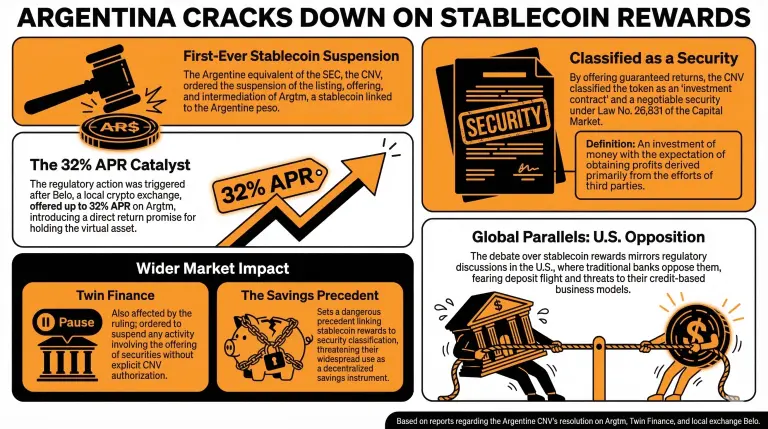
The action comes after Belo, an exchange that listed the stablecoin, offered up to 32% in APR, introducing a return promise linked to holding the virtual asset. As a consequence, the CNV assessed that this would make it “fall under the figure of an investment contract included in the definition of negotiable security provided for in article 2 of Law No. 26,831 of the Capital Market, which results in its classification as a negotiable security subject to the public offering regime.”
The institution clarified that when these assets meet the criteria of an investment contract, “an investment of money in a joint venture with the expectation of obtaining profits derived primarily from the efforts of third parties,” it can be considered a security, and will be subject to the compliance regime described for these assets.
The action also affects Twin Finance, which will have to suspend any activity, including the offering of securities, without the CNV’s authorization.
The development sets a precedent in Argentina, linking the offering of rewards for holding a stablecoin to its classification as a security, closing the potential savings use case for these instruments in the future, with no regulation tackling this issue.
The subject of stablecoin rewards is also being discussed in the U.S., as banks have opposed it, alleging that it could fuel deposit flight from the financial system and affect their credit intermediation-based business model.
FAQ
- What recent action did Argentina’s CNV take regarding a stablecoin?
The CNV suspended the listing and intermediation of argt, classifying it as a security being offered without regulatory compliance.
- Why was argt classified as a security?
The token was categorized as a security because it was linked to an investment contract promising up to 32% APR for holding the virtual asset.
- What implications does this resolution have for Twin Finance?
Twin Finance must halt all activities involving the stablecoin, including offering securities, without prior authorization from the CNV.
- What broader impact does this decision have on stablecoin offerings in Argentina?
This action sets a precedent by linking rewards for holding stablecoins to their classification as securities, potentially limiting their use for savings in the country.
Disclaimer: The information on this page may come from third parties and does not represent the views or opinions of Gate. The content displayed on this page is for reference only and does not constitute any financial, investment, or legal advice. Gate does not guarantee the accuracy or completeness of the information and shall not be liable for any losses arising from the use of this information. Virtual asset investments carry high risks and are subject to significant price volatility. You may lose all of your invested principal. Please fully understand the relevant risks and make prudent decisions based on your own financial situation and risk tolerance. For details, please refer to
Disclaimer.
Related Articles
Hong Kong will pass legislation for a crypto-asset reporting framework, with the goal of completing it by 2026
Hong Kong’s Financial Secretary and the Treasury Bureau Deputy Director, Chan Ho-lim, revealed that the OECD revised the Common Reporting Standard, incorporating new types of digital financial products such as central bank digital currency, and issued a framework for reporting crypto assets, aiming to enhance transaction transparency. The Hong Kong Legislative Council supports this bill, with the goal of enacting the legislation by 2026.
GateNews4m ago
Hong Kong’s first batch of stablecoin licenses has been delayed, and the Monetary Authority says it is working to move forward as quickly as possible
Hong Kong’s first batch of stablecoin issuer licenses was originally set to be issued in March 2026, but it did not roll out as scheduled. The Hong Kong Monetary Authority said it is moving forward with the licensing process, and the market is watching the application status of HSBC and Standard Chartered. Among the applications for the second batch of licenses, Futu Securities and OSL Group are strong contenders.
GateNews49m ago
Texas Lt. Gov. lists crypto, prediction markets in charges for lawmakers
Texas Lieutenant Governor Dan Patrick has prioritized studying prediction markets and cryptocurrency regulations for the upcoming legislative session, aiming to address gambling loopholes and evaluate the state's crypto policies and AI's workforce impact.
Cointelegraph3h ago
Federal Reserve Governor Waller Warns About Stablecoin Risks, Emphasizing the Need to Strengthen Reserve Oversight and Enforcement Mechanisms
Federal Reserve Board Governor Michael Barr emphasized that stablecoins must develop under strict regulation, warning that a lack of safeguards could repeat the history of problems caused by private currencies. He noted that while the GENIUS Stablecoin Act has provided an initial framework, it needs stronger enforcement and oversight to ensure the safety and liquidity of reserve assets and to prevent potential financial stability risks.
GateNews3h ago
Cardano founder questions the U.S. CLARITY Act: may take 15 years to implement and could be politicized to curb innovation
Cardano founder Charles Hoskinson expressed strong doubts about the “Digital Asset Market CLARITY Act,” saying the bill could have long-term negative effects, stifle innovation in the industry, and warning that its complex structure may further drive industry consolidation, favoring established projects.
GateNews3h ago
Clarity Act ‘not a gatekeeper’ for crypto innovation, WisdomTree exec says
WisdomTree believes that pending U.S. crypto legislation, like the Clarity Act, won't hinder its innovation in digital assets. The company has a history of early involvement in crypto and aims to enhance regulated investment products on blockchain, focusing on tokenized assets.
CoinDesk6h ago


