Individuals transacting cryptocurrency on offshore platforms or independently must now report their movements when the amount of crypto transacted surpasses $5,000 per year. Users must now deliver sensitive data, including the purpose of each transaction, hashes, and destination addresses.
Paraguay Ramps Up Crypto Reporting Requirements For VASPs and Individuals
The government of Paraguay is ramping up the scrutiny of the cryptocurrency market.
The National Directorate of Tax Revenue (DNIT), Paraguay’s tax watchdog, has issued a resolution creating a new figure, a sworn cryptoassets statement, to obtain a more granular control and oversight of the crypto movements in the country.
Resolution No. 47 establishes that both operators of virtual asset service providers (VASPs) and individuals making crypto transactions with volumes going over $5,000 per year, even if transacting using offshore accounts or outside exchange platforms, must issue this detailed statement.
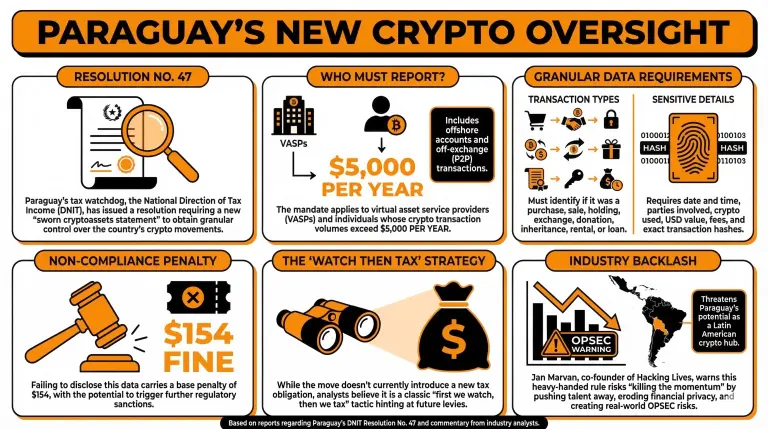
The document must identify, at the very minimum, the class of transaction completed -purchases and sales, holding or possession, exchanges between different crypto assets, donations, inheritances, temporary assignments, rentals, or loans, among others.
In the same way, for each transaction, the user must include sensitive data, such as date and time, the parties involved, the cryptocurrency used, the amount traded, the value transacted in U.S. dollars, fees, and transaction hashes.
The penalty for failing to disclose this data during the expected period is $154, and it could result in other penalties.
While this move doesn’t introduce a tax obligation, analysts believe this might be a classic “first we watch, then we tax” move, hinting at future moves to leverage this information via new levies.
Jan Marvan, co-founder of Hacking Lives, stressed that this was a troubling development for the nation’s crypto scene, as it could affect its possibilities of becoming a crypto hub in Latin America.
“This kind of heavy-handed rule risks killing that momentum. It will push talent away, slow down everyday adoption, erode financial privacy, and in the worst cases create real-world OPSEC risks for users,” he concluded.
FAQ
- What recent action has the government of Paraguay taken regarding cryptocurrencies?
Paraguay is increasing scrutiny of the crypto market by implementing a sworn cryptoassets statement for enhanced oversight of crypto transactions.
- What does Resolution No. 47 require from virtual asset service providers and individuals?
Operators and individuals engaging in crypto transactions over $5,000 per year must issue a detailed statement identifying transaction types and sensitive data.
- What details must be included in the sworn statement?
The statement must include transaction specifics such as date, time, parties involved, cryptocurrency used, and amount traded, along with the transaction hash.
- What implications does this resolution have for Paraguay’s crypto market?
Analysts warn that while it doesn’t introduce new taxes now, it may lead to future taxation, potentially hindering Paraguay’s growth as a crypto hub in Latin America.
Disclaimer: The information on this page may come from third parties and does not represent the views or opinions of Gate. The content displayed on this page is for reference only and does not constitute any financial, investment, or legal advice. Gate does not guarantee the accuracy or completeness of the information and shall not be liable for any losses arising from the use of this information. Virtual asset investments carry high risks and are subject to significant price volatility. You may lose all of your invested principal. Please fully understand the relevant risks and make prudent decisions based on your own financial situation and risk tolerance. For details, please refer to
Disclaimer.
Related Articles
Fed Governor Calls For Strict Rules For Stablecoins Ahead Of Clarity Act Markup
A Fed governor highlighted that the regulatory framework on stablecoins established by the GENIUS Act should be complemented by strict federal oversight.
The warning comes amid the scheduled markup of the Clarity Act, which aims to patch the regulatory gaps of the GENIUS Act on digital
Blockzeit11m ago
Not like the Mega Bank experiment! The U.S. Federal Reserve: Stablecoins can significantly reduce cross-border payment costs, but there’s also a concern
The U.S. Federal Reserve’s first systematic assessment of payment stablecoins finds that they could improve cross-border payment efficiency, but may also change the flow of reserves and monetary policy. Stablecoin regulation is governed by the GENIUS Act and may affect the Fed’s asset management policies; as the scale grows, regulation will become more stringent.
CryptoCity39m ago
Six Spanish banks have received MiCA authorization to provide crypto asset custody and trading services
Spanish bank CaixaBank was approved on March 30 to become the sixth crypto-asset service provider under the EU MiCA regulation, allowing it to offer services for crypto-asset custody, trading, and transfers. The EU’s MiCA authorization is valid across member states, providing regulatory convenience. Unauthorized institutions will lose their eligibility to provide services in 2026.
GateNews42m ago
Hong Kong stablecoin license issuance delayed, hitting obstacles for HKD stablecoin regulation rollout?
Hong Kong’s Hong Kong dollar stablecoin licensing program has been delayed, and it has still not been approved to date. The market expects it may be pushed back to April. Regulators are focused on the applicants’ use cases and compliance, and the high bar is intended to reduce risk. HSBC, Standard Chartered, and others are potential licensees. Stablecoins will connect traditional finance with blockchain assets, and this will be tied to competition in regional digital finance.
GateNews58m ago
Hong Kong’s first batch of stablecoin issuer licenses were not issued as scheduled in March. The Hong Kong Monetary Authority: fully committed to advancing efforts and will disclose information in a timely manner.
Hong Kong’s first batch of stablecoin issuer licenses was originally expected to be issued in March 2026, but as of the end of March, none has been issued yet, drawing market attention. The Hong Kong Monetary Authority emphasized that it will announce progress in due course. The frontrunners with stronger support currently include Standard Chartered and HSBC, while it appears that mainland Chinese institutions have not been able to make the shortlist. Delays in granting licenses could affect Hong Kong’s position as a pioneer in the global stablecoin regulatory space.
動區BlockTempo1h ago
Federal Reserve Board Governor Barr: Stablecoins carry money-laundering risk, the GENIUS Act framework is taking shape soon
The Federal Reserve Board member Michael Barr warned that stablecoin reserve assets face money laundering and financial stability risks, emphasizing that reserve quality is crucial. Stablecoins have advantages in areas such as real-time cross-border payments, but they could pose dangers due to insufficient regulation. Pushing the “Lummis Act” will require issuers to formally register and hold equivalent reserves to strengthen market stability. The implementation of regulatory details will directly affect the development of the U.S. stablecoin market.
MarketWhisper1h ago


